**Identify Spider By Picture: Instant Photo Recognition**
> Quickly identify spider by picture with expert tips on photographing, key visual cues, species comparisons, and using Orvik's AI for accurate ID.
Source: https://orvik.app/insects/identify-spider-by-picture/ · updated: 2026-06-21
- [Home](https://orvik.app/)
- [Insects](https://orvik.app/insects/)
Field Guide: Identify Spiders from Photo...
Insects
# Field Guide: Identify Spiders from Photos
Compiled by
- [Merey Tleugazin](https://orvik.app/about/)
February 6, 2026
## Table of Contents
1. Introduction: What people mean when they search to identify spider by picture
2. How to take a photo that makes spider identification reliable
3. Key visual cues for accurate spider identification
4. Common species you can often identify from photos
5. Comparison: How to tell lookalikes apart
6. Workflow: Use photos + tools to identify a spider from picture
7. Safety, first aid, and ethical considerations
8. Advanced tips and limitations of photo-based identification
9. Conclusion
## Introduction: What people mean when they search to identify spider by picture
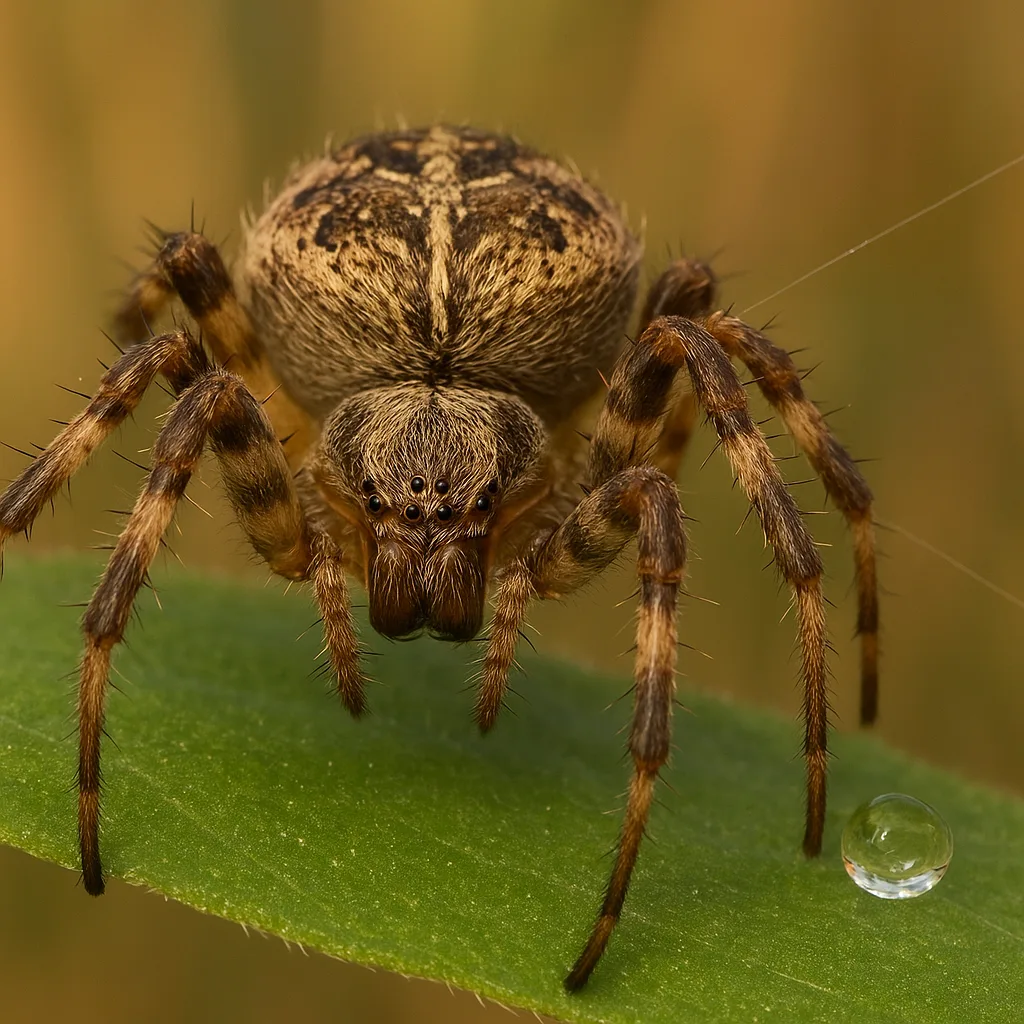
When someone types queries like "spider identifier by picture," "spider identification by picture," or "identify spider by photo," they usually want a fast, reliable answer: is the spider dangerous, what species is it, where it came from, and what to do next. They’re often dealing with a single photo taken in a house, yard, garage or on clothing. The goal is practical: reassurance, safety guidance, or documentation for science and pest control.
- Immediate safety concern (bite risk, venom)
- Species-level identification (e.g., *Latrodectus*, *Loxosceles*)
- Natural history (habitat, seasonality)
- Next steps (remove, relocate, monitor)
## How to take a photo that makes spider identification reliable
Quality photos let both humans and AI make accurate determinations. If you want to identify a spider from picture evidence—especially with a spider photo identifier app—follow these field-tested tips.
- **Get close, but safe:** Use a macro or zoom; keep at least a few centimeters distance. Do not handle dangerous spiders.
- **Multiple angles:** Photograph dorsal (top), ventral (underside) if possible, lateral (side) and close-ups of the cephalothorax and abdomen.
- **Scale:** Place an object of known size (coin, ruler) next to the spider. Note that most common house spiders range from 3 mm to 25 mm in body length.
- **Lighting:** Use diffuse light to avoid glare; natural daylight or a ring light works best.
- **Focus on distinguishing features:** Eyes, leg spination, web type, and abdominal patterns are critical.
- **Context shots:** Photograph the web, nearby substrate (wood, leaf litter, walls) and habitat for ecological clues.
## Key visual cues for accurate spider identification
Knowing which features to look for cuts through lookalikes. Below are the anatomical, pattern, and behavioral cues that professionals and AI models use.
### Size and proportions
- **Body length:** Measure the combined cephalothorax + abdomen; typical ranges—small: 3–7 mm, medium: 8–15 mm, large: 16–40+ mm (tarantulas).
- **Leg span:** Often 2–4× body length; wolf spiders (*Lycosidae*) may have leg spans of 25–45 mm for medium-sized species.
### Color, pattern, and texture
- Distinct bands, dorsal crosses (e.g., *Araneus diadematus* has a white cross), or violin-shaped markings (a hallmark of *Loxosceles* species).
- Metallic or iridescent chelicerae are common in some *Salticidae* (jumping spiders) like *Phidippus audax*.
- Smooth, glossy carapace vs. hairy, velvety abdomen helps distinguish families.
### Eye arrangement
- Eye rows and size are diagnostic: jumping spiders have large anterior median eyes (giving a ‘‘big-eyed’’ appearance), while wolf spiders have a distinctive 2-2-4 arrangement with very large posterior median eyes.
- Orb-weavers and cellar spiders have more uniform, smaller eyes.
### Legs, spines, and setae (hair)
- Presence of thick spines on legs often indicates a hunting spider (wolf spiders, lynx spiders).
- Long, thin legs and delicate bodies point to cellar spiders (*Pholcidae*).
### Web type and behavior
- Orb webs (circular) suggest *Araneidae* (orb-weavers).
- Tangled, irregular webs point to cobweb spiders (*Theridiidae*) including widow relatives.
- No web and rapid running/active hunting indicates ground hunters like wolf spiders or jumping spiders.
## Common species you can often identify from photos
Here are species and groups frequently encountered in homes and gardens, with key photo-identification clues, habitat, size, seasonality, distribution and toxicity notes.
For more on this topic, see our guide on
- [Identify Insects from Photos Like a Field Naturalist](https://orvik.app/insects/identify-bug-by-photo/).
- **Black widow (*Latrodectus*, e.g., *Latrodectus mactans*)** Size: body 8–13 mm (female), legspan up to 35 mm; glossy black with red hourglass on ventral abdomen.
- Habitat: dark, dry shelters—woodpiles, under eaves, garages.
- Distribution: Americas, southern Europe, Africa, Asia (varies by species).
- Toxicity: potent neurotoxin (latrotoxin); bites can cause latrodectism—muscle pain, cramps, abdominal rigidity. Seek medical care.
- **Brown recluse (*Loxosceles reclusa*)** Size: body 6–20 mm; light to medium brown with a faint violin-shaped marking on the cephalothorax.
- Habitat: undisturbed indoor areas—closets, boxes, attics; also under bark outdoors.
- Distribution: central and southern United States (true range is limited—many reports are misidentifications).
- Toxicity: venom contains sphingomyelinase D; bites can cause localized necrosis in rare cases. Medical evaluation recommended for suspected bites.
- **Wolf spiders (*Lycosidae*)** Size: body 7–35 mm; stout, hairy, cryptic brown/gray with longitudinal stripes in many species.
- Habitat: ground-dwelling, leaf litter, grassland, sometimes houses.
- Behavior: active hunters, do not build capture webs; often carry egg sacs on spinnerets.
- Toxicity: generally non-dangerous to humans; bites cause minor local symptoms.
- **Jumping spiders (*Salticidae*, e.g., *Phidippus audax*)** Size: body 3–15 mm; compact with large anterior median eyes and often iridescent chelicerae.
- Habitat: vegetation, walls, indoors; active by day.
- Toxicity: harmless to humans; may deliver a small bite but not medically significant.
- **Orb-weavers (*Araneidae*, e.g., *Araneus diadematus*)** Size: body 6–20 mm; often round-bodied with clear dorsal patterns (cross-like marks).
- Habitat: gardens, shrubs; build classic wheel-shaped webs at night or dawn.
- Toxicity: not dangerous to humans.
- **False widow (*Steatoda*)** Size: body 6–14 mm; dark glossy abdomen, sometimes with cream markings; looks superficially like widow spiders.
- Habitat: buildings, sheds, eaves.
- Toxicity: may cause painful bites and localized symptoms but rarely severe systemic effects.
## Comparison: How to tell lookalikes apart
Many misidentifications arise from superficial similarities. Here are practical comparison checklists that help you distinguish common confusions when you identify a spider by photo.
### Brown recluse vs. Wolf/House Spider
1. Look for the violin marking on the cephalothorax—brown recluse often shows a distinct, crisp violin shape; many house spiders lack it or show different patterns.
2. Check the eyes: brown recluse has 6 eyes arranged in three dyads (paired), whereas most spiders (including wolf spiders) have 8 eyes.
3. Legs: brown recluse legs are long, slender and uniform in color with sparse fine hairs; wolf spiders are generally hairier and more robust.
### Black widow vs. False widow (*Steatoda*)
1. Ventral abdominal markings: black widows usually have a bright red hourglass (or partial hourglass) on the underside; false widows have less vivid or no hourglass and different dorsal patterns.
2. Shape: true widows have a bulbous, spherical abdomen; false widows may be more elongated or variable in shape.
3. Behavior and web: both build irregular cobwebs, but context and close inspection of markings matter most for ID.
## Workflow: Use photos + tools to identify a spider from picture
Combining good photos with expert tools and resources gives the best results. A modern workflow integrates human expertise, specialist keys, and AI-powered apps like Orvik.
You may also find our article on
- [Identify Spiders with AI: Field Guide](https://orvik.app/insects/app-that-identifies-spiders/) helpful.
- **Step 1:** Capture multiple, well-lit photos (see photography tips above).
- **Step 2:** Use an AI spider photo identifier such as Orvik for a rapid preliminary ID. Orvik’s visual model compares your photos against thousands of labeled specimens to propose likely species.
- **Step 3:** Cross-check AI suggestions with authoritative field guides or regional keys—look at eye arrangement, leg spination, and dorsal patterns.
- **Step 4:** If the spider is potentially venomous (*Latrodectus*, *Loxosceles*), consult local health resources or an arachnologist for confirmation.
- **Step 5:** Record location, date, and microhabitat for ecological or reporting uses.
Orvik can be particularly useful when you need rapid identification from a phone photo, but always verify AI outputs for medically significant cases.
## Safety, first aid, and ethical considerations
When people search "identify spider from picture" they often want immediate advice about handling or bites. Here’s responsible, evidence-based guidance.
Looking beyond this category? Check out
- [AI Field Guide: Identify Birds Fast](https://orvik.app/birds/bird-recognition-app/).
Related reading:
- [Identify That Spider: A Practical Field Guide](https://orvik.app/insects/what-type-of-spider-is-this/).
- **Do not handle unknown spiders:** Use a jar, card, or long-handled tool to contain a specimen for photography if necessary.
- **If bitten:** 1. Clean the wound with soap and water. 2. Apply a cool compress and keep the limb immobilized and slightly elevated. 3. Seek medical care if systemic symptoms appear (severe pain, cramping, shortness of breath, spreading necrosis).
- **When to call professionals:** If you find multiple black widows, a confirmed brown recluse in an occupied home, or see spiders nesting in critical areas (childcare, elderly care), contact pest control or local extension services.
- **Ethics and conservation:** Most spiders are beneficial predators of pests. Relocate rather than kill when possible; document species for citizen science if you can do so without harm.
## Advanced tips and limitations of photo-based identification
Photos can get you to family and often genus, but species-level certainty sometimes requires microscopic examination of genitalia (epigyne in females, palpal bulbs in males) or DNA analysis.
- Photos are excellent for family-level IDs: *Salticidae*, *Lycosidae*, *Araneidae*, *Theridiidae*, etc.
- Species-level uncertainty increases in genera with cryptic morphology (e.g., many *Loxosceles* species look very similar).
- Sexual dimorphism: males and females can look quite different; consider season—males often wander in late summer/autumn to find mates.
- When in doubt, include a record of location (latitude/longitude) and date—many species have restricted ranges that help identification.
## Conclusion
To identify a spider by picture reliably, combine high-quality photographs, attention to diagnostic features (size, eye pattern, abdominal markings, web type), and smart tools. Orvik and similar AI-powered photo identifiers provide fast, evidence-based suggestions, but always verify medically important IDs with experts. With good photos and the workflow above, most spider identifications—enough for safety and ecological understanding—are achievable from a single smartphone image.
## Work through it yourself
The keys below are free, need no account, and render every entry in the page
source — so they work with scripting switched off, and the whole list is
readable rather than hidden behind a filter.
- [Is that a butterfly or a moth, and which one?](https://orvik.app/tools/butterfly-moth-identifier/) — Colour, wingspan and flight time narrow 28 butterflies and moths.
- [What spider is this?](https://orvik.app/tools/spider-identifier/) — Markings, web shape and size narrow 31 common spiders down fast.
- [What caterpillar is this?](https://orvik.app/tools/caterpillar-identifier/) — Colour, hair, size and host plant narrow 34 caterpillars down in seconds.
- [Orvik or Rock Identifier: neither camera can measure hardness](https://orvik.app/compare/orvik-vs-rock-identifier/) — prices and in-app purchase lists pulled from the App Store, not typed.
- [Orvik or Picture Insect: one domain or eight](https://orvik.app/compare/orvik-vs-picture-insect/) — prices and in-app purchase lists pulled from the App Store, not typed.
## Frequently Asked Questions
Can I identify any spider from a photo alone?
Photos can usually identify spider family and often genus; species-level ID can be uncertain for cryptic groups and may require microscopic genital examination or DNA.
How should I photograph a spider to get the best ID?
Take multiple, well-lit photos from dorsal, lateral, and ventral angles if safe; include a scale object and shots of the web and habitat.
Is an AI app like Orvik reliable for spider identification?
Orvik and similar AI tools provide fast, probabilistic IDs by comparing your photos to large datasets. They’re useful for preliminary results but verify medically significant cases with experts.
What are the signs a spider is dangerous?
Watch for diagnostic species: true widows (Latrodectus) often have a ventral red hourglass; brown recluses (Loxosceles) show a violin mark and 6 eyes. If unsure, avoid handling and seek medical advice after a bite.
How can I tell a brown recluse from common house spiders?
Brown recluses have 6 eyes in three pairs, a violin-shaped cephalothorax mark, and uniformly colored legs; many house spiders have 8 eyes and different body patterns.
Should I capture a spider for ID or just photograph it?
Photographing is usually sufficient and less stressful for the animal. If capture is necessary, do so safely with a container; avoid handling unknown spiders.
What first aid should I use for a suspected venomous spider bite?
Clean the area with soap and water, apply a cool compress, immobilize the limb, and seek medical attention if symptoms worsen or systemic signs appear.
Can juvenile spiders (spiderlings) be identified to species from a photo?
Juveniles are often much harder to identify to species because they lack adult coloration, size and reproductive structures, so most photo IDs can usually only reach family or genus. High-resolution close-ups of body proportions, eye arrangement, leg spination and any visible spinnerets can sometimes allow a specialist or AI to narrow the ID further, but expect greater uncertainty than with adults.
How useful is showing a spider’s web or exact habitat in a photo for identification?
Web architecture (orb, funnel, sheet, cobweb, etc.) and microhabitat (leaf litter, under logs, inside buildings, near water) are strong clues that often narrow an ID to family or genus because many families build characteristic webs and occupy specific niches. Identification apps and experts use that context to improve accuracy—apps like Orvik factor in habitat and web type along with morphology to produce better suggestions.
Orvik App
#### Identify anything with your camera
Point the camera, get a name and the look-alikes ranked underneath. Free to download.
- [Download Free](https://orvik.app/app/)
Free, in your browser
- [Is that a butterfly or a moth, and which one? 0 , no account, works with scripting off](https://orvik.app/tools/butterfly-moth-identifier/)
- [What spider is this? 0 , no account, works with scripting off](https://orvik.app/tools/spider-identifier/)
- [What caterpillar is this? 0 , no account, works with scripting off](https://orvik.app/tools/caterpillar-identifier/)
- [All Insects articles](https://orvik.app/insects/)
## Related Articles
More from Insects
- [All articles](https://orvik.app/insects/)
- [### Identify Any Insect from a Photo — Field-Proven Tips Use bug id by photo to identify insects quickly. Learn photo tips, visual cues, habitats, and safety steps for accurate AI-backed identification with Orvik. January 2026](https://orvik.app/insects/bug-id-by-photo/)
- [Plants ### Identify Plants from Photos: Field-Proven Tips Quickly search plants by picture: learn how to photograph, use Orvik and other apps, and confirm IDs with leaf, flower and habitat clues. February 2026](https://orvik.app/plants/search-plants-by-picture/)
- [Animals ### Photo ID: Mastering Animal Identification in the Field Learn how to identify animal by picture with expert visual cues, habitat hints, and app workflows. Practical tips for photos, safety, and species ID. February 2026](https://orvik.app/animals/identify-animal-by-picture/)
- [### Identify Insects from Photos Like a Field Naturalist Identify bug by photo quickly with Orvik's AI. Practical camera tips, exact visual cues (size, color, antennae, wing venation), habitat notes and safety steps. February 2026](https://orvik.app/insects/identify-bug-by-photo/)
- [Animals ### Photo Guide: Recognize Snakes in the Wild Identify snake by picture with a 7-step photo ID workflow: key visual cues, habitat and safety tips, plus photo advice for accurate identification. January 2026](https://orvik.app/animals/identify-snake-by-picture/)
- [### Spotting a Roach: A Field Guide Learn how to identify a cockroach with clear visual cues, species traits, behavior and safety steps. Practical tips for quick, accurate identification. January 2026](https://orvik.app/insects/how-to-identify-a-cockroach/)
- [Birds ### How to ID a Bird from a Photo Step-by-step guide to identify this bird from photos. Learn visual cues, habitat, seasonality and best tips to use Orvik for accurate bird identification. February 2026](https://orvik.app/birds/identify-this-bird/)
- [Plants ### Mastering Plant ID with AI: A Field Guide Discover how a plant recognition app can ID species from photos. Practical tips, accuracy, safety, and comparisons to help you choose the right tool. January 2026](https://orvik.app/plants/plant-recognition-app/)
- [Plants ### Identify Cacti Quickly with AI Find and identify cactus species fast with an AI cactus identification app. Get visual cues, habitat info, care tips and safety warnings for accurate IDs. January 2026](https://orvik.app/plants/cactus-identification-app/)
## Explore Other Topics
Identify more with Orvik — from plants to rocks, insects to birds
- [### Plants 135 articles](https://orvik.app/plants/)
- [### Animals 18 articles](https://orvik.app/animals/)
- [### Birds 11 articles](https://orvik.app/birds/)
- [### Rocks & Minerals 20 articles](https://orvik.app/rocks/)
- [### Collectibles 7 articles](https://orvik.app/collectibles/)
- [### Food 11 articles](https://orvik.app/food/)
- [### Nature 4 articles](https://orvik.app/nature/)
- [### Sports Cards 15 articles](https://orvik.app/sports-cards/)
---
HTML version: https://orvik.app/insects/identify-spider-by-picture/
Structured data for this site: https://orvik.app/api/v1/openapi.json · https://orvik.app/llms.txt
Free to quote and reuse with a link back to the source URL above (CC BY 4.0).