
Why animal track identification matters
Identifying animal tracks is more than a curiosity: it is a scientific skill used by wildlife biologists, hunters, ecologists, and outdoor enthusiasts to infer presence, behavior, population trends, and habitat use. A single clear print can tell you species, size, sex in some cases, gait (walking vs running), how recently an animal passed, and whether it was carrying food or a young.
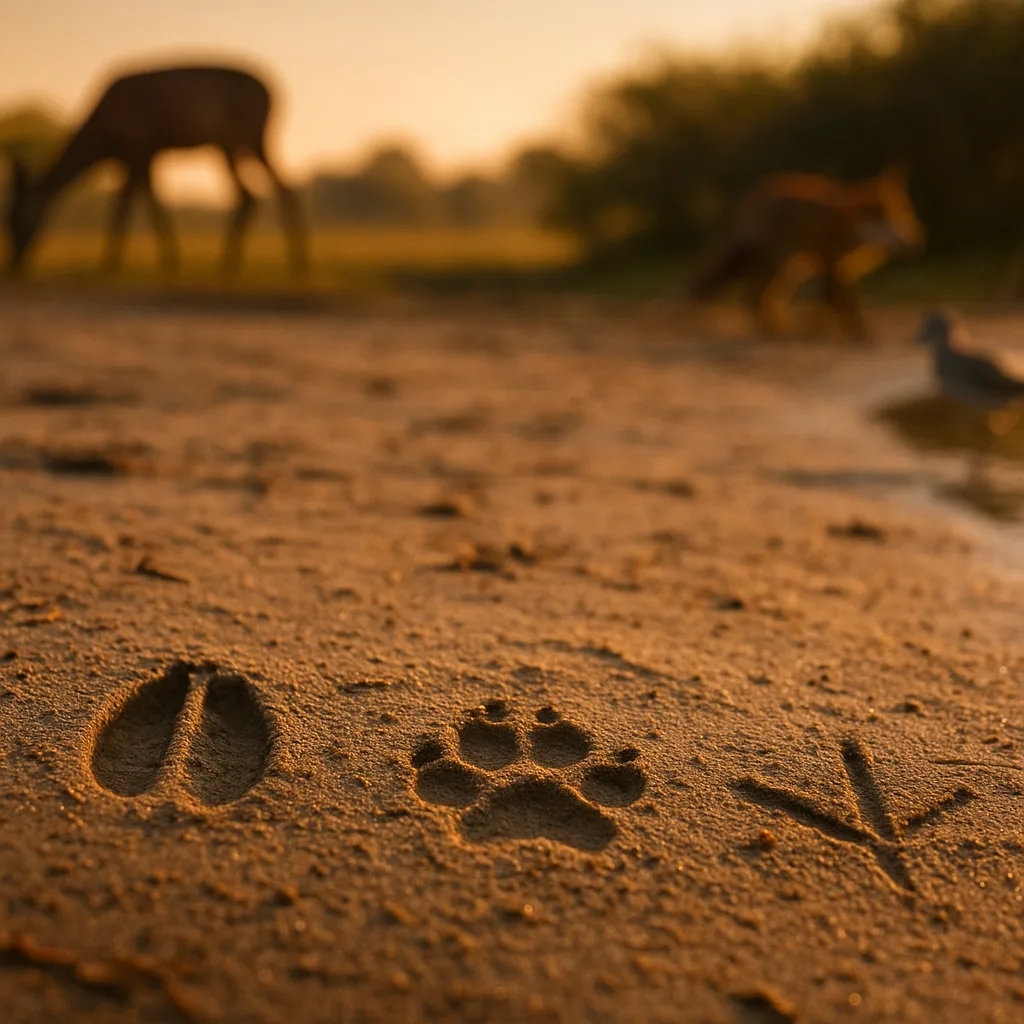
- Conservation: non-invasive monitoring of species such as Odocoileus virginianus (white-tailed deer) and Lynx rufus (bobcat).
- Safety: detect large predators like Puma concolor (cougar) or Ursus americanus (black bear) before close encounter.
- Research: estimate densities and movements when camera traps are absent or insufficient.
- Recreation & education: learn about natural history and seasonal behaviors, especially in winter track surveys.
Essential tools and measurement techniques
Accurate identification begins with careful measurement. Most misidentifications occur because people estimate size from memory rather than measuring. Carry these basic tools on every tracking outing.
Field kit checklist
- Ruler or folding ruler (metric and imperial), ideally with millimeter markings
- Measuring tape (1–5 m) for stride/step measurements
- Field notebook and pencil (graph paper is useful)
- Camera or smartphone for high-resolution photos (scale included)
- Plaster kit or silicon putty for casts if legal and ethical in your area
- Compass and GPS for recording locations
Key measurements and how to take them
- Print length: measure from tip of longest toe to rearmost pad (mm or cm). Example: white-tailed deer tracks typically 4–6 cm long; adult canine prints 5–11 cm long depending on species.
- Print width: measure perpendicular to length across outer toes or pad.
- Stride: distance between two successive prints of the same foot in a gait (e.g., left hind to next left hind). Useful to estimate speed; a deer trot stride = 1–2 m, deer walk ~0.6–1.0 m.
- Straddle: lateral width between left and right tracks; shows body width—helps separate similarly sized species.
- Toe orientation and claw marks: note toe splay angle and presence/absence of claw impressions (digital photos with scale help).
Reading tracks in snow: challenges and practical tips
Snow simultaneously freezes a moment in time and complicates interpretation. Melting, crusting, wind-etching, and secondary sinks can alter the original cast. Still, snow can preserve excellent detail—often better than mud—if you know how to read it.
Snow conditions and their effects
- Fresh powder: soft edges; prints may be too deep and rounded—measure depth but expect distortion.
- Wet, heavy snow: well-defined edges and claw marks but may stick to toes creating false lobes.
- Crusted snow: animals can break through crust or rebound on top—look for scuff marks and rimmed impressions.
- Sun-melted prints: edges slump into a saucer shape; timing since passage may be inferred by collapse and drip patterns.
Practical techniques for snow prints
- Photograph prints from multiple angles with a scale next to them; include sunlight direction to show shadow for depth.
- Measure the original dimensions quickly—snow prints can degrade within hours in warm conditions.
- Look for secondary sign: scat frozen in a print, disturbed vegetation beneath the snow, and hair caught on bark near the track.
- Use a popsicle stick or ruler to gauge depth in cm; depth helps estimate weight and gait.
Common tracks: species descriptions, measurements, and cues
This section covers species most frequently encountered across North America and temperate Eurasia. For each I provide measurements, visual cues, habitat, seasonal notes, and distinguishing features.
For more on this topic, see our guide on Dolphin Diets: What They Eat and Why.
White-tailed deer (Odocoileus virginianus)
- Track size: 4–7 cm long, 3–5 cm wide; heart-shaped cloven hoof with two tear-drop toes.
- Gait: walk stride 40–80 cm; trot 1.0–2.0 m.
- Habitat and distribution: widespread across North America; uses forests, fields, and suburbs.
- Seasonal notes: heavier travel and rutting behavior in fall; snow may compress tracks making them appear larger.
Elk (Cervus canadensis)
- Track size: 7–12 cm long; hooves more elongated and robust than deer.
- Presence: mountainous and prairie regions of North America; large herds change track patterns.
Gray wolf (Canis lupus) vs Coyote (Canis latrans)
Canids are frequently misidentified. Measurements and pattern are key.
- Wolf tracks: 9–13 cm length, centrally placed pad, four toes with visible claw marks; stride at a walk 1–1.6 m, trotting 1.5–2.5 m.
- Coyote tracks: 6–8 cm length, narrower, often asymmetrical; claws visible but more delicate.
- Distribution and behavior: wolves favor remote forests and tundra, coyotes occupy diverse habitats including suburbs.
Red fox (Vulpes vulpes) and Gray fox (Urocyon cinereoargenteus)
- Track size: 3–5 cm length; small, oval, with sharp toe tips and minimal pad lobing.
- Gait: trot and single-file pattern; stride 30–60 cm when walking.
- Note: red fox often leaves a more elongated print than gray fox; gray fox may climb trees—look for climbs and scrapes.
Bobcat (Lynx rufus) and domestic cat (Felis catus)
- Bobcat tracks: 3.5–5 cm wide, rounder pads, toes in a semicircular arc; usually no claw marks because felids retract claws.
- House cat: 2–3.8 cm; often found near human structures; stride much shorter.
- Behavioral cues: bobcats often leave a direct register with pads clearly defined and tail drag uncommon.
Black bear (Ursus americanus)
- Track size: hind print 13–25 cm long with a distinct heel pad; toes 5 in a curved row; front paw more rounded.
- Gait: plantigrade (walks on the sole). Stride varies widely; walking stride often 40–80 cm.
- Safety: bears can be aggressive if surprised, especially sows with cubs—never approach.
Raccoon (Procyon lotor)
- Track size: front 3–6 cm; distinctive hand-like print with 5 long digits, often showing splayed toes in soft substrate.
- Habitat: near water, urban areas; foraging behavior leaves prints with drag marks and frequent repeated patterns.
Snowshoe hare (Lepus americanus)
- Track pattern: large hind feet 7–12 cm long, front feet 3–5 cm; bounding pattern with front prints close together and hind prints landing ahead.
- Seasonality: hind feet develop white winter fur, and tracks are common in deep snow where foot size prevents sinking.
Gaits, patterns, and what they reveal
Gait analysis helps you infer speed, intent, and even the number of animals. There are five common gait patterns you will see.
You may also find our article on Identify Your Cat: A Field Guide helpful.
- Walk: four-beat pattern, slow; prints spaced evenly, stride short—useful for estimating body length.
- Trot: diagonal pairs hit together—tracks form a straight line for many canids and ungulates.
- Canter/Lope: three-beat gait; stride increases, prints staggered.
- Bound: front feet together, hind feet land ahead; common in lagomorphs (hares) and small carnivores during escapes.
- Gallop: asymmetrical with long stride; often two jumps visible between sets of prints.
Measure stride (cm), and note whether prints are single-file. Direct register (hind foot landing in front of front print) is common in felids and provides clues to foot placement and stealthy travel.
Comparison cases: how to tell similar tracks apart
Many identification problems are comparative. Below are frequent confusions and diagnostic tips.
You might also be interested in Spotting Bed Bugs: A Clear Visual Guide.
Wolf vs dog vs coyote
- Size: wolf > dog > coyote—wolves 9–13 cm, coyotes 6–8 cm. But large dogs overlap with wolves.
- Shape: wolf tracks are more compact and proportionally larger toe pads; domestic dog prints often splay with less symmetry due to paw pads and toe placement.
- Context: trackway straightness—wolves travel in a straight purposeful line; dogs meander and have more variable stride lengths.
Fox vs small cat
- Claws: foxes show claw marks; cats usually do not. Fox prints are more oblong; cat prints rounded with a triangular central pad.
- Gait: fox trotting is single-file with a more direct register; cats often pad silently and may show a binder gait when stalking.
Deer vs elk vs moose
- Relative size: deer 4–7 cm, elk 7–12 cm, moose 10–15+ cm. Toe splay and shape of the dewclaw and the space between toes help distinguish species.
- Substrate: larger ungulates compress snow differently—moose often leave deep, oval impressions with long straddles.
Technology, field apps, and using Orvik
Modern tools speed identification and reduce uncertainty. Smartphones make excellent field guides when used properly—always include a scale in photos and record GPS coordinates.
Related reading: Identify Your Dog: Expert Visual Guide.
- Photo identification apps can provide rapid suggestions based on image analysis. Orvik is an AI-powered visual identification app that analyzes prints and suggests likely species with confidence scores and similar reference images.
- Use field apps to log tracks, including measurements, habitat notes, and time stamps for later study. Many apps export data for GIS mapping.
- Always validate app suggestions with your own measurements: AI can be misled by distortion in snow or mud.
Orvik is particularly useful when you need a second opinion in the field—its database includes thousands of reference prints and can help narrow down canine vs feline, or differentiate deer from elk based on size and gait. Use it in combination with the measurement techniques above rather than as a sole authority.
Safety, ethics, and seasonal considerations
Tracking involves interaction with wildlife habitat. Respect laws, animal welfare, and personal safety.
- Safety: large carnivores and bears can be dangerous. Keep a safe distance, carry bear spray where appropriate, and avoid surprising animals—make noise in thick cover.
- Ethics: do not disturb den sites, nests, or dens. Avoid plaster casting of rare species or in protected areas without permits.
- Disease and toxicity: avoid handling scat or fur directly—wear gloves. Raccoons and canids can carry rabies; rodents may host hantavirus in nesting materials.
- Seasonality: winter preserves tracks but can also concentrate animals along open corridors (trails, frozen streams). Reproductive seasons alter movement patterns—expect more adult male movement during rut periods.
Frequently Asked Questions
- What is the best way to measure a track?
- Measure print length and width with a ruler, note stride and straddle with a tape, and photograph the print with a scale and orientation indicator.
- How do I tell a canine from a feline print?
- Felines usually lack claw marks and have a two-lobed central pad; canines show claw marks and have a single triangular central pad with asymmetrical toes.
- Can tracks tell how recent an animal passed?
- Yes. Fresh prints have sharp edges and crisp detail; older prints show softened edges, melt collapse in snow, or wind-filled depressions.
- Are plaster casts necessary for track records?
- Not usually. High-resolution photos with a scale are sufficient for most records. Casts are useful for rare species or permanent specimens and may require permits.
- How can I avoid misidentifying tracks in snow?
- Measure carefully, note gait and stride, take multiple photos with a scale, consider snow condition effects, and use apps like Orvik to supplement field observations.
- Is it legal to follow tracks onto private land?
- No. Always obtain permission before entering private property and follow local rules, especially in protected areas and wildlife refuges.