
Identifying frogs by sound is one of the most rewarding skills for naturalists and citizen scientists. A single call can tell you species, sex, breeding status and even habitat quality. This guide explains how frog calls are made, how to record and interpret them, and how to combine audio clues with visual features — including tadpole traits — to answer the question, "What frog is this?" We also show how tools like Orvik can speed identification by matching pictures and recordings to species-level references.
Why frog sound identification matters
Many frogs are cryptic, nocturnal or secretive in dense vegetation. Sound is often the first, and sometimes the only, reliable way to detect them. When you search "frog sound identification" you usually want to know three things: which species is calling, whether a population is breeding, and where to find the animals for further study or conservation.
- Detection: Calls reveal presence even when frogs are hidden or underwater.
- Monitoring: Count calling males to estimate population size; a stable index is often 5–10 years of annual surveys.
- Conservation: Identify breeding sites and invasive species (e.g., Lithobates catesbeianus, the American bullfrog).
How frogs make sound (and what to listen for)
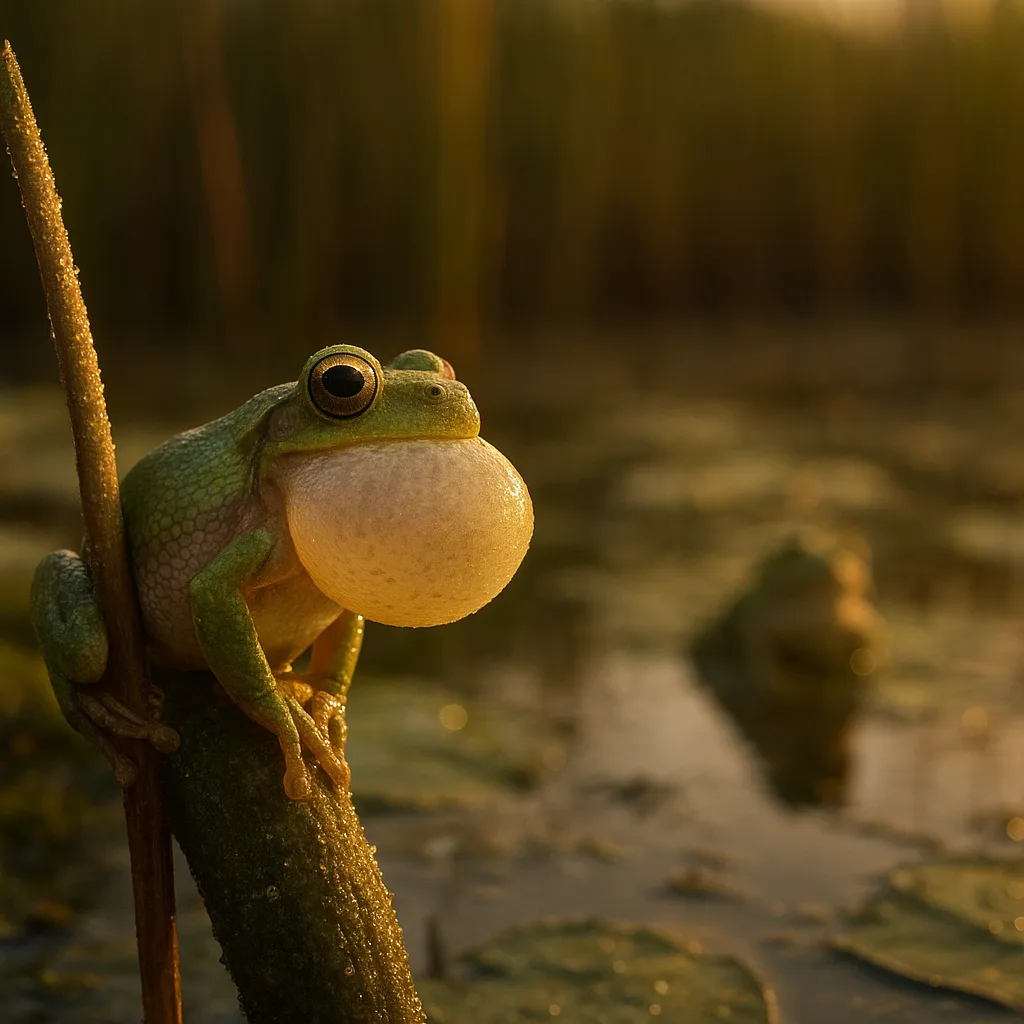
Frog vocalizations are produced when air from the lungs passes over the larynx and vibrates the vocal cords; many species amplify sound with a vocal sac. Understanding the mechanics helps interpret call features.
Key call characteristics
- Pitch/frequency: Measured in Hertz (Hz). Small frogs tend to call at higher frequencies (2–4 kHz); large species often call <1 kHz.
- Duration: Length of a single note or trill; from ~0.05 s (peeps) to 20+ s (long trills).
- Call rate and pulses: Notes per second or pulses within notes; used to differentiate similar calls.
- Modulation: Rising, falling, or steady frequency within a note.
- Amplitude: Loudness in decibels (dB). Bullfrogs can exceed 90 dB at close range; smaller frogs are often <70 dB.
Biological context
- Most advertisement calls are given by males to attract females and repel rivals.
- Alarm, release and distress calls exist but are less commonly heard in field surveys.
- Temperature affects call rate and pitch: for many species, rate increases and pitch rises with higher temperatures (Q10 effects).
Field methods for identifying frog calls
Good methods make identification reliable. These practical tips reduce errors and make your recordings useful for automated tools and experts.
For more on this topic, see our guide on Identify Your Cat: A Field Guide.
- Record with a directional microphone or a smartphone held steadily 1–5 m from the calling frog. Aim the mic toward the water or vegetation where the call originates.
- Note the time of day, air and water temperature, weather, and moon phase — many species are most vocal at dusk or night and after rain.
- Record at least 30–60 seconds of continuous sound to capture call variation; annotate with species hypotheses and approximate distances.
- Take a few photos of the habitat and any frogs you see; visual confirmation complements audio ID.
- Upload recordings and photos to expert platforms or use apps like Orvik for rapid visual and audio matching.
Recording tips
- Use lossless or high-quality formats (WAV, 44.1 kHz+). Compressed files (MP3) can still be useful but may lose harmonics.
- Reduce wind noise with a windshield or natural shelter; record close but without stressing animals.
- Record ambient sound for 10–20 s before and after calls to capture context and for noise filtering.
Common calls and species to know (with visual cues)
This section focuses on species often encountered across Britain and temperate regions, plus a few widely known international examples. Scientific names and typical call characters are given for precision.
British species
- Common frog (Rana temporaria): Call: a soft, low-pitched croak or series of clucking grunts (0.2–0.6 s notes). Size: 6–9 cm snout–vent length (SVL). Visual: smooth skin, dorsal brown/green with darker patches and a pale belly; long legs. Habitat: ponds, damp grassland. Breeding: early spring.
- Common toad (Bufo bufo): Call: low, sustained trilling or barking, audible several metres away. Size: 7–13 cm SVL. Visual: warty, dry skin, prominent parotoid glands behind the eyes; olive-brown. Habitat: woodland ponds, gardens. Breeding: spring mass migrations.
- Natterjack toad (Epidalea calamita): Call: long, high-pitched rasping trill lasting up to 20 seconds; distinctive and carries long distances. Size: 6–7.5 cm SVL. Visual: dorsal yellow stripe down a warty back; coastal dunes and ephemeral pools. Breeding: early summer in warm shallow pools.
- Midwife toad (Alytes obstetricans): Call: high, repetitive 'peep' or chirp; males carry eggs on their backs. Size: 3–5 cm SVL. Visual: compact, granular skin, mottled brown and grey. Habitat: rocky, dry areas with nearby breeding ponds.
- European tree frog (Hyla arborea): Call: metallic, short 'krrrk' or 'twang' repeated in bouts. Size: 3–5 cm SVL. Visual: bright green with a dark stripe through the eye; toe pads for climbing. Habitat: reed beds, ponds, warm sheltered sites.
- Marsh frog (Pelophylax ridibundus): Call: deep, loud 'croak' repeated in series; males have large throat sacs. Size: 6–11 cm SVL. Visual: green with dark spots, often with dorsal ridge; introduced in the UK in parts. Habitat: large lakes, marshes; breeding: late spring–summer.
International examples (helpful comparisons)
- American bullfrog (Lithobates catesbeianus): Call: low, resonant "jug-o'-rum" or deep bellow ~0.5–1 s; loud (80–90 dB). Size: 9–15 cm SVL. Visual: large, green-brown; tympanum larger than eye in males. Habitat: ponds, lakes; invasive in many regions.
- Spring peeper (Pseudacris crucifer)): Call: piercing single 'peep' or whistle, typically 1–2 kHz. Size: 1.5–3.5 cm SVL. Visual: small, X-shaped dorsal marking; woodland ponds; early spring choruses.
Tadpole identification: shape, mouthparts and development
Tadpoles often give away their identity if you know which traits to check. Key features include total length, tail shape, mouthparts and habitat. Many frog and toad tadpoles are morphologically distinct by late larval stages.
You may also find our article on Photo ID: Mastering Animal Identification in the Field helpful.
- Size and proportions: Tadpoles range from 5–60 mm total length depending on species and stage. Bullfrog tadpoles can exceed 100 mm before metamorphosis.
- Tail: Shape (rounded vs pointed), tail fin height and pigmentation are diagnostic. Fast-swimming species often have more muscular tails.
- Mouthparts and labial teeth rows: Many anurans (frogs and toads) have keratinized mouthparts with specific labial tooth row formulas (LTRF). For example, some Rana tadpoles have 2 upper and 3–4 lower rows; others differ.
- Color and pattern: Dorsal speckling, lateral lines, and belly translucence vary by species.
- Habitat and behavior: Herbivorous grazers (pond-bottom feeders) vs filter-feeders vs predatory tadpoles (e.g., some spadefoot species).
Practical tadpole ID steps
- Measure total length (tip of snout to tip of tail) and note body length vs tail length.
- Photograph from above and side; use a small ruler in the frame for scale.
- Examine mouthparts under magnification if possible and record the LTRF.
- Record the habitat (permanent vs ephemeral pool, temperature, vegetation).
- Compare with regional keys or use Orvik to match photos to known species records.
Comparison: How to tell similar calls and species apart
Some species sound similar, especially in mixed choruses. Comparing attributes and combining audio with visual cues reduces mistakes.
Frog vs Toad
- Calls: Frogs often produce clear musical notes or croaks; toads produce rasping trills or grunts that may be longer and lower.
- Skin: Frogs usually have smooth, moist skin; toads have drier, warty skin and prominent parotoid glands.
- Legs: Frogs have longer hind legs for jumping; toads have shorter, sturdier legs for walking.
Common frog (Rana temporaria) vs Common toad (Bufo bufo)
- Call: Common frog calls are shorter, clucking notes; common toad trills are longer and more monotone.
- Behavior: Toads congregate in larger, louder breeding assemblies; frog choruses can be more dispersed.
- Visual: Frogs lack large parotoid glands and have smoother skin.
Natterjack toad vs Common toad
- Call: Natterjack's long, high-pitched trill is unmistakable; common toad's call is deeper and shorter.
- Habitat: Natterjacks favour sandy, coastal or dune pools and shallow ephemeral water; common toads use a broader range of pond types.
- Markings: Natterjacks have a prominent yellow dorsal stripe.
Using technology: spectrograms, apps and Orvik
Modern tools combine human expertise with automated pattern matching. When you search "identify frog sounds" you likely want a quick, reliable answer — apps and spectrograms can help, but they work best in combination with field notes and photos.
You might also be interested in Field Guide to Flower Names.
- Spectrogram analysis: Visual plots of frequency over time highlight call structure, harmonics, pulse rate and frequency modulation. Use software like Raven, Audacity or mobile apps that display spectrograms.
- Automated classifiers: Machine learning models can propose species from recordings with varying confidence. Always check suggested IDs against your own observations.
- Orvik: Orvik is useful for matching photos of frogs or tadpoles to reference images and can augment audio-based IDs by linking visual records to likely species. Use Orvik to cross-check your audio-based hypotheses.
Best practices when using apps
- Provide context: upload photos, location, date, time and temperature with your recording.
- Verify automated IDs: check spectrogram features yourself or with expert guides; models can confuse species in noisy environments.
- Contribute validated records to citizen science platforms; they improve algorithms over time.
Orvik integrates well into this workflow: use it to identify photographed individuals and link those observations to your audio archive for stronger, evidence-backed identifications.
Related reading: Identify Snakes Fast: Field-Proven Tips.
Safety, ethics and conservation when listening and handling
Respect for animals and habitats protects both you and the species you study.
- Handling: Avoid handling frogs and tadpoles unless necessary. Amphibian skin is permeable and can absorb oils, lotions and salts from human hands. If you must handle, wet your hands with pond water, minimize handling time, and release gently.
- Toxicity warnings: Some species secrete toxins (e.g., African poison frogs in captivity), but common British species are not dangerously toxic to humans. Still, always wash hands after contact. Keep frogs and toads away from pets — dogs and cats may become ill if they mouth toads with parotoid secretions.
- Legal protections: In the UK, several amphibian species and their habitats are protected under the Wildlife and Countryside Act and other regulations. Avoid disturbing breeding aggregations and do not collect animals or eggs without permits.
- Habitat care: Stay on paths, avoid trampling vegetation around ponds, and do not introduce fish or non-native species (a major threat to native tadpoles).
Conclusion
Frog sound identification blends careful listening, solid field technique and visual confirmation. Use good recordings, spectrograms and apps like Orvik to cross-check species, and always pair audio with visual habitat notes or photos. With practice you will learn to recognise regional choruses, distinguish common confusions (toad vs frog, natterjack vs common toad) and identify tadpoles by body shape and mouthparts. Responsible observation supports conservation — and it makes night-time ponds come alive in a whole new way.
Frequently Asked Questions
- How accurate are apps at frog sound identification?
- Accuracy varies by app, noise level and species. Well-recorded calls in quiet settings can reach over 80% accuracy for common species, but always verify with photos and expert validation.
- Can I identify a frog from a single short call?
- Sometimes. Distinctive calls like a natterjack trill or bullfrog bellow can be recognised from one note, but most species require longer (30–60 s) recordings for confident ID.
- What time of year are frogs most vocal in Britain?
- Most breeding calls occur in spring and early summer (March–June), although some species, such as marsh frogs, may call into later summer. Temperature and rainfall affect calling activity.
- How do I identify a tadpole to species?
- Combine size, tail shape, mouthpart (labial teeth) formula, pattern and habitat. Photograph tadpoles with a scale bar and note pond type to use regional identification keys effectively.
- Are British frogs poisonous to humans?
- Native British frogs and toads produce mild skin secretions that are not typically dangerous to humans but can irritate mucous membranes and are toxic to pets. Wash hands after handling.
- Can I use recordings I find online to train myself?
- Yes. Curated databases and verified spectrograms are useful learning tools. Compare your own recordings to references and note differences in pitch, duration and pulse rate.
- How can Orvik help with frog identification?
- Orvik matches your photos of frogs or tadpoles to reference images and links visual records to audio archives, strengthening automated and expert identifications without replacing field verification.