
When someone types "identify coins" into a search bar they may mean anything from a battered copper penny found in the garden to the name and ticker of a cryptocurrency listed on an exchange. This guide bridges both worlds: the tactile skills of numismatics (coin collecting) and the digital literacy of recognizing and naming cryptocurrencies. Read on for practical, measurable identification tips, geographic and seasonal context for finds, counterfeit warnings, and the best workflows to identify coins fast — including how AI tools like Orvik can speed the process.
Why people search "identify coins"
Understanding search intent helps us provide the right information. People who want to identify coins generally fall into a few categories:
- Hobbyists finding a potentially valuable coin in change or in the soil.
- Travelers who want to know the name and value of foreign currency.
- Collectors looking to grade or authenticate a rare piece.
- Investors and traders seeking to map cryptocurrency names and tickers (e.g., bit coin names, cryptocoin names).
- Researchers needing provenance, mint marks, or historical context.
Each group needs different signals: visual cues, measurements and metallurgy for physical coins; name, ticker, blockchain and supply metrics for crypto. This guide addresses all these needs with clear, actionable steps.
Tools and first steps for identifying physical coins
Start with a small, consistent toolkit. Professional numismatists use simple instruments that dramatically increase identification accuracy.
- Digital caliper: Measure diameter to 0.01 mm and thickness to 0.01 mm.
- Precision scale: Weigh to 0.01 g; metal content is often inferred from weight.
- Loupe or jeweller's magnifier: 10x to 20x magnification to read mint marks, die cracks, and micro-lettering.
- Strong LED light or raking light: Reveals relief, die alignment, and surface texture.
- Magnet: Quick check for ferrous metals (helps detect steel or iron core coins).
- Reference books and databases: Standard catalogs (e.g., Krause, Yeoman) and online databases like NGC, PCGS, CoinArchives.
Quick visual cues
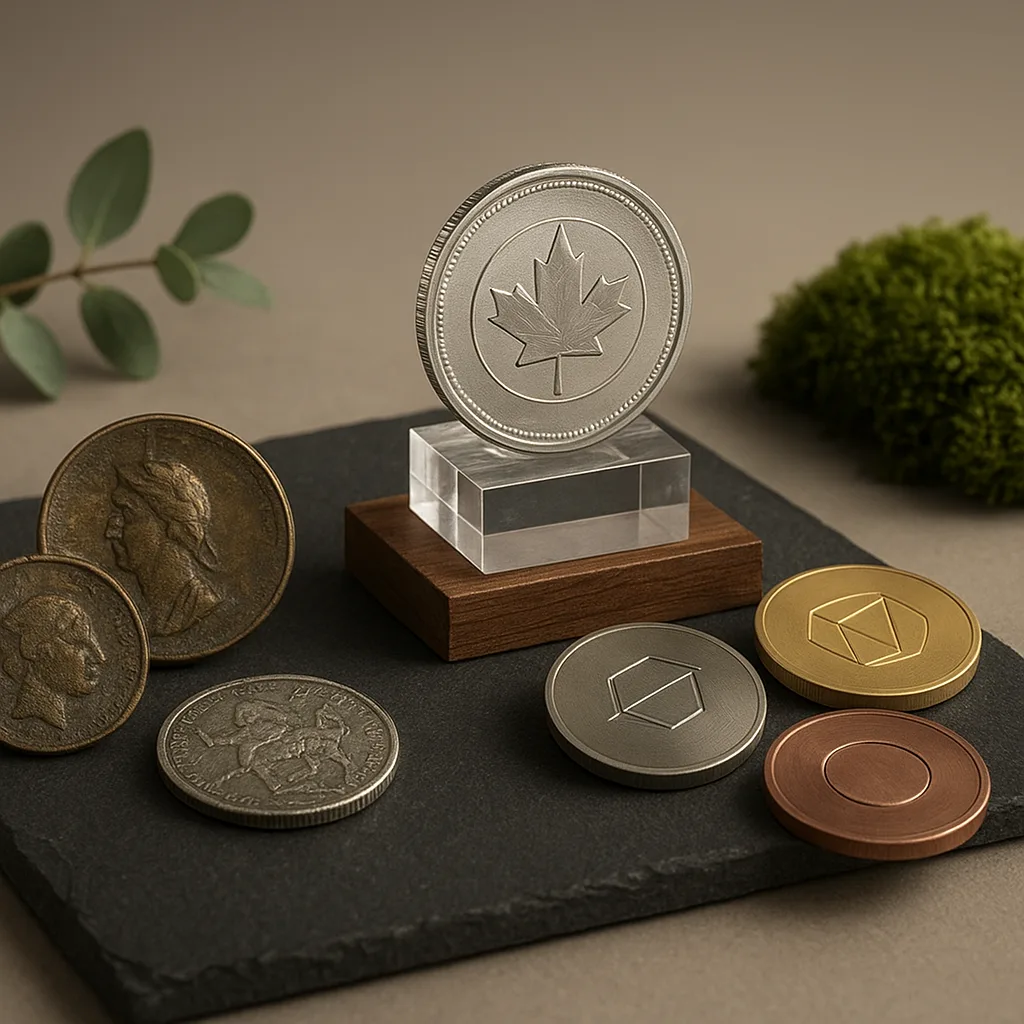
- Color: Copper-red suggests high copper; silver-grey suggests cupro-nickel or silver; bright gold tone suggests brass/clad or plated base metal.
- Edge: Reeded (grooved) edges are common on higher denominations; plain edges can signal token or low-denomination coin; lettered edges carry inscriptions or dates.
- Portraits and inscriptions: National language, portrait orientation, and dates help place the coin in time and place.
- Mint marks: Small letters (P, D, S, W in US coins) indicate where the coin was struck and are crucial for cataloging.
Simple tests for metal identification
- Magnet test: If magnetic, likely steel or iron; most modern U.S. circulating coins are non-magnetic (except some wartime or plated issues).
- Specific gravity estimation: Compare weight and displacement in water to identify silver (Ag, density 10.49 g/cm3) vs copper (8.96 g/cm3) vs nickel (8.90 g/cm3).
- Visual toning and patina: Silver develops a grey-black tarnish; copper develops green or brown patina (verdigris).
Identification specifics: Common U.S. coins (sizes, weights, and telltale marks)
For many collectors and finders in the U.S., knowing standard diameters and weights provides an immediate identification scaffold. These are precise modern specifications used by the U.S. Mint.
For more on this topic, see our guide on Mastering Coin Identification: A Field Guide.
- Penny (Lincoln cent): Diameter 19.05 mm; weight 3.11 g (pre-1982 bronze) or 2.50 g (post-1982 zinc core with copper plating). Edge: plain.
- Nickel (Jefferson): Diameter 21.21 mm; weight 5.00 g; composition: cupro-nickel (75% Cu/25% Ni) modern. Edge: plain.
- Dime (Roosevelt): Diameter 17.91 mm; weight 2.268 g; clad composition (outer layers 75% Cu/25% Ni, core copper). Edge: reeded (118 reeds on most modern dimes).
- Quarter (Washington): Diameter 24.26 mm; weight 5.670 g; clad composition; edge: reeded (119 reeds typical).
- Half Dollar (Kennedy): Diameter 30.61 mm; weight 11.340 g; clad composition; edge: reeded.
- Dollar (Sacagawea/Presidential): Diameter 26.50 mm; weight 8.100 g; manganese-brass clad or other alloys depending on series; edge: incused lettering or plain depending on issue.
Use these measurements first: if a coin's diameter and weight fall within ±1% of a standard, you have a high-confidence ID. If not, consider foreign origin, token, or counterfeit.
Foreign, historical, and ancient coins: geography and context
Coins found in gardens, shorelines, or archaeological contexts often need geographic and historical context.
- Modern circulating coins: Euro, Pound, Yen, Rupee — these typically show national emblems and denominations in numerals (1, 2, 5, 10, 20, 50).
- Historical coins: Look for monarch portraits, regnal years, or Latin inscriptions indicating older European coins.
- Ancient coins: Greek tetradrachm, Roman denarius, and Byzantine follis have distinct iconography — gods, emperors, and mint control marks often in Greek or Latin.
Habitat and geographic distribution
- Beach and river finds: Coin concentrations near old ports, ferry crossings, and trade hubs — look for hammered silver and foreign trade tokens.
- Urban gardens and construction sites: High probability of modern coins and 19th–20th century coinage, including pocket change and merchant tokens.
- Fields and rural areas: May yield older domestic coinage (e.g., 18th–19th century) often corroded and needing conservation.
Seasonal behavior: metal detecting and fieldwork increase in dry seasons; flood events can reveal hoards and deposit layers with mixed-date coins.
You may also find our article on Mastering Stamp ID in the Field helpful.
Detecting counterfeits, grading, and conservation (safety warnings)
Counterfeits and altered coins are common. Detection requires a layered approach: visual, tactile, and instrumental. Safety and conservation are equally important — improper cleaning reduces value and can be hazardous.
- Common counterfeit signs:
- Wrong weight/diameter for the issue.
- Off-center or mismatched edge reeding.
- Unnatural surface texture: casting bubbles, pitting inconsistent with wear.
- Incorrect or blurred lettering; mismatched fonts.
- Tests to perform:
- Weigh and measure precisely, compare to reference.
- Magnet and specific gravity tests for metal composition.
- Microscopic inspection for die markers, tool marks, and micro-lettering.
- Grading tips: Professional grading uses a 70-point scale (e.g., PCGS/NGC). Key grades: Good, Fine, Extremely Fine, About Uncirculated, Mint State (MS-60 to MS-70). Surface preservation, strike quality, and luster determine grade.
Conservation and safety warnings
- Do not clean valuable coins with abrasives, vinegar, or chemical dips — these remove patina and lower value.
- Avoid nitric acid tests unless you are trained — they are destructive and toxic.
- Wear nitrile gloves when handling archaeological or very corroded coins: corrosion products and old solder can contain lead or other toxic metals.
- Store coins in inert holders (mylar flips, acid-free envelopes) and avoid PVC-containing plastics which produce harmful residues over time.
Identifying cryptocurrencies and cryptocoin names
When people search for "identify coins" in the digital realm, they often mean identifying crypto assets by name, ticker, or logo. The space is vast: there are tens of thousands of tokens and coins — so "all cryptocurrency names" is a moving target. Here are practical steps to identify a crypto coin confidently.
You might also be interested in Spotting Bed Bugs: A Clear Visual Guide.
- Start with the name and ticker: Bitcoin (BTC), Ethereum (ETH), Litecoin (LTC), Dogecoin (DOGE). Often users mix "bit coin names" and "cryptocoin names" — remember the canonical form is either the project name or its ticker.
- Check a reputable index: CoinMarketCap and CoinGecko list thousands of coins and provide logos, contract addresses, chains, and market data — useful for confirming the exact token.
- Verify the blockchain and contract address: For ERC-20 tokens (Ethereum) and other smart contract tokens, always match the contract address to the official project site or a trusted index to avoid scam tokens with similar names.
- Look up explorers: Use etherscan.io (Ethereum), blockchain.info (Bitcoin), or chain-specific explorers to view transaction history and supply metrics.
Common crypto names and examples
- Bitcoin (BTC) — original, Proof-of-Work, fixed supply 21,000,000 BTC.
- Ethereum (ETH) — smart-contract platform, originally PoW, now PoS (post-Merge).
- Ripple (XRP), Litecoin (LTC), Bitcoin Cash (BCH), Cardano (ADA), Polkadot (DOT), Solana (SOL), Binance Coin (BNB), Monero (XMR).
- Namecoin (NMC) — an early altcoin intended for decentralized DNS/name registration (one of the first forks of Bitcoin technology).
Because many users search variations — "names of coin", "all coin names", "crypto currency names" — point them to aggregator pages. However, beware of scam coins using name similarity: a token called "BitCoin2" with a different ticker is not BTC.
Related reading: Identify Coins Fast: An Expert AI Guide.
X vs Y: coin vs token — how to tell them apart
- Coin: Native asset of a blockchain (e.g., BTC on Bitcoin, ETH on Ethereum). Usually a ledger-level currency used to pay fees and transfer value.
- Token: Asset created on top of an existing blockchain (e.g., many ERC-20 tokens on Ethereum). Tokens have contract addresses and can be replicated with similar names — always verify the contract address.
Using Orvik and other digital tools for fast identification
AI and mobile tools can accelerate coin identification dramatically. Orvik, an AI-powered visual identification app, recognizes visual features on coins and matches them to catalog records, helping you identify names, mint marks, and probable dates from a single photograph. It’s particularly useful for busy field collectors and casual finders who need a fast, reliable first pass.
- Workflow with a visual app (e.g., Orvik):
- Take a high-contrast, well-lit photo of both obverse and reverse. Include a ruler or coin card for scale.
- Upload to Orvik or another app. The AI analyzes portraits, lettering, and edge patterns and proposes candidate IDs.
- Cross-check AI results with a reference database or a catalog number for confident valuation.
- Digital crypto ID tools: Use CoinGecko, CoinMarketCap, and blockchain explorers to verify token names and contract addresses. Wallet apps also allow scanning contract addresses or QR codes to confirm the exact asset.
Orvik is not a replacement for a trained numismatist or a professional grading service, but it provides a fast, evidence-based start — particularly useful when sorting a large lot of coins or when you want to quickly map a crypto token’s identity and metadata.
Conclusion
To "identify coins" means different things depending on context: for metal coins the work is tactile and observational — measuring diameter, weighing, reading mint marks, and assessing metal content. For cryptocurrencies, identification is a matter of name, ticker, blockchain, and contract addresses. Use precise tools (calipers, scales, loupes), trusted references (catalogs and CoinGecko/CoinMarketCap), and modern aids like Orvik to speed up identification. Always verify suspicious finds with multiple methods and handle both valuable physical coins and sensitive crypto credentials with care. With these steps you can move from uncertainty to confident identification — whether you’ve dug up a bronze penny or encountered an unfamiliar cryptocoin name online.
Frequently Asked Questions
- How do I quickly tell what coin I have in my pocket?
- Check diameter and weight against common standards, read the date and mint mark, and match the portrait/inscription to a reference. A photo-ID app like Orvik can also provide a fast match.
- Where can I find a list of all cryptocurrency names?
- Use aggregator sites like CoinMarketCap or CoinGecko for up-to-date listings; note that new tokens appear frequently, so no list is permanently complete.
- What is Namecoin?
- Namecoin (NMC) is an early Bitcoin-derived cryptocurrency designed for decentralized name registration (DNS). It’s one of the first altcoins and remains a niche project.
- How can I tell if a coin is counterfeit at home?
- Compare weight and diameter to references, use a magnet test, inspect under magnification for casting defects or wrong lettering, and check edge reeding; seek professional authentication for high-value pieces.
- Are gold-colored coins actually gold?
- Not necessarily. Many are brass or plated base metals; density tests or professional assays are needed to confirm real gold content.
- Is it safe to clean old coins I find?
- Generally avoid cleaning valuable or archaeological coins. Cleaning can strip patina and reduce value. If needed, use gentle methods (distilled water, soft brush) or consult a conservator.
- How do I avoid scam crypto tokens with names similar to big coins?
- Verify contract addresses via the official project site or trusted indices, check liquidity and explorers, and be wary of tokens that mimic popular names but have different tickers or addresses.