
Foragers, parents, hikers and curious gardeners ask the same urgent question: how can you tell if a wild berry is poisonous? There is no single rule that works every time, but experienced naturalists rely on a combination of visual cues, plant context, season, and species knowledge. This guide gives field‑tested, science‑based methods you can use immediately, plus specific comparisons and safety steps. Use tools like Orvik to aid visual ID, but always pair app results with local guides and common‑sense precautions.
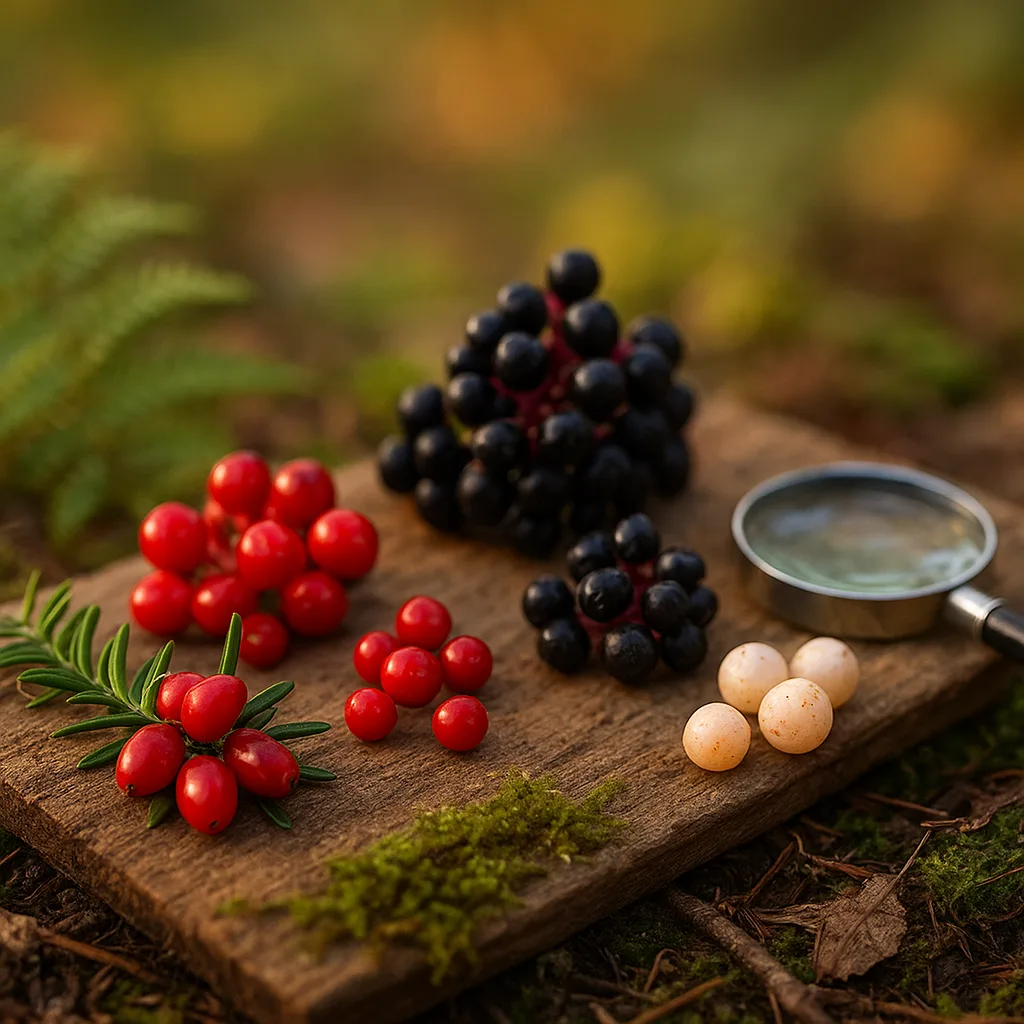
Why identification matters: risk, numbers, and real cases
People often assume that all brightly colored berries are safe because they look appetizing. In reality, dozens of plant species worldwide produce toxic fruit. Some facts to keep in mind:
- Certain species, like Atropa belladonna (deadly nightshade), can be lethal—children have been fatally poisoned by ingesting as few as 2–3 berries (berries ~1–1.5 cm diameter).
- Other species cause mainly gastrointestinal distress (nausea, vomiting, diarrhea) or neurologic symptoms (drowsiness, hallucination) depending on toxin and dose.
- Many common garden and woodland plants with red, black, blue or white berries are either edible, mildly toxic, or poisonous when raw (for example, Sambucus nigra—elderberry—must be cooked to remove cyanogenic compounds).
Understanding what to look for reduces risk. If you are searching "how to tell if a berry is poisonous," you want practical visual features, habitat clues, and immediate safety actions—this guide provides all three.
Basic rules of thumb (and why they aren’t foolproof)
There are widely circulated “rules” (e.g., “red berries are poisonous”, “if birds eat them they’re safe”) but all have exceptions. Still, rules of thumb help triage when you’re in the field.
- Rule: Bright color alone is not proof of toxicity. Many edible species have bright fruit (Vaccinium spp. blueberries, Rubus idaeus raspberries). Conversely, toxic berries can be dull or glossy.
- Rule: Berries with seeds visible when squashed tend to be drupes (like raspberries) and are often edible—but not always. Examples: edible blackberries versus red baneberry (Actaea rubra) which is highly toxic and does not separate into drupelets.
- Rule: Birds eating berries is not a guarantee of safety for humans. Birds metabolize many compounds humans cannot; pokeweed (Phytolacca americana) is eaten by birds but is toxic to people.
- Rule: Bitter or soapy taste is unreliable and dangerous to test. Don’t taste unknown berries—some toxins act quickly or in tiny doses.
Bottom line: use rules of thumb for caution, not confirmation. Prefer multiple ID features over a single rule.
For more on this topic, see our guide on Wild & Garden Berries: How to Identify Them.
Visual identification cues: color, size, shape, texture and patterns
When asked "how do you tell if a berry is poisonous?" the most helpful answer is: compare multiple visual attributes against known species. Below are concrete features and measurements to note for reliable identification.
Color and surface
- Red: many species—compare shade and gloss. Holly (Ilex aquifolium) berries are glossy deep red, 6–10 mm diameter; their skin is smooth and the berries are clustered. Red baneberry (Actaea rubra) often has translucent red fruit with a white dot on many berries, grouped on an upright stalk—highly toxic.
- Black/purple: Atropa belladonna produces shiny black to purple berries ~1–1.5 cm; Phytolacca americana (pokeweed) berries are dark purple and form elongated clusters.
- White/cream: Actaea pachypoda (doll’s eyes) has white berries with a black “pupil” (6–8 mm); extremely poisonous—avoid any white berry with contrast markings.
Size and shape
- Small (2–6 mm): many toxic berries (e.g., Rivina humilis—pigeonberry or bloodberry—3–5 mm) and edible small berries (Vaccinium spp.) coexist; size alone is not diagnostic but useful to compare with species descriptions.
- Medium (7–15 mm): Atropa belladonna (1–1.5 cm), black nightshade (Solanum nigrum) 5–8 mm, pokeweed 6–12 mm. Measure if possible—use a fingertip (~1.5 cm) as a quick reference.
- Aggregate vs single drupe: Raspberries and blackberries are aggregate fruits made of many drupelets that separate easily from the core; toxic species like baneberry remain as single, attached berries on a central stalk.
Arrangement and attachment
- Clustered bunches on an elongated raceme: pokeweed and elderberry (Sambucus spp.)—note whether berries are attached to a persistent stem.
- Umbel or flat clusters: many Apiaceae relatives have umbels, but that primarily applies to flowers; for fruit, check if the berries hang in a flat, umbrella‑like array.
- Single or paired on short stems: belladonna berries often appear solitary or in small groups beneath leaves.
Texture and internal cues
- Shiny, translucent skin—some toxic species (baneberry) are translucent red with internal seeds visible as dots.
- Dry or mealy: unripe or certain toxic berries can be dry; ripe edible berries tend to be juicy.
- Seeds: cut one open only if you know safe protocol. Many berries have small seeds; some toxins concentrate in seeds (e.g., rosaceae seeds contain cyanogenic glycosides).
Common poisonous berries and edible look‑alikes (comparison section)
When asking "how to tell if a berry is poisonous or not", comparing common toxic species with their safe look‑alikes is the most practical approach. Below are several side‑by‑side distinctions with key ID markers.
Atropa belladonna (deadly nightshade) vs edible blackberries/blueberries
- Belladonna: solitary glossy black berries, 10–15 mm, drop beneath leaves, plant is a bush 0.5–1.5 m tall; toxic tropane alkaloids (atropine, scopolamine). One or two berries can poison a young child.
- Blackberries/blueberries (Rubus spp., Vaccinium spp.): aggregate drupelets (blackberries) or small round berries in clusters (blueberries) that are soft and detach easily; lack the solitarily positioned grape‑like belladonna fruits.
Actaea pachypoda (doll’s eyes) vs white wild strawberries
- Doll’s eyes: white berries with a black dot, 6–8 mm, on red stalks; herbaceous plant in eastern North American woodlands; berries contain cardiogenic toxins—dangerous to children and pets.
- White alpine strawberry (Fragaria vesca var. alba): aggregate, flattened fruits that separate into drupelets; smell and taste like strawberries—rare in the wild.
Pokeweed (Phytolacca americana) vs elderberry (Sambucus nigra/cerulea)
- Pokeweed: elongated racemes of dark purple berries that stain deep purple; plant can reach 1–3 m tall. All parts are toxic, especially roots and seeds.
- Elderberry: dense flat clusters (corymbs) of small dark purple berries ~3–5 mm; raw elderberries and other raw parts are mildly toxic due to cyanogenic glycosides—cooking removes most toxins and produced edible syrups/jams.
Rivina humilis (bloodberry/pigeonberry) — is blood berry poisonous?
- Rivina humilis: commonly called bloodberry or pigeonberry. Small, bright red berries 3–6 mm in tight clusters; native to the Americas and commonly naturalized in warm climates. Considered mildly toxic to humans and pets, causing nausea and vomiting; not typically fatal but best avoided.
Habitat, geographic distribution and seasonal behavior
Knowing where and when a berry appears narrows down species possibilities quickly. Many toxic and edible plants have distinct habitat preferences and fruiting times.
You may also find our article on Goji Berries: A Field Guide to the Red Superfruit helpful.
- Woodland understory (e.g., Actaea spp., Atropa belladonna): shade‑tolerant perennials fruit from late spring through mid‑summer—check leaf shape, scent, and stalk structure.
- Open fields and disturbed soils (Phytolacca americana, Solanum dulcamara): these species fruit from mid‑summer into fall; pokeweed often forms conspicuous racemes in abandoned lots and hedgerows.
- Wetlands and riparian zones (Sambucus spp., Ilex verticillata—winterberry): winterberry is a holly that retains bright red berries into winter and is toxic to humans if eaten raw.
- Geographic notes: Atropa belladonna is native to Europe, North Africa and Western Asia but cultivated elsewhere; Phytolacca americana is native to eastern North America and invasive in parts of Europe.
Field protocol: safe ways to investigate unknown berries
If you must identify a berry in the field, follow a methodical, low‑risk process. Never rely on a single characteristic.
- Observe from a distance: note cluster shape, attachment, plant height and leaf type. Photograph the whole plant, leaves, stems, and fruit cluster from multiple angles—Orvik and other plant ID apps use multiple views to increase accuracy.
- Measure roughly: compare berry size to a known reference (pencil eraser ~6 mm, fingertip ~15 mm). Record color, gloss, and whether fruit is translucent or opaque.
- Check time/season: when are the fruits ripe locally? A field guide specific to your ecoregion (e.g., Pacific Northwest vs. Eastern deciduous forest) matters.
- Use multiple references: consult local flora, trusted field guides, and an app like Orvik for a preliminary ID; cross‑check with at least two sources before assuming safety.
- Never taste: do not taste or let children taste unknown berries. Avoid home remedies like touching berries to lips or tongue to test for bitterness—some toxins absorb quickly through mucous membranes.
Signs of poisoning and first aid steps
Recognizing symptoms quickly can save lives. Symptoms vary by toxin but include:
- Gastrointestinal: nausea, vomiting, abdominal pain, diarrhea.
- Neurologic: dizziness, drowsiness, confusion, hallucinations, dilated pupils (mydriasis) for alkaloid poisonings.
- Cardiovascular: palpitations, slow or fast heart rate, low blood pressure in severe cases.
- Respiratory: shortness of breath, difficulty breathing—serious and requires emergency care.
Immediate steps:
You might also be interested in Mastering Coin Identification: A Field Guide.
- Remove any remaining fruit from the mouth.
- Note the plant appearance and take photos for medical staff or poison control.
- Call your local Poison Control center (US: 1‑800‑222‑1222) or emergency services if symptoms are moderate to severe—don’t wait for progression.
- Do not induce vomiting unless instructed by a medical professional. Activated charcoal may be recommended in some cases but only under guidance.
- If a child has ingested unknown berries and is symptomatic, seek immediate medical attention—children are more susceptible to small doses.
Tools that help: field guides, keys and mobile ID apps (Orvik mentioned)
Modern tools complement field knowledge. Use a combination of resources:
Related reading: Identifying Elderberries in the Wild.
- Regional field guides with botanical keys (e.g., Peterson Field Guides, Newcomb’s Wildflower Guide) for accurate morphological IDs.
- Herbarium sheets and online resources (USDA PLANTS database, Royal Botanic Gardens) for distribution maps and flowering/fruiting calendars.
- Mobile apps like Orvik for AI‑assisted visual ID: Orvik can compare uploaded photos to vast image libraries and suggest likely species with confidence scores. Use its suggestions as a starting point, then verify with a regional guide.
Limitations and best practice:
- Apps may misidentify similar species—especially when photos show only fruit. Always photograph leaves, flowers, and growth habit to increase accuracy.
- Cross‑reference app results with local expertise. Orvik’s AI gives rapid feedback in the field but should not replace a botanist’s judgment for high‑risk decisions (e.g., feeding unknown berries to children or livestock).
Common myths and dangerous advice to ignore
There are persistent urban myths about identifying poisonous berries. Ignore these potentially deadly shortcuts:
- Myth: "If a berry stains your hands it's poisonous." Reality: many edible berries (blackberries, elderberries) stain; staining is not a toxicity indicator.
- Myth: "Berries eaten by birds are safe for humans." Reality: birds and humans metabolize different compounds; many berries eaten by birds (pokeweed, holly) harm humans.
- Myth: "All white berries are poisonous." Reality: some white berries can be edible in certain species, though many white‑fruited plants are indeed toxic; always verify species.
Conclusion
When you search "how to tell if a berry is poisonous," you are seeking practical, reliable steps to avoid harm. There is no single visual rule that guarantees safety. Instead, use a layered approach: observe multiple physical features (color, size, arrangement), note habitat and season, consult regional guides, and verify with tools like Orvik. Never taste unknown berries; if ingestion occurs, document the plant and seek immediate medical help. With careful observation and the right tools, you can greatly reduce the risk of accidental poisoning while enjoying the outdoors responsibly.
Frequently Asked Questions
- How can you tell if a wild berry is poisonous without tasting it?
- Observe multiple features: color, size (compare to a fingertip or pencil eraser), cluster arrangement, leaf and stem characteristics, and habitat. Photograph the entire plant (leaves, flowers, fruit) and cross‑check with regional field guides or an app like Orvik. Never taste unknown berries.
- Is blood berry poisonous?
- The plant commonly called bloodberry (Rivina humilis, aka pigeonberry) produces small red berries ~3–6 mm that are considered mildly toxic to humans and pets, causing nausea and vomiting. They are not typically fatal but should be avoided.
- Can you rely on birds eating a berry as a safety test?
- No. Birds can tolerate many toxins humans cannot. Species like pokeweed are eaten by birds but are toxic to people. Use bird feeding as a non‑diagnostic observation only.
- What should I do if a child eats an unknown berry?
- Remove any remaining berry from the mouth, take photos of the plant, call poison control (US: 1‑800‑222‑1222) or emergency services immediately, and follow professional guidance. Do not induce vomiting unless instructed.
- Are white berries always poisonous?
- No, but many white‑fruited species (e.g., Actaea pachypoda, doll’s eyes) are highly toxic. White berries should be treated with extreme caution and verified by species before any interaction.
- Can apps like Orvik definitively identify poisonous berries?
- Apps like Orvik are useful for rapid, AI‑assisted identification and can provide probable matches with confidence scores. However, they should be used alongside regional guides and expert confirmation, especially for high‑risk decisions.
- How quickly do berry toxins act?
- It varies by toxin: gastrointestinal symptoms often begin within 30 minutes to a few hours; neurologic and cardiac symptoms can appear within minutes to hours. Because timing varies, seek medical advice promptly after ingestion.