
Introduction: The Night Soundscape and Why It Matters
When daylight fades, a different orchestra starts: high-pitched chirps, rhythmic trills, mechanical clicks and low buzzing carry through yards, forests and city streets. If you search "what are the bugs that make noise at night," you’re usually looking for three things: 1) the identity of those sounds, 2) whether the insect could be biting or dangerous, and 3) how to tell similar species apart. This article gives field-tested identification cues (size, shape, color, sound character), habitat and seasonal notes, plus safety tips and practical ways to confirm an ID—including using Orvik to instantly identify photographed insects.
Why Insects Make Noise at Night
Insects produce noises for several biological reasons. Most nocturnal calls are mating signals—males advertising to females; others are alarm or territorial sounds. Some noises are incidental mechanical sounds made when an insect moves or flips.
- Mating calls: stridulation (rubbing wings/legs), tymbal sounds
- Territorial/agonistic displays: short aggressive chirps
- Alarm or anti-predator sounds: clicks or buzzes to startle
- Mechanical noises: wingbeats (high-frequency buzzing) or body clicks
Understanding the purpose helps narrow ID: repeated regular trills usually mean crickets/katydids, loud sustained buzzes suggest cicadas or large beetles, and tiny continuous buzzes often come from mosquitoes or gnats.
Major Nighttime Singers: Crickets, Katydids and Grasshoppers
These orthopterans are the most familiar nighttime musicians. Their sounds are produced by stridulation—rubbing a toothed vein on one wing against a scraper on the other.
True Crickets (Family Gryllidae)
- Size: 10–30 mm body length
- Color: usually brown to black with shiny, cylindrical bodies
- Visual cues: long antennae (often longer than the body), enlarged hind legs for jumping, flattened wings covering abdomen
- Sound: rhythmic chirps; rate varies with temperature (Dolbear's Law relates chirps/ minute to temperature)
- Habitat & distribution: global, common in lawns, under rocks, inside buildings in winter
Identification tip: If the insect is dark brown/black, chunky and chirping in a steady cadence from ground level or inside walls, it’s likely a field or house cricket (Gryllus spp.).
Katydids (Family Tettigoniidae) and Tree Crickets (Subfamily Oecanthinae)
- Size: 20–70 mm (katydids), 10–25 mm (tree crickets)
- Color: bright green common in katydids; tree crickets pale green or yellowish translucent
- Visual cues: very long antennae, leaf-like wings in katydids, slender body in tree crickets
- Sound: katydids often produce a high-pitched, repetitive "ka-ty-did" echoing call; tree crickets make pure, musical trills or high-pitched chirps
- Habitat & distribution: trees, shrubs and gardens across temperate and tropical regions, especially active on warm summer nights
Identification tip: A green, leaf-shaped insect sitting on vegetation that emits a musical, flute-like trill is usually a tree cricket (Oecanthus) or a katydid species.
Mole Crickets (Family Gryllotalpidae)
- Size: 30–50 mm
- Color: tan to dark brown, velvety forelegs adapted for digging
- Visual cues: cylindrical body, shovel-like forelegs, often found in soil or turf
- Sound: deep, booming trills that can carry a long distance at night
- Habitat & distribution: subterranean, in moist soils worldwide; often detected by singing males near burrow entrances
Note: Mole crickets can damage turf and young roots. They are robust and noisy when disturbed.
For more on this topic, see our guide on Spotting Bed Bugs: A Clear Visual Guide.
Big Buzzers: Cicadas and Large Beetles
Not all nighttime noise is high-pitched chirping. Some species produce loud, sustained buzzes or humming sounds.
Cicadas (Family Cicadidae)
- Size: 20–50 mm body length; wingspan up to 100 mm
- Color: green, brown or mottled; transparent veined wings
- Visual cues: stout body, prominent compound eyes, large membranous wings held tent-like over body
- Sound: very loud, sustained buzzing or whining produced by tymbals—can reach 80–100 dB in some species
- Habitat & distribution: trees and shrubs; common in temperate and tropical regions. Periodical cicadas (Genus Magicicada) emerge in synchronized cycles (13- or 17-year broods) and can be deafening in summer
Identification tip: If the sound is a persistent, powerful buzz from tree canopy level, look for flying teardrop-shaped insects with clear wings—cicadas.
Large Night-Flying Beetles (Scarabaeidae & Other Families)
- Common types: June beetles (Scarabaeidae), fireflies (Lampyridae; not noisy), and some longhorn beetles
- Size: 10–25 mm (June beetles) to 30 mm+
- Sound: wingbeat buzz—often low frequency and continuous when in flight
- Habitat & distribution: attracted to lights, common in summer evenings
Visual tip: buzzing around porch lights in summer are often scarab beetles or big-bodied insects with rapid wingbeats.
Small Buzzers and Clickers: Mosquitoes, Midges and Click Beetles
These are the tiny noises people often notice near their ears or beds: faint, high-pitched whines or intermittent clicks.
You may also find our article on Spotting Stink Bugs: Key Identification Traits helpful.
Mosquitoes and Small Flies (Family Culicidae, Ceratopogonidae)
- Size: 3–12 mm
- Color: gray, brown or black; slender bodies, long legs
- Visual cues: delicate mosquito-profile with long proboscis; midges are tiny and fly in swarms
- Sound: high-pitched whining from wingbeats—note pitch correlates with wingbeat frequency and species (male vs female differences)
- Habitat & distribution: near standing water, wetlands, irrigated lawns, worldwide; biting midges (Ceratopogonidae) are small and active at dusk/night
Health note: Female mosquitoes can vector diseases (West Nile virus, dengue, Zika, malaria in endemic regions). Use repellents and screening. Bites are itchy and appear within minutes to hours.
Click Beetles (Family Elateridae)
- Size: 10–30 mm
- Color: brown to black, elongated, hard-bodied
- Visual cues: flattened, elongated beetle with a pointed pronotum; flips and makes a sharp "click" as a startle and righting mechanism
- Sound: single mechanical click audible at close range, especially against hard surfaces at night
- Habitat & distribution: around lights, on tree trunks, worldwide
Identification tip: A solitary mechanical "click" followed by sudden flipping or launching motion points to a click beetle rather than a calling cricket.
Who’s Biting at Night? Identifying Nocturnal Biters
When the question is "what bug is biting me at night?" the suspects change from singers to biters. Many biting insects are quiet or make only a faint buzz.
Mosquitoes (Culicidae)
- Bite pattern: solitary, raised itchy welt; may be multiple if host left exposed
- Timing: dusk to dawn peak activity for many species
- Visual sign: tiny puncture with red bump; often on exposed skin
- Health risk: vectors of arboviruses (varies by region)
Bed Bugs (Cimicidae: Cimex lectularius and Cimex hemipterus)
- Bite pattern: clusters or linear rows of small red bites, often on exposed areas (face, arms, neck)
- Timing: nocturnal feeders, typically 2–10 minutes per feed
- Visual signs: blood spots on sheets, rusty fecal dots, live bugs (flat, reddish-brown, 4–7 mm long)
- Health risk: bites cause itching and allergic reactions but bed bugs are not known to transmit disease
Fleas (Siphonaptera)
- Bite pattern: clustered small red bumps, often around ankles and lower legs; pets often have heavy infestation
- Timing: active at night and day depending on host
- Visual signs: fleas are tiny (1–3 mm), laterally flattened and dark; flea dirt (digested blood) on bedding/pet fur
- Health risk: can carry pathogens and transmit tapeworms to pets
Biting Midges / No-See-Ums (Ceratopogonidae)
- Bite pattern: painful, tiny bites often feel worse than they look; can cause itchy, red swelling
- Timing: dawn and dusk, but many species active at night
- Visual signs: almost invisible (<2 mm) flies; often near marshes and damp soil
- Health risk: local allergic reactions; in some regions livestock disease vectors
How to Identify Nocturnal Insects—Practical Steps (Use Orvik)
Field ID at night can be tricky. Use a combination of auditory, visual and behavioral cues. Digital tools like Orvik make it easier: photograph the insect under light, upload, and receive visual ID suggestions and species-level matches.
Looking beyond this category? Check out How to Identify Any Rock in the Field.
- Listen to the sound. Is it a repeated trill, a single click, a sustained buzz or a faint high-pitched whine?
- Look at silhouette and size. Long antennae indicate orthopterans (crickets/katydids); stout bodies with clear wings point to cicadas.
- Note the location. Ground-level singing often means crickets or mole crickets; canopy-level buzzing suggests cicadas.
- Photograph the insect with a reference scale (coin or ruler); take close-ups of head, wings and legs.
- Upload the images to Orvik for image-based identification and comparison to library specimens; cross-check with sound recordings when available.
Tip: Record the sound with your phone. Spectrograms and pitch help separate midges from mosquitoes and tree crickets from katydids.
Related reading: Understanding the Little Things: What Bugs Are.
Comparison Corner: How to Tell Similar Sounds Apart
People confuse many species. Below are side-by-side cues for common confusions.
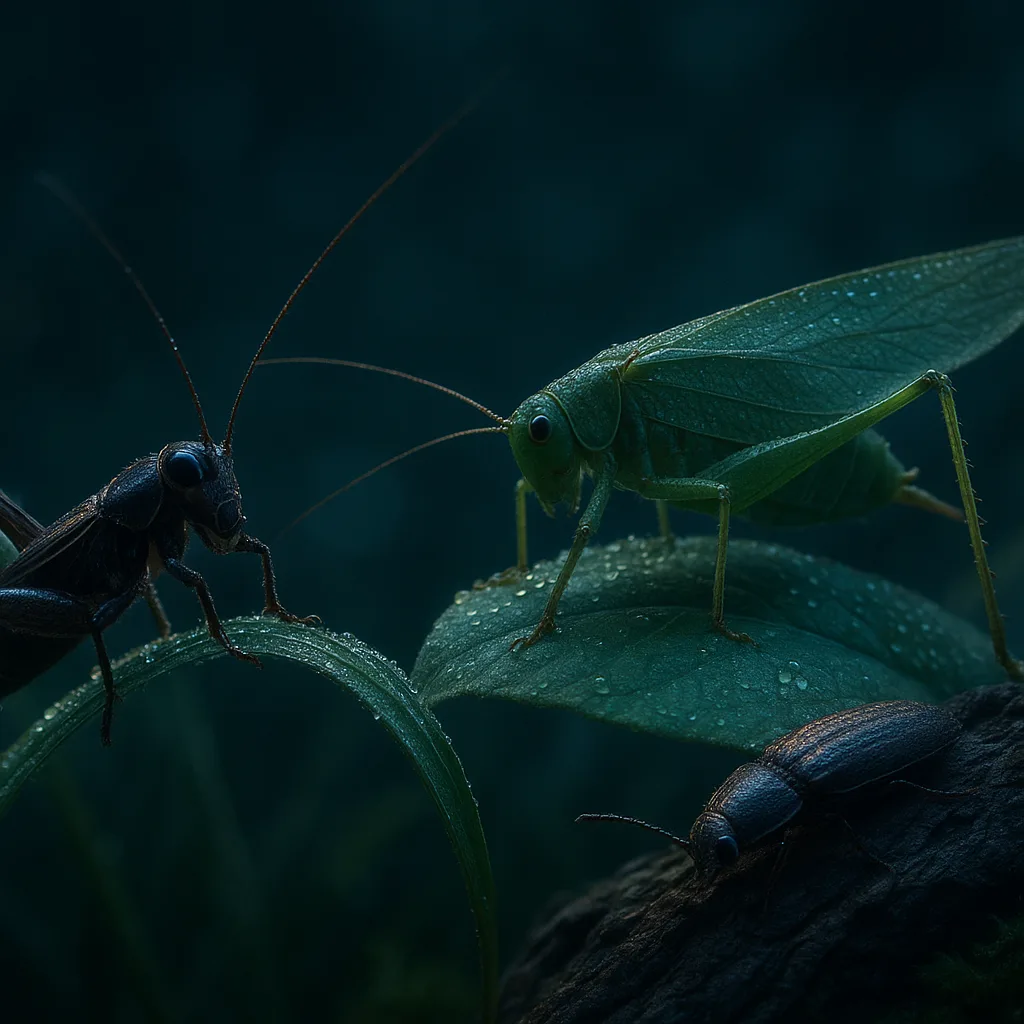
Cricket vs Katydid
- Cricket: darker, ground-dwelling or in crevices, chirp is rhythmic and tempo correlates closely with temperature.
- Katydid: bright green, leaflike wings, calls are higher pitched and can sound like repeated syllables; usually in vegetation above ground level.
Mosquito vs Midge (No-See-Um)
- Mosquito: slender body, proboscis visible, wings beat producing a lower-pitched continuous whine; bites cause itchy welts.
- Midge: even smaller (<2–4 mm), often in swarms, bites can be sharper and more irritating; wingbeat pitch higher than many mosquitoes.
Cicada Buzz vs Beetle Buzz
- Cicada: extremely loud, sustained, emanates from tree canopy; the insect is large with transparent wings.
- Beetle: buzz from flight, lower volume, often near lights, body typically hard and elytra-covered.
Prevention, Safety and When to Seek Help
Most nocturnal noise-makers are harmless or only a nuisance. When to worry and what to do:
- If you have itchy welts clustered on bedding and find small brown insects (4–7 mm) in mattress seams, suspect bed bugs—call a pest professional.
- Use mosquito control strategies in disease-prone areas: screens, repellents with DEET or picaridin, remove standing water.
- If bites produce severe allergic reactions (swelling, difficulty breathing), seek immediate medical care.
- For unknown biting or repeated nocturnal infestations, document specimens and use Orvik to get quick ID before calling an exterminator—accurate ID guides correct treatment.
Safety note: many insects are beneficial (pollinators, natural pest predators). Avoid broad-spectrum pesticide use unless you have a confirmed pest problem; target and proportionate responses reduce ecological harm.
Conclusion
The nocturnal insect chorus is mostly a mix of crickets, katydids, cicadas, beetles and small flies—each with distinct visual and acoustic signatures. If you’re asking "what are the bugs that make noise at night," use sound pattern, body shape, antenna length and habitat to narrow the suspects. For biting concerns, focus on bite patterns and signs of infestation. Photograph and record what you hear; tools like Orvik can speed and refine identification by matching your images to species records. With a few measured observations, you can tell a cricket from a click beetle, a mosquito from a midge, and decide whether the visitor is harmless or requires control.
Frequently Asked Questions
- What insect makes a clicking sound at night?
- Click beetles (Elateridae) make a mechanical click when they flip, and some crickets can produce short clicking calls. If the click is a single sharp sound followed by a flipping motion, it's likely a click beetle.
- What bug makes a high-pitched noise at night?
- Tree crickets (Oecanthinae) and many katydids produce high-pitched, musical trills at night. Their calls are usually pure tones or fast, continuous chirps coming from vegetation.
- What bug makes a buzzing sound in the summer?
- Large buzzing in summer often comes from cicadas (Cicadidae) in trees or from large beetles (e.g., June beetles) flying near lights. Cicadas produce especially loud, sustained buzzes using tymbals.
- What bug is biting me at night?
- Common nocturnal biters include mosquitoes, bed bugs, fleas and biting midges. Identify by bite pattern: scattered welts for mosquitoes, linear clusters for bed bugs, clustered lower-leg bites for fleas, and tiny painful bites for no-see-ums.
- Do crickets bite humans at night?
- Crickets rarely bite humans and are not considered a biting nuisance. Their mouthparts are suited to plant matter and small invertebrates, so human bites are uncommon and minor.
- Can any noisy nighttime insects be dangerous?
- Most noisy nocturnal insects (crickets, katydids, cicadas) are harmless. Mosquitoes are a notable risk because females can transmit diseases in certain regions. Biting insects can cause allergic reactions in sensitive people.
- How can I identify an unknown nighttime insect quickly?
- Record the sound, take clear photos (include scale), note habitat and behavior, then use an image-ID app like Orvik or consult local field guides. Orvik can match photos against species databases to provide likely IDs.
- Why do crickets chirp more on warm nights?
- Cricket chirp rate is temperature-dependent—warmer temperatures increase metabolic rates and muscle contraction speed used for stridulation. Dolbear's Law describes a correlation between chirp rate and ambient temperature.