
Boxelder bugs (Boisea trivittata) are a familiar late-summer and autumn sight across much of North America. If you've ever seen clusters of black-and-red insects sunning on a warm wall or spilling from cracks near your eaves, you probably wondered, "What do box elder bugs eat?" This deep, field-based guide explains their diet, life cycle, habitat, role in the ecosystem, how to identify them visually, and practical steps to prevent and manage infestations — including what kills boxelder bugs outside and safe, targeted controls. Use Orvik's visual ID features to confirm sightings and get tailored advice for your location.
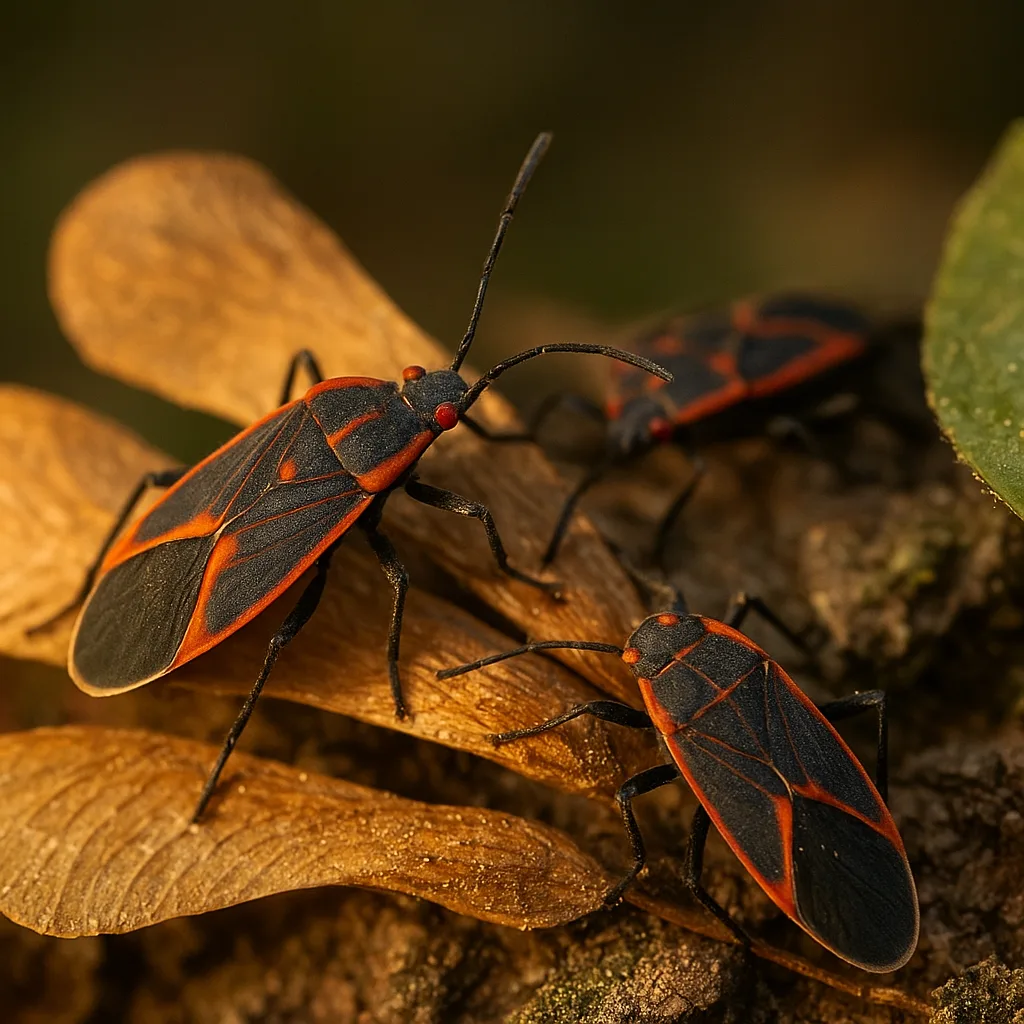
Quick overview: What is a boxelder bug?
Before we dig into diet, a clear, concise ID helps. The boxelder bug (Boisea trivittata) is a true bug in the family Rhopalidae. It is primarily phytophagous (plant‑feeding), specialized on seeds and sap of certain trees, most notably the boxelder (Acer negundo) but also other maples and ash.
- Scientific name: Boisea trivittata
- Adult size: about 9–14 mm long (0.35–0.55 in)
- Main host plants: boxelder, silver maple, other maples, some ash species
- Range: Widespread across the continental United States and southern Canada; present in varied climates where host trees grow
Identification: Visual cues and practical tips
Accurate identification answers much of the "what do box elder bugs do" question. Look for these key visual and behavioral clues.
Adults
- Color and pattern: Black bodies with distinctive red or orange veins. Adults show three red/orange longitudinal lines on the pronotum (the segment behind the head) and lighter red edging on wing membranes.
- Shape and texture: Elliptical, somewhat flattened body, 9–14 mm long. Wings fold flat over the back, creating a diamond-shaped outline.
- Legs and antennae: Long, slender legs and antennae, usually with faint red banding.
Nymphs
- Young nymphs are bright red/orange and lack fully developed wings.
- As they mature over several instars (molts), black patterning appears and wings develop.
Behavioral ID
- Sun-loving: Frequently cluster on warm, sunlit surfaces — south- or west-facing walls, rocks, or pavement.
- Crowding: Form groups numbering from dozens to thousands in fall as they seek overwintering sites.
- Motion: Slow-moving; when disturbed they may flutter or scatter but rarely fly long distances.
For quick visual confirmation, a photo taken with Orvik's app will help differentiate boxelder bugs from similar species (see the comparison section below).
Diet and feeding behavior: What do box elder bugs eat?
At the heart of the matter: boxelder bugs are primarily seed and sap feeders. Their mouthparts are piercing-sucking — they pierce plant tissue and suck out fluids, favoring reproductive tissues (seeds) and developing leaf and flower tissues.
Primary foods
- Boxelder seeds (Acer negundo): The top food source. Boxelder bugs congregate on seed clusters (samaras) and feed heavily during late spring through summer when seeds develop.
- Maple seeds and sap: Silver maple (Acer saccharinum) and other maples are important secondary hosts.
- Ash seeds and shoots: They will feed on certain Fraxinus species when available.
Occasional or opportunistic feeding
- Late-season feeding on leaves and tender shoots if seeds are scarce.
- Rarely feed on fruit — they may probe soft fruits but typically do not cause major economic damage.
- They do not eat wood; boxelder bugs are not wood-boring insects (see "what insect eats wood" section below).
Lifecycle timing ties directly to diet: adults emerge in spring, seek host trees to feed and mate, and nymphs develop through the summer on sap and seed resources. Eggs are laid on leaves, twigs, or tree bark, and hatch in roughly 10–14 days under warm conditions; the nymphal period to adult typically takes 4–6 weeks depending on temperature and food quality.
For more on this topic, see our guide on Spotting Bed Bugs: A Clear Visual Guide.
Habitat, geography, and seasonal behavior
Understanding where and when boxelder bugs feed helps answer why they appear on your house and what attracts them.
Habitat and geographic distribution
- Range: Widely distributed through the continental United States and southern Canada; common across temperate North America where boxelder and maple trees grow.
- Preferred microhabitats: Sunny, warm surfaces for basking; crevices in bark, siding, or rock for overwintering.
- Urban/suburban presence: Frequently found where ornamental boxelders or maples are planted near buildings.
Seasonal behavior
- Spring: Overwintering adults emerge and move to host trees to feed, mate, and lay eggs.
- Summer: Nymphs develop and feed heavily on seeds and sap. Peak feeding activity often occurs when seeds are maturing.
- Late summer/fall: Adults and late-instar nymphs may aggregate in warm sunlit spots and begin seeking overwintering sites near homes.
- Winter: Adults overwinter in protected cracks, attics, wall voids, or leaf litter — they become active again in spring.
This seasonal rhythm explains why homeowners report large numbers in autumn clustering on sunny walls and in spring when they start to reappear around landscapes.
Ecological role and predators: What eats box elder bugs?
Boxelder bugs are part of a broader food web. While not a preferred prey for many large predators due to their defensive pigments and sometimes foul-tasting secretions, several predators and mortality factors limit populations.
Known predators
- Birds: Some insectivorous birds (e.g., sparrows, starlings) will eat them, especially nymphs.
- Spiders: Orb weavers and generalist web-building spiders capture individuals.
- Assassin bugs and predatory hemipterans: These can take nymphal stages.
- Praying mantids and larger predatory insects: Occasional predation on both adults and nymphs.
- Parasitic wasps: Some parasitoids attack eggs or nymphs, reducing survival.
Other mortality and disease
- Fungal pathogens and entomopathogenic nematodes can kill high-density populations under humid conditions.
- Extreme weather (cold snaps, heavy rains) reduces survival of exposed nymphs.
- Human removal and chemical controls can significantly reduce local populations.
If your interest includes natural biological control, Orvik can help you document predator presence near an infestation to assess whether natural enemies are acting on the population.
Damage, safety, and toxicity: Do they harm people, structures, or plants?
Boxelder bugs cause concern because of sheer numbers and their tendency to congregate on houses. They are not, however, the same as structural pests or stinging insects.
You may also find our article on Spotting Stink Bugs: Key Identification Traits helpful.
- Plant damage: Their feeding seldom causes significant damage to healthy trees. Heavy feeding on seeds and sap can cause cosmetic leaf stippling; only in rare, severe cases does it affect tree vigor.
- Structural damage: They do not chew wood, bore into structures, or consume fabrics. They are not termites, carpenter ants, or wood-boring beetles.
- Health risks: Boxelder bugs do not transmit disease, rarely bite, and their bites are not medically significant. Some people report mild skin irritation or allergic reactions from handling them.
- Staining: When crushed, adults can leave rust-colored stains on walls, curtains, or clothing due to body pigments.
Safety note: Avoid crushing clusters on porous materials. If using pesticides, follow label directions and avoid spraying flowering plants or edible crops where pollinators are active.
Management: Prevention, control, and what kills boxelder bugs outside
When people search "what kills boxelder bugs" they want practical, safe solutions for reducing numbers around homes. The best approach is integrated: exclusion, habitat modification, and targeted removal. Here are evidence-based options.
Prevention and exclusion (first line of defense)
- Remove or limit host trees near foundations. If practical, remove boxelder saplings that produce abundant seeds within 10–20 m (30–60 ft) of buildings.
- Seal entry points: caulk cracks, weather-strip doors and windows, seal gaps around utility lines and soffits. Use 1–2 mm tolerances — boxelder bugs can fit through small openings.
- Reduce sun-exposed congregation sites: trim vegetation close to walls and reduce exposed rock or light-colored siding that heats up in sun.
- Prune seed-producing branches off host trees to reduce food resources in late spring and summer.
Non-chemical controls
- Vacuuming: Indoor or porch infestations are easily removed with a household vacuum. Empty or dispose of the bag outdoors to prevent escape.
- Manual removal: Sweep or brush clusters into a container and relocate or dispose of them. Wear gloves to avoid staining or mild irritation.
- Diatomaceous earth or silica dust: Lightly applied to perimeter cracks and crevices can desiccate insects; effectiveness is highest in dry conditions.
- Traps: Sticky traps placed on sunny walls can catch basking bugs, but traps are limited for large infestations.
Chemical and targeted treatments (what kills boxelder bugs outside)
- Synthetic pyrethroids (e.g., bifenthrin, cyfluthrin) applied to building exteriors and vegetation can reduce adult populations. These are commonly used by pest professionals for perimeter treatments.
- Insecticidal soap and horticultural oil: Useful on exposed nymphs in landscape settings; safer for use around non-flowering plants if applied correctly.
- Residual insecticides: Professional-grade residual sprays applied to siding, eaves, and cracks will knock down numbers for weeks. Follow label directions; avoid pollinator exposure.
- Boric acid has limited effect on adults but may affect nymphs when ingested; effectiveness is variable.
Practical note: Chemical treatments kill exposed bugs but rarely eliminate populations unless combined with source reduction (removing host seeds). If you hire a licensed pest control operator, ask them to target perimeter exclusion zones and to treat host trees or seed deposits if necessary.
Looking beyond this category? Check out How to Identify Any Rock in the Field.
Environmentally safer tactics
- Spot-treat rather than broadcast spraying to limit non-target impacts.
- Time treatments: late-summer nymph sprays reduce future overwintering adults; autumn perimeter treatments minimize house-entry pressures.
- Encourage natural predators by maintaining landscape diversity — birds, spiders, and predatory insects help keep populations in check.
Orvik can help prioritize actions by identifying the insect and suggesting local, season-appropriate management steps based on your location.
Related reading: Understanding the Little Things: What Bugs Are.
Comparison: Boxelder bugs vs similar insects (how to tell them apart)
Homeowners often confuse boxelder bugs with several other insects. Quick visual comparisons help you choose the right management approach.
Boxelder bugs vs. Stink bugs
- Shape: Stink bugs (Pentatomidae) are broader, shield-shaped; boxelder bugs are narrower and more elongated.
- Color: Stink bugs vary from brown to green; boxelder bugs are black with red/orange markings.
- Behavior: Both may overwinter in buildings, but stink bugs emit a characteristic odor when crushed, while boxelder bugs are less odorous but can stain.
Boxelder bugs vs. Leaf-footed bugs
- Leaf-footed bugs (Coreidae) have expanded tibiae on hind legs and can be brown or gray; boxelder bugs lack the leaf-like hind legs and have the red/black pattern.
Boxelder bugs vs. Carpet beetles or lady beetles
- Carpet beetles are tiny and rounded; lady beetles (Coccinellidae) are dome-shaped and beneficial predators. Boxelder bugs are larger (9–14 mm) with flattened backs and long legs.
Boxelder bugs vs. wood-boring insects (answering "what insect eats wood")
- Wood-boring insects (termites, carpenter ants, powederpost beetles) physically chew or bore wood and leave frass, damaged galleries, or structural weakening. Boxelder bugs do not bore or eat wood; their mouthparts are for sucking plant sap, not chewing wood fiber.
If you suspect a wood-eating insect, document damaged areas and use Orvik to capture images — the app can help you sort out true wood-destroying pests from harmless nuisance bugs like boxelders.
When to act and practical checklist
Not every sighting requires aggressive control. Use this checklist to decide whether to act and how.
- Confirm ID: Use Orvik or a field guide to ensure the insects are boxelder bugs.
- Assess numbers and location: Hundreds on house exteriors or dozens entering interiors? Large autumn aggregations near windows warrant exclusion work.
- Remove food sources: Trim seed-bearing branches within 30–60 ft (10–20 m) of the structure, when feasible.
- Implement exclusion: Seal gaps, screen vents, and weather-strip doors before autumn to stop overwintering adults from entering.
- Choose control: Vacuum or manually remove indoor bugs; use targeted perimeter treatments outdoors in late summer/fall if necessary.
- Monitor next spring: If numbers remain high, follow up with tree maintenance and targeted treatments on seed clusters.
Conclusion
So, what do box elder bugs eat? Their diet centers on seeds and sap of boxelder (Acer negundo) and related maples, with occasional feeding on ash and tender shoots. They are primarily nuisance invaders rather than destructive pests. Practical management focuses on exclusion, source reduction (removing seed sources), manual removal, and targeted treatments when necessary. For fast, accurate identification and location-based recommendations, use Orvik’s photo ID tools to confirm the insect and choose the right next steps.
Frequently Asked Questions
- What do box elder bugs eat?
- Boxelder bugs feed mainly on seeds and sap of boxelder (Acer negundo) and other maples; they pierce seeds and tender plant tissues with piercing-sucking mouthparts.
- Do box elder bugs damage trees or wood?
- They cause only minor, usually cosmetic damage to leaves and seeds; boxelder bugs do not eat or bore wood and are not structural pests.
- What kills boxelder bugs outside?
- Perimeter treatments with residual pyrethroid insecticides, targeted sprays of insecticidal soap or horticultural oil on exposed nymphs, and desiccants like diatomaceous earth can reduce outdoor populations. Combine chemical controls with exclusion and source reduction for best results.
- What attracts boxelder bugs to houses?
- Sunlit, warm walls and the presence of nearby host trees (boxelder, maples) attract them; they also seek sheltered overwintering sites in cracks, attics, and wall voids.
- What animals eat boxelder bugs?
- Birds, spiders, assassin bugs, praying mantids, and some parasitic wasps prey on boxelder bugs, especially nymphs; fungal pathogens and weather also reduce populations.
- Are boxelder bugs harmful to humans or pets?
- They are not venomous or disease vectors. They rarely bite; bites are minor. Crushing them can stain fabrics or surfaces with rust-colored pigments and may cause mild skin irritation in sensitive people.
- How can I identify a boxelder bug quickly?
- Look for a 9–14 mm black, flattened insect with red/orange veins and three distinct red lines on the pronotum; nymphs are bright red. Photo ID via apps like Orvik speeds confirmation.
- What insect eats wood?
- True wood-eating insects include termites (Isoptera), carpenter ants (Camponotus spp.), and various wood-boring beetles (e.g., powderpost beetles, cerambycids). Boxelder bugs do not eat wood.