
The genus Acer — the maples — contains more than 120 species of trees and shrubs across temperate regions of the Northern Hemisphere. If you've searched "what leaf is this" or "plant identification by leaf pictures," you likely want clear, practical signs to tell a maple from lookalikes and to identify common species in the field. This guide gives detailed visual cues (shape, size, margin, texture, color), seasonal and habitat notes, and comparison tests you can use with photos or a specimen. For quick field identifications, tools like Orvik can analyze leaf pictures and confirm your read in seconds.
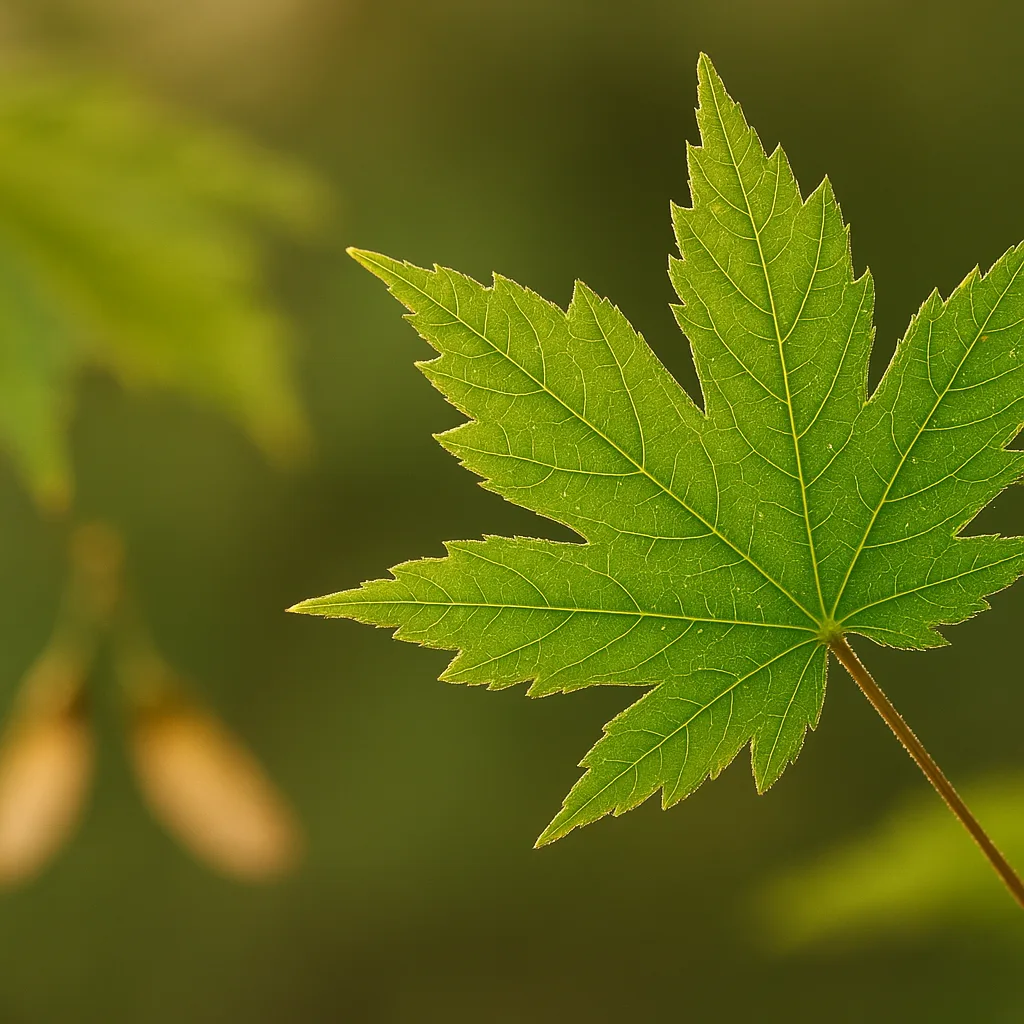
How maples (Acer) look: basic characteristics
Maples share a set of consistent features you can check quickly. Knowing these baseline traits will help you filter out unrelated plants before worrying about species-level ID.
- Leaf arrangement: Opposite on the twig — two leaves (or leaflets) arise at the same node, opposite each other. This is a primary diagnostic for Acer.
- Leaf type: Most maples have simple palmate leaves (single leaf blade with lobes radiating from a central point). Some, like boxelder (Acer negundo), are pinnately compound with 3–7 leaflets.
- Lobes: Palmate leaves commonly have 3–9 lobes. Lobes may be deep or shallow, with sinuses between them.
- Margins: Smooth to coarsely toothed or serrated, depending on species (e.g., Acer platanoides has distinct teeth).
- Fruit: Paired winged samaras — two seeds each with a wing (a key reproductive trait for Acer).
- Petiole: Often long relative to blade; breaking the petiole in some species (Acer platanoides) exudes a milky sap.
Quick field checklist
- Are the leaves opposite or alternate? (Opposite — likely a maple.)
- Are the leaves palmately lobed or pinnately compound?
- Measure leaf width and lobes — compare to species ranges below.
- Look for samaras on branches or ground.
- Note fall color and bark texture.
Key visual cues: size, shape, color, texture
Species-level ID hinges on measurable traits. Here are precise ranges and visual cues to record when identifying Acer leaves.
- Leaf size: Typical maple leaves range from 3–20 cm (1.2–8 in) across. For example, Acer palmatum leaves are small (4–8 cm), while Acer saccharinum (silver maple) leaves can reach 12–20 cm.
- Number of lobes: 3 lobes in Acer rubrum forms; 5 lobes are common in sugar maple (Acer saccharum) and Norway maple (A. platanoides); 7–9 lobes in some Asian species.
- Sinus depth and shape: Deep V-shaped sinuses (sugar maple) vs. shallow, rounded sinuses (red maple).
- Margins: Prominent teeth in Norway maple (coarse serration); smoother edging in silver maple center lobes with serrated edges.
- Surface texture: Glabrous (smooth) or pubescent (hairy) undersides — Acer negundo often has hairy undersides; A. rubrum has smooth.
- Color: Spring and summer greens vary from glossy dark green to bluish-green; many cultivars have red or purple foliage (e.g., Acer palmatum varieties), and autumn color varies dramatically by species: orange-red (sugar maple), brilliant scarlet (red maple), pale yellow (silver maple).
Measuring and photographing for ID
- Place a ruler or coin beside the leaf for scale.
- Photograph both upper and lower surfaces and the petiole base.
- Include the whole twig with opposite leaves and any fruits (samaras).
- Note habitat and GPS or region (helps narrow species by distribution).
Common North American and European species to recognize
Below are profiles of commonly encountered maples with precise ID points.
Acer saccharum — Sugar maple
- Leaf: 8–16 cm across, 5 lobes with rounded sinuses.
- Margin: Smooth or weakly toothed; lobes broad.
- Autumn: Orange to deep red; prized for syrup (sap high in sugar).
- Range: Northeastern and Midwestern North America; hardwood forests.
Acer rubrum — Red maple
- Leaf: 6–12 cm, usually 3–5 lobes with V-shaped shallow sinuses.
- Margin: Coarse teeth present; petiole red often.
- Autumn: Bright red, variable by locale.
- Range: Widespread in eastern North America, tolerant of wet soils.
Acer platanoides — Norway maple
- Leaf: 7–14 cm, 5 lobes with pointed tips and distinct teeth.
- Diagnostic: Milky sap from petiole when broken; samaras more horizontal.
- Autumn: Yellow to brown; invasive in parts of North America.
Acer saccharinum — Silver maple
- Leaf: 12–20 cm, deeply cut lobes and narrow sinuses.
- Underside: Pale, silvery fuzz on some cultivars (hence the name).
- Habitat: Riverbanks, wet soils; fast-growing, brittle wood.
Acer palmatum — Japanese maple
- Leaf: Small 4–8 cm, typically 5–9 slender lobes; many cultivated forms with deeply dissected leaves.
- Color: Many cultivars with purple or red foliage throughout the season.
- Range: Native to Japan, Korea, China; widely planted as ornamentals in temperate zones.
Comparisons: How to tell maples from lookalikes
People searching "what type of leaf is this" often confuse maples with other palmate-leaved plants. Use these comparison tests.
For more on this topic, see our guide on How to Identify Maple Leaves in the Field.
Maple vs. Horse chestnut (Acer vs. Aesculus)
- Leaf arrangement: Both appear palmate, but horse chestnut has palmately compound leaves with 5–7 separate leaflets attached to one petiole; maple has a single blade with lobes.
- Fruit: Horse chestnut produces large glossy brown seeds (conkers) in spiky capsules, not paired samaras.
Maple vs. Plane tree / sycamore (Acer vs. Platanus)
- Leaf: Platanus (sycamore) leaves are alternately arranged, thick, and coarsely toothed; maples are opposite.
- Bark: Sycamore bark exfoliates in plates revealing pale patches; many maples have furrowed or smooth bark depending on age.
Maple vs. Squash leaves (addressing "squash leaf identification" queries)
Some users confuse large, lobed squash leaves with tree leaves when found on the ground or in garden beds. Here’s how to tell them apart:
- Arrangement: Squash (Cucurbita) leaves are alternate on a vine, not opposite.
- Texture: Squash leaves are typically coarse, fuzzy, and have prominent veins radiating from the petiole; they are thicker and often heart-shaped or roughly circular with deep lobes.
- Petiole and stem: Squash petioles are hairy and often have tendrils or vine stems nearby; maples are woody with smooth or ridged petioles on twigs.
- Fruit nearby: Presence of squash fruit, flowers, or vine is a giveaway.
Special cases: purple leaves and unusual forms
If you’ve found a purple-leaf plant and typed "purple leaf plant identification," several maples and other species can match that look. Distinguish them by leaf structure and arrangement.
- Japanese maple cultivars (Acer palmatum 'Atropurpureum', 'Bloodgood'): True palmate lobed leaves, opposite arrangement, small size (4–8 cm), and consistent red/purple pigment through the season. These are common ornamental purple maples.
- Purple-leaf plum (Prunus cerasifera): Also purple leaves but alternate arrangement and simple entire margins; flowers and fruits (plums) indicate Prunus, not Acer.
- Perennials like Heuchera or Oxalis: Purple foliage but very different habit (low perennials, not woody, leaves arise from basal rosettes or trifoliate leaflets).
Identification tips for purple-leaf specimens
- Check leaf arrangement on the stem (opposite = likely maple).
- Look for samaras or flower/fruit structures.
- Measure leaf size — small lobed leaves on a small tree often indicate Japanese maple cultivars.
Habitat, range and seasonal behavior
Understanding where and when you find a leaf narrows ID considerably.
You may also find our article on How to Recognize Maple Trees in the Field helpful.
- Geographic distribution: Maples occur across temperate North America, Europe and Asia. Species richness peaks in East Asia (China, Japan, Korea) with many endemic species.
- Preferred habitats: Some species prefer upland hardwood forests (Acer saccharum), others favor riparian and wet soils (A. saccharinum), and some tolerate urban conditions (A. platanoides).
- Seasonal cues: Spring: new leaves often show distinct color (reddish in A. rubrum); Summer: mature leaf shape and texture; Autumn: fall color is an excellent diagnostic for many species — note the timing (early vs. late fall).
Altitude and microclimate
- High-elevation maples (e.g., some East Asian species) may have smaller, thicker leaves and intensely colored fall displays.
- Urban trees can retain leaves later into fall and may look different due to heat island effects.
Safety, toxicity and practical cautions
Maples are generally safe for humans — sugar maple sap is used for syrup — but there are important cautions.
- Livestock risks: Some reports link boxelder (Acer negundo) and wilted sycamore leaves to atypical myopathy in horses when consumed in large quantities under certain conditions. If livestock consume large amounts of any unfamiliar tree material, consult a veterinarian immediately.
- Allergic reactions: Handling leaves generally isn’t hazardous, but sap on skin can cause mild irritation for sensitive individuals.
- Planting cautions: Some maples (Norway maple) are invasive in parts of North America and can outcompete native species; consider natives when planting.
Using photos and apps for ID: best practices
When your search intent is "plant identification by leaf pictures" or "what leaf is this," good photos make all the difference. Orvik and similar AI-powered tools analyze leaf pictures quickly, but feeding them high-quality images increases accuracy.
Looking beyond this category? Check out Mastering Coin Identification: A Field Guide.
- Capture context: Photograph the leaf on the tree (show a twig with opposite leaves), the whole tree form if possible, bark, and any fruit (samaras).
- Include scale: Use a ruler, coin, or hand to show size.
- Photograph both surfaces: Top and underside frequently differ in color or hairiness.
- Multiple angles: Shoot the petiole base, leaf margin close-up, and the attachment point on the twig.
- Lighting and focus: Avoid backlit silhouettes; aim for even light to show surface texture and color accurately.
Orvik can process these images and suggest species-level matches; it’s a helpful second opinion to validate field observations.
Related reading: Identifying Acacia: Names, Species, and Field Tips.
When pictures aren’t enough: additional steps for certainty
Sometimes leaf photos alone don’t clinch an ID — seasonal stage, juvenile forms, and cultivars complicate matters. Use these follow-up steps.
- Collect samaras: Fruit morphology (angle between wings, length of wing) helps separate species.
- Examine buds and bark: Bud shape, arrangement, and bark patterning are useful year-round.
- Check seasonal traits: Note spring bud color, timing of leaf-out, and precise fall coloration.
- Consult local keys: Regional floras or county-level plant lists narrow candidates by range.
Conclusion
Identifying an "acer" leaf starts with the basics: opposite leaf arrangement, palmate lobing (or pinnately compound in certain species), and paired samaras. From there, measure leaf size, note lobe number and sinus depth, examine margins and undersides, and record seasonal color and habitat. When in doubt, photograph multiple features as described and use tools like Orvik to compare your images against thousands of verified specimens. With practice, you’ll rapidly narrow down "what leaf is this" to a confident species-level ID.
Happy exploring — and remember to observe responsibly: avoid damaging living trees when collecting diagnostic material and consult local authorities if you suspect invasive species.
Frequently Asked Questions
- What are the easiest features to check for acer leaf identification?
- Start with leaf arrangement (opposite vs. alternate), leaf type (palmate vs. compound), number of lobes, depth of sinuses, margin teeth, and presence of paired samaras.
- How can I tell a maple leaf from a squash leaf?
- Squash leaves are alternate, thick, and fuzzy with a vine nearby; maple leaves are opposite on woody twigs, usually smooth or lightly textured, and accompanied by samaras and a branching tree habit.
- Does leaf color (purple or red) mean it's not a maple?
- Not necessarily. Many maples — especially cultivars of Acer palmatum — have purple or red foliage. Confirm maple by opposite leaf arrangement, palmate lobing, and samaras.
- Are any maples toxic to pets or livestock?
- Maples are generally safe for humans, but some species (notably boxelder and wilted tree material) have been associated with livestock issues in certain conditions. Always consult a veterinarian if animals consume large amounts of tree material.
- What's the most reliable way to identify a maple from a photo?
- Photograph the leaf's upper and lower surfaces, a twig showing opposite leaves, the petiole base, any samaras, and include a scale. Use an AI tool like Orvik for rapid comparison to verified specimens.
- How many lobes do maple leaves have?
- Maple leaves typically have 3–9 lobes. Species like Acer rubrum commonly show 3–5 lobes; others like some Japanese maples may have 7–9 or deeply dissected forms.
- Can fall color help with species identification?
- Yes. Fall color is often diagnostic: sugar maple tends to orange-red, red maple bright red, silver maple pale yellow, and some species show early or late color changes depending on climate.