
Why use an app for weed identification?
People search for an app for weed identification because a fast, reliable ID saves time, reduces misapplication of herbicides, prevents accidental poisoning, and helps gardeners and land managers make informed decisions. Modern apps pair smartphone camera images with machine learning and botanical databases to suggest likely names within seconds. They turn uncertain field observations into actionable identification data.
- Speed: Many apps return likely matches in 1–5 seconds once the photo is uploaded.
- Accuracy improvements: Top systems achieve 85–95% accuracy on clear, high-resolution photos for common species.
- Practical decisions: Identify poisonous species (e.g., poison hemlock) or invasive species (e.g., giant hogweed) before they spread.
How weed ID apps work: AI, images, and botany
Understanding how an app works helps you know its strengths and limitations. Most weed-identification apps combine computer vision, curated plant databases, and community validation.
Key technical components
- Computer vision models: Convolutional neural networks analyze leaf shapes, flower structure, venation, and textures.
- Reference datasets: Millions of labelled photos (herbarium scans, field shots) provide the base for identification.
- Contextual data: GPS, season, and local species lists narrow possible matches.
- Human verification: Community reviews, expert confirmations, or integrated field guides refine results.
- Offline models can provide IDs without connectivity but usually at lower confidence.
- Privacy: Many apps anonymize photos and location; always review permissions.
How to use a weed ID app effectively (photo and field tips)
Even the best AI can be tripped up by a poor photo. Follow field-tested rules to maximize identification accuracy.
Photo checklist: what to capture
- Multiple angles: Take 3–5 photos—whole plant, close-up of leaf, underside of leaf, flower/seed head, stem base.
- Scale: Include a known-size object (coin ~2.4 cm, ruler, or your finger) so apps estimate leaf length and overall plant size.
- Lighting: Use diffuse daylight; avoid strong backlighting that produces silhouettes.
- Focus: Ensure edges and venation are sharp—most models rely on edge detection and texture.
- Background: Plain contrasting backgrounds help—move debris away or photograph against soil/grass rather than busy patterns.
Field notes to add
- Habitat: lawn, roadside, wetland, forest edge, agricultural field.
- Location and GPS coordinates if available; many apps use range data to exclude unlikely species.
- Season and plant stage: seedling, vegetative (leaf only), flowering, seeding.
Top features to look for in a weed identification app
When selecting a weed id app, compare features that matter for your use case—casual gardener vs. land manager vs. field botanist.
For more on this topic, see our guide on Identify Any Plant: Field Guide & Expert Tips.
Must-have features
- High-accuracy visual ID with confidence scores (e.g., 0–100%).
- Multiple-photo input so you can upload several angles per observation.
- Reference information: scientific name (Latin), common names, family, distribution maps, phenology.
- Verification options: community confirmations or expert review.
- Offline mode for fieldwork without cell coverage.
- Exportable records: CSV/KML or integration with management systems for invasive species tracking.
Free vs paid: what you get
- Free tier: basic visual IDs, limited daily queries, community answers. Great for casual users learning common weeds.
- Paid tier: batch processing, higher-resolution model access, expert verification, offline maps, and advanced export tools—useful for professionals.
- Trial periods: many apps offer 7–30 day trials so you can test model performance on your local flora.
Orvik is an AI-powered visual identification app designed to provide rapid weed and wild plant identification. It pairs computer vision with curated references and community feedback—check the app for its free vs premium features and whether its offline model suits your fieldwork.
Common weeds: field profiles and practical ID cues
Below are concise, high-value profiles of common weeds you’ll likely encounter in temperate lawns, roadsides, and fields. Each entry includes visual cues, habitat, size, seasonality, and safety notes.
You may also find our article on Identify Garden Weeds Fast with Smart Photo ID helpful.
Dandelion (Taraxacum officinale)
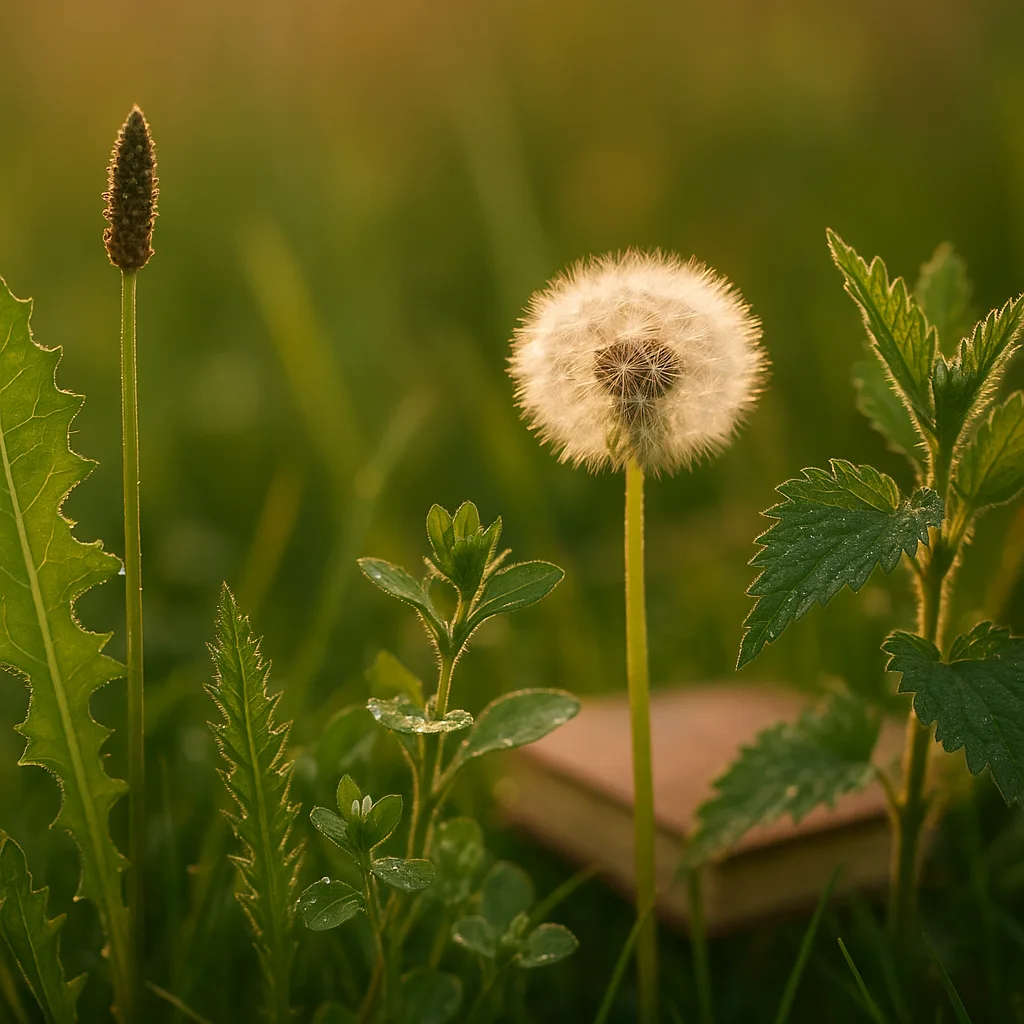
- Visual cues: Bright yellow composite flower head 2–5 cm across; basal rosette of oblong-lobed leaves 5–25 cm long; hollow, milky-sap stem (30–40 cm when in flower).
- Habitat: Lawns, disturbed soils, roadsides; tolerant of compacted soil and frequent mowing.
- Season: Flowers spring through fall; peak in April–June.
- Notes: Taproot can reach 10–30 cm; careful removal required to prevent regrowth.
Common plantain (Plantago major) vs. Broadleaf dock (Rumex obtusifolius)
These low rosette plants are often confused when young; here's how to tell them apart.
- Plantago major: Leaves 3–15 cm long, smooth or slightly ribbed, parallel venation (3–7 prominent veins running lengthwise). Seed spikes are slender, 1–10 cm tall with tiny inconspicuous flowers.
- Rumex obtusifolius (Broadleaf dock): Leaves 10–60 cm long, more elliptic to obovate with a wavy margin; pinnate venation (central midrib with branching veins). Seed clusters form large panicles with triangular brown seeds.
- Habitat differences: Plantain tolerant of heavy compaction and lawns; dock prefers moist, nutrient-rich soils, pastures, and field margins.
Poison hemlock (Conium maculatum) vs. Queen Anne’s lace (Daucus carota)
Distinguishing these umbellifers can be life-saving—poison hemlock is highly toxic.
You might also be interested in Field Guide to Visual ID with Orvik.
- Poison hemlock: Hairless, smooth stems often with purple blotches; leaves triangular and finely divided, giving a feathery appearance; smell like mouse urine when crushed. A single plant can be 1.5–3.5 m tall. All parts are toxic—contains coniine and other alkaloids.
- Queen Anne’s lace: Hairy stems without purple blotches, leaves finely dissected but typically darker green; central tiny dark flower in the umbel is common; carrot-like smell when crushed. Usually 0.5–1.2 m tall.
- Practical tip: Never taste or ingest unknown umbellifers. If ingestion occurs, seek emergency care immediately.
Giant hogweed (Heracleum mantegazzianum)
- Visual cues: Massive plants 2–5 m tall with umbrella-shaped white flower heads 50–100 cm across; coarse, deeply incised leaves up to 1.5 m wide; hollow stems with coarse purple blotches and stiff white hairs.
- Habitat: Riparian zones, roadsides, disturbed sites; spreads by seed.
- Season: Flowers late spring to mid-summer (May–July in many temperate zones).
- Safety: Sap contains furanocoumarins causing severe phytophotodermatitis—blisters and long-term scarring if skin contacts sap then sunlight. Wear full protective clothing and seek medical attention for burns.
Common ragweed (Ambrosia artemisiifolia)
- Visual cues: Erect annual 30–100 cm tall with deeply divided leaves (3–6 cm long segments), inconspicuous greenish-yellow flowers in narrow spikes; prolific pollen producer (major allergen).
- Habitat: Disturbed ground, agricultural edges, roadsides.
- Season: Pollen season typically mid-late summer through early fall.
- Allergy note: Reducing flowering plants and seed production reduces pollen loads locally.
Safety, toxicity, and legal considerations
Identifying weeds is not just academic—many plants are toxic to humans or livestock, and some species are regulated as invasive. Treat uncertain plants with caution.
Related reading: Identifying Acacia: Names, Species, and Field Tips.
Practical safety rules
- Never taste or ingest a plant identified only by an app without cross-checking with a field guide or expert.
- Wear gloves, eye protection, and long sleeves when handling unknown plants—especially giant hogweed and Euphorbia species.
- Keep pets and livestock away from identified toxic species (e.g., Conium maculatum, Aconitum napellus).
- For suspected chemical burns from plant sap (e.g., hogweed), wash with soap and water immediately and avoid sunlight; seek medical care for blistering.
Regulatory and invasive species actions
- Many regions require reporting or eradicating noxious weeds like giant hogweed or Japanese knotweed (Reynoutria japonica). Use your app to document location and provide evidence when contacting local authorities.
- Orvik and similar apps often provide distribution maps and links to local invasive-species databases to help you act responsibly.
Evaluating and comparing weed identification apps
When someone searches for a weed id app they want to know: Is it accurate? Is it free? Can I trust it for safety-sensitive decisions? Below is a framework and a practical comparison approach.
Evaluation checklist
- Model accuracy: Look for published accuracy stats or independent reviews; test with 20–50 local species to gauge real-world performance.
- Local flora coverage: An app trained heavily on European plants may underperform in Australia; check region-specific coverage.
- Verification: Community/experts, or the ability to export to a botanist.
- Usability: Batch uploads, offline use, photo annotation, and clear confidence metrics.
- Data policy: Privacy, photo ownership, and location sharing options.
Orvik vs generic weed-id apps
- Orvik focuses on AI-powered visual ID with a curated knowledge base—check the app for how it handles multiple images per observation and whether it offers expert verification.
- Generic apps may emphasize community-driven IDs (useful for rare species) but can vary in accuracy and moderation.
- For professional uses—inventorying invasive plants, creating herbicide plans—prefer apps that allow export of geotagged records and batch verification.
Free weed identification app vs paid offerings
- Free apps are excellent for casual gardeners and to learn common weeds; they typically limit uploads and lack batch export.
- Paid plans give priority processing, higher-resolution models, and integration with management systems—valuable for landscapers and conservationists.
- Always trial an app on local reference species to judge value-for-money before committing to a subscription.
Best practices for verification and follow-up
An app suggestion is the start of the identification process, not the final word—here’s how to validate and act on results.
Verification workflow
- Capture multiple photos (see earlier checklist) and submit them together.
- Check the app’s confidence score and suggested alternatives—many misidentifications are close relatives.
- Cross-reference with a regional field guide or online herbarium (e.g., USDA PLANTS, regional flora databases).
- When stakes are high (toxicity, legal removal), get expert confirmation—upload to a local extension service or university herbarium.
- Document: Keep a dated record of removals or treatments (photos, location, and method) for regulatory compliance or long-term monitoring.
Frequently Asked Questions
- Are weed identification apps accurate?
- Many modern apps achieve 85–95% top-1 accuracy for common species with clear photos, but accuracy drops for juveniles, non-flowering plants, and rare species; verify critical IDs with experts.
- Is there a free weed identification app I can use?
- Yes. Several apps offer free tiers that provide basic visual IDs and community identification; free versions can be great for casual users but often limit daily queries or advanced features.
- Can an app reliably identify poisonous plants?
- Apps can flag likely poisonous species, but you should not rely solely on an app for safety-sensitive decisions—cross-check with field guides or an expert and avoid direct contact until confirmed.
- How can I improve app identification accuracy?
- Take multiple photos (whole plant, leaves, underside, flowers/seed heads), include a scale object, use diffuse lighting, note habitat and season, and upload all images together for the app to analyze.
- What do I do if the app’s ID conflicts with a botanist’s opinion?
- Trust the botanist. Preserve your photos and specimen details, note the discrepancy, and follow expert guidance—apps provide probabilistic suggestions, not definitive diagnoses.
- Can I use weed ID apps offline in the field?
- Some apps offer offline models or downloadable species packs; offline IDs are handy without cell coverage but may have lower confidence and narrower species lists.
- How can apps help manage invasive weeds?
- Apps can document geotagged observations with photos for reporting, help prioritize removals by identifying invasives, and export records for local authorities or conservation programs.