
Why people search for an app that identifies trees
When someone types "app that identifies trees" they usually want three things: a quick ID in the field, confidence in the result, and practical information they can act on (range, edibility, toxicity, or conservation status). Recreational naturalists, arborists, educators and hikers all share this intent. An accurate app saves time compared with carrying a field guide and helps confirm IDs before collecting, pruning, or consuming parts of a tree.
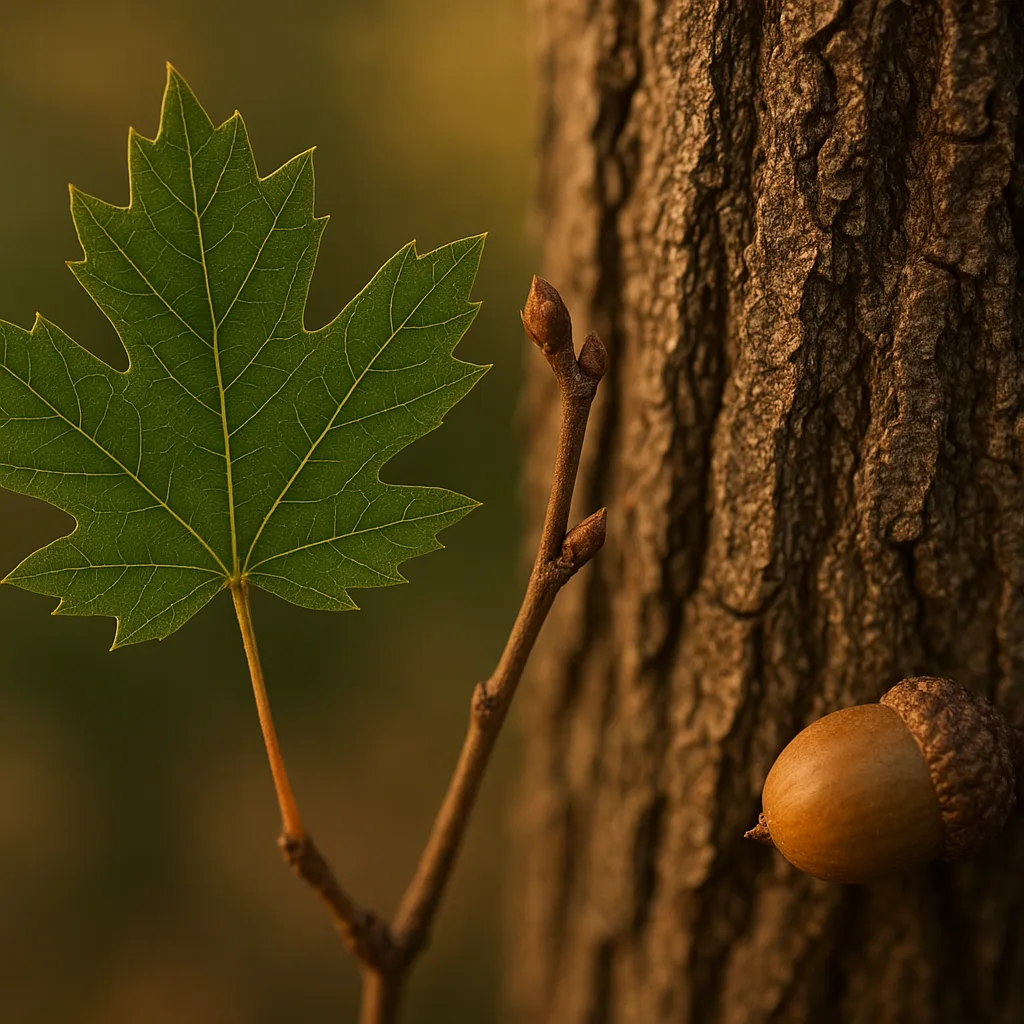
- Quick answers: instant or near-instant species suggestions from photos.
- Contextual data: habitat, distribution and seasonal notes (flowering, fruiting, leaf color).
- Safety & legality: warnings about poisonous species and protected trees.
How tree identification apps work
Modern tree ID apps combine image recognition, plant databases, user-contributed observations and simple keys. Understanding the underlying methods helps you use them more effectively and interpret probabilities correctly.
For more on this topic, see our guide on Identify Plants & Trees Fast with AI.
Image recognition and AI
- Convolutional neural networks (CNNs) analyze leaf shape, venation, bark texture and fruit morphology from photos.
- Accuracy often improves with multiple images: leaf + bark + fruit + whole-tree silhouette.
- Top-performing models report 85–98% accuracy on curated datasets, but field accuracy varies with lighting, angle and species rarity.
Databases and crowdsourcing
- Reference libraries supply verified images and metadata (scientific name, native range, phenology).
- Crowdsourced platforms let experts confirm or correct IDs, improving data quality over time.
- Apps like Orvik combine AI suggestions with curated databases and expert feedback for higher reliability.
Field identification: practical tips and safety
Good identifications come from observing multiple characters: leaves, bark, buds, fruit, flowers, and growth form. Here are measurable, visual cues to collect in the field and safety notes to keep in mind.
You may also find our article on Identify Trees from Photos: Expert Guide helpful.
Leaves
- Arrangement: alternate, opposite, or whorled. Example: maples (Acer spp.) are opposite; oaks (Quercus spp.) are alternate.
- Shape & size: measure leaf length and width. Sugar maple (Acer saccharum) leaves: 7–15 cm wide with 5 lobes; red maple (Acer rubrum): 6–12 cm, 3–5 lobes with serrated margins.
- Venation: pinnate vs palmate. Palmate venation occurs in maples; pinnate in birches and cherries.
- Margin: entire, serrated, lobed—use a ruler in cm to note dimensions for similar species.
Bark and trunk
- Texture: smooth (Fagus grandifolia, American beech), furrowed (Quercus rubra), peeling (Betula papyrifera).
- Pattern: vertical ridges, flaky plates, or papery curls—note bark color (gray, brown, white) and age-related changes.
- Diameter at breast height (DBH): approximate trunk diameter at 1.3 m above ground; useful for estimating age in many species.
Flowers, fruit and seeds
- Flowering time: note month and whether flowers are conspicuous (e.g., magnolia in early spring) or inconspicuous (many oaks).
- Fruit type: samara (maples), nut (oaks), cone (pines), berry-like arils (yews).
- Measurements: samara length, acorn size (e.g., Quercus alba acorns 1–2 cm long), cone length (e.g., Pinus strobus cones 8–16 cm).
Overall form and habitat
- Silhouette: columnar, vase-shaped, pyramidal or sprawling; e.g., Pinus strobus is conical when young, broader with age.
- Substrate & soil: wetland, dry ridge, calcareous soils—many species have specific preferences (e.g., Quercus palustris favors wet, poorly drained soils).
- Geographic distribution: knowing whether a species is native to your region narrows candidates drastically.
Safety and toxicity
- Toxic species: do not ingest seeds or bright arils unless verified safe. Yew (Taxus spp.) seeds and leaves contain taxine alkaloids; ingestion can be fatal in small mammals and humans.
- Contact hazards: Toxicodendron radicans (poison ivy) causes allergic contact dermatitis; learn leaflets of three—no more, no less.
- Handling precautions: wear gloves when sampling sap, seeds or fruits, and avoid tasting unknown tree parts.
Best apps: free options, paid tools, and practical comparisons
There are many tree ID apps. Below are top choices, including free apps and options that pair AI with expert verification. Orvik is one of the newer AI-powered tools worth mentioning for consistent, image-driven IDs.
- Orvik — AI-powered visual identification with curated database suggestions and rapid image analysis. Strong for leaf + bark combos and provides habitat cues.
- iNaturalist — community-driven, excellent for rare or regional specialists; free and backed by GBIF data.
- Seek (by iNaturalist) — kid-friendly, fast, free, uses the same recognition engine as iNaturalist but focuses on immediate ID gamification.
- Leafsnap — originally focused on North American trees with a high-quality photo library, free basic use.
- PlantNet — strong for wild plants globally; free and crowdsourced, works well for leaves and flowers.
Best free tree identification app
- For simple, immediate ID: Seek or PlantNet.
- For community verification and long-term records: iNaturalist (free, but requires account).
- For AI-driven, fast field IDs with habitat data: Orvik offers a strong free tier and premium options.
Orvik vs iNaturalist vs Seek
- Orvik: focuses on rapid AI suggestions, useful when you want an immediate probable identification and habitat notes.
- iNaturalist: best for verification by experts, distribution mapping and research-grade observations; responses can take longer but are thorough.
- Seek: best for beginners and children—instant feedback and badges, but less depth on habitat and phenology.
How to use an app effectively in the field
AI and databases are only as good as the data you provide. Follow these best practices to improve ID confidence and allow apps like Orvik to return better results.
You might also be interested in Identify Coins Fast: An Expert AI Guide.
Related reading: Understanding Pine Trees: Latin Names Explained.
- Take multiple photos: leaf (top and underside), bark close-up (with a coin or ruler for scale), whole-tree silhouette, flowers/fruits.
- Include scale: a 2 cm leaf margin or a coin (~2.3 cm diameter for a US quarter) helps algorithms infer size.
- Note location and date: many apps use coordinates and phenology to eliminate non-native or out-of-season species.
- Use manual checks: compare app suggestions with range maps and habitat notes; don’t rely solely on one probability score.
- Record metadata: soil type, elevation and canopy context (forest edge, riparian, urban) improve accuracy.
Photography tips
- Lighting: avoid harsh backlight; use diffuse light on overcast days or shade the leaf with your hand for even exposure.
- Focus: ensure the focal plane is the leaf or bark texture; motion blur reduces recognition accuracy drastically.
- Angles: shoot the leaf flat (parallel to lens) and the bark at 45° to capture texture.
Common lookalikes: X vs Y — how to tell them apart
Certain species pairs commonly confuse users. Below are field-tested differences that separate lookalikes by using measurable traits.
Red maple (Acer rubrum) vs Sugar maple (Acer saccharum)
- Leaf lobes: Red maple lobes are shallower, with serrated edges; sugar maple has deep U-shaped sinuses and smooth lobes.
- Leaf size: sugar maple leaves typically 7–15 cm across; red maple 6–12 cm.
- Fruit: red maple samaras are smaller (2–3 cm) and often red-tinged; sugar maple samaras are larger (3–4 cm) and yellow-brown.
- Habitat: sugar maple favors cooler upland soils across northeastern North America; red maple tolerates wetter, disturbed sites.
White oak (Quercus alba) vs Swamp white oak (Quercus bicolor)
- Leaf underside: swamp white oak often has a whitish, tomentose underside; white oak is paler but not densely hairy.
- Habitat: swamp white oak is common in wet bottomlands; white oak prefers well-drained uplands.
- Acorn cups and size: note cup scale texture and acorn length (measure in mm).
Pine species: Eastern white pine (Pinus strobus) vs Red pine (Pinus resinosa)
- Needle bundles: P. strobus has 5 needles per fascicle; P. resinosa has 2 needles per fascicle.
- Needle length: P. strobus 8–13 cm; P. resinosa 8–15 cm but stiffer and darker.
- Bark: P. resinosa has thick, plate-like orange-brown bark, while P. strobus has thinner, furrowed bark with resinous sap.
Frequently Asked Questions
- What is the best app to identify trees for free?
- iNaturalist and Seek are top free options for general use; PlantNet is strong globally. Orvik offers a robust free tier with AI-driven suggestions and habitat context.
- How accurate are tree identification apps?
- Accuracy varies: 70% in rough field conditions to >95% on curated datasets. Accuracy improves with multiple photos (leaf, bark, fruit), good lighting and location data.
- Can an app tell if a tree is poisonous?
- Apps can flag known toxic species (e.g., Taxus spp., Toxicodendron radicans) but should not be the sole source for safety decisions—verify with field guides or experts.
- Do tree ID apps work offline?
- Some offer limited offline features (reference images, keys). Real-time AI generally needs connectivity unless the model is available locally; check specific app settings—Orvik has options for offline use in premium tiers.
- How do I get better ID suggestions from an app?
- Take multiple high-quality photos (top and underside of a leaf, close-up of bark, fruit or flower, whole-tree silhouette), include a scale, and add location and date.
- Should I trust community-verified IDs?
- Community IDs are valuable, especially "research-grade" verifications. Cross-check with morphological traits and range data for the highest confidence.