
Eucalyptus is one of the most recognizable and ecologically important genera in the world. If you searched for the "botanical name of eucalyptus," you likely want to know the formal scientific name, how it fits into plant taxonomy, and how to tell these trees or shrubs apart in the field. This guide—designed for naturalists, gardeners, and users of visual ID tools like Orvik—explains the botanical name, key species, identification cues, distribution, seasonal behavior, and safety considerations.
1. Botanical name and taxonomy
The formal botanical (scientific) name for the genus commonly called eucalyptus is Eucalyptus L'Hér., placed in the family Myrtaceae. The genus name was published by the French botanist Charles Louis L’Héritier de Brutelle in 1789. There are roughly 700–900 species traditionally placed in Eucalyptus, though modern treatments have split several groups into related genera.
Recent taxonomic changes
- Corymbia K.D.Hill & L.A.S.Johnson — contains the bloodwoods, ghost gums and related species formerly placed in Eucalyptus (about 100 species).
- Angophora R.Br. — a small genus of trees similar to eucalypts (about 9 species).
- As a result, some species you encounter may be labelled as Corymbia citriodora or Angophora costata, even though laypeople still call them eucalypts.
When someone asks for the "eucalyptus latin name" or "eucalyptus tree scientific name," they may mean the genus name (Eucalyptus) or the species name (for example Eucalyptus globulus Labill., the Tasmanian blue gum). For correct scientific notation, write the genus capitalized and italicized followed by the species epithet: e.g., Eucalyptus camaldulensis Dehnh. (river red gum).
2. Common species and their scientific names
Below are commonly encountered species, each presented with its botanical name and a brief ID note. This answers searches for specific "eucalyptus plant scientific name" queries.
For more on this topic, see our guide on Understanding Lily Identity: Names & Science.
- Eucalyptus globulus Labill. — Tasmanian blue gum. Large tree to 70–90 m in ideal conditions; juvenile leaves glaucous and rounded; adult leaves lanceolate, bluish-green.
- Eucalyptus regnans F.Muell. — mountain ash or swamp gum. One of the world's tallest flowering plants, recorded to >90 m; smooth pale bark.
- Eucalyptus camaldulensis Dehnh. — river red gum. Widely distributed along Australian waterways; smooth white to cream bark, often with red patches.
- Eucalyptus citriodora (now Corymbia citriodora) — lemon-scented gum. Recognizable by strong lemon fragrance and smooth pale bark.
- Eucalyptus pauciflora Sieber ex Spreng. — snow gum. Found in alpine areas; twisted habit and smooth mottled bark.
3. Visual identification: leaves, bark, flowers, fruit
Practical field identification relies on consistent visual cues. Use these characteristics and measurements to identify eucalyptus species in the field or with an app like Orvik.
Leaf characteristics
- Arrangement: Adult leaves are typically alternate; juvenile leaves often opposite for many species.
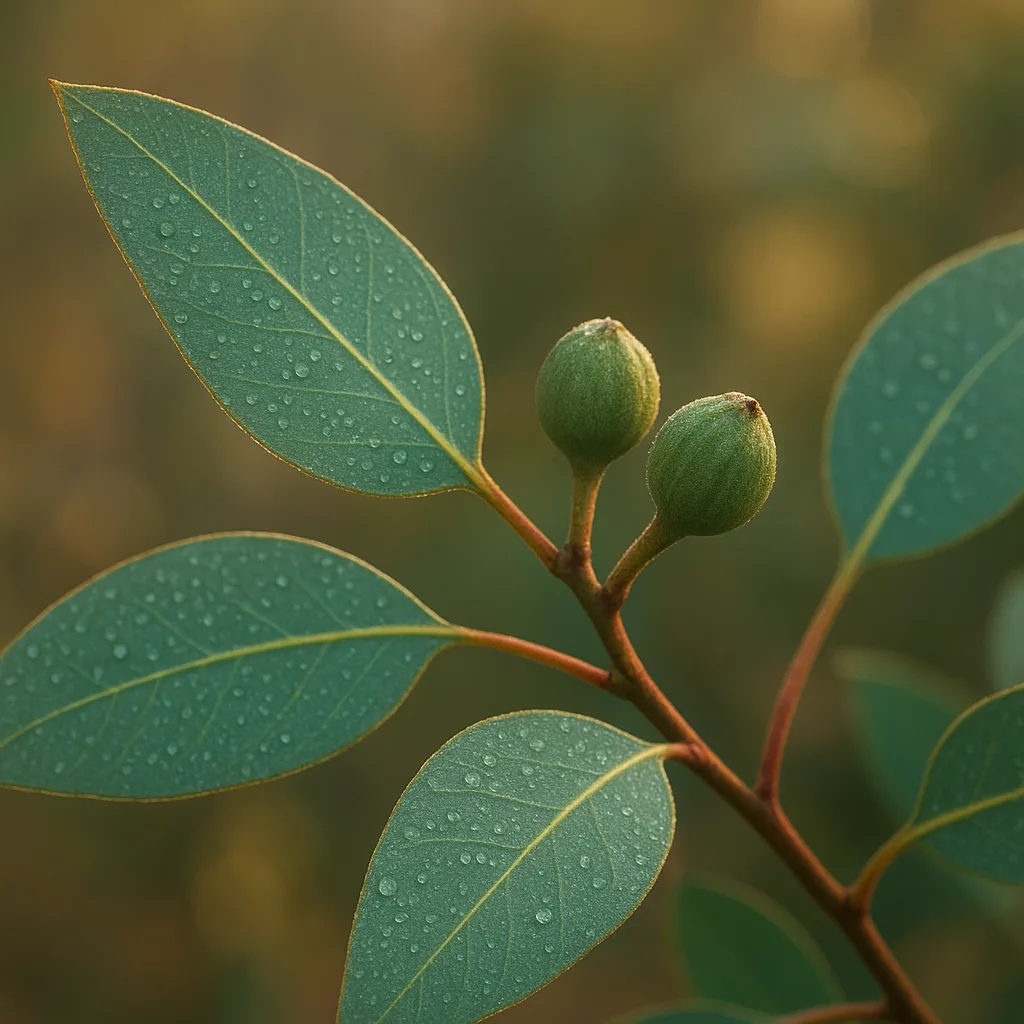
- Shape and size: Adult leaves are usually lanceolate (sword-shaped) or sickle-shaped, ranging from 6–25 cm long and 1–5 cm wide. Juvenile leaves can be ovate to orbicular and 2–12 cm across.
- Color/texture: Leaves may be glossy green, bluish-green (glaucous), or dull. Many species have a leathery texture and visible oil glands when held to light.
- Smell: Crushing leaves releases aromatic essential oils (cineole, terpenes); scent intensity varies by species.
Bark types
- Smooth bark: Sheets peel annually, revealing pale green, cream, or pink tones (e.g., E. globulus).
- Stringybark and fibrous: Rough, fibrous bark that hangs in strips (e.g., E. eugenioides).
- Ironbark: Dark, deeply furrowed, hard bark impregnated with kino (e.g., E. crebra).
- Box-type: Persistent rough bark on trunk but smooth higher up.
Flowers and fruit
- Flowers: No petals — the showy part is the mass of stamens (10–250 stamens per flower). Flower diameters commonly range from 8–40 mm.
- Bud cap (operculum): Unique cap covering the developing flower; shapes and number of opercula are diagnostic.
- Fruit: Woody capsules called "gumnuts," usually 5–25 mm across with 3–5 valves that release seeds.
Practical field tips
- Note leaf arrangement and juvenile vs adult leaves — juvenile foliage often differs dramatically and is diagnostic.
- Examine bark form at the base (rough) and higher trunk (smooth or rough) — bark persists are species-specific.
- Inspect buds and fruits — size, shape, and attachment are reliable species characters.
- Smell a crushed leaf — strong lemon, camphor, or medicinal scents can narrow candidates.
4. Habitat, geographic distribution, and seasonal behavior
Eucalyptus species are primarily native to Australia with a few species in adjacent regions. They occur in almost every Australian habitat from coastal dunes to alpine ranges. Many species have been widely planted or become naturalized worldwide.
Distribution and habitat
- Native range: Australia (mainland and Tasmania), with some species in New Guinea and Indonesia.
- Introduced range: Mediterranean climates worldwide — California, Chile, South Africa, Spain, Portugal, India, and parts of Africa and Asia.
- Habitat types: Wet sclerophyll forests, dry woodlands, riverbanks, coastal heaths, montane forests, and mallee shrublands.
Seasonal behavior and phenology
- Evergreen habit: Most species retain leaves year-round though leaf production and flowering are seasonal.
- Flowering times: Variable — some species flower in winter, others in spring or summer. Flowering often coincides with insect and bird activity.
- Regeneration after disturbance: Many eucalypts resprout from epicormic buds on trunks and branches or from lignotubers after fire; some rely on seed release after canopy scorch.
5. Ecology, uses, and safety considerations
Eucalyptus trees are ecologically significant, provide timber and essential oils, but also carry safety and environmental risks. Know both their uses and cautions when planting or handling them.
You may also find our article on Roses: Scientific Names and Field ID Guide helpful.
Ecological roles
- Habitat: Provide food and shelter for insects, birds (honeyeaters), and mammals like koalas (select species).
- Pollination: Primarily insect- and bird-pollinated due to conspicuous stamens.
- Fire ecology: Adaptations to frequent fire include lignotubers, epicormic resprouting, and thick insulating bark in some species.
Human uses
- Timber and pulp: Species such as E. regnans, E. grandis, and E. globulus are important for timber and paper.
- Essential oils: Cineole-rich oils from species like E. globulus are used in pharmaceuticals and aromatherapy.
- Ornamental planting: Many species are planted for shade and amenity value.
Safety and toxicity
- Toxicity: Eucalyptus oil is toxic if ingested in large amounts—symptoms include nausea, vomiting, ataxia, and in severe cases CNS depression. Keep oils away from children and pets.
- Livestock: Some eucalyptus leaves can be unpalatable or toxic to livestock in quantity; however, koalas have specialized diets and tolerate certain species that are toxic to other animals.
- Fire risk: High oil content and shedding bark make many eucalypts highly flammable; avoid planting high-oil species too close to structures in fire-prone zones.
- Allergy and irritation: Pollen can cause allergic reactions in sensitive individuals; handling leaves may cause dermatitis in rare cases.
6. Eucalyptus vs. cypress and thuja: How to tell them apart
Search queries such as "cypress tree scientific name" and "common name of thuja" often come up when people compare evergreen trees. Below is a clear comparison so you can distinguish eucalypts from Cupressaceae members in the field.
Key differences
- Leaves: Eucalyptus — broad, lanceolate or rounded, oil glands visible; Corymbia/Angophora similar. Cypress (Cupressus), Thuja (arborvitae) — scale-like or awl-shaped leaves arranged in flat sprays.
- Bark: Eucalyptus — variable (smooth, fibrous, stringy, ironbark). Cypress/Thuja — fibrous but generally thinner, often reddish-brown and shredding.
- Flowers and cones: Eucalyptus — showy stamens, no petals, woody gumnuts. Cypress/Thuja — inconspicuous flowers; female cones woody and usually with overlapping scales.
- Scent: Eucalyptus leaves are aromatic (cineole), Thuja has a resinous, citrusy or cedar-like scent when crushed.
Scientific names to remember
- Cypress tree scientific name: Many species are in genus Cupressus (e.g., Cupressus sempervirens L.).
- Common name of Thuja: Thuja is commonly called arborvitae or "Western red cedar" (e.g., Thuja plicata Donn ex D.Don).
7. Using tools like Orvik for field identification
Visual ID apps make identifying eucalypts faster, especially when juvenile and adult forms differ. Orvik can analyze leaf shape, bark texture, and flower or fruit photos to suggest candidate species with probability scores.
Looking beyond this category? Check out Inside the Acai Berry: Nature’s Amazonian Purple Fruit.
- Photograph multiple parts: leaves (both sides), bark, buds/flowers, and fruits for best results.
- Note location and habitat: Geographic range narrows candidate species significantly; Orvik uses geolocation to refine matches.
- Compare outputs: Use app suggestions alongside field keys—apps are best combined with observation of bark type, operculum shape, and leaf arrangement.
Orvik is useful for hobbyists and professionals alike; it expedites identification while you confirm critical diagnostic features on site.
Related reading: How Flowers Get Their Scientific Names.
8. Practical identification checklist and measuring tips
When you’re in the field, carry a small hand lens, measuring tape, and notebook. This checklist helps create a reliable record for identification or an Orvik submission.
- Record GPS coordinates and habitat (riverbank, coastal dunes, montane forest, etc.).
- Measure tree height and trunk diameter at breast height (DBH, 1.3 m). Many eucalypts range from 2–8 m (mallees/shrubs) to 30–90+ m for tall forest species.
- Collect photos: whole tree from a distance, bark close-up, juvenile leaves, adult leaves (include scale), buds and fruits.
- Note leaf arrangement (alternate vs opposite), shape, length (cm), and color (glossy green vs glaucous blue-green).
- Describe bark: smooth (color), fibrous/stringy, ironbark (dark, furrowed), or box-type.
- Smell a crushed leaf and record aroma (e.g., eucalyptus/camphor/lemongrass).
Conclusion
The concise botanical name of eucalyptus is Eucalyptus L'Hér., but correctly identifying a specimen often means going to the species level such as Eucalyptus globulus or Eucalyptus camaldulensis. Knowledge of leaf arrangement, bark type, flowers (stamens, operculum), and fruit (gumnuts) plus habitat and geographic range will usually point you to the right species. Use tools like Orvik to speed identification, but always confirm with multiple field characters. Remember the safety notes about oil toxicity and fire risk before planting or handling eucalyptus.
Frequently Asked Questions
- What is the botanical name of eucalyptus?
- The genus botanical name is Eucalyptus L'Hér. Individual species have their own scientific names, e.g., Eucalyptus globulus.
- Is the eucalyptus Latin name always Eucalyptus?
- Mostly yes, but some species have been reclassified into Corymbia and Angophora; these are closely related but not in the genus Eucalyptus.
- How can I tell eucalyptus from cypress or thuja?
- Eucalypts have broad, aromatic leaves and gumnuts; cypress (Cupressus) and thuja have scale-like leaves and woody cones. Bark and flowers also differ.
- What is a common cypress tree scientific name?
- A common cypress is Cupressus sempervirens L., the Mediterranean cypress. There are many other Cupressus species.
- Are eucalyptus leaves toxic to pets or livestock?
- Eucalyptus oil is toxic in large doses. Leaves can be unpalatable or harmful to some livestock; keep oils and concentrated extracts away from children and pets.
- Which eucalyptus species is the tallest?
- Eucalyptus regnans (mountain ash) is among the tallest, with historical trees exceeding 90 m; Eucalyptus regnans commonly reaches 60–100 m in optimal conditions.
- Can I use Orvik to identify eucalyptus species from photos?
- Yes. Orvik analyzes leaf, bark, flower, and fruit images and narrows candidate species using visual features and location data—useful alongside field measurements.