
When someone asks for the "botanical name of money plant," they are often looking for a single scientific answer. In reality, "money plant" is a common name applied to several unrelated species around the world. This guide explains the most frequent candidates, gives precise identification tips (leaf size, shape, color, texture), compares look-alikes, outlines native habitats and seasonal behavior, and warns about toxicity. If you use a visual ID tool such as Orvik, these diagnostic cues will help confirm the species in your photo.
1. Why "money plant" is ambiguous
Common names are regional and imprecise. "Money plant" can refer to climbing vines, braided indoor trees, succulents or flowering ornamentals depending on where you live. Botanists use scientific (botanical) names to remove this ambiguity.
- Common English names vary by country, language and trade (garden centres, traditional medicine, feng shui).
- At least five different plants are frequently called "money plant" or closely related names like "money tree" or "moneywort."
- Knowing the botanical name lets you find accurate care, toxicity and distribution data.
Below are the most common species people mean when they search for the botanical name of money plant, with the accepted scientific names and families.
- Epipremnum aureum (Araceae) — often called Golden Pothos, Devil's Ivy, or simply "money plant" in many English-speaking homes.
- Pachira aquatica (Malvaceae) — sold as the "money tree" with a braided trunk, popular in indoor horticulture and feng shui.
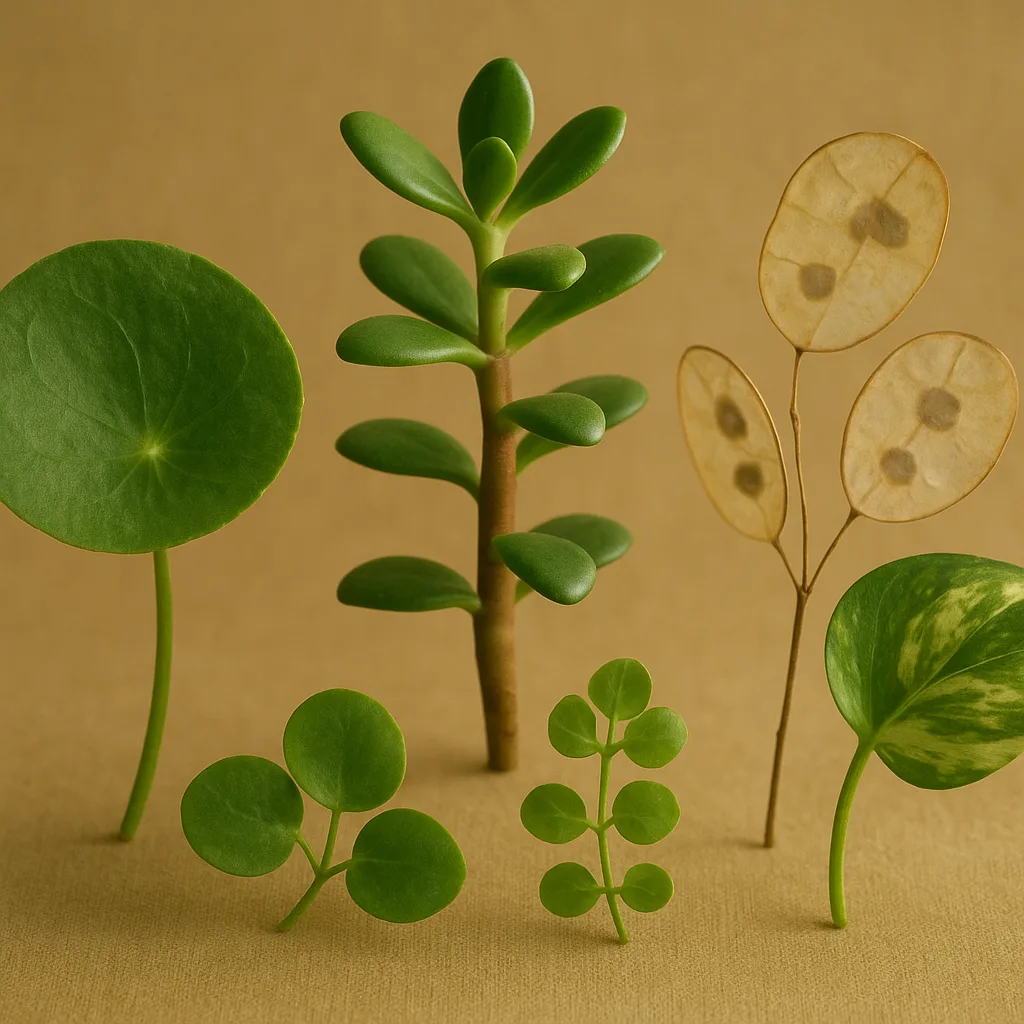
- Crassula ovata (Crassulaceae) — the jade plant, called "money plant" in South Asia and parts of Africa.
- Lunaria annua (Brassicaceae) — called "honesty" or "money plant" in the UK because of its silvery seed pods.
- Lysimachia nummularia (Primulaceae) — known as moneywort or creeping Jenny; sometimes called money plant in gardens.
2. Epipremnum aureum — the vine most people mean
In many online searches the botanical name of money plant refers to Epipremnum aureum, a tropical vine native to the Solomon Islands and widely distributed as a houseplant. It is extremely hardy, easy to propagate, and highly variable in leaf form.
Botanical profile
- Family: Araceae
- Synonyms: Scindapsus aureus (older literature)
- Growth habit: Evergreen climbing vine; climbs by aerial roots
- Typical adult length: 2–10 m indoors (longer in greenhouses), vines can reach >20 m in native habitat
- Leaf size: Juvenile leaves 5–12 cm long; mature leaves 10–30+ cm, sometimes >40 cm in large specimens
Visual identification tips
- Leaf shape: Broad heart-shaped to ovate; mature leaves often develop lobes and fenestrations (holes or splits) when climbing a support.
- Color & pattern: Variegated cultivars common — "Golden Pothos" (yellow variegation), "Marble Queen" (white/cream marbling), "Jade" (solid green).
- Texture: Glossy, leathery leaves with a smooth surface and pronounced central vein.
- Stem: Thin, flexible, with aerial roots at nodes that cling to surfaces.
- Flowers: Rare indoors; arum-type spathe and spadix typical of Araceae when they do flower.
Habitat, distribution & seasonal behavior
- Native to the Solomon Islands; now pantropical and a very common indoor plant worldwide.
- Thrives in warm, humid conditions; tolerates low light but shows best variegation in bright, indirect light.
- Growth slows in winter in temperate indoor environments but rarely becomes fully dormant.
Care highlights
- Light: Bright, indirect light; variegated forms need more light to maintain color.
- Water: Allow top 2–3 cm of potting mix to dry between waterings; avoid waterlogging.
- Temperature: Ideal 18–29°C (65–85°F); not tolerant of frost.
- Soil: Fast-draining, organic-rich mix.
Because Epipremnum is so frequently the subject of searches for the botanical name of money plant, if your plant is a trailing vine with glossy heart-shaped leaves, Epipremnum aureum is a likely identification. Use Orvik to upload a photo and confirm variegation patterns and node structure quickly.
3. Pachira aquatica — the classic "money tree"
Pachira aquatica is a tropical wetland tree native to Central and South America. In the nursery trade it's sold as a small indoor tree with a distinctive braided trunk and palmate leaves — commonly called the money tree.
For more on this topic, see our guide on Mastering Plant ID with Plantsnap.
Botanical profile
- Family: Malvaceae
- Synonyms: Occasionally placed in Bombacaceae in older sources
- Growth habit: Tree or large shrub in the wild; typically 1–2 m as a houseplant, up to 18 m in native tropical forests
- Leaf structure: Palmate compound leaves, usually 5 leaflets per leaf; leaflets 10–30 cm long
Visual identification tips
- Leaflets: Long, narrow-elliptic leaflets with a smooth margin and glossy surface.
- Arrangement: Leaves radiate from a single point, giving a star-like (palmate) appearance.
- Trunk: Nursery plants are often sold with 3–5 stems braided together into a decorative trunk.
- Flowers & fruit: Large, showy cream flowers with many stamens; woody nut-like seeds in pods in outdoor specimens.
Habitat & geographic distribution
- Native to Central America and the Amazon basin; naturally occurs in swampy habitats and river margins.
- As a houseplant it's distributed globally in tropical and temperate regions (indoors in cooler climates).
- Seasonal behavior: In the wild it experiences a wet-dry seasonal rhythm; indoor plants may flush growth in warmer months.
Care highlights
- Light: Bright light, some direct morning sun tolerated.
- Water: Regular watering; keep evenly moist but not waterlogged.
- Temperature: Best at 16–24°C (60–75°F).
- Soil: Rich, well-draining potting mix.
Pachira aquatica differs from Epipremnum in overall habit (tree vs vine), leaf structure (palmate vs simple), and trunk presence. If your plant has a braided trunk and palm-shaped leaves, its botanical name is almost certainly Pachira aquatica.
4. Regional and garden "money plants" (Jade, Honesty, Creeping Jenny)
Other plants called "money plant" regionally are quite different botanically. Below are quick identification notes and botanical names for the most common regional uses.
- Crassula ovata (Jade plant) — succulent shrub, thick opposite oval leaves 2–5 cm (household bonsai/Jade). Called money plant in India and South Africa.
- Lunaria annua (Honesty, Silver Dollar) — biennial in the mustard family; produces translucent, coin-like seed pods 3–4 cm across, which give the plant its monetary nickname in the UK.
- Lysimachia nummularia (Moneywort/Creeping Jenny) — low-growing stoloniferous groundcover with rounded leaves 1–3 cm; common in water gardens and used as a money plant in some English contexts.
Each of these plants is easy to differentiate by growth form and leaf/seedpod morphology. If you live outside North America, check regional common names before assuming a single botanical name.
5. X vs Y: How to tell them apart (practical comparison)
Here are direct diagnostic contrasts to answer the typical search intent: "What is the botanical name of my money plant and how can I tell which one it is?" Follow this short checklist.
- If your plant is a trailing/climbing vine with heart-shaped glossy leaves and aerial roots — likely Epipremnum aureum.
- If your plant is an upright small tree with a braided trunk and palmate leaves — likely Pachira aquatica.
- If your plant is a succulent with thick opposite leaves and a shrubby form — likely Crassula ovata (jade).
- If your plant produces round translucent papery seed pods in the second year — likely Lunaria annua (honesty).
- If your plant is a mat-forming groundcover with small coin-like leaves and yellow flowers — likely Lysimachia nummularia.
Quick visual cues
- Leaf type: simple vs compound vs succulent — this is the fastest clue.
- Growth habit: vine vs tree vs groundcover.
- Presence of aerial roots (Epipremnum) vs braided trunk (Pachira).
- Seedpods or flowers: Lunaria's silver pods are unmistakable.
For more precise identification, a photo of a leaf (showing both surface and underside), a close-up of the node or trunk, and a full-plant habit shot are most helpful. Uploading those images to Orvik yields high-confidence IDs and links to the botanical literature for care and toxicity information.
You may also find our article on Photo-Based Plant ID: Field-Proven Techniques helpful.
6. Practical identification checklist (useful for photos)
When trying to determine the botanical name of a money plant, capture these visual details. Use the checklist below before querying an app or search engine:
- Full-plant shot showing habit (vine, tree, succulent shrub, groundcover).
- Close-up of a single mature leaf (include a ruler or coin for scale if possible).
- Close-up of the stem/node area showing roots or braiding.
- Any flowers, seedpods or fruit—these are often diagnostic.
- Notes on texture (glossy, leathery, succulent) and leaf arrangement (alternate, opposite, compound).
Visual cues to record with measurements:
- Leaf length and width in cm (e.g., 12 x 8 cm) — helps separate species.
- Number of leaflets in a compound leaf (e.g., 5 palmate leaflets = Pachira).
- Color patterns: variegation (white, yellow), uniform green, red margins.
Orvik can analyze these images and the measurements you provide, returning likely botanical names (e.g., Epipremnum aureum, Pachira aquatica, Crassula ovata) and confidence scores. Use a combination of your observations and Orvik's visual recognition for the best result.
You might also be interested in Spotting Bed Bugs: A Clear Visual Guide.
7. Safety and toxicity
Knowing the botanical name of a money plant is essential for safety. Commonly called money plants vary in toxicity:
Related reading: Practical Guide to PictureThis Plant ID.
- Epipremnum aureum (Pothos): Toxic to pets and humans if ingested. Contains insoluble calcium oxalate crystals that cause oral irritation, drooling, vomiting, and difficulty swallowing. Seek veterinary care for pets that ingest leaves.
- Pachira aquatica: Generally considered non-toxic to humans and pets, though seeds and bark can cause stomach upset if eaten in large amounts.
- Crassula ovata (Jade): Mildly toxic to cats and dogs; ingestion can cause vomiting and lethargy.
- Lunaria annua and Lysimachia nummularia: Generally low toxicity, but ingestion can cause mild digestive upset.
Practical safety tips:
- Keep suspected toxic plants away from pets and small children; place them out of reach or in hanging baskets for vines.
- If ingestion occurs, identify the plant's botanical name (Orvik or tag data helps) and contact your local poison control or veterinarian immediately.
- Wear gloves when pruning species with calcium oxalate (pothos) to avoid skin irritation for sensitive individuals.
8. Why knowing the botanical name matters
Search intent behind "botanical name of money plant" usually falls into these categories:
- Care: People want accurate watering, light and soil recommendations—these differ widely by species.
- Safety: Knowing the botanical name lets you check toxicity for pets and children.
- Propagation: Methods vary (stem cuttings work for Epipremnum; leaf or stem cuttings for Crassula; seed or cutting for Pachira).
- Identification: A botanical name links you to authoritative horticultural and botanical resources.
Using a tool like Orvik speeds identification: upload a clear photo, get a botanical name, and access species-specific care and safety instructions. For example, a photo of a glossy heart-shaped leaf with fenestrations will generally return Epipremnum aureum with high confidence.
Conclusion
There is no single botanical name that covers all plants called "money plant." The term applies to several different species, most commonly Epipremnum aureum (a trailing vine) and Pachira aquatica (the braided "money tree"). Regional usages include Crassula ovata, Lunaria annua, and Lysimachia nummularia. To answer the real intent behind the query "botanical name of money plant," identify your plant's growth habit, leaf structure, and distinctive features, and use a visual tool like Orvik to confirm the species and access accurate care and safety guidance.
Frequently Asked Questions
- What is the most common botanical name used for "money plant"?
- The most common species called "money plant" is Epipremnum aureum (Araceae), frequently known as Golden Pothos or Devil's Ivy.
- Is the money tree and the money plant the same thing?
- Not always. "Money tree" usually refers to Pachira aquatica (a braided-trunk indoor tree), while "money plant" often means Epipremnum aureum (a trailing vine).
- How can I tell Epipremnum aureum from Pachira aquatica?
- Epipremnum is a trailing vine with simple glossy, often variegated leaves and aerial roots. Pachira is an upright plant with palmate compound leaves (5 leaflets) and is commonly sold with a braided trunk.
- Are money plants toxic to pets?
- Some are. Epipremnum aureum contains calcium oxalate crystals and is toxic to cats and dogs. Pachira aquatica is generally considered low-risk but may cause mild stomach upset if ingested.
- What identification info should I capture when asking "what is my money plant?"
- Photograph the whole plant, a mature leaf (with scale), the stem or trunk, and any flowers or seedpods. Note leaf size, arrangement, and whether aerial roots or braiding are present.
- Can a visual app like Orvik confirm the botanical name?
- Yes. Orvik and similar AI-powered visual ID tools compare your photos to reference databases and provide likely botanical names plus care and safety notes.
- Why is knowing the botanical name important?
- A botanical name gives precise information for care, propagation, and toxicity. Common names vary by region and can lead to incorrect advice.