
What is Catharanthus roseus?
Catharanthus roseus (L.) G. Don is a small, evergreen subshrub native to Madagascar and widely naturalized across tropical and subtropical regions worldwide. The most commonly used English common name is Madagascar periwinkle. Other common names include vinca (especially in horticulture), rose periwinkle, and historically Vinca rosea when placed in the Vinca genus.
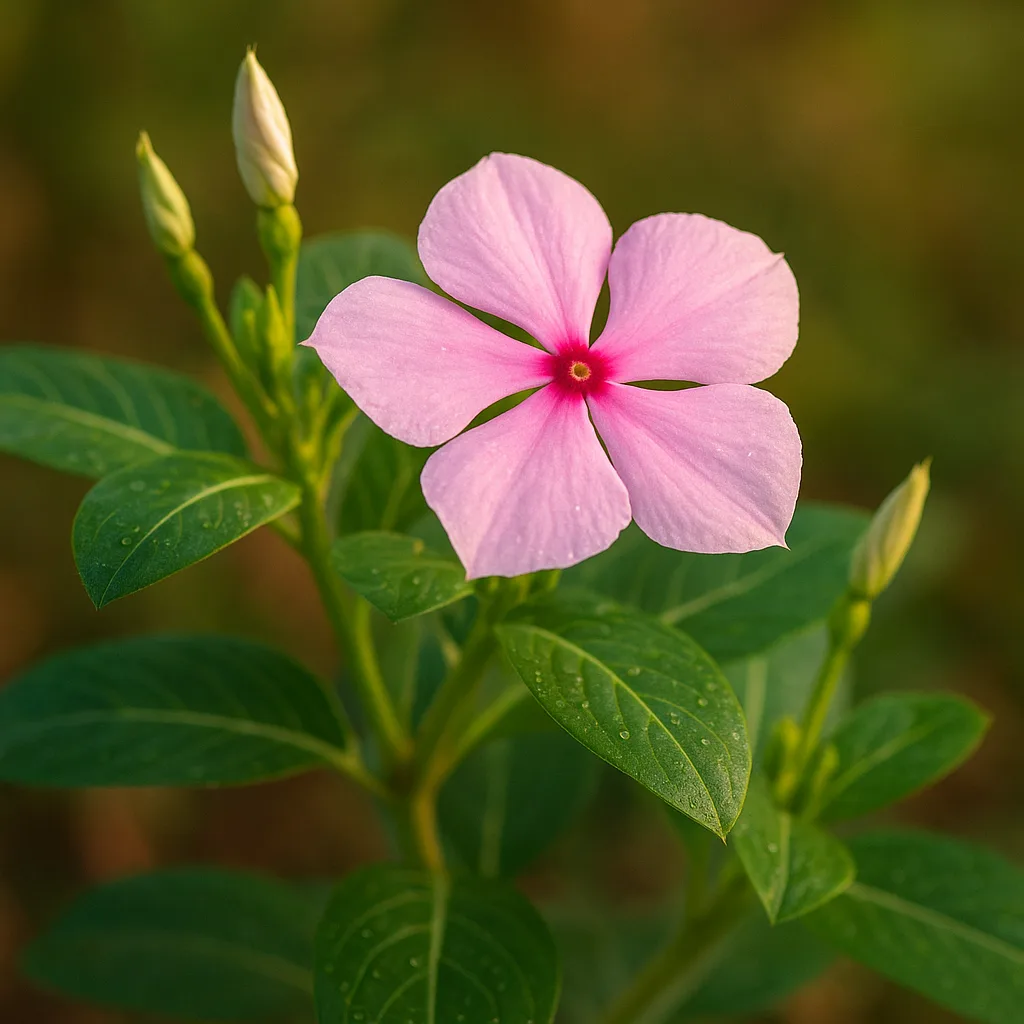
Key facts at a glance
- Family: Apocynaceae (dogbane family)
- Typical height: 15–60 cm (6–24 in) depending on cultivar and growing conditions
- Leaf size: 2.5–9 cm long, 1–3 cm wide; opposite, glossy
- Flower diameter: 2–3 cm (0.8–1.2 in) with 5 fused petals forming a flat corolla
- Native range: Madagascar; naturalized: tropical Americas, Africa, Asia, Australia, Mediterranean
- Hardiness: tropical to subtropical; generally USDA zones 9–11 for perennial planting
Identification: How to recognize Catharanthus roseus
People searching for "catharanthus roseus common name" usually want to know what the plant is called and how to identify it in a garden or in the wild. Identification relies on a combination of flower form, leaf arrangement, growth habit, and seasonal cues.
Visual ID checklist
- Growth habit: low, spreading subshrub or annual bedding plant forming mats or small clumps 15–60 cm tall
- Leaves: opposite arrangement, glossy, elliptic to obovate, smooth margins, 2.5–9 cm long; short petiole ~2–8 mm
- Flowers: single or paired in short terminal cymes; five-petaled corolla, often with a contrasting eye; colors range white, pink, rose, red, lavender, and bi-colors
- Stems: slightly succulent, green to reddish, easily breakable but not woody in young plants
- Fruit & seeds: slender paired follicles (seed pods) 2–4 cm, each containing numerous flattened seeds
Leaves
Leaves are a reliable field mark. Look for opposite pairs on the stem, glossy surface, and a prominent midrib. Younger leaves are lighter green; older leaves develop a leathery feel in dry conditions.
Flowers
Flowers are flat-faced and typically 2–3 cm across. Petals are fused at the base into a short tube and spread into a flat corolla with a distinct central eye (often darker). The contrast between petal color and eye is a useful ID feature—e.g., pale pink petals with a deep red eye.
Habitat, geographic distribution, and seasonal behavior
Catharanthus roseus is a classic tropical species that thrives in warm, sunny, well-drained sites. Its range and behavior change with climate and cultivation practices.
For more on this topic, see our guide on Identifying Jasmine: Name, Meaning, and Botany.
Habitat and soils
- Native habitat: open areas, dry forests, coastal scrub in Madagascar
- Soil: tolerant of a range from sandy to loamy soils; prefers pH 5.5–7.5 and good drainage
- Light: full sun to partial shade; flowering is best in full sun (6+ hours/day)
Geographic distribution
Although native to Madagascar, Catharanthus roseus is now naturalized across tropical and subtropical belts. You will find it in:
- Central and South America (naturalized)
- South and Southeast Asia
- Australia and Pacific islands
- Mediterranean coastal gardens where winters are mild
Seasonal behavior
- Flowering: year-round in frost-free climates; peaks spring through autumn where seasons are defined
- Dormancy: dies back or is treated as an annual where temperatures dip below 5 °C (41 °F)
- Seed production: occurs rapidly post-flowering; plants can self-seed in suitable climates
Common name confusion and comparisons
Searchers typing "catharanthus roseus common name" often want to distinguish it from look-alikes or from plants that share common names. Below are direct comparisons to several frequently searched species.
Catharanthus roseus vs Vinca (true Vinca)
- True Vinca (Vinca minor, Vinca major) are woody-stemmed perennials used as groundcovers in temperate gardens; Catharanthus is a tender subshrub from the tropics.
- Leaves: Vinca minor leaves are smaller (1–3 cm) and evergreen in cool climates; C. roseus leaves are larger (2.5–9 cm) and glossier.
- Flowers: Vinca minor flowers ~2–3 cm but usually in purple-blue; vinca petals overlap less uniformly than the flat corolla of Catharanthus.
Catharanthus roseus vs Caladium (caladium common name)
- Caladium (elephant ear) are tuberous plants with large (10–50+ cm) colorful foliage—very different from the small, opposite glossy leaves of C. roseus.
- Use: caladiums are grown primarily for leaves; Catharanthus is grown for flowers.
How Catharanthus roseus compares to other common search queries
- Podocarpus macrophyllus common name: commonly called yew plum pine or Buddhist pine. This is a tall coniferous tree (10–30 m) with long, leathery leaves—no resemblance to the low, flowering periwinkle.
- Rhododendron common name: rhododendron or azalea are woody shrubs with large, clustered blossoms and often evergreen leathery leaves. Rhododendron flowers are bell-shaped or funnel-shaped, unlike the flat 5-petaled face of Catharanthus.
- Coreopsis common name: known as tickseed, coreopsis are herbaceous plants with daisy-like yellow composite flowers; leaves are often pinnate—visually distinct from Catharanthus.
- Araucaria columnaris common name: Cook pine; a tall, narrow conifer with whorled branches—completely different habit and scale.
- Araucaria heterophylla common name: Norfolk Island pine; a symmetrical, soft-needled conifer used indoors and outdoors in subtropical climates—again contrasting strongly with low periwinkles.
- Caesalpinia pulcherrima common name: commonly called peacock flower or pride of Barbados; a shrub/small tree with compound leaves and flamboyant orange-red flowers, very different from Catharanthus’s small single flowers.
- Caladium common name: caladium (elephant ear) has large decorative leaves; not a floral look-alike to Catharanthus.
Uses, cultivation, and landscape value
Catharanthus roseus has broad value in horticulture, medicine, and erosion control. Gardeners prize it for long flowering, heat tolerance, and compact habit.
You may also find our article on Field Guide to Identifying Flowers with AI Tools helpful.
Landscape uses
- Bedding and mass plantings: creates vivid seasonal color blankets in formal beds
- Containers and hanging baskets: compact cultivars like 'Little Bright Eyes' perform well in pots
- Groundcover: spreading cultivars used where mild winters allow perennial habit
- Roadside and erosion control: tolerates dry, poor soils once established
Planting and cultural tips
- Plant spacing: 20–30 cm (8–12 in) apart for massing to achieve quick cover
- Soil: light, well-drained mix with moderate organic matter; avoid waterlogged soils
- Light: best flowering in full sun (6+ hours); tolerates partial shade but flowers less profusely
- Water: moderate—drought-tolerant once established but performs best with regular watering during prolonged heat
- Fertilizer: apply a balanced slow-release fertilizer (e.g., 10-10-10) every 6–8 weeks during growing season for continuous blooms
- Propagation: by seed (germinates in 7–14 days at 20–25 °C) or cuttings for cultivar fidelity
Toxicity, medicinal use, and safety
Catharanthus roseus is a striking example of a plant that is both toxic and medicinal. Gardeners should understand the risks and benefits.
Toxicity
- All parts of the plant contain alkaloids and are considered toxic if ingested. Symptoms may include nausea, vomiting, abdominal pain, and low blood pressure.
- Pets: toxic to dogs, cats, and livestock—prompt veterinary attention is advised if ingestion occurs.
- Skin contact: sap is mildly irritating for sensitive individuals; wear gloves when handling large quantities or cuttings.
Medicinal importance
Despite its toxicity, Catharanthus roseus is the original source of several clinically important alkaloids. The periwinkle yielded vinblastine and vincristine—chemotherapeutic agents used to treat cancers such as Hodgkin's lymphoma and acute lymphoblastic leukemia. These compounds are extracted and synthesized under strict pharmaceutical controls; do not attempt to extract or self-medicate from garden plants.
Looking beyond this category? Check out Mastering Coin Identification: A Field Guide.
Field identification tips and using Orvik to help
If you find a small, glossy-leaved plant with flat pink or white five-petaled flowers, you probably have Catharanthus roseus. For confident ID in the field, capture a few consistent diagnostic photos and use both human observation and tools like Orvik.
Related reading: Identifying Acacia: Names, Species, and Field Tips.
What to photograph
- Close-up of a single flower showing the central eye and petal shape
- Opposite leaf pair and petiole—include leaf length scale (ruler or finger) for size reference
- Overall growth habit—show the whole plant or matting form
- Fruit or seed pod if present (slender paired follicles)
How Orvik can assist
- Use Orvik to compare uploaded photos to a curated database of plant images and receive likely IDs based on visual features.
- Orvik can help differentiate Catharanthus from look-alikes (e.g., Vinca species or bedding annuals) by highlighting features like opposite leaves and flat corollas.
- Combine Orvik results with habitat notes—Orvik often links to distribution maps and seasonal observations to confirm identifications.
Comparison: Catharanthus roseus vs commonly confused species
Below are practical, side-by-side cues to tell Catharanthus roseus apart from plants people often confuse it with or search alongside.
Catharanthus roseus vs Coreopsis (tickseed)
- Flowers: Coreopsis has composite (daisy-like) flowers with a central disc; Catharanthus has a five-lobed corolla with a conspicuous eye.
- Leaves: Coreopsis often has pinnate leaves; Catharanthus has simple, opposite leaves.
- Habit: Coreopsis tends to be more erect and airy; Catharanthus is low and mounding.
Catharanthus roseus vs Caesalpinia pulcherrima (peacock flower)
- Scale: P. pulcherrima is a shrub to small tree 2–5 m tall with compound bipinnate leaves; Catharanthus is a low subshrub under 0.6 m.
- Flowers: P. pulcherrima has large, showy, multi-stamen flowers in clusters; C. roseus has solitary to few-flowered cymes.
Practical field notes and conservation
When documenting wild or naturalized populations, note the following to help researchers and apps like Orvik build accurate records.
Recording data
- Date and time of observation; flowering or fruiting stage
- GPS coordinates or a clear location description
- Photographs showing diagnostic traits (flower close-up, leaf pair, whole plant)
- Habitat notes: sun exposure, soil type, disturbance level (roadside, garden escape, coastal)
Conservation and invasive potential
- Catharanthus roseus is not typically invasive in temperate regions, but it naturalizes readily in many tropical and subtropical habitats.
- Where it escapes cultivation, monitor for displacement of native flora and report large populations to local invasive species authorities.
Conclusion
Catharanthus roseus, commonly called Madagascar periwinkle or vinca, is an unmistakable tropical bedding plant when you know what to look for: glossy opposite leaves, flat five-petaled flowers with a central eye, and a low, mat-forming habit. While beautiful in gardens, remember it contains potent alkaloids—medicinal in controlled settings but toxic if mishandled. Use careful observation and tools such as Orvik to confirm identifications in the field. With accurate photos of the flower, leaves, and overall habit, most sightings can be confirmed quickly and confidently.
Frequently Asked Questions
- What is the common name of Catharanthus roseus?
- The most widely used common name is Madagascar periwinkle. It is also commonly called vinca or rose periwinkle.
- Is Catharanthus roseus the same as Vinca?
- They are related but distinct: Catharanthus roseus was formerly placed in Vinca (as Vinca rosea) but differs in having a tender, tropical habit compared with the woody, temperate Vinca species.
- Are Catharanthus roseus flowers poisonous?
- Yes. All parts of the plant contain toxic alkaloids that can cause gastrointestinal and cardiovascular symptoms if ingested. Keep away from children and pets.
- Where is Catharanthus roseus native to?
- It is native to Madagascar but is widely naturalized across tropical and subtropical regions worldwide.
- How can I tell Catharanthus roseus from Coreopsis or Caladium?
- Catharanthus has opposite, glossy simple leaves and five-petaled flat flowers with a central eye. Coreopsis has daisy-like composite flowers and often pinnate leaves, while Caladium has very large colorful heart-shaped leaves and is grown for foliage.
- Can Orvik identify Catharanthus roseus from a photo?
- Yes. Upload clear photos showing a flower close-up, leaf pair, and overall habit to Orvik. The app compares visual features and provides likely identifications and additional context.
- What are the medicinal uses of Catharanthus roseus?
- Pharmaceutical derivatives vinblastine and vincristine, extracted from Catharanthus, are important chemotherapy drugs. However, extraction must be performed under stringent laboratory conditions—do not attempt home extraction.