
What people mean by “daisy names” (search intent)
When someone searches for "daisy names" they may be looking for several related things: the common and scientific names of plants called "daisy," the meaning and cultural history of the personal name Daisy, baby-name combinations such as middle names for Daisy, or even distinguishing similar yellow-flowered plants like the dandelion. This article addresses them all with botanical precision, naming conventions, cultural meaning, and practical ID tips you can use in the field or with an app such as Orvik.
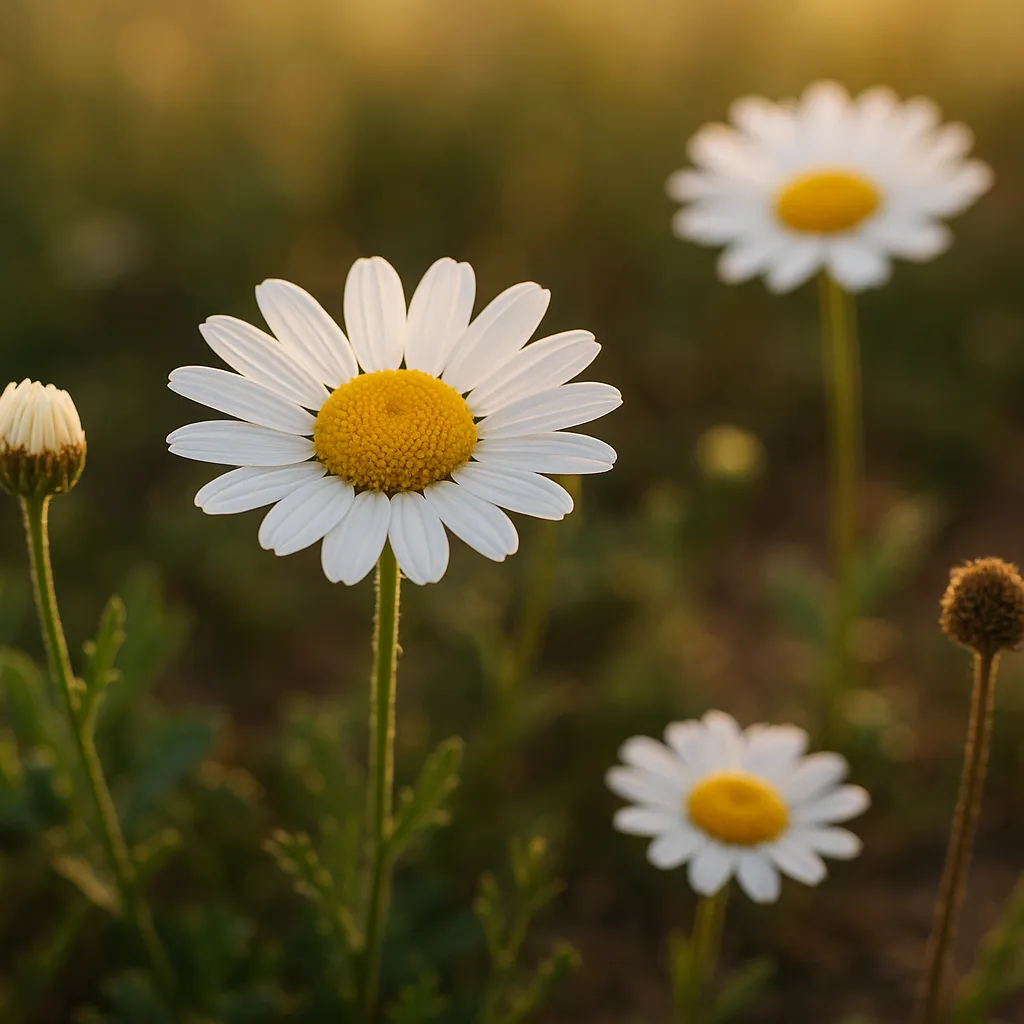
Common daisy species and their names
The plant family Asteraceae (sometimes called Compositae) contains thousands of species we call daisies. Below are the most commonly encountered plants referred to as daisies, with scientific names, key measurements, and identifying traits.
List of common daisy species
- Bellis perennis — English or common daisy. Small rosette perennial; flower heads 1–2.5 cm (0.4–1 in) across; white ray florets with yellow disc. Low-growing in lawns and meadows in temperate Europe and introduced worldwide.
- Leucanthemum vulgare — Oxeye daisy. Larger perennial; heads 2–5 cm (0.8–2 in) typically; white rays, yellow center. Tall stems 20–60 cm (8–24 in); common in meadows and roadsides across Europe and North America.
- Leucanthemum × superbum — Shasta daisy. Hybrid cultivar used in gardens; heads up to 7–10 cm (3–4 in); strong upright habit 40–90 cm (16–36 in).
- Gerbera jamesonii — Gerbera (African daisy). Large showy flowers 7–12 cm (3–5 in); broad petals often pink, red, orange, yellow or white; widely cultivated as cut flowers.
- Coreopsis lanceolata — Tickseed (often called a yellow daisy). Bright yellow rays, 3–7 cm (1–3 in); typically 30–60 cm (12–24 in) tall; common in prairies and dry meadows.
- Rudbeckia hirta — Black-eyed Susan. Yellow rays, dark brown cone-shaped center; heads 5–10 cm (2–4 in); 30–90 cm (12–36 in) tall; native to North America.
- Glebionis coronaria — Crown daisy (edible in parts of Asia); rays variable cream to yellow; used as a salad green in Mediterranean cuisine.
- Chrysanthemum spp. — Some chrysanthemums are called daisies (e.g., Chrysanthemum leucanthemum used historically), cultivated for ornamentals and tea flowers.
Identification quick facts
- Flower head type: daisies have a composite head made of central disc florets (tubular) and outer ray florets (ligulate petals).
- Ray count and symmetry: Bellis perennis often has many short rays; oxeye and Shasta have longer rays and distinct single-layered petals.
- Leaf arrangement: basal rosette (Bellis) vs alternate or opposite leaves on stems (Leucanthemum, Rudbeckia).
The meaning of the name "Daisy" and biblical notes
The given name Daisy is English in origin and derives from the Old English "dægeseage," literally "day's eye," referring to the way the flower opens with daylight and closes at night. As a personal name it evokes innocence, purity, cheerfulness and simplicity.
Symbolism and cultural meaning
- Innocence and purity: Often used in Victorian floriography to signal simplicity and a child's innocence.
- Loyal love and new beginnings: The cheerful, open face of the daisy suggests fresh starts, making it a popular motif in wedding bouquets and baby names.
- Folk meanings: In some cultures daisies were used in love divinations (e.g., "He loves me, he loves me not" uses petals).
Daisy name meaning in the Bible
There is no explicit, named reference to the modern "daisy" (Bellis perennis or other Asteraceae) in the canonical Bible texts. Biblical floral imagery centers more on lilies, roses (translated from hebrew words like chavatzelet), and blossoms of the field in general. Later Christian and medieval devotional literature attached the idea of humility and purity to simple wildflowers; thus the daisy is often given Christian symbolic meanings post-biblically rather than appearing as a named plant in scripture.
For more on this topic, see our guide on Field Guide to Flower Names.
Choosing a baby name: middle names and names like Daisy
If you like Daisy as a first name, you may be searching for middle-name pairings or similar-sounding names. Below are stylistic categories with suggestions and rationale.
Classic & vintage pairings
- Daisy Rose — two floral names, balanced and melodic.
- Daisy Margaret — "Margaret" links historically to daisies via French marguerite (another name for the oxeye daisy).
- Daisy Eleanor — a timeless combo that lengthens Daisy's crisp sound.
Short & modern pairings
- Daisy June — fresh, summery, and rhythmically pleasing.
- Daisy Mae — vintage Americana feel; "Mae" echoes a floral season.
- Daisy Quinn — modern and gender-neutral contrast.
Names like Daisy (variants and relatives)
- Maisie — Scottish diminutive of Margaret, often used as a variant of Daisy.
- Marguerite — French form that literally means "daisy" in some contexts and links to the oxeye daisy.
- Poppy, Lily, Rose, Violet — other floral names in the same stylistic family.
- Bellis — botanical genus for the common daisy; unusual but botanical-sounding alternative.
Yellow daisy flower meaning and dandelion names
Not all daisies are white: many species and look-alikes display bright yellow rays. Understanding the differences is useful for both symbolic meaning and plant ID.
Yellow daisy flower meaning
- Joy and energy: Yellow daisies typically symbolize cheerfulness, optimism and friendship.
- Sun-related symbolism: Because their centers resemble a tiny sun, yellow daisies are often read as solar symbols.
What about dandelions (Taraxacum officinale)?
Dandelion is in the Asteraceae family and often mistaken for a yellow daisy at first glance, but it differs in important ways.
You may also find our article on Understanding Lily Identity: Names & Science helpful.
Dandelion vs daisy — quick comparison
- Flower structure: A dandelion head (Taraxacum officinale) is composed entirely of ray florets — it looks like a single yellow pom-pom. Daisies have a distinct yellow disc made of tubular florets surrounded by rays.
- Leaves: Dandelion leaves are deeply lobed, forming a basal rosette. Many yellow daisies (Rudbeckia, Coreopsis) have lance-shaped or toothed leaves along the stem.
- Seed head: Dandelion produces the iconic spherical seedhead (pappus) for wind dispersal. Most daisies form achenes that are not pappus-puffed to the same extent.
- Height: Dandelions are short (5–30 cm / 2–12 in). Rudbeckia and Gerbera are taller, often 30–100 cm (12–40 in).
Identification tips: how to tell similar daisies apart
Field identification relies on consistent visual cues. Below are practical steps and measurements to distinguish common species and look-alikes.
Practical visual cues
- Measure the flower head diameter: Bellis perennis (1–2.5 cm) vs Leucanthemum (2–7+ cm) vs Gerbera (7–12 cm).
- Inspect the center disc: Is it raised and cone-shaped (Rudbeckia) or flat and button-like (Oxeye)?
- Count or note ray florets: Are the rays long and few, or short and crowded? Some cultivars have double rows (Shasta variants).
- Check leaves: Basal rosette with short stalks suggests English daisy; alternate leaves up the stem suggest oxeye or Rudbeckia.
- Stem texture: Hairy (Rudbeckia often hairy) vs smooth (Gerbera often smooth).
Using Orvik and other tools
- Take multiple photos: top of flower, side view of the head, close-up of leaves, whole-plant habit, and habitat context.
- Use Orvik to upload images for rapid AI-supported suggestions. Orvik cross-references visual traits with species known in your region to narrow the list to likely candidates.
- Confirm with a flora or field guide: local floras will list species distribution (e.g., Leucanthemum vulgare abundant in temperate meadows across northern latitudes).
Habitat, geographic distribution, and seasonal behavior
Daisies occupy a wide range of habitats globally. Below are generalized patterns for common types.
Habitat summaries
- Bellis perennis: Lawns, turf, short-grazed grasslands; tolerant of trampling and mild soil compaction.
- Leucanthemum & Shasta: Meadows, field margins, garden beds — prefer full sun and well-drained soils.
- Coreopsis & Rudbeckia: Prairies and open woodlands; many species tolerate drought and poor soils.
Geographic distribution & seasonal timing
- Europe: Bellis perennis and Leucanthemum species are native; flowering typically spring through mid-summer (April–July).
- North America: Rudbeckia, Coreopsis and introduced Leucanthemum are widespread; many bloom mid-summer to early fall (June–September).
- Subtropical/Tropical: Gerbera and certain Chrysanthemum species are cultivated; flowering times depend on cultivar and photoperiod control.
Safety, edibility and cautions
While many “daisy” relatives are harmless and some edible, there are cautions to keep in mind.
You might also be interested in Dolphin Diets: What They Eat and Why.
Edible species and uses
- Dandelion (Taraxacum officinale): Leaves and roots edible; leaves high in vitamins A and K. Young leaves are less bitter.
- Crown daisy (Glebionis coronaria): Eaten as a leafy vegetable in Mediterranean and East Asian cuisines.
- Chrysanthemum morifolium: Flowers used for chrysanthemum tea in East Asia; not all chrysanthemum species are used this way.
Toxicity and allergic reactions
- Many members of Asteraceae contain sesquiterpene lactones which can cause contact dermatitis in sensitive people; gardeners may develop a rash after handling certain daisies.
- Some chrysanthemum species and decorative cultivars can cause vomiting or diarrhea in dogs and cats if ingested; keep veterinary care in mind.
- Pollen from Asteraceae can be allergenic to hay fever sufferers; take care if you have seasonal allergies.
Comparison sections: How to tell them apart
Below are targeted comparisons people commonly need when identifying daisies or choosing names.
Related reading: Understanding Pine Trees: Latin Names Explained.
Oxeye daisy (Leucanthemum vulgare) vs English daisy (Bellis perennis)
- Size: Oxeye 2–5+ cm heads; English daisy 1–2.5 cm.
- Stem: Oxeye arises on upright, unbranched stems 20–60 cm high; English daisy forms close-to-ground rosettes with short stalked heads.
- Leaf type: Oxeye has more lanceolate or toothed leaves along stem; English daisy leaves are small, spoon-shaped in a basal rosette.
Gerbera vs Rudbeckia vs Coreopsis (garden identification)
- Gerbera: Large, bold, often single or double-layered rays; smooth, fleshy stems; cultivated as cut flowers.
- Rudbeckia: Pronounced dark central cone, often rough-hairy stems and leaves.
- Coreopsis: Typically finer, more delicate petals and foliage; many species have deeply cut leaves.
Conclusion
Daisy names can mean plant species, personal names, or symbolic meanings. Botanically, "daisy" spans genera in Asteraceae — Bellis, Leucanthemum, Gerbera, Rudbeckia, Coreopsis and more — each with measurable differences in flower diameter, leaf shape, stem habit and seasonality. As a given name, Daisy carries Victorian connotations of innocence and "day's eye" origins and pairs well with middle names like Rose, June, Margaret or modern options like Quinn.
For field identification, take clear photos of the whole plant, leaves, and flower head, note size with a ruler or coin for scale, and use tools like Orvik to get quick AI-supported candidate IDs that you can corroborate with a regional flora. Keep in mind safety: some Asteraceae members can cause allergic reactions or mild toxicity in pets. Whether you are naming a child, cataloging a garden, or simply curious, the world of daisies offers rich botanical and cultural stories to explore.
Frequently Asked Questions
- What is the scientific name for the common daisy?
- The small lawn daisy is Bellis perennis; the larger oxeye daisy is Leucanthemum vulgare.
- Does "Daisy" have a biblical meaning?
- The name Daisy does not appear in the canonical Bible. Its symbolic connections to purity and innocence come from later Christian and folk traditions, not direct biblical reference.
- Are yellow daisies the same as dandelions?
- No. Dandelions (Taraxacum officinale) are composed entirely of ray florets and form a puffball seedhead; yellow daisies like Rudbeckia or Coreopsis have a central disc and different leaf and stem morphology.
- Can I eat daisies?
- Some Asteraceae, such as dandelion greens and certain chrysanthemum varieties, are edible, but many can cause allergic reactions or mild toxicity in pets. Always identify species precisely before consuming.
- What are good middle names for Daisy?
- Classic pairings: Daisy Rose, Daisy Margaret, Daisy Eleanor. Short/modern options: Daisy June, Daisy Mae, Daisy Quinn.
- How can I identify a daisy in the field?
- Measure the flower head, photograph top and side views plus leaves, note growth habit and habitat, and use a visual ID tool like Orvik to get AI-assisted species suggestions you can verify with a flora.
- Why is the daisy called "day's eye"?
- From Old English "dægeseage," meaning "day's eye," because many daisies open with daylight and close at night, resembling an eye responding to the sun.