
Scientific name, taxonomy, and what 'name' really means
The plant commonly called the dandelion is most often referred to in scientific literature as Taraxacum officinale. That name places the familiar yellow-flowered weed in the genus Taraxacum, family Asteraceae, order Asterales. However, 'dandelion' is a common name applied to an aggregate complex of very similar species and microspecies, so the term Taraxacum officinale agg. is often used by botanists to reflect that variation.
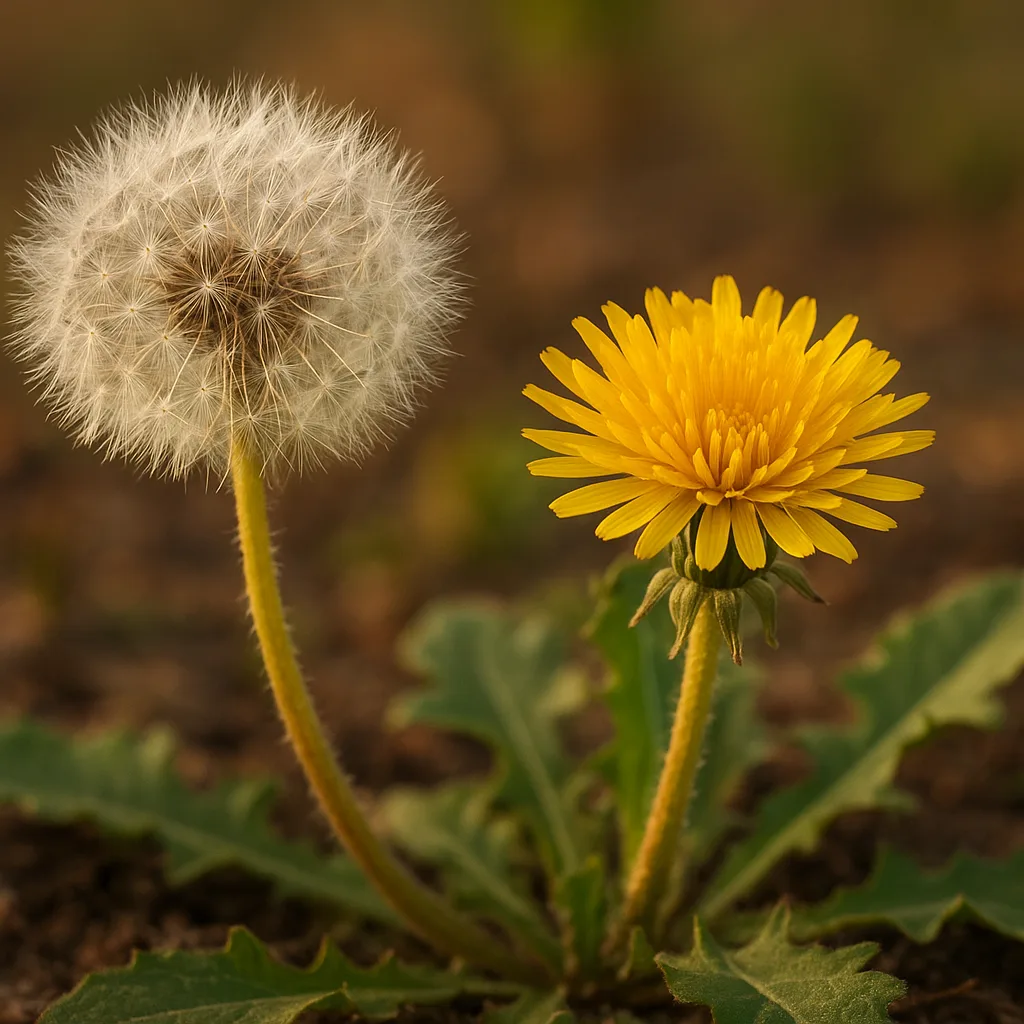
- Kingdom: Plantae
- Order: Asterales
- Family: Asteraceae (the daisy family)
- Genus: Taraxacum
- Species: Taraxacum officinale Weber ex F.H. Wigg. (most commonly cited)
Notes on nomenclature: the citation Weber ex F.H. Wigg. reflects formal botanical authorship. In practice, many field guides and apps simply use Taraxacum officinale. Botanists also recognize dozens to hundreds of named Taraxacum species worldwide, particularly in northern Europe, where apomictic reproduction produces stable microspecies.
How to identify a dandelion in the field
Key visual cues
- Flower: a single composite flower head 2–5 cm across made of numerous bright yellow ray florets; opens in daylight and often closes in cloudy weather.
- Scape (flower stalk): hollow, leafless, unbranched, typically 10–30 cm tall but sometimes up to 60 cm; exudes milky latex when broken.
- Leaves: basal rosette of toothed leaves 5–25 cm long, pinnatifid to deeply lobed with teeth pointing toward the leaf tip; leaves are hairless to sparsely hairy depending on variety.
- Seedhead: spherical white puffball 3–6 cm diameter with numerous parachute-like achenes each bearing a pappus of white hairs.
- Root: a deep, fleshy taproot often 10–50 cm long, brownish exterior, white interior; roots store carbohydrates and allow resprouting if cut.
Measurements and textures to watch for
- Flower head diameter: usually 20–50 mm (2–5 cm).
- Leaf length: typically 50–250 mm (5–25 cm), sometimes larger in fertile soils.
- Scape height: commonly 100–300 mm (10–30 cm). Hollow, smooth texture.
- Pappus size: each pappus 6–9 mm long, arranged to form a near-perfect sphere in mature seedheads.
Phenology: seasonal behavior
- Flowering: spring and early summer peak in temperate regions, with additional flushes in autumn in some climates.
- Seed dispersal: wind-dispersed seedheads form within 1–3 weeks after flowering; seeds can travel tens to hundreds of meters in wind.
- Perennial habit: plants persist via taproot and can flower year after year.
Habitat and geographic distribution
Dandelions are native to Eurasia but now occur worldwide as introduced plants. They thrive in disturbed ground and habitats created or maintained by humans, but they also occupy wild meadows and open woodlands.
- Typical habitats: lawns, roadsides, agricultural margins, lawns, pastures, meadows, and disturbed urban soils.
- Soil: adaptable to a wide range of soils from compacted clay to loamy garden soil; tolerate pH 5.5–8.0 but prefer neutral to slightly acidic soils.
- Climate range: temperate to subarctic and many subtropical areas; they can overwinter as rosettes in zones 3–9 depending on microclimate.
Because of human-mediated dispersal and exceptional ecological plasticity, Taraxacum officinale is among the most widely distributed flowering plants on Earth.
Similar species and how to tell them apart
People searching 'dandelion scientific name' often want to be sure they have the common dandelion and not a lookalike. Below are comparisons and practical ID tips.
For more on this topic, see our guide on Photo-Based Plant ID: Field-Proven Techniques.
Dandelion (Taraxacum officinale) vs Catsear (Hypochaeris radicata)
- Flower: both have yellow composite flowers, but catsear often has several branched flower stems with multiple heads; dandelion typically produces a solitary flower head per scape.
- Leaves: catsear leaves often hairy and lobes point backward or are more shallowly lobed; dandelion leaves generally smooth and lobes point toward the tip.
- Milk sap: dandelion yields a milky latex; catsear has little or none.
Dandelion vs Hawksbeard (Crepis spp.) and Sowthistle (Sonchus spp.)
- Hawksbeard: similar small yellow heads but stems are often branched and leaves can be airborne (cauline), not only basal.
- Sowthistle: typically taller, spiny or prickly stems/leaf margins, and many-flowered branching stems.
Dandelion vs Grass (family Poaceae)
Grasses are monocots with parallel-veined leaves and jointed hollow stems (culms). People searching 'grass scientific name' or 'bermuda grass scientific name' may confuse a lawn of grasses with the presence of broad-leaved dandelions.
- Leaves: grass leaves are long and narrow, 1–30 mm wide, with parallel veins; dandelion leaves are broad, with lobed margins and a central midrib.
- Flowers: grasses have spikelets and inflorescences like panicles or spikes; dandelion has a single composite head of ray florets.
Dandelion vs Moss (Bryophyta)
Mosses are nonvascular plants that form low carpets and have tiny, stalked spore capsules; they lack true flowers. If you searched 'moss scientific name' you were likely looking for very different organisms. Visually, moss is soft, green, and mat-forming; dandelion is a conspicuous flowering herb.
- Moss: tiny leaves, <5 mm, forming mats or cushions; no roots like higher plants.
- Dandelion: large, visible leaves and bright yellow flowers above the foliage.
Common scientific names gardeners and lawn-care searchers ask about
Search intent for 'dandelion scientific name' often overlaps with other common garden plant queries. Here are concise scientific names for common searches and how they relate to dandelion identification.
You may also find our article on Identify Plants Fast: Expert Guide to Free Apps helpful.
- Grass (general family): Poaceae. Example species: Lolium perenne (perennial ryegrass).
- Moss (general division): Bryophyta; common peat moss genus: Sphagnum spp.
- Asparagus fern (houseplant): Asparagus setaceus (syn. Asparagus plumosus) — not a true fern.
- Asparagus (edible): Asparagus officinalis.
- Azalea (ornamentals): members of Rhododendron sect. Tsutsusi and Pentanthera; commonly cited genus: Rhododendron.
- Barnyard grass: Echinochloa crus-galli — a troublesome weed grass in crops.
- Bermuda grass: Cynodon dactylon — a warm-season turf grass common in lawns.
Including these names helps place the dandelion in a wider horticultural and ecological context. For example, knowing that Bermuda grass is Cynodon dactylon clarifies that its fine-textured blades are nothing like broad-leaved Taraxacum rosettes.
Uses, edibility, and safety
Dandelions have a long history of culinary and medicinal use, but field identification and safety precautions are important.
- Edible parts: young leaves (salads or cooked), flower buds (fried or pickled), roots (roasted as a coffee substitute)
- Nutritional content: leaves are rich in vitamins A, C, and K and contain minerals like potassium; root contains inulin, a prebiotic polysaccharide.
- Traditional uses: diuretic and digestive tonic in folk medicine; modern evidence is limited and context-specific.
Safety and toxicity warnings
- Pesticide contamination: do not harvest dandelions from lawns treated with herbicides, fungicides, or pesticides unless you are certain of safety and waiting periods.
- Allergies: some people sensitive to plantes in Asteraceae may develop contact dermatitis; dandelion latex can irritate skin.
- Medical interactions: if you take prescription medications (especially diuretics, lithium, or blood thinners) consult a clinician before consuming dandelion preparations.
Using Orvik and other tools to confirm identifications
When someone types 'dandelion scientific name' into a search engine, they often want a quick, confident ID. Photographic tools like Orvik can speed that process and reduce uncertainty—especially when combined with field observations.
Looking beyond this category? Check out Dolphin Diets: What They Eat and Why.
- Take clear photos: capture the basal rosette, a close-up of the flower head, the hollow scape, and the underside of a leaf. Orvik performs best with multiple angles and a scale reference like a coin or ruler.
- Record habitat: note whether the plant is in compacted lawn, roadside soil, or meadow—Orvik uses context to increase accuracy.
- Use multiple data points: combine the app's suggested ID with the visual cues listed earlier to confirm Taraxacum officinale or a lookalike.
Orvik is useful for quick field confirmation and for building a photographic record. Use the app's suggested species name as a starting point, then verify key characters such as the hollow scape and pappus structure.
Related reading: Field Guide to Flower Names.
Management, control, and conservation considerations
Whether you consider dandelions a beneficial wild food or a lawn pest, understanding control and conservation helps you choose appropriate action.
- Nonchemical control: hand-pulling or deep digging to remove the taproot; repeated mowing reduces seed set but may not eradicate established plants.
- Chemical control: broadleaf herbicides (2,4-D, dicamba mixes) are commonly used on lawns; follow label directions and consider timing to minimize non-target impacts.
- Ecological value: dandelion flowers are an early nectar source for bees and other pollinators in spring; removal reduces forage options in early season.
Integrated approaches that combine cultural practices (healthy dense turf to outcompete broadleaves), mechanical removal, and spot treatment produce the best long-term results in managed landscapes.
Conclusion
When people search 'dandelion scientific name' they want reliable taxonomy plus practical ID help. Taraxacum officinale is the most commonly cited name, but the dandelion complex contains many microspecies. Use the visual cues above — yellow composite head, hollow scape, toothed basal rosette, milky latex, and spherical seedhead — to confirm identification. Tools like Orvik can accelerate identification by comparing your photos to reference records, but always cross-check with morphological features and habitat notes before harvesting or managing plants.
Frequently Asked Questions
- What is the exact dandelion scientific name?
- Taraxacum officinale is the most commonly used scientific name; botanists may use Taraxacum officinale agg. to reflect closely related microspecies.
- How can I tell a dandelion from a lookalike?
- Look for a single hollow, leafless scape, milky latex when broken, a basal rosette of toothed leaves, and a spherical white seedhead.
- Is it safe to eat dandelions from my lawn?
- Only if you are certain the area has not been treated with pesticides or herbicides; wash thoroughly and avoid plants near roads or treated turf.
- Can a plant ID app identify dandelions accurately?
- Yes. Apps like Orvik can provide accurate IDs with clear photos of the rosette, flower head, and seedhead, but always verify with morphological traits.
- What are the scientific names for common grasses and mosses?
- Grasses belong to Poaceae (e.g., Cynodon dactylon for Bermuda grass); mosses are in Bryophyta with genera like Sphagnum for peat moss.
- What is the asparagus fern scientific name?
- Asparagus fern commonly refers to Asparagus setaceus (synonym Asparagus plumosus); it is unrelated to true ferns and to dandelions.
- How do dandelions behave seasonally?
- They typically flower in spring with additional flushes in summer or autumn; seedheads form within 1–3 weeks after flowering and disperse by wind.