
When someone types "how to identify a douglas fir" they want fast, reliable field clues they can use while standing beneath a tall tree or scrolling photos on their phone. This guide — written like a field botanist walking you through the forest — shows the precise visual cues, measurements, seasonal changes and lookalike comparisons you need. It also explains habitat and safety considerations, and how tools like Orvik can speed up identification in the field.
What to look for at a glance
If you only have seconds to decide whether a tree is a Douglas-fir (Pseudotsuga menziesii), check these quick traits. They form the core ID checklist that answers the search intent directly.
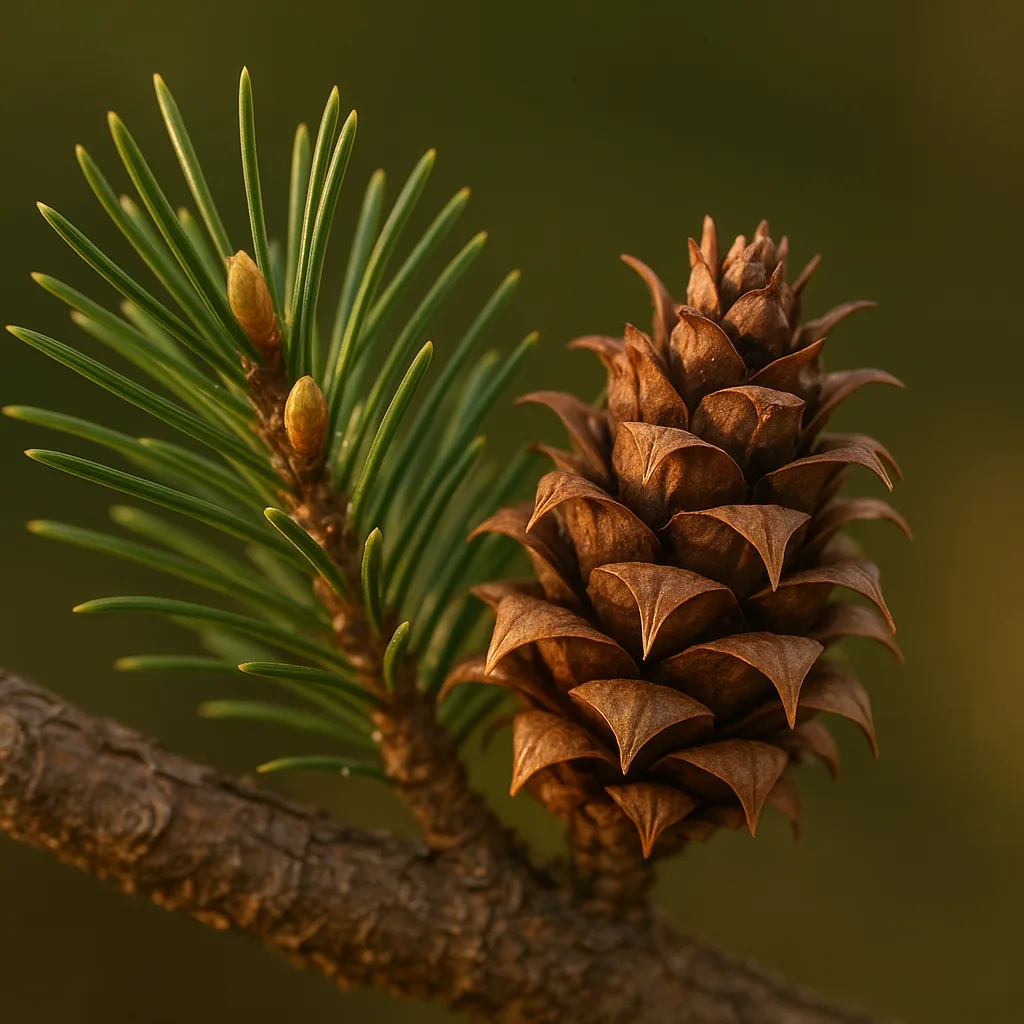
- Needles: Single, flattened needles 2–3.5 cm (0.8–1.4 in) long, spirally arranged but appearing in all directions.
- Cones: Pendulous (hanging) cones 6–10 cm long with three‑pointed bracts that stick out like mouse tails and feet.
- Bark: Young trees have smooth, resinous bark; mature trees have thick, deeply furrowed, puzzle‑like plates.
- Form: Conical crown on young trees, massive straight trunk with a narrow crown on older trees; can reach 40–70+ m in coastal stands.
- Habitat: Native to western North America—coastal and montane forests from Alaska to California (and inland Rockies).
Needles, shoots and foliage
Needle details
Needles are among the most reliable Douglas‑fir characters.
- Length: Typically 2–3.5 cm (0.8–1.4 in); rarely shorter on very young shoots or longer on vigorous growth.
- Shape & arrangement: Flat (not four‑sided), attached singly to twig pegs. Needles appear to radiate in all directions from the twig rather than lying in flattened sprays.
- Tip: Blunt to slightly pointed, not sharply spine‑tipped like many spruces.
- Color: Medium to deep green on coastal varieties; interior (Rocky Mountain) Douglas‑fir (P. menziesii var. glauca) often has a bluish, glaucous tinge.
- Scent: Crush a needle between fingers — Douglas‑fir gives a citrusy, resinous smell (not the strong turpentine of some pines).
Twigs and persistence
- Needles are attached to small peg‑like projections on the twig (pulvini) and fall individually; foliage persists for about 5–10 years depending on site.
- Twigs are smooth and may be slightly resinous; buds are small and conical.
Cones and reproductive features
Douglas‑fir cones are often the clinching trait because of their unique bracts.
- Size: Cones 6–10 cm (2.5–4 in) long, egg‑shaped to oblong.
- Position: Pendulous—hang down from branches rather than standing upright.
- Bracts: Each scale has a 3‑lobed, pointed bract that protrudes beyond the cone scales, creating a mouse‑tail‑and‑feet appearance. This is diagnostic for Pseudotsuga.
- Maturity: Cones form in spring–summer and mature by fall; seeds are winged and dispersed mainly in late summer to autumn.
Seedlings and cones in the field
- Seedlings have a spray of juvenile needles and a recognizable conical shape by year 3–5.
- Look for old cone remnants on the ground beneath trees in autumn; intact cones often remain on the lower branches until they disintegrate.
Bark, form and size
Bark characteristics
Bark appearance changes dramatically with age.
For more on this topic, see our guide on Master Tree Identification: A Field Guide.
- Young trees: Smooth, thin, reddish‑brown bark with resin blisters; may look similar to young firs and spruces.
- Mature trees: Thick, deeply furrowed bark with large interlacing plates; color ranges from dark brown to gray; furrows can be several centimeters deep on veteran trees.
- Fire resistance: Coastal Douglas‑fir develops thicker bark with age, an adaptation to low‑severity fire regimes.
Tree form and size
- Height: Coastal varieties can reach 60–100 m in old growth (200–330 ft); typical mature trees in managed stands are 30–60 m. Interior varieties are smaller, commonly 20–50 m.
- Trunk: Straight, often buttressed at the base in mature forest trees; diameter can exceed 2–4 m in ancient specimens.
- Crown: Broad conical crown on young individuals; becomes more open and drooping near the top on very old trees.
Habitat, range and seasonal behavior
Geographic distribution
- Range: Native to western North America — from southeastern Alaska and coastal British Columbia, through Washington and Oregon, to central California. Interior (Rocky Mountain) populations extend into Idaho, Montana and parts of British Columbia.
- Varieties: Pseudotsuga menziesii var. menziesii (coastal) and Pseudotsuga menziesii var. glauca (interior/rocky mountain) differ in tolerance and appearance (coastal taller and greener; interior bluer and more drought/hardy).
Habitat and elevation
- Preferred sites: Moist, well‑drained soils; coastal Douglas‑fir thrives in foggy, maritime climates and lower elevations, while interior types occupy drier montane slopes up to 2,400 m (8,000 ft) in elevation.
- Associates: Often found with western hemlock (Tsuga heterophylla), Sitka spruce (Picea sitchensis), redwood or ponderosa pine depending on latitude and elevation.
Seasonal notes
- Evergreen year‑round; needle color can deepen in winter on interior varieties.
- Cones develop over spring and summer and usually drop seeds in autumn; flowering/ pollination occurs in spring.
- Needles remain on branches for multiple years — counts of needle age can help gauge tree vigor and site quality.
How to tell Douglas‑fir from lookalikes
Many people confuse Douglas‑fir with true firs, spruces, pines, or even broadleaf trees like sassafras. Below are direct comparisons to settle common questions:
Douglas‑fir vs balsam fir (Abies balsamea)
- Cones: Douglas‑fir cones hang and have protruding bracts. Balsam fir cones are erect (sit upright on branches) and disintegrate on the tree; you won't find intact balsam cones on the forest floor.
- Needles: Balsam fir needles are shorter (1–3 cm), usually have two distinctive white stomatal bands beneath, and are arranged more consistently in flattened sprays; Douglas‑fir needles are more radial and lack the same paired white bands.
- Bark: Balsam fir bark stays relatively smoother even in older trees, with resin blisters common on young stems.
Douglas‑fir vs true firs (Abies spp.)
- Cones: True fir cones are upright and disintegrate on the tree. Douglas‑fir cones hang and fall whole.
- Needles: True fir needles are often arranged in flat sprays and have distinct stomatal bands; Douglas‑fir needles radiate around the twig.
Douglas‑fir vs spruce (Picea spp.)
- Needles: Spruce needles are four‑sided (can be rolled between fingers) and attached to the twig on woody pegs; Douglas‑fir needles are flat.
- Cones: Spruce cones hang but lack the distinctive three‑lobed bracts of Douglas‑fir.
Douglas‑fir vs pine (Pinus spp.)
- Pines have needles in bundles (fascicles) of 2–5; Douglas‑fir needles are single.
- Cones and bark differ: pine cones and bark texture are distinctive once you examine them closely.
Douglas‑fir vs sassafras (Sassafras albidum) — a broadleaf lookalike
Occasionally people confuse a young broadleaf tree with an evergreen when they only have a silhouette or a blurry picture. Sassafras is a deciduous broadleaf found in eastern North America; it is not a conifer.
- Leaves: Sassafras leaves are single, alternate and notably variable in shape — entire (ovate), mitten‑shaped or three‑lobed. Douglas‑fir has needles, not broad leaves.
- Bark & habit: Sassafras bark is furrowed with an orange inner bark and a distinctive aromatic smell when cut; it loses leaves in fall whereas Douglas‑fir stays green year‑round.
Field ID checklist, safety and using Orvik
Step‑by‑step field examination
- Observe overall form and habitat — Is the tree in a coastal, moist stand or an interior mountain slope?
- Inspect needles — Are they flat, individually attached and 2–3.5 cm long?
- Look for cones — Are there hanging cones with three‑pointed bracts?
- Examine bark — Is it thick and deeply furrowed on older trees?
- Smell a crushed needle for citrusy/resinous scent.
- Use a reference app like Orvik to compare photos from multiple angles and confirm key features; Orvik can quickly point to diagnostic traits when your field notes are incomplete.
Safety and toxicity notes
- Resin: Douglas‑fir resin can cause skin irritation or contact dermatitis in sensitive people. Avoid prolonged skin contact with sap and wash exposed areas promptly.
- Pets and wildlife: Needles and small amounts of cones are not highly toxic but can cause gastrointestinal upset if ingested in quantity by dogs or livestock.
- Tree hazards: Large Douglas‑fir can drop heavy branches or entire tops in storms; maintain safe distances during high winds and stay out from under large dead limbs.
Tools that help
- Hand lens (10x) to inspect needle stomatal bands and twig attachments.
- Tape measure or ruler to gauge needle and cone lengths.
- Camera or phone: take photos of needles, cones, bark and whole tree silhouette for later verification in Orvik or with field guides.
FAQ
- Q: How can I tell a young Douglas‑fir from other saplings?
A: Look for flattened, individually attached needles and the start of a conical crown. Young Douglas‑fir often has smooth reddish bark with resin blisters; check needle length and scent for confirmation.
You may also find our article on Field Guide to Flower Names helpful.
- Q: When do Douglas‑fir cones appear?
A: Cones form in spring and summer and typically mature by late summer to autumn; they hang from branches and often persist into fall.
- Q: Are Douglas‑fir and balsam fir the same?
A: No. They belong to different genera. Douglas‑fir has hanging cones with protruding bracts; balsam fir has upright cones that disintegrate on the tree and needles with distinct stomatal bands.
Looking beyond this category? Check out How to Identify Any Rock in the Field.
- Q: Does Douglas‑fir grow outside western North America?
A: While native to western North America, Douglas‑fir has been planted worldwide (Europe, New Zealand, Chile) and can naturalize in suitable climates.
Related reading: Identify Any Plant: Field Guide & Expert Tips.
- Q: Can I use Douglas‑fir needles to identify the tree in winter?
A: Yes. Douglas‑fir is evergreen and needles remain on the tree year‑round. Needle shape, attachment and scent are reliable winter features.
- Q: Are Douglas‑fir cones safe to handle?
A: Yes, intact cones are safe to handle but may be sticky with resin. Wear gloves if you’ll be collecting many cones or working with resinous bark.
Conclusion
Identifying a Douglas‑fir becomes straightforward when you combine a few key traits: flattened, singly attached needles, pendulous cones with three‑lobed bracts, and the change from smooth young bark to the thick, furrowed bark of maturity. Habitat and tree form add context, and quick comparisons (especially with balsam fir, spruces and pines) eliminate common confusions. Tools like Orvik are helpful when you need rapid confirmation from photos in the field. With the checklist above, a measuring tape, and a keen eye, you can answer "how to identify a douglas fir" confidently on your next walk in the woods.
Frequently Asked Questions
- What are the most reliable features to identify a Douglas‑fir?
- Look for flat, singly attached needles (2–3.5 cm), hanging cones with three‑pointed bracts, and mature bark that is thick and deeply furrowed.
- How do Douglas‑fir cones differ from balsam fir cones?
- Douglas‑fir cones hang and have visible three‑lobed bracts; balsam fir cones are upright and disintegrate on the tree, leaving no intact cones beneath.
- Where does Douglas‑fir naturally grow?
- Native to western North America—from southeastern Alaska and coastal British Columbia through Washington and Oregon to central California; an interior variety occurs in the Rocky Mountains.
- Can I confuse Douglas‑fir with spruce or pine?
- Less likely if you inspect needles: spruces have four‑sided needles that roll between fingers; pines have needles in bundles. Douglas‑fir needles are flat and singly attached.
- Is Douglas‑fir resin harmful?
- Resin can irritate skin and cause contact dermatitis in sensitive individuals; ingesting large amounts of needles or cones may upset pets.
- What months do Douglas‑fir trees produce seeds?
- Cones develop in spring and summer, and seeds are typically released in late summer to autumn when cones mature.