
Walnut trees (genus Juglans) are unmistakable once you know the key features: pinnate leaves, round nuts inside a green husk, and deeply furrowed bark on mature trunks. This guide — written for naturalists, landowners, and anyone using tools like Orvik for visual ID — walks through the reliable visual cues, measurements, seasonal changes, habitat, safety notes, and how to tell walnuts apart from similar trees such as elms and willows.
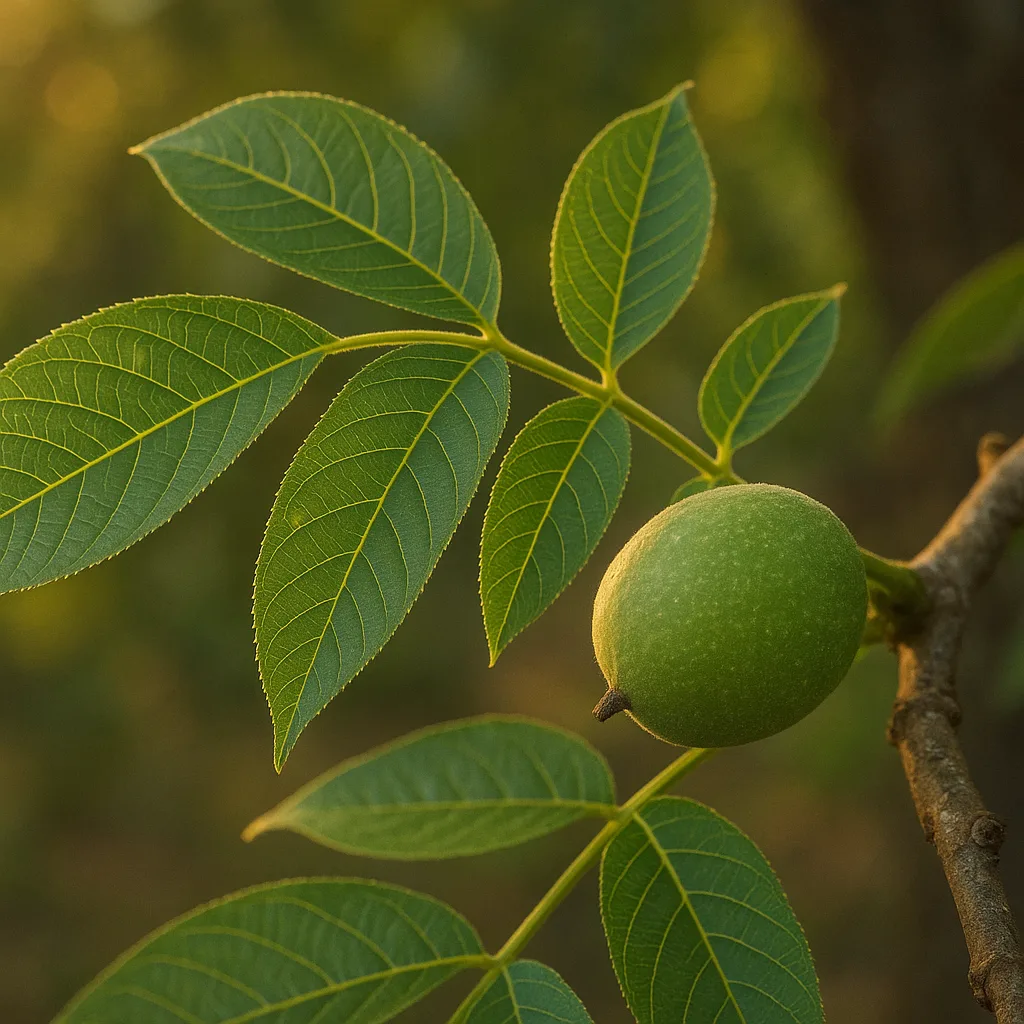
Quick ID at a glance
Before you go into detail, here are the essential walnut ID points you can check in 30–60 seconds out in the field.
- Leaf type: Pinnate compound leaves (many leaflets on a single stem) — not single blades.
- Leaflets per leaf: Often 11–23 on black walnut (Juglans nigra), 5–9 on English walnut (Juglans regia).
- Fruit: Round to slightly oval nut ~2.5–5 cm across in a green to brown husk that splits in autumn.
- Bark: Mature trees have deeply furrowed, interlacing diamond-shaped ridges (especially Juglans nigra).
- Flowers: Monoecious — male catkins and short female spikelets in spring.
Leaves, leaflets and arrangement
Leaf structure is one of the fastest and most reliable ways to identify a walnut.
Overall leaf form
Walnuts have pinnate, alternate leaves — a central rachis with multiple leaflets attached. This contrasts with many common trees such as elms and willows, which have simple leaves (a single blade per stem).
- Black walnut (Juglans nigra): 15–23 leaflets; whole leaf length typically 30–60 cm (12–24 in).
- English/Carpathian walnut (Juglans regia): usually 5–9 leaflets; leaf length commonly 20–40 cm (8–16 in).
- Butternut (Juglans cinerea): 11–17 narrow leaflets; leaflets often lance-shaped and more hairy beneath.
Leaflet shape, margin and texture
Look closely at a leaflet:
- Shape: Elliptic to lanceolate, ending in an acuminate (tapering) tip on many species.
- Margin: Finely serrate to entire depending on species and age; black walnut leaflets often have a few coarse teeth near the tip.
- Texture: Smooth, slightly glossy upper surface; some species have a paler, slightly fuzzy underside.
- Size: Leaflets typically 4–12 cm (1.5–4.5 in) long.
Bark, trunk and growth habit
Bark and overall tree form help confirm an ID, particularly on mature specimens.
Bark characteristics
- Young trees: Smooth, gray bark with occasional lenticels (small pores).
- Mature black walnut (Juglans nigra): Deeply furrowed, with interlacing ridges forming diamond-shaped patterns; color dark brown to gray-black.
- English walnut (Juglans regia): Less deeply furrowed than black walnut, often with scaly plates.
- Butternut (Juglans cinerea): Furrowed but often with longer ridges and a corkier texture.
Size and crown
Walnuts are medium-to-large shade trees with a broadly spreading crown.
For more on this topic, see our guide on Mastering Oak Leaves: Identify Trees in the Field.
- Height: Typical mature height ranges — 15–30 m (50–100 ft) in many environments; exceptional specimens reach 35–40 m (115–130 ft).
- Trunk diameter: Large mature trees commonly 0.6–1.5 m (2–5 ft) DBH, occasionally much larger on old-growth specimens.
- Branching: Major branches often extend horizontally, creating a rounded crown.
Flowers, fruit and nuts (seasonal cues)
The reproductive parts provide unmistakable walnut clues — if you're observing in spring through fall.
Flowers
- Monoecious: Both male and female flowers on the same tree.
- Male flowers: Long yellowish-brown catkins that hang in spring before or as leaves unfurl.
- Female flowers: Small clusters of bud-like flowers near the tips of shoots; after pollination they develop into nuts.
Fruit and nuts
Walnut fruits are tough to miss in late summer and autumn.
- Husk: Green, fleshy outer husk that becomes brown and brittle as it matures. Husk thickness varies by species.
- Nut kernel: A hard-shelled seed inside the husk. Typical diameter ~2.5–5 cm (1–2 in).
- Shape: English walnut nuts are often more elongated or heart-shaped; black walnut nuts are nearly round.
- Timing: Nuts mature and drop late summer to fall (August–October in temperate regions).
Crushed husks stain hands and equipment; fallen husks can be messy but also an easy sign the tree is a walnut.
Habitat, geographic distribution and seasonal behavior
Different walnut species occupy distinct ranges and habitats. Knowing local species narrows the ID quickly.
- Black walnut (Juglans nigra): Native to eastern North America — from Minnesota and New York south to Florida and Texas. Prefers deep, well-drained bottomlands, floodplains and rich upland soils.
- English walnut (Juglans regia): Native to central Asia but widely cultivated and naturalized across Europe, California and parts of the U.S.; favors well-drained soils and temperate climates.
- Butternut (Juglans cinerea): Native to northeastern North America — cooler uplands and streamside areas; currently less common due to disease.
Seasonal behavior:
You may also find our article on How to Recognize Maple Trees in the Field helpful.
- Early spring: male catkins appear; leaves emerge soon after.
- Summer: full canopy; nuts developing inside green husks.
- Late summer–autumn: husks mature and fall; foliage turns and drops with temperate fall timing.
Walnut vs. look-alikes: Elm, Willow and Slippery Elm
Many people searching "how to identify a walnut tree" also encounter elms and willows in the same landscapes. Here’s exactly how to tell them apart.
Walnut vs Elm (Ulmus spp.)
Key differences to check:
- Leaves: Walnut = pinnate compound leaves with many leaflets. Elm = simple, single leaves with an asymmetrical (offset) leaf base and doubly serrated margin.
- Fruit: Walnut = hard-shelled nuts in a fleshy husk. Elm = thin, round-ish samara (winged seed) that disperses in spring.
- Bark: Walnut = diamond-interlacing furrows on mature trunks. Elm = rough, flaky bark but not arranged in walnut-like diamond ridges.
- Bud and twig: Elm buds are typically short, clustered near leaf scars; walnut buds are small and terminal on the rachis for leaflets.
Search queries like "how to identify an elm tree", "how do I identify an elm tree", or "how to id elm tree" usually refer to the single asymmetrical leaf and samara as the easiest elm cues. If you see pinnate leaves, you can rule out elm immediately.
You might also be interested in Goji Berries: A Field Guide to the Red Superfruit.
Walnut vs Willow (Salix spp.)
- Leaves: Willow leaves are simple and narrow (lanceolate) with a soft texture; walnuts have broad pinnate leaves made of multiple leaflets.
- Habit: Willows often have long flexible stems and prefer wet soils; walnuts are more upright with a substantial trunk and tolerate drier, richer soils.
- Fruit: Willows have tiny capsules with silky hairs (wind-dispersed); walnuts have large single nuts inside husks.
Walnut vs Slippery Elm (Ulmus rubra)
Slippery elm is a common elm species people confuse with other broadleaf trees. How to tell:
- Slippery elm leaves: Simple, rough (sandpapery) texture on top and fuzzy underside; asymmetrical leaf base is a giveaway.
- Inner bark: Slippery elm’s inner bark is mucilaginous (slimy) when chewed — a traditional medicinal trait.
- Walnut: Has compound leaves and nuts; no mucilaginous inner bark and no samaras.
So if you’re asking "how to identify slippery elm tree" and you find compound leaves or nuts, you’re not looking at an elm.
Related reading: Field Guide to Identifying Flowers with AI Tools.
Field tips, tools and safety
Practical, safe techniques for identifying walnut trees and collecting evidence.
Tools and techniques
- Carry a small ruler or folding measuring tape to measure leaflet and nut size (cm or inches).
- Use a hand lens (10–20x) to inspect margins, hairs beneath leaflets, and bud structure.
- Photograph multiple features: whole tree, bark at chest height, a full leaf (showing rachis), close-up of a leaflet, fruit/husk, and flowers if present. Orvik’s visual ID can analyze these photos quickly.
- Note habitat and GPS or map location — species distribution helps narrow ID.
Safety and toxicity
- Juglone: Many Juglans species (especially black walnut) produce juglone, an allelopathic compound that inhibits growth of some plants (tomatoes, apples, blackberries, azaleas). Avoid planting sensitive species close to large walnuts.
- Skin staining and irritation: Fresh walnut husks stain skin, clothes, and boots — wear gloves when handling. Some people may have mild skin reactions to fresh husks.
- Allergies: Tree nut allergies are common; avoid tasting or handling kernels unless you know it is safe for you.
- Falling limbs: Large walnuts can drop heavy nuts and branches — use caution under mature crowns.
When identification is tricky: juveniles, hybrids and disease
Not every tree will match textbook descriptions. Here’s what to do when features are ambiguous.
- Young trees: Saplings often have fewer leaflets and smoother bark; rely on leaf arrangement (compound vs simple) rather than bark.
- Hybrids and cultivars: Cultivated English walnuts can show intermediate traits. Nut shape and leaflet count plus location (cultivated orchard vs wild) give context.
- Disease (e.g., thousand cankers disease): Black walnut populations may show dieback, cankers, or sparse crowns. Dead wood and few nuts can make ID harder; look for historic bark pattern and any remaining compound leaves on lower branches.
- Use technology: Orvik and other AI-powered apps can compare your photos to thousands of reference images to suggest species and confidence levels — especially useful when you only have a partial specimen.
Practical examples: field walk-through
Follow these steps for a confident on-site ID:
- Step 1 — Leaves: Look at a leafy shoot. If the shoot has a central stem with multiple leaflets (compound), you likely have a walnut or butternut. If there is a single blade per petiole, rule out walnuts.
- Step 2 — Count leaflets: 5–9 suggests Juglans regia; 11–23 suggests Juglans nigra; examine leaflet shape for confirmation.
- Step 3 — Examine fruits: Any roundish nuts in a fleshy husk? That confirms a walnut genus (Juglans).
- Step 4 — Check bark: Mature diamond-furrowed bark supports black walnut ID; smoother or scaly bark suggests other walnut species.
- Step 5 — Habitat and range: Cross-check with local distribution — is the species native or commonly planted here?
- Step 6 — Use Orvik: Photograph leaves, bark, and fruit and run them through Orvik for a fast AI-backed confirmation and confidence score.
Conclusion
Identifying a walnut tree is straightforward when you focus on a few reliable features: pinnate compound leaves, the number and shape of leaflets, distinctive nuts inside a husk, and mature bark texture. Pay attention to season and habitat, watch for look-alikes (elm and willow have single leaves and different fruits), and use tools like a hand lens, measuring tape, and Orvik to confirm tricky cases. Remember juglone-related planting concerns and handle husks with gloves — and you'll be identifying walnuts like a pro.
Frequently Asked Questions
- How do I tell a walnut tree from an elm tree?
- Walnuts have pinnate compound leaves with multiple leaflets and produce nuts in fleshy husks. Elms have single (simple) asymmetrical leaves and produce winged samara seeds. If you see a compound leaf, it’s not an elm.
- When do walnut nuts ripen?
- Walnut nuts typically mature and drop in late summer to autumn — roughly August through October in temperate climates, depending on species and local climate.
- Is black walnut toxic to nearby plants?
- Yes. Black walnut (Juglans nigra) produces juglone, an allelopathic chemical that can inhibit or kill sensitive plants (e.g., tomatoes, apples, azaleas) within the tree’s root zone or drip line.
- How do I identify a slippery elm versus a walnut?
- Slippery elm (Ulmus rubra) has single rough leaves with an asymmetrical base and fuzzy undersides; its inner bark is mucilaginous when chewed. Walnuts have compound leaves and nuts; they do not have samaras or slimy inner bark.
- What is the easiest feature to check in the field?
- Check the leaves: if the branch has a central rachis with multiple leaflets (a compound leaf), it’s likely a walnut. That single observation rules out many look-alikes like elm and willow.
- Can I use an app to identify walnut trees?
- Yes. Apps like Orvik can analyze photos of leaves, bark, and fruit and compare them to reference images, often giving a fast identification and confidence score.
- Are walnut husks safe to handle?
- Walnut husks stain skin and clothing and may cause mild skin irritation for some people. Wear gloves when handling fresh husks; do not assume safe to taste unless you have no tree-nut allergies.