
Quick overview: what an ash tree is and why identification matters
Ash trees (genus Fraxinus) are deciduous hardwoods found across temperate regions of North America, Europe and Asia. Common North American species include white ash (Fraxinus americana), green ash (Fraxinus pennsylvanica), black ash (Fraxinus nigra) and blue ash (Fraxinus quadrangulata). Mature ashes typically reach 10–35 m (33–115 ft) tall depending on species and site conditions. Identifying an ash tree correctly matters for urban planning, woodland management, conservation (especially because of threats such as emerald ash borer), and simple backyard curiosity.
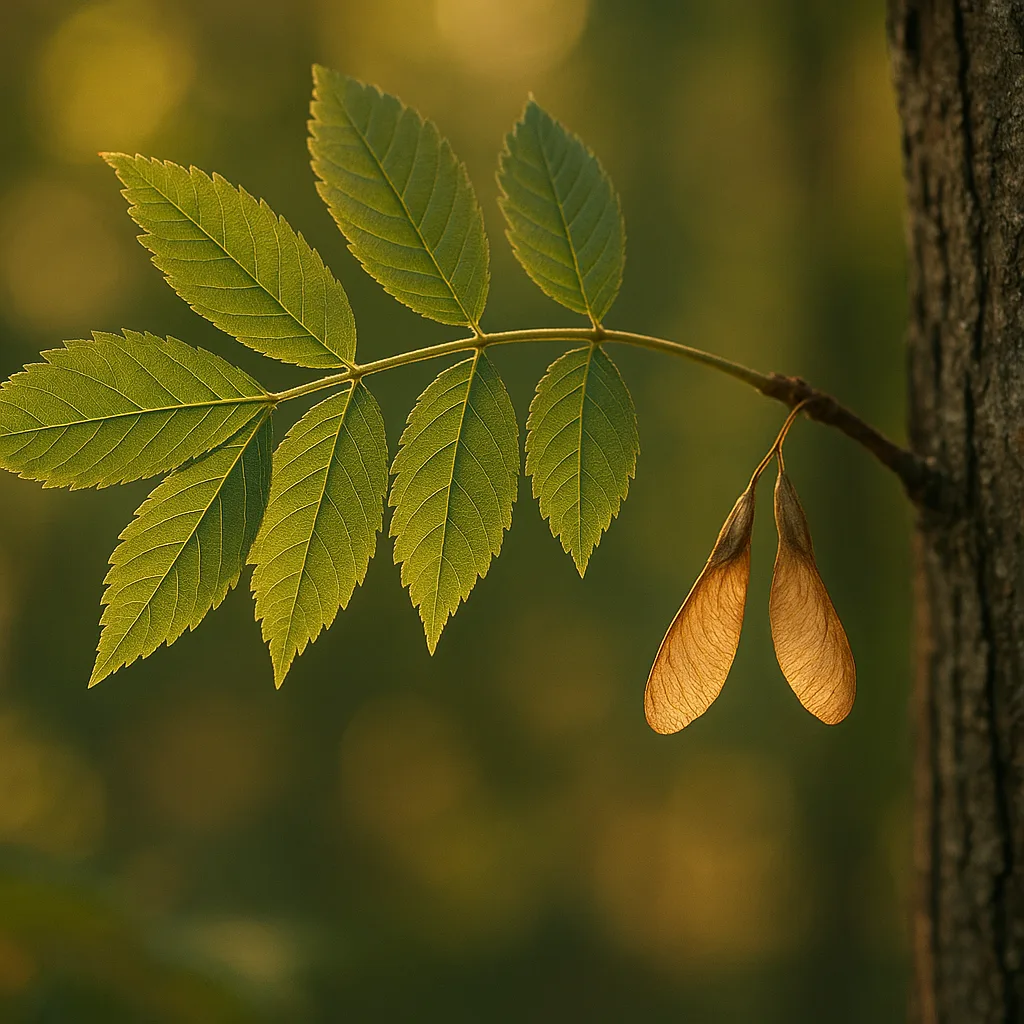
- Scientific name: Fraxinus spp.
- Typical height: 10–35 m (33–115 ft)
- Leaf type: pinnately compound, most often 5–11 leaflets
- Fruit: winged samara, usually single-seeded
Leaves and leaf arrangement: the single best field clue
Opposite vs. alternate leaf arrangement
One of the quickest ways to recognise an ash tree is by its leaf arrangement. Ash trees have opposite leaves — leaf stems (petioles) and buds are paired directly across from one another on the twig. This opposite arrangement distinguishes ashes from many common trees with alternate leaves, such as oaks, hickories and pecans.
- Opposite leaf and bud pairs at regular intervals on the twig.
- Compare: pecan (Carya illinoinensis) has alternate, pinnate leaves.
Leaf type, leaflet count and size
Ash leaves are pinnately compound: a central rachis bears multiple leaflets. Typical counts are:
- White ash (F. americana): usually 7 leaflets (range 5–9).
- Green ash (F. pennsylvanica): usually 7 leaflets (range 5–9).
- Black ash (F. nigra): often 7–13 leaflets, smaller and more numerous.
- Leaflet length: commonly 5–12 cm (2–5 in) long, though this varies by species.
- Leaflet width: 2–5 cm (0.8–2 in) across typical species.
- Margins: often serrated (finely toothed) or occasionally entire depending on species.
Seasonal notes on leaves
- Spring: new leaflets emerge light green, often with a slightly downy texture on budbreak.
- Summer: leaves darken to medium or deep green; leaf arrangement remains opposite and easy to spot.
- Fall: many ashes turn shades of yellow to purple‑yellow before dropping; timing varies with species and geography.
Bark, twigs and buds: texture, pattern and shape
Bark characteristics by age
Bark is another strong identifying feature and changes with age.
For more on this topic, see our guide on Maple Leaf ID: Recognizing Acer Species in the Field.
- Younger ash trees: smooth, light gray bark with small lenticels (pores) and faint ridging.
- Mature trees: furrowed bark with a distinctive diamond or interlaced pattern — deep fissures separated by ridges that form roughly diamond‑shaped blocks.
- Blue ash often has corky ridges, while green ash can develop pronounced, rough ridges.
Twigs and buds
Look at twig cross‑section and buds for confirmation.
- Twigs are often stout and smooth; some species (blue ash) have a slightly square or ridged twig.
- Buds are opposite and usually paired directly above leaf scars — a useful winter ID trait.
- Buds may be 3–8 mm long, conical to rounded, and can be brown to dark brown.
Flowers, fruit and seeds: samaras and their timing
Flowers and flowering season
Ash trees produce small, inconspicuous flowers in spring, often before or as leaves unfold. Flowers are wind‑ or insect‑pollinated and are not showy: they can be greenish, purple, or yellowish depending on the species.
You may also find our article on Mastering Oak Leaves: Identify Trees in the Field helpful.
- Flowering: typically March–May in temperate North America.
- Separate sexes: many ash species are dioecious (male and female flowers on different trees) or polygamous; only female trees produce fruit.
Samaras: the winged keys
The fruit of ash is a single‑seeded samara — a flat winged seed commonly called a "key". The samara shape and size are distinctive and persist on trees and the ground into summer in many species.
- Size: typically 2–5 cm (0.8–2 in) long, slender and single‑winged.
- Orientation: most samaras are vertical or slightly curved; some species bear clusters.
- Timing: ripe samaras often appear in late spring to early summer and may persist into fall.
Habitat, geographic range and seasonal behavior
Where ash trees grow
Ash species occupy a wide range of habitats. General patterns include:
Looking beyond this category? Check out AI Field Guide: Identify Birds Fast.
- Green ash (F. pennsylvanica): adaptable, commonly found in riparian zones, floodplains, city streets and disturbed sites across eastern and central North America.
- White ash (F. americana): upland forests, well‑drained soils, eastern and central North America.
- Black ash (F. nigra): wet soils, swamps and bog edges, northeastern and north‑central North America.
Climate and seasonal cues
- Leaf out: spring (March–May) depending on latitude and elevation.
- Fall color: yellow to purplish hues before leaf drop; timing varies by year.
- Winter ID: rely on opposite buds and twig characters when leaves are absent.
Look‑alikes: how to tell ash from mayhaw, pecan and other similar trees
When someone searches "how do i identify an ash tree" they often want to distinguish ash from other trees with compound leaves or similar samaras. Below are practical comparisons to common look‑alikes.
Related reading: How to Recognize Maple Trees in the Field.
Ash vs. Mayhaw (Crataegus aestivalis / Crataegus opaca)
- Leaf type: Mayhaw (a type of hawthorn) has simple, alternate leaves with serrated margins — not pinnate leaflets. Ash has pinnate, opposite leaves. This is the single easiest distinguishing trait.
- Fruit: Mayhaw produces pome fruit (small apple‑like hawthorn berries) 1–2 cm across in spring; ash produces dry winged samaras.
- Bark/twigs: Mayhaw has thorny branches and a shrubby habit in many cases; ash typically lacks thorns and forms a distinct tree crown.
Ash vs. Pecan (Carya illinoinensis)
- Leaf arrangement: pecan leaves are alternate pinnate with 11–17 leaflets; ash leaves are opposite pinnate with usually 5–11 leaflets.
- Fruit: pecan produces a thick‑shelled nut encased in a husk; ash produces samaras (winged seeds).
- Habitat: pecan favors well‑drained bottomlands and groves; ash species vary but green ash tolerates wet soils.
Ash vs. Box Elder/Maple (Acer negundo and other maples)
- Box elder is actually a maple with pinnate leaves (rare among maples) that can look ash‑like. However, maples have opposite leaves too; the bark and samaras differ — maple samaras are paired and helicopter‑like, whereas ash samaras are single‑winged.
- Maple samaras: always in paired units (two wings joined at seed); ash samaras: single wings attached to a solitary seed.
- Leaflet margin and venation: box elder leaflets are often more lobed or irregular; ash leaflets tend to be more uniform in shape.
Practical field ID tips, tools and safety/management considerations
Field checklist for a confident ID
- Step 1: Check leaf arrangement — are the leaves opposite? If yes, ash is possible.
- Step 2: Count leaflets on a compound leaf — 5–11 suggests ash.
- Step 3: Inspect bark — smooth on young trees, diamond‑patterned on older trunks.
- Step 4: Look for samaras in late spring to summer — single winged keys confirm ash.
- Step 5: Note habitat and compare with local species guides.
Using tools and apps (including Orvik)
Modern tools make identification faster and more reliable. Photograph a whole leaf spray, close‑ups of leaflets, a twig showing opposite buds, bark texture and any samaras. Apps such as Orvik use AI to analyze these photos and suggest likely species; combining app suggestions with the field checklist above increases confidence. Orvik can flag key features like opposite leaves and samara shape, and that corroboration is particularly helpful in winter or for novice identifiers.
- Photo tips: include scale (a coin or ruler), shoot multiple angles, and capture both close and distant shots of the tree.
- When to sample: gather fallen samaras in summer; take twig and bud photos in winter.
- Cross‑check: use a regional tree key or field guide to verify app results.
Safety, allergies and management
- Allergies: ash pollen can trigger hay fever in sensitive people during spring bloom.
- Wood and dust: ash wood dust can cause respiratory irritation or skin reactions for some people — use PPE when sawing or sanding.
- Pests & disease: emerald ash borer (Agrilus planipennis) is a serious invasive beetle that has killed millions of ash trees across North America. Symptoms include thinning canopy, D‑shaped exit holes, epicormic shoots and woodpecker activity. Ash dieback (Hymenoscyphus fraxineus) affects European ashes and leads to crown dieback and lesions.
- Management: consult certified arborists for treatment options (systemic insecticides such as emamectin benzoate are commonly used) and report suspected EAB infestations to local authorities. Early detection preserves options.
Conclusion
Identifying an ash tree rests on a handful of reliable field marks: opposite pinnate leaves with 5–11 leaflets, diamond‑patterned mature bark, and single‑winged samaras. Seasonal clues — spring samaras and fall yellowing — plus habitat help confirm species. When in doubt, photograph the leaf arrangement, leaflets, buds and samaras and use tools like Orvik to cross‑check your observation. Care is warranted where emerald ash borer or ash dieback is present — timely identification can help protect surrounding trees and inform proper management.
Frequently Asked Questions
- How do I identify an ash tree in winter?
- Look for opposite buds and leaf scars on twigs and the mature diamond‑patterned bark. Buds are paired and positioned directly across from each other.
- How do you identify an ash tree from a pecan?
- Ash has opposite pinnate leaves with 5–11 leaflets and single‑winged samaras; pecan has alternate pinnate leaves with 11–17 leaflets and produces nuts.
- How to identify a mayhaw tree compared to an ash?
- Mayhaw (a hawthorn) has simple, alternate leaves and small pome fruits (hawberries) and often thorny branches; ash has compound opposite leaves and winged samaras.
- Can Orvik help me identify an ash tree?
- Yes. Orvik’s AI can analyze photos of leaves, twigs and bark and highlight diagnostic features like opposite leaves and samaras to suggest Fraxinus species.
- Are ash trees poisonous?
- Ash trees are not generally toxic to humans or pets, though pollen can trigger allergies and ash wood dust may irritate skin or lungs.
- What are common threats to ash trees?
- Emerald ash borer (Agrilus planipennis) and ash dieback (Hymenoscyphus fraxineus) are major threats. Early detection and professional management are critical.
- What key measurements should I take for a confident ID?
- Record leaflet count, leaflet length (cm or in), samara length, trunk diameter (DBH), and tree height; include photographs with a scale for reference.