
When someone searches for the hydrangea latin name they usually want more than a single word — they want to know which hydrangea they are looking at, what that scientific name means, and how to use botanical names to identify and care for the plant. This article explains the botanical (Latin) names and common names of hydrangeas, offers practical field identification tips with measurements and visual cues, outlines habitat and seasonal behavior, warns about toxicity, and compares key species so you can confidently name the hydrangea in your garden or on the trail. If you’re using an identification app like Orvik, the visual clues below will help you confirm results.
What the Hydrangea Latin Name Means
The term "hydrangea latin name" refers to the scientific (botanical) naming system used by botanists to classify living plants. In formal botany this is called binomial nomenclature: a two-part Latin or Latinized name comprising the genus and the species.
- Genus: Hydrangea — the group of related species sharing core traits (flowers in clusters, opposite leaves).
- Species: e.g., macrophylla, paniculata, quercifolia — the specific epithet that distinguishes each species within the genus.
- Full scientific name: Hydrangea macrophylla (italicized in formal writing), where Hydrangea is the genus and macrophylla the species.
Why Latin names matter
- Precision: Hydrangea macrophylla refers to the bigleaf hydrangea globally, avoiding local name confusion.
- Hierarchy: Subspecies, cultivars and hybrids can be expressed after the species name (e.g., Hydrangea macrophylla 'Nikko Blue').
- Research and care: Scientific names connect you to horticultural data (hardiness, soil preferences, pruning).
Common Hydrangea Species and Their Scientific Names
The genus Hydrangea contains roughly 70–75 species (estimates vary as taxonomy updates). Gardeners most often encounter a handful of species and their cultivated forms. Below are the principal species with their common names and quick ID notes.
- Hydrangea macrophylla — bigleaf hydrangea (mophead and lacecap flower forms; leaves 6–15 cm). Very common in temperate gardens.
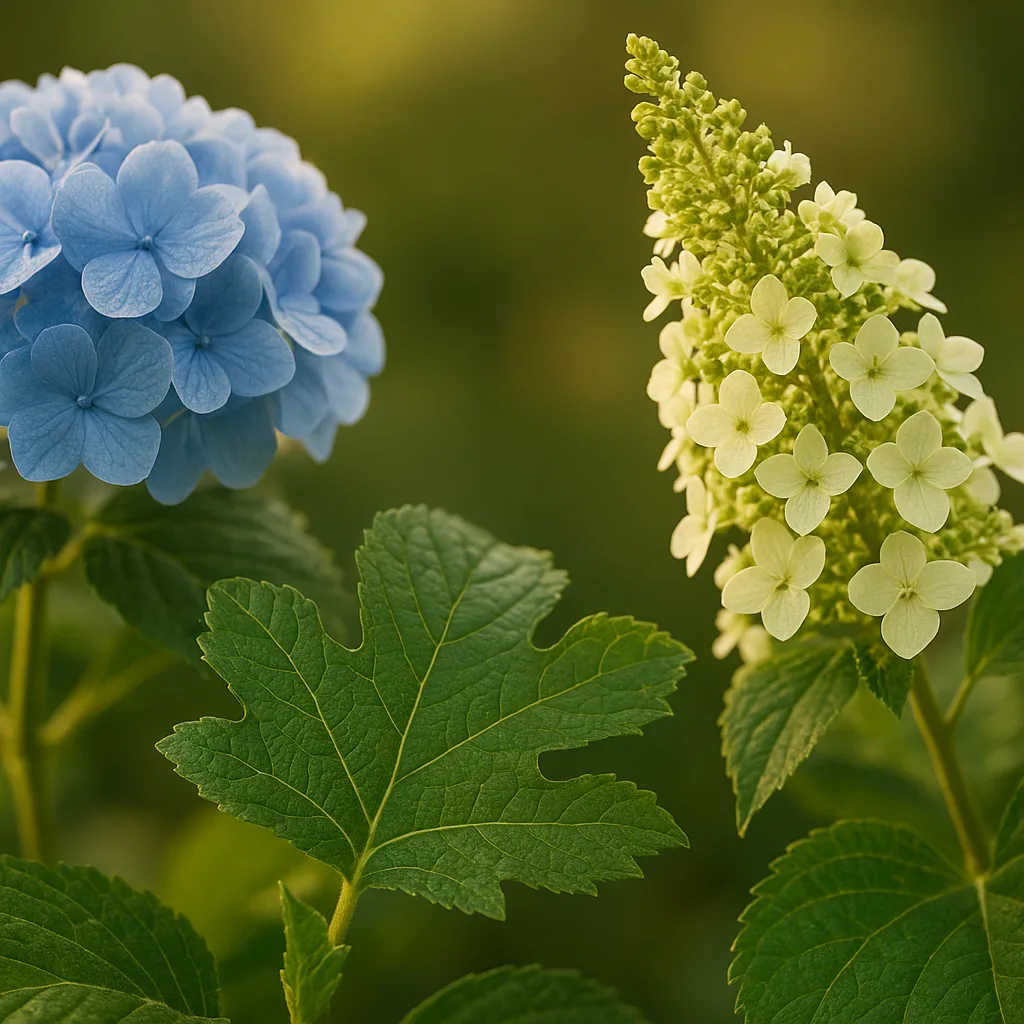
- Hydrangea paniculata — panicle hydrangea (conical, candle-shaped flower panicles 10–30 cm long; hardy, can reach 2–6 m tall).
- Hydrangea quercifolia — oakleaf hydrangea (distinctive deeply lobed leaves resembling oak leaves; white blooms that age pink; 1–3 m tall).
- Hydrangea arborescens — smooth hydrangea (solid dome-shaped white flower heads; stems often suckering; 0.9–1.5 m tall).
- Hydrangea serrata — mountain hydrangea (similar to H. macrophylla but smaller leaves and flowers; native to higher elevation Asia).
French common name
- In French, hydrangeas are commonly called "hortensia." You will see garden labels and nursery signs in France using hortensia for the same plants known in English as hydrangeas.
Identifying Hydrangea: Visual Cues, Sizes and Textures
If you want to know the hydrangea latin name for a particular plant, start with these visual and measurable characteristics. Photographs taken with Orvik or another ID tool are extremely helpful — capture the leaf surface, underside, flower cluster shape and overall habit.
For more on this topic, see our guide on Understanding Lily Identity: Names & Science.
Leaves
- Size: Most bigleaf hydrangea (H. macrophylla) leaves measure about 6–15 cm long and 4–10 cm wide; H. paniculata leaves can be 6–20 cm long.
- Shape and texture: H. macrophylla leaves are broadly ovate with serrated margins and a glossy or slightly rough texture; H. quercifolia has deep lobes (3–7 lobes) that resemble oak leaves.
- Arrangement: Leaves are opposite (paired at each node), a useful field clue to confirm genus.
Flowers and Inflorescences
- Mophead vs lacecap: H. macrophylla produces mophead (rounded, globe-like heads 10–25 cm across) or lacecap (flat heads with conspicuous central fertile flowers and showy sterile florets along the rim).
- Panicle vs dome: H. paniculata forms elongated panicles 15–30+ cm long, often upright and cone-shaped; H. arborescens and some H. quercifolia form rounder dome heads 8–20 cm across.
- Color changes: In many H. macrophylla cultivars, sepal color shifts with soil pH — acidic soils (pH <5.5) favor blue tones, alkaline soils (pH >6.5) favor pinks, and neutral soils produce purple/mixtures.
Habit and Size
- Shrub height: H. macrophylla typically 1–2 m tall; H. paniculata often 2–6 m; H. arborescens 0.9–1.5 m; H. quercifolia 1–3 m.
- Stem texture: H. paniculata stems can be more erect and woody; H. arborescens stems are often softer and sucker-forming.
Hydrangea macrophylla: The Bigleaf Hydrangea and Its Names
When people search "hydrangea macrophylla common name" they are usually asking for the everyday name for this species. Hydrangea macrophylla is commonly called the bigleaf hydrangea in English. In France it is often labelled as "hortensia." It includes many garden cultivars and the familiar mophead flowers seen in cottage gardens and borders.
- Scientific name: Hydrangea macrophylla
- Common names: bigleaf hydrangea, French hortensia (in French-speaking regions)
- Typical dimensions: 1–2 m tall and wide; flower heads 10–25 cm across
- Flower forms: mophead (rounded) and lacecap (flat, rim of showy sterile florets)
- Soil influence on color: Color change governed by soil aluminum availability and pH: pH <5.5 often blue; pH >6.5 often pink.
Why the name macrophylla?
- Macrophylla means "large-leaved" in Greek/Latin—an apt descriptor for the species’ broad leaves.
Habitat, Geographic Distribution and Seasonal Behavior
Hydrangeas have a broad native range and adapt to many garden conditions. Understanding where a species comes from helps with identification and care.
You may also find our article on Understanding Pine Trees: Latin Names Explained helpful.
- Native range: Most Hydrangea species are native to eastern and southern Asia (Japan, China, Korea, the Himalayas) and the Americas (southeastern United States for H. quercifolia and H. arborescens).
- Natural habitats: Woodland edges, mountain slopes, shaded stream banks and moist soils. Many species prefer partial shade and consistent moisture.
- Hardiness: H. macrophylla zones roughly USDA 6–9; H. paniculata 3–8; H. arborescens 3–9 — consult cultivar-specific data for precise hardiness.
- Bloom season: Most H. macrophylla bloom late spring to mid/late summer (June–September in temperate Northern Hemisphere), while H. paniculata can bloom later into fall. Some cultivars rebloom.
Seasonal notes for identification
- Flowers: Note bloom timing and whether flower heads age to deeper shades (pink, red, or brown) — helps separate species and cultivars.
- Leaves: Observe leaves in summer and autumn — H. quercifolia has striking autumn color (reds, purples) and exfoliating bark in winter which is identification aid.
Toxicity and Safety — What to Know
Hydrangeas are beautiful but not edible. They contain cyanogenic glycosides (including compounds often referred to as hydrangein), which can release cyanide when plant tissue is chewed or digested.
- Symptoms of ingestion: vomiting, diarrhea, lethargy, and, in severe cases, more serious systemic effects in humans and animals.
- Risk groups: pets (dogs and cats), grazing animals (horses, cattle), and small children should not eat hydrangea leaves, buds or flowers.
- Handling: skin contact rarely causes serious irritation, though gardeners with sensitive skin should wear gloves and wash hands after pruning.
- First aid: If ingestion is suspected, contact your local poison control center, veterinarian, or emergency services immediately.
Comparisons: How to Tell Hydrangea Species Apart
People searching for the hydrangea latin name often want to know which species they have. Below are comparison checklists that help separate commonly confused species.
Looking beyond this category? Check out Mastering Coin Identification: From Minted Metal to Crypto Names
.
Hydrangea macrophylla vs Hydrangea paniculata
- Inflorescence: H. macrophylla = mophead or lacecap rounded clusters; H. paniculata = elongated conical panicles.
- Leaf size: H. macrophylla leaves 6–15 cm; H. paniculata often larger and coarser 8–20 cm.
- Hardiness: H. paniculata is generally hardier (USDA zones 3–8) than H. macrophylla (zones 6–9).
Hydrangea macrophylla vs Hydrangea quercifolia
- Leaves: H. quercifolia has lobed, oak-like leaves; H. macrophylla has simple, broadly ovate serrated leaves.
- Bark & winter interest: H. quercifolia often shows peeling bark and excellent fall color; H. macrophylla less so.
Mophead vs Lacecap (within H. macrophylla)
- Mophead: large, showy sterile sepals create a round head (10–25 cm diameter).
- Lacecap: flat, disk-like center of fertile flowers surrounded by a ring of larger sterile sepals.
Using Orvik and Other Tools to Confirm Identification
Visual identification is easiest when you combine field observation with technology. Orvik — an AI-powered visual identification app — can help confirm a hydrangea’s botanical name when you upload photos of leaves, flower heads, and the whole shrub.
Related reading: Roses: Scientific Names and Field ID Guide.
- Take multiple photos: leaf upper surface, leaf underside, full flower head, and a picture of the entire plant in context.
- Note measurements: Use a ruler or common object for scale to show leaf length (cm) or flower head diameter.
- Use metadata: Record location, soil pH if known, and bloom time — this contextual data improves identification accuracy.
- Cross-check results: Use Orvik's suggested species names then confirm with local floras or horticultural resources for cultivar-level ID.
Orvik is particularly useful for recognizing subtle differences (mophead vs lacecap, leaf lobe patterns) from smartphone photos. Pair the app’s suggestions with the visual cues in this guide to reach a reliable identification.
Conclusion
When someone types "hydrangea latin name" into a search engine they usually want a reliable scientific name plus practical guidance to identify which hydrangea they have. The genus is Hydrangea, and key garden species include Hydrangea macrophylla (bigleaf), H. paniculata (panicle), H. quercifolia (oakleaf), H. arborescens (smooth), and H. serrata (mountain). Use leaf shape, flower form (mophead, lacecap, panicle), measurements, seasonal timing, and habitat as the main clues. Remember hydrangeas are toxic if ingested, and always handle with basic precautions. For on-the-spot help, use an image-ID tool like Orvik to photograph distinguishing features and confirm the botanical (Latin) name.
Frequently Asked Questions
- What is the hydrangea Latin name for the common garden hydrangea?
- The genus name is Hydrangea; the most common garden species is Hydrangea macrophylla (bigleaf hydrangea).
- Is "hortensia" the same as hydrangea?
- Yes — "hortensia" is the common French name for hydrangea and is often used in French-speaking regions.
- How can I tell mophead and lacecap hydrangeas apart?
- Mophead forms have rounded, globe-like flower heads made of showy sterile sepals, while lacecaps have a flat center of fertile flowers surrounded by a ring of sterile florets.
- Does soil pH change hydrangea color?
- For many H. macrophylla cultivars, soil pH influences color: acidic soils (pH <5.5) favor blue tones, alkaline soils (pH >6.5) favor pinks due to aluminum availability.
- Are hydrangeas poisonous to pets?
- Yes. Hydrangeas contain cyanogenic glycosides and can cause vomiting, diarrhea, and other symptoms if ingested. Contact a veterinarian if ingestion is suspected.
- Which hydrangea species is best for cold climates?
- Hydrangea paniculata and Hydrangea arborescens are among the hardiest species (typically suitable to USDA zones 3–8/9); H. macrophylla is generally less cold-hardy.