
Why identify oak leaves? What seekers really want
When people search how to identify oak tree by leaf, they're usually standing beneath a tree wondering two things: “What species is this?” and “Is it the same oak I saw in a different park?” They want reliable visual cues, comparisons with lookalikes (like poplars and maples), habitat notes, and tips for photographing leaves so an app or field guide can confirm the ID. This guide gives measurable features, seasonal behavior, and practical steps you can use in the field or with Orvik, an AI-powered visual ID app that helps confirm species from photos.
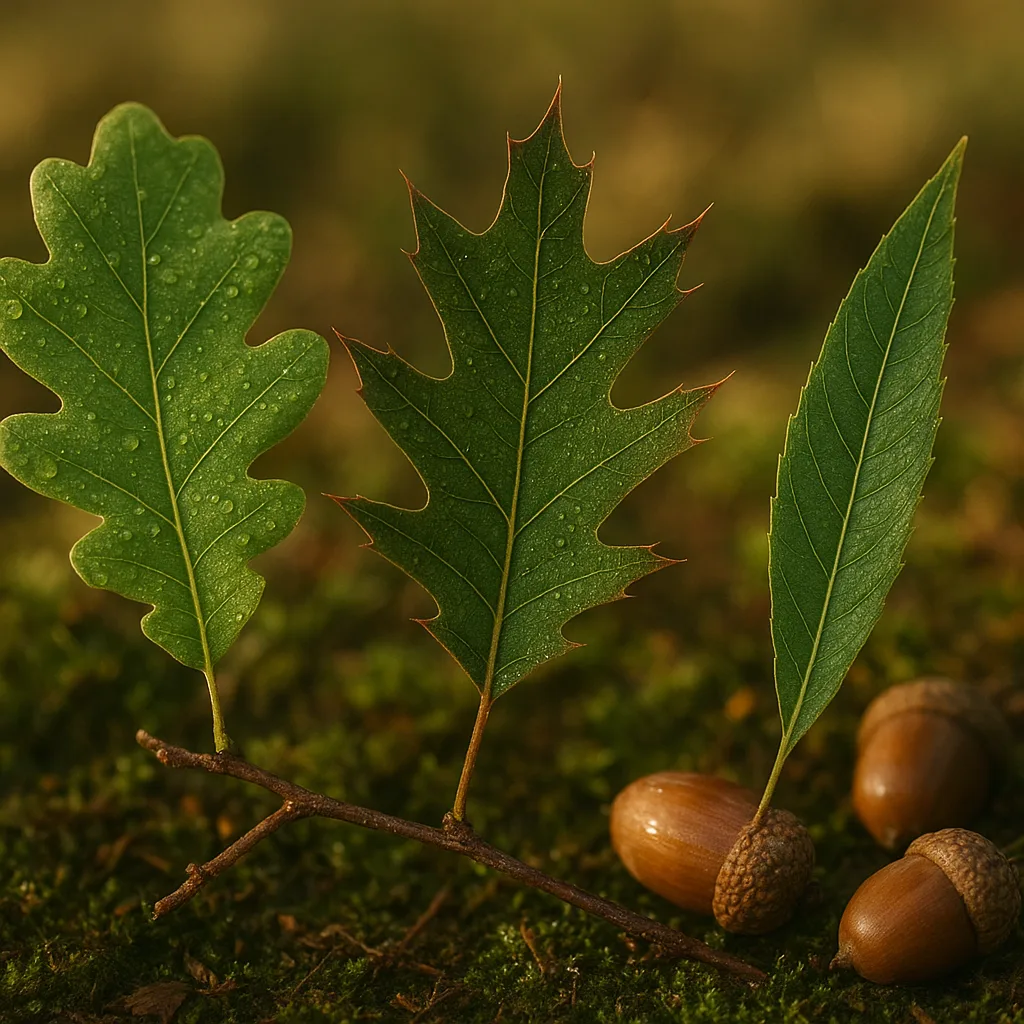
- Who this helps: hikers, gardeners, arborists, land managers, educators.
- What you’ll learn: leaf shape, size, lobing patterns, texture, seasonality, and similar species comparisons.
- How to verify: visual cues, acorns and bark clues, plus photo tips for Orvik or any ID tool.
Oak leaf anatomy & key features to inspect
Oaks (genus Quercus) share a basic leaf structure but vary enough to separate species by careful observation. Focus on these measurable characteristics.
Primary features to note
- Leaf type: Simple leaves (one blade per petiole) in most oaks; some species have lobed margins, others toothed.
- Length and width: Record sizes with a ruler—many species have leaf lengths between 5 cm and 25 cm (2–10 in).
- Lobes and sinuses: Depth and shape of lobes (rounded vs pointed) are diagnostic—e.g., Quercus alba (white oak) has rounded lobes; Quercus rubra (northern red oak) has pointed lobes with bristles.
- Leaf margin: Entire, lobed, or serrated. Presence of bristle tips often indicates the red oak group (subgenus Lobatae).
- Leaf base and petiole: Note whether the base is tapered, rounded, or cordate; petiole length often 1–4 cm (0.4–1.6 in).
- Surface texture: Shiny/glossy vs dull; presence of hairs (pubescence) on underside or midrib.
- Vein pattern: Pinnate venation with a distinct midrib; secondary veins often extend to lobes or teeth tips.
Practical field checklist
- Measure leaf length and width (cm/inches).
- Count lobes and note their shape (rounded or bristle-pointed).
- Flip leaf: check underside color, hairs, or tininess of scales.
- Look for acorns nearby—size and cupule characteristics help species ID.
- Photograph bark pattern, twig buds, and whole crown for context.
Common oak species and identifying leaf traits
Below are several widespread oaks with precise leaf descriptions. Including scientific names helps avoid regional name confusion.
White oak group (Quercus sect. Quercus)
- Quercus alba (White oak): Leaves 12–20 cm long, 7–12 rounded lobes, lobes separated by shallow to moderate sinuses; upper surface dull green, underside pale grayish with tiny hairs.
- Quercus robur (English oak): 7–14 cm long, 4–8 deep rounded lobes, often a short stalk (petiole) on the leaf; common across Europe and planted worldwide.
Red oak group (Quercus subg. Lobatae)
- Quercus rubra (Northern red oak): Leaves 12–22 cm, 7–11 bristle-tipped lobes, U-shaped sinuses; glossy top surface, paler underside.
- Quercus palustris (Pin oak): 7–15 cm, sharply pointed lobes with deep sinuses forming a distinctive silhouette; usually has a shiny top surface.
Others to know
- Quercus cerris (Turkey oak): 10–18 cm, lobes often irregular and bristled; underside fuzzy with tawny hairs.
- Quercus virginiana (Southern live oak): Evergreen, 8–15 cm thick, leathery, entire or shallowly lobed; dark glossy top, pale underside.
How to identify oak leaves across seasons
Leaves change seasonally and these changes are helpful identifiers if you know what to look for.
For more on this topic, see our guide on How to Recognize Maple Trees in the Field.
Spring and early summer
- New leaves often flush lighter green and can be hairy; note the initial shape and presence of hairs on emerging leaves.
- Catkins (male flowers) may be present—long, dangling clusters in spring for many species.
Summer maturity
- Leaves reach full size and color; measure now for accurate length and width values.
- Check undersides—many species show distinctive color contrasts only when mature.
Autumn color and drop
- Color ranges widely: Quercus rubra turns russet to red, Quercus alba shows muted browns and tans. Leaf retention varies: live oaks (Q. virginiana) can be semi-evergreen.
- Acorn maturity peaks in autumn—collecting a few (without damaging habitat) helps species confirmation.
X vs Y: How to tell oaks from lookalikes (poplar, maple, beech)
Many non-oaks have superficially similar leaves. Here are focused comparisons to help you rule out common confusers.
Oak vs Poplar (Populus spp.)
- Leaf shape: Poplar leaves are often triangular (Populus deltoides, cottonwood) or rounded and almost circular (Populus tremuloides, aspen), with a flat petiole that causes trembling in wind.
- Margin: Poplars have finely serrated or nearly smooth margins, not deep lobes like most oaks.
- Texture: Poplar leaves are usually thin and papery; oak leaves tend to be thicker and stiffer.
- Venation: Poplar veins radiate broadly from the base or midrib; oak veins are pinnate with distinct midrib and veins leading to each lobe.
Quick field test: gently hold the leaf petiole. If the blade trembles in the breeze because the petiole is flattened, it’s likely a Populus (e.g., Quaking Aspen, Populus tremuloides).
Oak vs Maple (Acer spp.)
- Maples have palmately lobed leaves (lobes radiate from one point) while oaks are pinnately lobed (along a central midrib).
- Maple petioles often have opposite leaf arrangement on twigs; oak leaves are alternate.
Oak vs Beech (Fagus spp.)
- Beech leaves are typically simple with serrated margins and more uniform oval shapes; oaks show lobing or bristle-tipped margins depending on group.
Using photographs and Orvik to confirm species
Smartphone photos are the fastest way to get an ID. Orvik’s AI excels when you provide clear, standardized photos. Here’s how to get the best images and what Orvik looks for.
You may also find our article on Leaf ID: Practical Guide to Tree Identification helpful.
Photo checklist for accurate AI or human ID
- Take a close-up of the leaf against a plain background—5–10 cm of ruler or coin for scale.
- Photograph both the upper and lower surfaces (flip the leaf).
- Capture the whole leaf on the twig and the arrangement of leaves on the branch (alternate vs opposite).
- Include at least one photo of the whole tree crown and one of the bark.
- If present, photograph acorns and cupules (acorn caps) from multiple angles.
How Orvik helps
- Orvik analyzes silhouette, lobing, vein patterns, and color to suggest species and confidence levels.
- It cross-references geographic distribution—if your photo is from Michigan, it will prioritize species known there (e.g., Q. rubra, Q. alba).
- Use Orvik’s suggestions as one line of evidence; confirm with acorn and bark traits when possible.
Users often pair Orvik results with the field checks above to reach a confident ID. Orvik is helpful for novices and pros alike because it flags similar species and points out distinguishing features.
Habitat, geographic distribution, and seasonal behavior of oaks
Oaks are a large genus—about 600 species worldwide—so habitat and location are crucial to narrowing species.
General habitat types
- Upland dry sites: Many white oaks (e.g., Q. alba) prefer well-drained soils and full sun.
- Bottomlands and floodplains: Species such as Quercus palustris (pin oak) and Quercus bicolor (swamp white oak) tolerate periodic flooding.
- Coastal and warm-temperate: Live oak (Q. virginiana) thrives in the southeastern U.S. and coastal areas.
Geographic range examples
- North America: Q. alba, Q. rubra, Q. palustris are widespread across temperate regions.
- Europe: Q. robur (English oak) and Q. petraea (Sessile oak) dominate many woodlands.
- Asia: Numerous species adapted to montane and subtropical climates.
Seasonal notes
- Flowering: Spring; male catkins and female flowers appear before or with leaves.
- Acorn maturation: One growing season for many white oaks, two seasons for some red oaks (e.g., Q. rubra takes two years).
- Leaf retention: Most oaks are deciduous, but several (e.g., live oak) are evergreen or semi-evergreen.
Safety, toxicity, and human uses
Oaks play important ecological and human roles, but there are safety notes to consider.
You might also be interested in How to ID a Bird from a Photo.
- Toxicity to livestock: Oak leaves and acorns contain tannins and can be toxic to cattle, horses, and pigs if consumed in large quantities—symptoms include gastrointestinal distress and kidney damage. Keep livestock away from heavy oak mast years.
- Allergies: Oak pollen can be a seasonal allergen for people in spring.
- Handling: While oak leaves rarely cause severe dermatitis, tannin-rich galls and crushed plant material can irritate sensitive skin; wear gloves when collecting specimens.
- Uses: Acorns were a traditional food for many indigenous cultures after leaching tannins; oak wood is prized for furniture, flooring, and cooperage.
Practical step-by-step: Identify an oak tree by leaf in the field
Follow this reproducible routine to go from unknown tree to confident identification.
Related reading: Maple Leaf ID: Recognizing Acer Species in the Field.
- Gather specimens: Take 3–5 fully expanded leaves from different parts of the crown; include leaves from sun and shade branches.
- Measure: Record length and width in centimeters or inches. Note petiole length.
- Count lobes and note tips: Rounded lobes point to white oak group; bristle-tips indicate red oak group.
- Check underside: Look for hairs, color contrast, or scales.
- Search for acorns: Note size (mm), cupule shape, and whether acorns are solitary or clustered.
- Photograph for Orvik: Use the photo checklist earlier in the guide and submit images for AI verification.
- Confirm with habitat: Cross-check species likely in your county or bioregion to narrow candidates.
Example: If you find a 15 cm leaf with 9 pointed lobes ending in bristles, deep U-shaped sinuses, and acorns that mature in two years, you are likely observing Quercus rubra (Northern red oak).
Conclusion
To identify oak tree by leaf, rely on a combination of clear measurements (leaf length, lobe count, petiole length), visual cues (rounded vs bristle-tipped lobes, underside hairs, texture), habitat context, and reproductive features (acorns). When in doubt, photograph multiple views and use Orvik to get AI suggestions that factor in visual patterns and local species ranges. With practice and the field checks in this guide, you’ll move from uncertain to confident in your oak identifications.
Frequently Asked Questions
- What is the fastest way to identify an oak by its leaf?
- Look for lobing pattern (rounded vs bristle-tipped), measure leaf size, check underside color and hairiness, and find acorns. If unsure, photograph leaves and use Orvik for AI-assisted confirmation.
- How do I tell a white oak from a red oak by the leaf?
- White oaks have rounded lobes and lack bristle tips; their leaves are often paler underneath. Red oaks have pointed lobes with tiny bristles at the tips and usually darker, glossier upper surfaces.
- Can poplar leaves be mistaken for oak leaves?
- Rarely—poplar leaves (Populus spp.) are typically triangular or almost circular with a flattened petiole that makes them tremble. Oaks have pinnate venation and lobed or toothed margins. Compare venation, petiole shape, and leaf texture to differentiate.
- Do acorns help identify oak species?
- Yes. Acorn size, shape, cupule (cap) texture, and whether acorns mature in one or two seasons are valuable diagnostic features that often confirm leaf-based ID.
- Are oak leaves toxic to humans or pets?
- Oak leaves and acorns contain tannins that can be toxic to livestock in large quantities. For humans, acorns must be leached to remove tannins before eating. Pets rarely eat enough to be harmed, but avoid feeding them acorns or large amounts of fallen leaves.
- How should I photograph a leaf for the best ID results?
- Photograph the leaf against a plain background with a ruler or coin for scale. Capture both upper and lower surfaces, the leaf on the twig, the whole tree, bark, and any acorns. Good lighting and multiple angles improve accuracy for Orvik or any ID tool.
- Why does Orvik recommend multiple photos?
- Different features are visible from different angles—undersides, lobes, petioles, and acorns. Orvik’s AI uses these combined views plus your location to produce a higher-confidence identification.