
Leaves are the most reliable single feature many people have when trying to identify a plant in the field. If you search to "identify plant by leaf shape," you want a clear, repeatable method: what to look for, how to take measurements, which species share those forms, and how to avoid dangerous look‑alikes. This guide—written for naturalists, gardeners and curious walkers—gives practical visual cues, habitat notes, seasonal tips and safety warnings. Use the workflow here and an app like Orvik to confirm your findings in seconds.
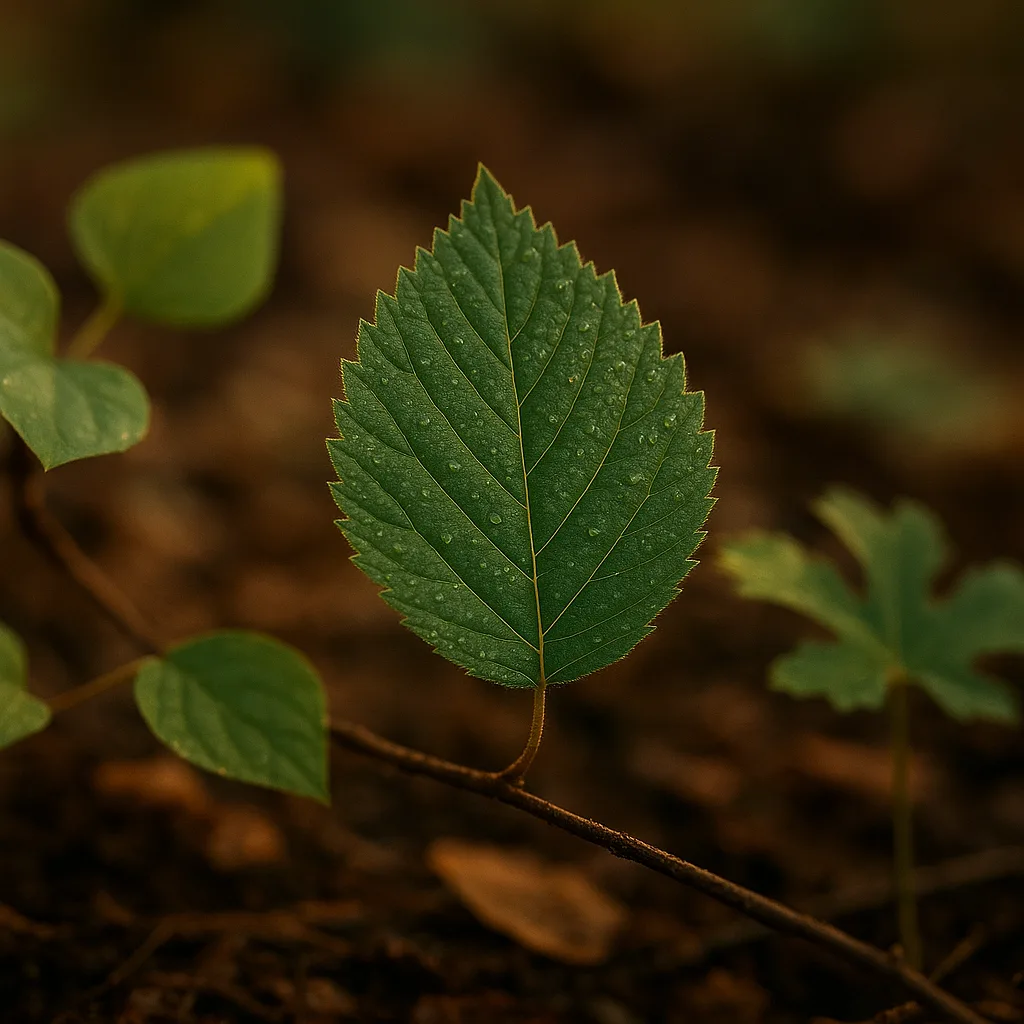
How botanists describe leaf shape (the basics)
Before naming plants, learn the vocabulary. Botanists use consistent terms to describe form, margin, venation and arrangement. Accurate identification starts with precise observation.
Key terms
- Blade (lamina): the flat part of the leaf, measured in cm or mm.
- Petiole: stalk that attaches the blade to the stem; note length in mm–cm.
- Margin: edge of the blade (entire, serrate, crenate, lobed).
- Venation: pattern of veins (palmate, pinnate, parallel).
- Compound vs simple: compound leaves are divided into leaflets; simple leaves are single blades.
How to take measurements in the field
- Measure blade length and width with a ruler (cm). Record petiole length (mm–cm).
- Note the leaf arrangement: alternate, opposite, or whorled.
- Photograph both leaf face and underside, and the attachment to the stem (these are often diagnostic).
Common leaf shapes and notable species
Below are widely used shape categories, typical sizes, and representative species with scientific names. Use these visual anchors to narrow an unknown plant to a small group.
1. Ovate and lanceolate (egg- to spear-shaped)
- Ovate: broader at the base, 3–20 cm long. Example: Rhododendron spp., 4–15 cm.
- Lanceolate: long and narrow, 5–40 cm long. Example: Salix (willows).
2. Cordate and sagittate (heart- and arrow-shaped)
- Cordate: heart-shaped base (e.g., Hibiscus, 8–20 cm).
- Sagittate: arrowhead-shaped with basal lobes pointing downward (e.g., Arum family).
3. Palmate and lobed
- Palmate: veins and lobes radiate from one point. Examples: horse chestnut (Aesculus hippocastanum) with 5–7 leaflets, 15–30 cm diameter; maple (Acer) lobed leaves 5–20 cm.
- Lobed: deep or shallow incisions; note depth as fraction of blade (e.g., oak lobes often reach 1/3–1/2 of blade).
4. Linear and needle-like
- Linear leaves: narrow with parallel sides (e.g., grass blades, 1–50 cm long).
- Needles: conifers like Pinus with bundles (fascicles) of 2–5 needles; length 2–30 cm.
5. Large (big-leaf) forms
- Gunnera manicata: blades up to 2.5 m wide in cultivation; coarse texture, serrated margin.
- Magnolia macrophylla: leaves commonly 50–90 cm long, simple and obovate.
- Alocasia and Colocasia (taro family): 30–90 cm, arrow-shaped, prominent veins.
Leaf arrangement and compound leaves (3 leaf, 5 leaf, and more)
Arrangement and leaflet number are decisive. Many searches like "3 leaf plant identification" or "five leaf plant identification" hinge on whether you're counting leaflets or entire leaves.
For more on this topic, see our guide on Maple Leaf ID: Recognizing Acer Species in the Field.
Counting leaflets vs leaves
- If leaflets attach to a single petiole, you have a compound leaf (e.g., trifoliate, pinnate, palmate-compound).
- Look for a bud at the base of the petiole—buds occur where a leaf (not a leaflet) attaches to the stem.
Three-leaf plants (trifoliate)
- Poison ivy (Toxicodendron radicans): classic "leaves of three," leaflets 3–7 cm, variable margins, glossy; grows as vine or shrub across much of North America, found in edges and forests; causes contact dermatitis.
- White clover (Trifolium repens): low, herbaceous, round leaflets 5–25 mm; common lawn plant.
Five-leaf plants
- Virginia creeper (Parthenocissus quinquefolia): five leaflets, 5–12 cm each, toothed margins, turns red in fall; climbs by adhesive discs on stems.
- Horse chestnut (Aesculus hippocastanum): palmately compound with 5–7 large leaflets (10–30 cm), common in temperate parks.
Texture, margin and venation: fine details that narrow an ID
Leaf texture, edge and veins often separate look‑alikes. Spend time on these details.
Margins
- Entire: smooth edge (e.g., magnolia).
- Serrate: saw-toothed like a knife (e.g., elm, rose).
- Crenate: rounded teeth.
- Lobed: indentations that may be deep (oaks) or shallow (maples).
Venation patterns
- Pinnate: a central midrib with lateral veins (typical of roses, cherries).
- Palmate: several main veins from one point (maple, horse chestnut).
- Parallel: many veins running lengthwise (monocots: lilies, grasses, agaves).
Surface and texture cues
- Glabrous (smooth) vs pubescent (hairy)—feel the surface; hairs can be minute but visible with a loupe.
- Waxy or glossy vs matte affects light reflection—glossy leaves (e.g., laurel) often indicate evergreen broadleaf plants adapted to lower light.
- Succulent leaves store water (thick, fleshy) as in Aeonium, Crassula, or aloe.
Spiky leaf plant identification and big-leaf plants
Spiky and very large leaves are visually striking and easier to narrow down, but they include both safe ornamentals and dangerous species.
Spiky leaves: typical features
- Agave: rosettes of stiff, fibrous leaves 30–200 cm long, terminal spine and marginal teeth; thick, fibrous tissue—often cultivated in arid landscapes.
- Yucca: narrow, sword-like leaves 30–150 cm, fibrous margins, sometimes tall flower stalks to 3–5 m.
- Aloe: succulent rosettes, margins may be toothed; sap often yellow and medicinal or mildly toxic.
Big-leaf identification—what to check
- Leaf size (cm): note whether blade width exceeds 30 cm; species like Gunnera manicata exceed 100 cm in diameter.
- Veining: giant palmate vs large pinnate (Magnolia macrophylla is simple pinnate with huge blade).
- Habitat: many large-leaf species prefer moist, sheltered sites (Gunnera near streams; Colocasia in wetlands).
Habitat, distribution and seasonal behavior
Where a plant grows and when it shows certain leaf traits are essential parts of identification. A leaf alone can mislead if you ignore ecology and phenology.
You may also find our article on Field Guide to Flower Names helpful.
Habitat cues
- Woodland understory: look for thin, larger leaves with lower light adaptation (thin, wide blades, often glossy).
- Wetlands: lush, often large leaves with aerenchyma or thick petioles (e.g., Typha, Colocasia).
- Arid slopes: succulent or needle-like leaves, thick cuticles, sunken stomata.
Seasonal behavior
- Deciduous trees: leaf emergence in spring, size and shape consistent through summer, color change in autumn (maples, oaks).
- Evergreens: leaves persist multiple years; note needle retention in conifers (1–5 years typically).
- Annuals and herbaceous perennials: leaves may die back after flowering; note timing (early spring vs late summer).
Comparison: separating common look‑alikes
Comparison is often where amateur identifiers get stuck. Here are clear visual contrasts for frequent confusions.
Poison ivy (Toxicodendron) vs boxelder seedling
- Poison ivy: trifoliate leaflets, glossy, may have lobed edges; growth as vine or shrub; no terminal bud at leaflet tips; causes contact dermatitis.
- Boxelder (Acer negundo) seedling: compound leaves with 3–7 leaflets but there is a terminal bud at the petiole; bark and overall tree form differ.
Monstera deliciosa vs Philodendron spp.
- Monstera: fenestrated leaves (natural holes) in mature specimens; thicker, leathery texture; petiole often with aerial roots.
- Philodendron: many are entire or lobed but rarely produce the regular fenestrations of Monstera; check petiole shape and sap (both have calcium oxalate crystals—irritant).
Virginia creeper vs poison ivy
- Virginia creeper: typically five leaflets, toothed, turns bright red in fall.
- Poison ivy: three leaflets. Remember the rhyme "Leaves of three, leave it be."
Practical ID workflow: step-by-step
When you find an unknown plant, follow a repeatable workflow. This reduces error and speeds identification.
- Observe whole plant habit: vine, shrub, tree, herb, rosette.
- Count leaves and leaflets; look for buds at petiole base.
- Measure leaf length and width; note petiole length.
- Record margin, venation, surface texture and smell (gently crush a small piece).
- Note habitat, exact location (GPS if possible), and season.
- Compare with regional field guides or databases; take clear photos of leaf face, underside, petiole, and the whole plant.
- Use an identification aid: photograph the leaf with an app such as Orvik to receive AI suggestions and distribution maps, and then verify with characteristics above.
Safety and toxicity—what leaf features warn you to use caution
Certain leaf characteristics or family traits should trigger caution. Learn these to protect yourself, pets and livestock.
You might also be interested in Identify Your Cat: A Field Guide.
- Greasy or glossy trifoliate leaves could be poison ivy (Toxicodendron)—avoid skin contact; the urushiol oil causes rash in most people.
- Milky or colored sap: many Euphorbiaceae and Apocynaceae (e.g., Euphorbia, Nerium oleander) have toxic latex—do not ingest; eye contact can injure.
- Leaves with stinging hairs: nettles (Urtica): hairs inject irritants—do not touch directly.
- Plants with calcium oxalate crystals: Araceae family (e.g., Dieffenbachia, Philodendron) cause burning and swelling if chewed—keep away from children and pets.
- Berries and fruits look harmless but may be toxic—do not taste to identify.
If you suspect contact with a poisonous plant: wash skin with soap and water promptly, and seek medical help for severe reactions or eye exposure. For severe ingestion, contact poison control immediately.
Related reading: Identify Any Plant: Field Guide & Expert Tips.
Using technology and Orvik to confirm leaf-based IDs
Leaf shape narrows the field quickly; AI image recognition like Orvik speeds confirmation. Orvik analyzes leaf outline, venation and texture against millions of reference images and returns likely species with confidence scores and distribution maps. Use it as part of the workflow—not a substitute for observation.
- Photograph the whole leaf plus the plant's habit and upload to Orvik for candidate matches.
- Cross-check Orvik's suggestions against your measured traits: leaflet count, margin type, and habitat.
- For critical uses (poisonous plants, medicinal collecting), verify with a regional flora or a botanist in addition to app results.
Conclusion
To identify plant by leaf shape reliably, combine careful observation—shape, size, margin, venation, arrangement and habitat—with a repeatable workflow. Note measurements, photograph diagnostic angles, and watch seasonal behavior. For speed and verification, use an AI tool such as Orvik alongside traditional keys. With practice you will move from a broad shape to a confident species-level ID in minutes, while staying safe around potentially toxic plants.
Frequently Asked Questions
- Can I identify a plant from just one leaf?
- You can often narrow the plant to a genus or group from a single leaf by noting shape, venation, margin, size and arrangement, but confirm with habit, flowers or fruit when possible.
- How do I tell if a leaf is compound or simple?
- Look for a bud at the base of the petiole—if there is a bud where the whole leaf meets the stem and not at individual leaflets, it is a compound leaf.
- What plants typically have three leaflets?
- Trifoliate leaves appear in species like poison ivy (<em>Toxicodendron radicans</em>), clovers (<em>Trifolium</em> spp.), and some legumes; always exercise caution with "leaves of three."
- How do I distinguish Virginia creeper from poison ivy?
- Virginia creeper usually has five leaflets (rarely three), toothed edges and is a climber with adhesive discs; poison ivy has three leaflets and causes dermatitic reactions on contact.
- Are big-leaf plants more common in certain habitats?
- Yes—many large-leaf species prefer moist, shaded or riparian habitats where water and light conditions favor larger blades to capture light more efficiently.
- Is it safe to taste a leaf to identify it?
- No—tasting is dangerous because many plants have toxic compounds. Use visual cues, smell only when safe, and consult resources or an app like Orvik instead of tasting.
- How accurate are apps at identifying species from leaf photos?
- Modern AI apps can be highly accurate—often 80–95% for common species with clear photos—but they should be used with verification by field traits, especially for toxic or protected plants.