
When people search for identifying osage orange trees they usually want one clear thing: to know whether a spiky-branched tree with odd round fruits in their yard is Maclura pomifera. This detailed field guide gives exact, visual cues—measurements, textures, seasonal notes, and comparison keys—to help you identify Osage orange confidently. Designed for naturalists, landowners, and users of image-ID apps like Orvik, it covers leaves, bark, fruit, habitat, common look‑alikes (oaks, poplars, mulberries) and safety considerations.
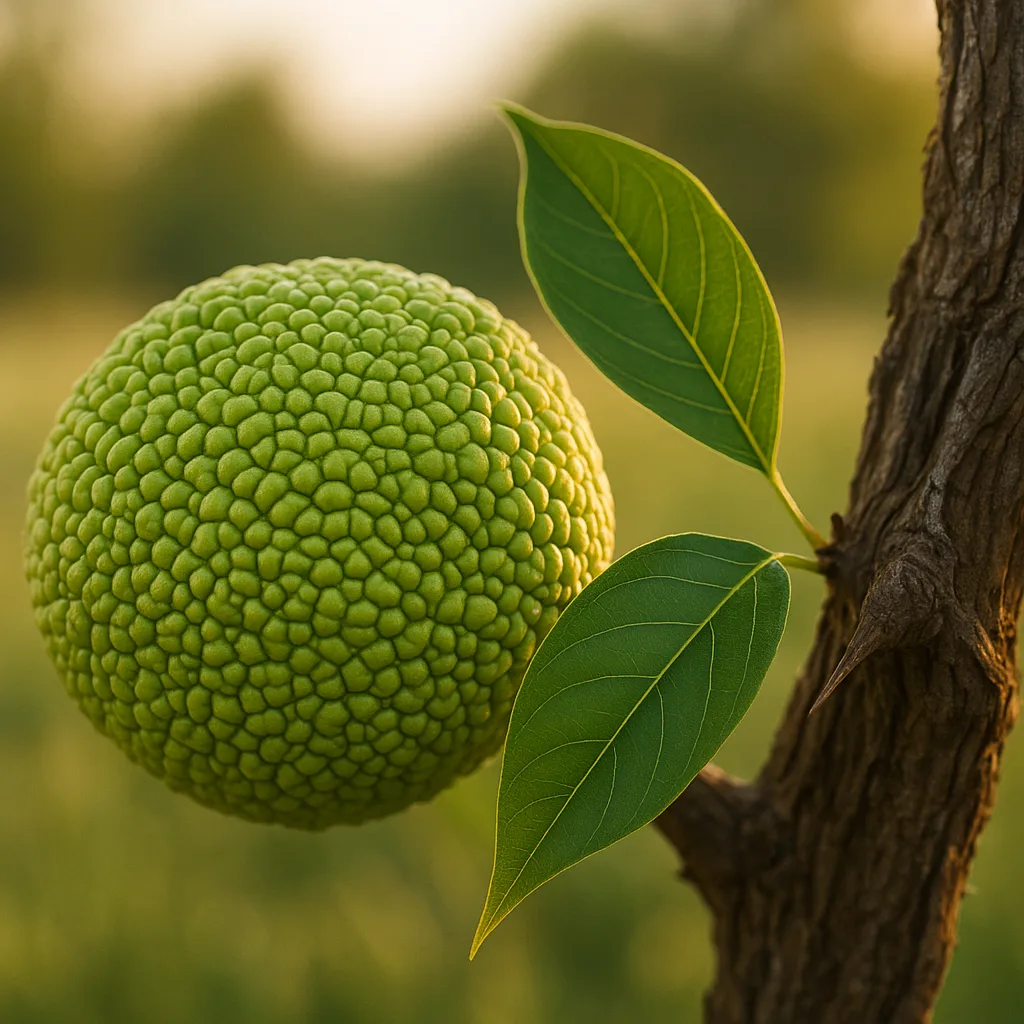
Quick ID at a Glance
If you only have a moment outdoors, use these immediate markers to flag an Osage orange:
- Fruit: Single, spherical, bumpy "hedge apple" 4–6 in (10–15 cm) in diameter, yellow‑green to brownish.
- Leaves: Simple, alternate, glossy, 3–6 in (7–15 cm) long, entire margins (no lobes).
- Thorns: Short stout spines commonly present on branches—especially on younger growth.
- Bark / wood: Deeply furrowed gray-brown bark with bright orange-yellow heartwood when cut.
- Growth form: Small to medium tree 8–15 m (25–50 ft), often multi-stemmed where hedged.
Leaves, Buds, and Twigs
Leaf details you can rely on
Leaf shape and arrangement are among the fastest ways to separate Osage orange from oaks and poplars.
For more on this topic, see our guide on Mastering Oak Leaves: Identify Trees in the Field.
- Arrangement: Alternate (one leaf per node), not opposite.
- Size: 3–6 in (7–15 cm) long; 1–3 in (2.5–7.5 cm) wide.
- Shape: Narrowly ovate to elliptic with a pointed tip; margins are entire (smooth) rather than toothed or lobed.
- Texture & color: Thin but firm, glossy bright green in summer, turning yellow in fall.
Twigs and buds
- Twill: Twigs are typically zig-zag and may bear short, sharp spines 0.5–2.5 cm long (0.2–1 in).
- Buds: Inconspicuous; unlike oaks, the buds are small and not easily visible from a distance.
- Smell: When crushed, leaves have a mild odor but not the strong resin of some poplars.
Bark, Wood, and Trunk Characteristics
Bark
- Younger trees have smoother gray bark; mature trees develop deep, interlacing furrows and ridges that can appear plaited or coarsely furrowed.
- When bark is cut away, the heartwood is distinctively yellow‑orange to deep orange—one of the fastest field clues if you can inspect a broken branch or stump.
Trunk and form
- Often multi-stemmed, especially where it has been used as hedgerow; solitary mature specimens form a rounded crown.
- Height typically 8–15 m (25–50 ft); diameter at breast height (DBH) commonly 30–60 cm for older trees.
Fruit and Seeds: The Distinctive "Hedge Apple"
What the fruit looks like
The fruit of Maclura pomifera—commonly called hedge apple, horse apple, or bois d'arc—is the most diagnostic feature for identifying osage orange trees.
You may also find our article on How to Recognize Maple Trees in the Field helpful.
- Size: Round, 4–6 in (10–15 cm) diameter.
- Surface: Irregularly bumpy and brain‑like, textured with convoluted lobes.
- Color: Green to yellow‑green on the tree; fruits may persist and become dull brown in winter.
- Weight: Often 200–500 g (0.5–1 lb) depending on moisture content and size.
- Interior: Numerous hard seeds embedded in a fibrous, pulpy matrix; seeds are roughly 5–8 mm long.
When they appear
- Flowers are small and appear in spring (April–May) but are easily missed. Fruits develop over summer and are ripe by late summer to fall, often hanging on into winter.
Habitat, Geographic Range, and Seasonal Behavior
Native range and spread
- Native: Indigenous to the south‑central United States—particularly parts of eastern Texas, Oklahoma, and western Arkansas (the Red River drainage).
- Naturalized: Widely naturalized across the Midwest and Eastern U.S. after widespread planting as living hedges in the 19th century.
- USDA hardiness: Typically hardy in zones 5–9.
Preferred habitat
- Thrives in well‑drained soils, tolerates drought, and grows in pastures, field edges, fencerows, and hedgerows. Less common in dense, shaded forests.
- Often found where it was intentionally planted as a living fence—look along old property lines and abandoned hedgerows.
Osage Orange vs. Similar Trees: How to Tell Them Apart
People searching for "identifying osage orange trees" often confuse them with other species. Below are practical comparisons.
Osage orange vs. oak trees (incl. white oak)
- Leaves: Oaks (Quercus spp.) have lobed leaves with deep sinuses or toothed margins; Osage orange leaves are entire, non‑lobed.
- Fruits: Oaks produce acorns (single‑seed nut with a cupule); Osage produces large bumpy spheres. If you find acorns, you have an oak—not an Osage.
- Bark: Mature oak bark varies by species but is often thick and furrowed; white oak (Quercus alba) has pale, flaky bark and rounded leaf lobes—distinct from Osage’s orange heartwood and smooth, glossy leaves.
Osage orange vs. poplar (how to identify a poplar tree)
- Leaves: Poplars (Populus spp.) usually have triangular or deltoid leaves with serrated margins and flattened petioles that make the leaves "quake" in the wind; Osage leaves are oval and entire.
- Fruit: Poplars produce catkins and wind‑born cottony seeds, not large bumpy fruit.
Osage orange vs. mulberry and other fruiting trees
- Mulberries (Morus spp.) produce elongated aggregate fruits that look like blackberries—entirely different from Osage’s single sphere.
- If the fruit is round and bumpy like a brain, that strongly points to Osage orange.
How to Identify Oak Trees, White Oak, and "Acorn Trees"
Searches such as how to identify an oak tree, how to identify a white oak, names of oak trees, and how to identify acorn trees reflect a broad interest in oak identification. Here’s a concise primer.
You might also be interested in Mastering Coin Identification: A Field Guide.
General oak identification steps
- Examine leaf shape: lobed (white oak group) vs. bristle‑tipped lobes (red oak group).
- Check leaf underside: many white oaks have pale, sometimes fuzzy undersides.
- Look for fruit: acorns are the telltale sign—note cap shape and size for species ID.
- Observe bark: texture varies by species and age; use bark in combination with leaves and acorns.
How to identify a white oak (Quercus alba)
- Leaves: 5–9 rounded lobes with deep sinuses; lobes end in smooth, rounded tips.
- Bark: Light gray, flaky to scaly with age.
- Acorns: Relatively small with a shallow, saucer‑like cap; mature in one season.
- Range: Eastern and central North America; prefers well‑drained upland soils.
Names of common oak trees (quick list)
- White oak (Quercus alba)
- Northern red oak (Quercus rubra)
- Bur oak (Quercus macrocarpa)
- Black oak (Quercus velutina)
- Pin oak (Quercus palustris)
- Live oak (Quercus virginiana)
Safety, Wildlife, and Human Uses
Toxicity and handling
- Osage orange fruit is generally considered inedible for humans. It is not a common food and may cause stomach upset if eaten in quantity.
- There are no widespread reports of severe toxicity to humans, but children and pets should not be encouraged to eat the fruit.
- Wood splinters can irritate the skin; when cutting, use gloves and eye protection. The dense heartwood is hard on saws and can blunt blades quickly.
Wildlife and practical uses
- Wildlife interactions: Some mammals and birds may eat seeds or use trees for shelter, though the large fruit is not a major wildlife food item.
- Historical uses: Dense, rot‑resistant wood valued for fence posts, bows (bois d'arc), and tool handles. Historically planted for hedgerows because of its spiny branches.
Using Tools and Apps Like Orvik to Confirm an ID
Field identification is easier when you combine visual keys with technology. Orvik and similar image‑ID tools can speed confirmation by comparing your photos against species databases.
Related reading: Spotting Hickory Trees in the Wild.
- Take photographs of: the whole tree, a close-up of a single leaf (both sides if possible), twig with thorn, fruit, and bark texture. These are the shots that give the highest confidence for automated ID.
- Use Orvik to cross‑check your observations; the app can highlight diagnostic features and suggest comparisons (e.g., "Osage orange vs. white oak"), helping validate what you see in the field.
- Combine Orvik’s suggestions with the measurements and cues in this guide for a final determination—if several lines of evidence match (fruit, leaves, bark), you can be confident of an ID.
Field Checklist: Step-by-Step When You Encounter a Suspect Tree
- Note location and habitat (hedgerow, pasture, forest edge).
- Measure or estimate leaf length (3–6 in) and fruit diameter (4–6 in) if present.
- Look for paired or single thorns on twigs.
- Inspect bark and, if practical and safe, look at the color of the heartwood in a broken twig.
- Photograph: whole tree, leaf (top/bottom), twig with thorn, bark, fruit. Upload to Orvik for rapid comparison.
Conclusion
Identifying osage orange trees is straightforward once you know the key visual cues: the trademark bumpy 4–6 in spherical fruit, glossy entire leaves 3–6 in long, thorny twigs, and bright orange heartwood. Use habitat context (hedgerows, old fences), seasonal timing (fruit in fall), and direct comparisons to oaks and poplars to rule out look‑alikes. For quick confirmation in the field, photograph the tree and run the images through Orvik—its visual ID can validate your observations and point out species‑specific traits. With the measurements and checks in this guide you’ll be able to identify Osage orange reliably and know when you’re looking at a different species, like a white oak or a poplar.
Frequently Asked Questions
- What is an osage orange tree (scientific name)?
- The osage orange is Maclura pomifera, a small to medium deciduous tree known for its large, bumpy fruits often called hedge apples.
- How do I identify an osage orange tree quickly?
- Look for a round, brain‑like fruit 4–6 inches across, alternate glossy leaves 3–6 inches long with smooth margins, and short spines on twigs. Orange heartwood on cut branches is also diagnostic.
- Are osage orange fruits poisonous?
- The fruits are generally considered inedible and may cause stomach upset if eaten in quantity; they are not commonly eaten by people. There are no widespread reports of severe toxicity, but avoid consumption, especially by children and pets.
- How can I tell an osage orange from an oak or white oak?
- Oaks have lobed leaves and produce acorns. White oak (Quercus alba) has rounded lobes and pale, flaky bark. Osage orange leaves are entire (no lobes) and its fruit is a single large, bumpy sphere rather than an acorn.
- What habitats do osage orange trees prefer?
- They prefer well‑drained soils in open sites: pastures, fencerows, and hedgerows. Native to parts of Texas, Oklahoma and Arkansas, they are now naturalized widely across the U.S.
- Can Orvik or other apps help identify osage orange?
- Yes — apps like Orvik can analyze photos of the leaves, twigs, fruit and bark to suggest species matches and highlight distinguishing features, which is helpful for confirming field IDs.
- How do I identify a poplar tree compared to osage orange?
- Poplars (Populus spp.) typically have triangular or deltoid leaves with serrated margins and flattened petioles that cause leaves to flutter; poplars produce catkins and cottony seeds, not large bumpy fruits like osage orange.