
Quick answer: is mistletoe poisonous?
Yes—many species of mistletoe contain biologically active compounds that can cause illness if eaten. European mistletoe (Viscum album) and several North American mistletoes in the genus Phoradendron contain lectins (mistletoe lectins), small toxic proteins called viscotoxins, and other compounds that affect the heart, gut and nervous system. Serious outcomes are uncommon with a single berry in an adult, but children, pets, and people with underlying heart conditions are at higher risk. Use identification tools like Orvik to confirm species before handling or removing plants.
What mistletoe species are most relevant to toxicity?
Mistletoe is a common name for several parasitic or hemiparasitic plants. Toxicity varies by species and by host tree.
Key species and scientific names
- European mistletoe: Viscum album — historically best studied; contains viscotoxins and mistletoe lectins (ML-I, ML-II, ML-III).
- American mistletoes: Phoradendron serotinum, Phoradendron leucarpum, Phoradendron flavescens — common in the U.S.; chemical profile differs but can still cause poisoning.
- Other related genera: Several related mistletoes in tropical regions (e.g., Tapinanthus) can have different toxicities.
What the chemicals do (briefly)
- Mistletoe lectins: glycoproteins that can damage cells and interfere with protein synthesis.
- Viscotoxins: small, basic proteins (~40–50 amino acids; ~4–6 kDa) that are cytotoxic and affect cardiac tissue and the gut.
How poisonous is mistletoe? Symptoms, onset and severity
Toxicity depends on species, plant part (berries are the most commonly ingested), the amount consumed, and the age/health of the person or pet.
For more on this topic, see our guide on Milkweed and Toxicity: What You Need to Know.
Common signs after ingestion
- Gastrointestinal: nausea, vomiting, abdominal pain, diarrhea — often within 30 minutes to a few hours.
- Cardiovascular: slow heart rate (bradycardia), low blood pressure (hypotension), arrhythmias in severe cases.
- Neurologic: dizziness, drowsiness, confusion; in high doses, seizures or coma are possible.
- Respiratory: in severe poisoning there can be difficulty breathing due to central or peripheral effects.
Severity and numbers
- Children are most vulnerable; even a few berries (5–10) can cause significant vomiting and drowsiness in small children.
- Adults usually require ingestion of larger quantities for life-threatening effects; serious poisoning from a single berry is rare but possible in sensitive individuals.
- Fatalities are documented but uncommon—most exposures produce mild to moderate symptoms with proper treatment.
Identification: how to recognize mistletoe in the field
Identification is the first step in assessing risk. Below are practical, measurable visual cues for the most common temperate mistletoes.
General growth form and habit
- Growth: hemiparasitic shrub that lives attached to branches of host trees, forming rounded clumps often called "witches' brooms."
- Clump size: typically 10–50 cm across for small plants; some clumps reach 1 m or more in diameter on large hosts.
- Attachment: visible haustoria (root-like attachments) at the base where it penetrates host branch bark.
Leaves, stems and berries — measurable cues
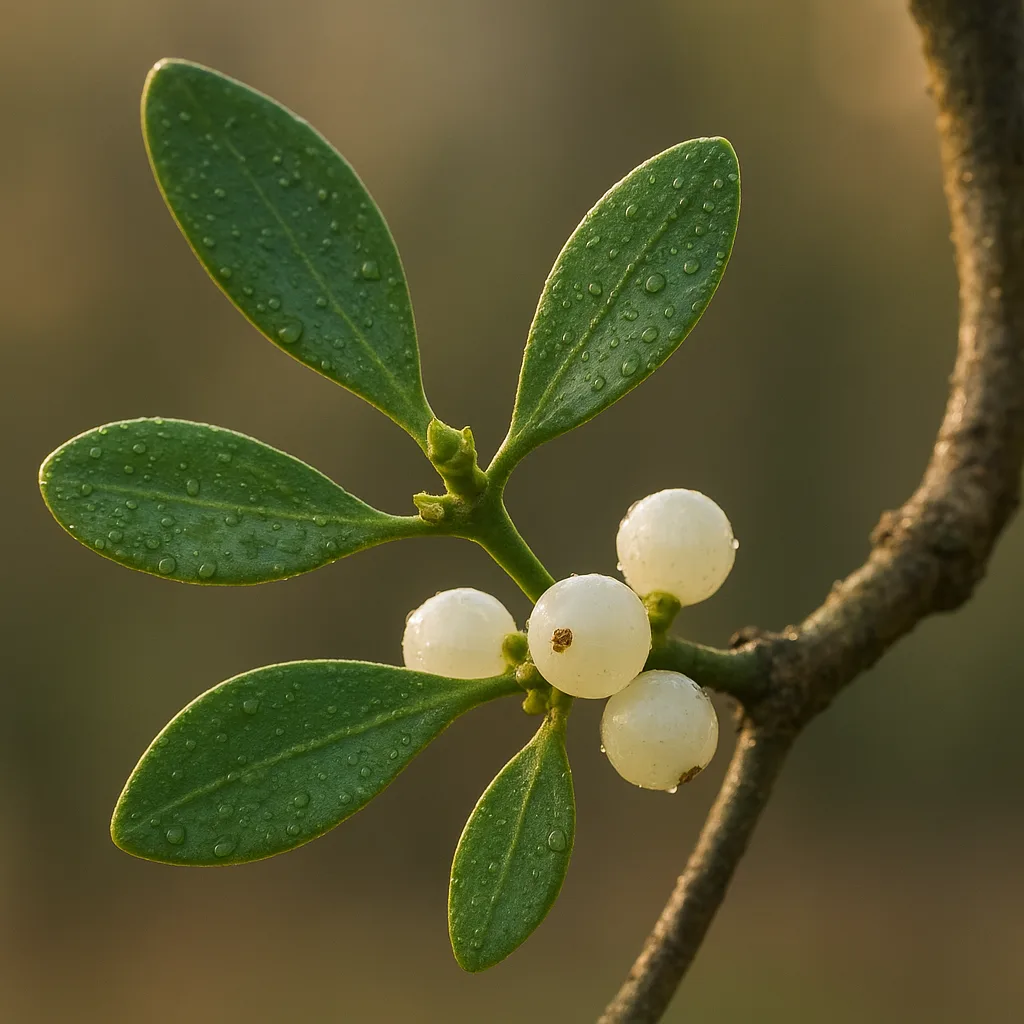
- Leaves: opposite or nearly opposite arrangement (paired), leathery, elliptic to obovate; length commonly 2–7 cm (0.8–2.8 in).
- Stems: green to yellow-green, slightly woody; often forked repeatedly producing a dense network.
- Berries: globose, translucent to white or yellowish (European), or white to pinkish (some American species); diameter typically 3–6 mm (0.1–0.25 in). Berries occur in clusters of 2–20.
- Flowers: small, inconspicuous; often yellowish-white; borne in leaf axils.
Seasonal cues and hosts
- Season: evergreen or semi-evergreen — berries and green foliage are most noticeable in late autumn and winter when host trees have lost leaves.
- Host trees: European mistletoe commonly on apple (Malus), hawthorn (Crataegus), lime/linden (Tilia), poplar (Populus); American mistletoes often on oaks (Quercus), pecan (Carya), and other hardwoods.
- Geographic clues: Viscum album is native to Europe and parts of Asia/Africa; Phoradendron species are native to North and Central America.
Practical identification tips using photos
- Take close-up photos of the leaf pairs, berry clusters, and the host branch — Orvik can help match these features to species.
- Note the host species and whether the mistletoe clump is high in the canopy or low on branches; some mistletoes prefer particular hosts and positions.
- Look for a rounded, ball-like silhouette in winter when host leaves are gone — an easy field cue.
Toxicity compared: mistletoe vs holly vs hemlock vs monkshood
When people ask "is mistletoe poisonous" they often mean "how dangerous is it compared to other toxic plants". Below are practical comparisons with visual and toxicological distinctions.
You may also find our article on Bleeding Heart Toxicity: What You Need to Know helpful.
Mistletoe vs Holly (Ilex spp.)
- Appearance: Holly is a woody shrub or small tree with distinct spiny or smooth glossy leaves and red/orange berries ~6–10 mm in diameter. Mistletoe forms green clumps with opposite leaves and white/yellow translucent berries 3–6 mm across.
- Toxins: Holly berries contain saponins and other irritants; mistletoe contains lectins and viscotoxins. Both cause GI upset; mistletoe has more potential for cardiovascular effects.
- Risk: Holly often causes vomiting and diarrhea; ingestion of a dozen or more berries can be significant in children. Mistletoe can be more dangerous to infants or vulnerable adults due to heart and neurologic effects.
Mistletoe vs Poison Hemlock (Conium maculatum)
- Appearance: Poison hemlock is a tall biennial herb (1–3 m), with hollow, smooth stems often spotted purple, finely divided pinnate leaves, and umbrella-shaped white flower clusters (umbels). Mistletoe is woody, grows on trees, and has evergreen leaves in paired arrangement.
- Toxins: Hemlock contains alkaloids such as coniine and gamma-coniceine that cause neuromuscular paralysis leading to respiratory failure. Mistletoe toxins act differently (lectins and viscotoxins) but can affect heart rate and consciousness.
- Contact risk: Hemlock is not typically poisonous to the touch, but ingestion of any part can be rapidly fatal. Mistletoe toxins are mainly dangerous when ingested; skin contact is not a usual route of severe poisoning.
Mistletoe vs Monkshood (Aconitum spp.)
- Appearance: Monkshood is a herbaceous perennial with deeply divided leaves and distinctive helmet-shaped blue, purple or yellow flowers arranged on spikes. All parts are highly toxic. Mistletoe grows on branches of trees, has small opposite leaves and berries.
- Toxins and contact: Monkshood contains aconitine and related alkaloids that can be absorbed through the skin; dermal exposure can cause numbness, tingling, and cardiac effects. Mistletoe is less likely to poison via skin contact but ingestion remains the primary risk.
Hemlock (tree) vs Poison hemlock (plant)
- Hemlock tree: Genus Tsuga — common temperate conifers (e.g., Tsuga canadensis). Not poisonous; needles and cones are typical conifer features.
- Poison hemlock: Conium maculatum — highly toxic herb unrelated to the hemlock tree; distinguished by tall hollow spotted stems and umbrella-like flower clusters.
- Quick ID: If it’s a tree with needles and cones, it’s a hemlock tree (non-poisonous). If it’s an herb with parsley-like leaves and white umbels, it’s poison hemlock (dangerous if ingested).
First aid and safety: what to do if someone eats mistletoe
Immediate, calm action improves outcomes. Here’s how to triage and respond.
First aid steps
- Remove any remaining plant material from the mouth and rinse with water.
- Do not induce vomiting unless instructed by a medical professional or poison control.
- Call your local poison control center immediately (in the U.S. call 1-800-222-1222) or emergency services if the person is having trouble breathing, convulsions, severe drowsiness, an irregular heartbeat, or loss of consciousness.
- Provide the person's age, weight, what was eaten (berries, leaves, quantity), and identification or photos if available — use Orvik to identify the plant and share that information with responders.
- Keep the patient calm and lying down; monitor breathing and pulse until help arrives.
Home and garden safety tips
- Keep mistletoe clumps out of reach of children and pets; consider removing or pruning infested branches if the plant is on a low branch.
- Wear gloves and eye protection when removing mistletoe; cut the host branch a safe distance from the crown to remove the clump and prevent regrowth.
- Store holiday greenery and decorations with mistletoe out of reach and labeled clearly. Many holiday injuries are accidental ingestions.
Practical removal and management
Because mistletoe is a parasite, removal often involves both immediate clump removal and longer-term host management.
Looking beyond this category? Check out How to ID a Bird from a Photo.
Related reading: Wisteria: Toxicity, ID, and Safe Handling.
Effective removal techniques
- For small clumps on accessible branches: prune the host branch 15–30 cm (6–12 in) below the base of the mistletoe to remove the infected tissue and haustoria.
- For larger trees or high clumps: hire a certified arborist; improper cutting can stress the host and encourage more regrowth.
- After removal: burn or dispose of clumps safely; do not leave clumps where children or pets can reach berries.
Long-term control
- Annual pruning of new shoots can suppress mistletoe over time but usually requires several seasons of diligence.
- Resistant or tolerant host species: in orchards and landscape plantings, select species less prone to severe mistletoe infections where practical.
Using technology to identify suspicious plants
When you find a plant and ask "is mistletoe poisonous?" you usually need fast confirmation. Smartphone apps can speed identification; Orvik is especially helpful for field ID.
How to get a reliable ID
- Photograph close-ups of leaf pairs, berries, the overall clump silhouette, and the host branch. Include a ruler or coin for scale if possible.
- Use Orvik to analyze images and compare characteristics (leaf size, berry color, host species). Orvik’s AI can suggest likely species and flag potentially toxic plants.
- If in doubt, combine app identification with local extension services or poison control advice — apps supplement, not replace, professional assessment.
Conclusion
Mistletoe is indeed poisonous: its berries and foliage contain lectins and viscotoxins that commonly cause gastrointestinal upset and, in larger doses or sensitive individuals, can affect the heart and nervous system. Identification by visual cues—paired leathery leaves, rounded evergreen clumps on host branches, and small translucent white or yellow berries—helps you assess risk. Use tools like Orvik to confirm species quickly and follow safe removal and first-aid steps if exposure occurs. Compare mistletoe carefully to holly, poison hemlock and monkshood to avoid confusion; remember that a "hemlock tree" (Tsuga) is not the same as poison hemlock (Conium maculatum). When in doubt, treat any ingestion as a potential emergency and contact poison control or medical services immediately.
Frequently Asked Questions
- Is mistletoe poisonous to touch?
- Skin contact with mistletoe rarely causes systemic poisoning. However, wear gloves when handling; minor skin irritation can occur and ingestion is the main danger.
- Are mistletoe berries poisonous to children?
- Yes. Children are more sensitive; ingesting a few berries can cause vomiting and drowsiness. Call poison control promptly for any ingestion.
- Is a hemlock tree poisonous?
- No. The hemlock tree (genus Tsuga) is an evergreen conifer and is not poisonous. Do not confuse it with poison hemlock (Conium maculatum), a toxic herb.
- Is hemlock poisonous to the touch?
- Poison hemlock isn’t typically absorbed through intact skin to cause severe toxicity, but avoid contact and wear gloves. Monkshood (Aconitum) can be absorbed through the skin and is more hazardous to touch.
- How is hemlock poisonous?
- Poison hemlock contains alkaloids such as coniine that disrupt neuromuscular transmission, causing paralysis and potentially fatal respiratory failure if ingested.
- Are holly berries poisonous?
- Yes. Holly (Ilex spp.) berries contain saponins and other irritants that can cause vomiting and diarrhea. Large numbers (e.g., 20–30 berries) can cause more severe symptoms in children.
- How can I quickly identify mistletoe?
- Look for a rounded evergreen clump on tree branches, paired leathery leaves 2–7 cm long, and clusters of translucent white or yellow berries ~3–6 mm across. Use Orvik to photograph and confirm identification.