
Maples (genus Acer) are among the most recognizable trees in temperate landscapes, yet casual observers often confuse species or mistake maples for other trees. This guide gives field-tested, measurable cues—leaf shape, size, lobe count, venation, petiole sap, samara form, and seasonal color—to make maple leaf identification reliable whether you’re in a city park or deep in mixed woodlands. I also explain how to distinguish maples from lookalikes such as American elm and black cherry, and how digital tools like Orvik can speed ID when leaves are incomplete or juvenile.
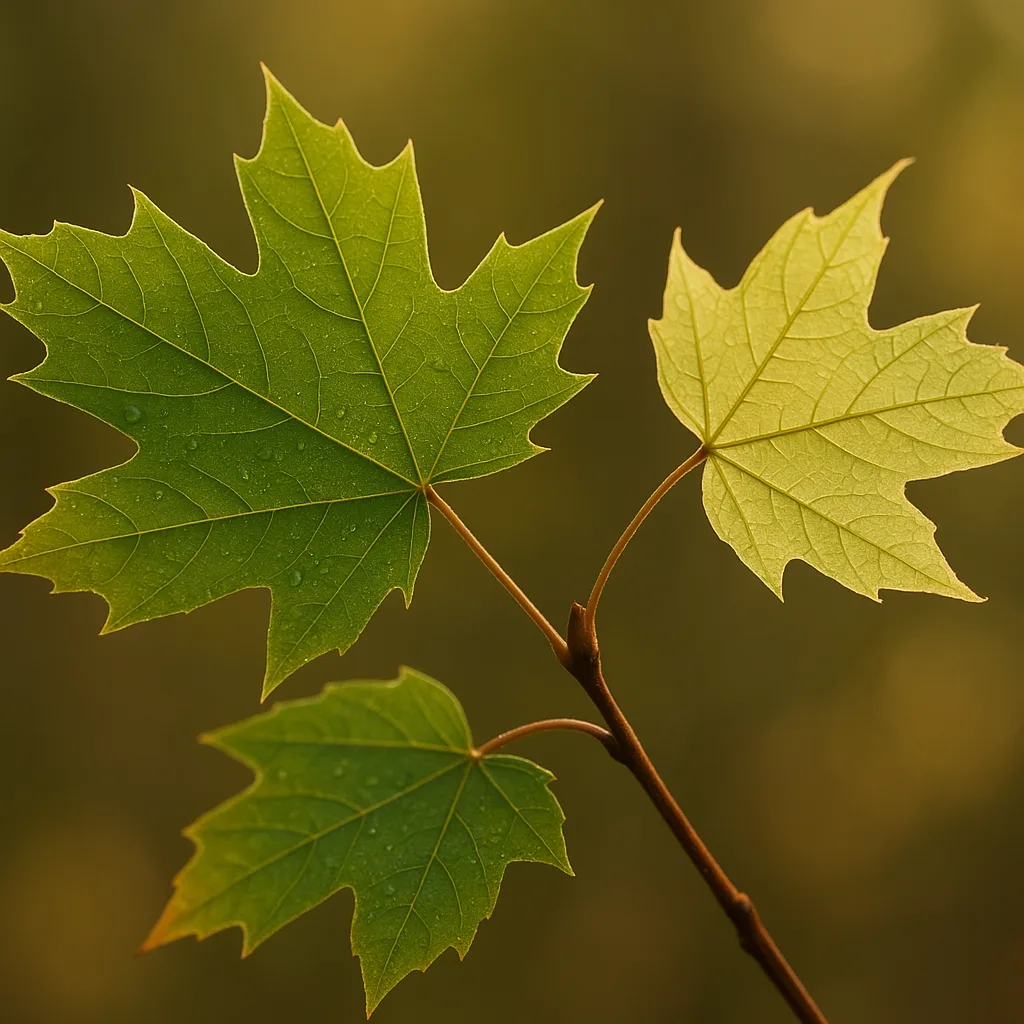
1. Quick Maple ID: The Key Visual Traits
Start with a handful of high-value traits that separate maples from most other trees. These are quick to check in the field.
- Leaf arrangement: Opposite (a pair of leaves emerges from the same node). This is a primary trait—maples are opposite, elms and cherries are alternate.
- Leaf type: Most maples have palmate simple leaves—flat blades with radiating lobes (3–9 lobes typical). Some, like boxelder (Acer negundo), have pinnately compound leaves with 3–7 leaflets.
- Size: Leaf width ranges from tiny 4 cm (1.5 in) in some Japanese maples to >30 cm (12 in) in bigleaf maple (Acer macrophyllum).
- Lobes and sinuses: Lobes vary from shallow to deeply cut. For example, silver maple (Acer saccharinum) has deeply incised lobes; sugar maple (Acer saccharum) has rounded, shallow sinuses.
- Samara (fruit): Paired winged samaras, often called "helicopters" or "whirlybirds," typically 2–5 cm (0.8–2 in) long from seed tip to wing tip.
- Petiole sap: Norway maple (Acer platanoides) exudes a milky sap when the petiole is cut—a useful diagnostic.
Field checklist to carry
- Note leaf arrangement (opposite vs alternate).
- Measure leaf width and length (in cm or inches).
- Count lobes and note depth of sinuses.
- Inspect leaf margin (toothed, serrated, or smooth).
- Look for samara clusters and measure wing length.
2. Common North American Maples: Species Profiles
Below are species you’re most likely to encounter in North America, with precise, field-ready descriptors.
-
Sugar maple (Acer saccharum)
- Leaf: Opposite, simple, typically 5 lobes, 7–12 cm (3–5 in) across. Lobes rounded, shallow sinuses.
- Fall color: Brilliant orange to deep red. Sap: primary source of commercial maple syrup.
- Habitat: Mixed hardwood forests in northeastern and central U.S. and southeastern Canada.
-
Red maple (Acer rubrum)
- Leaf: 3–5 shallow lobes, 6–10 cm (2.5–4 in) across. Margins often serrated.
- Fall color: Variable—bright red, orange, or yellow. Buds and twigs red-tinged.
- Range: Widespread across eastern North America; tolerates wetlands and uplands.
-
Silver maple (Acer saccharinum)
- Leaf: Deeply cut lobes (5), narrow sinuses; 8–18 cm (3–7 in) across. Underside often whitish-silvery.
- Habitat: Floodplains and riversides; fast-growing and often planted as street trees.
-
Norway maple (Acer platanoides)
- Leaf: 5–7 lobes, 7–15 cm (3–6 in) across. Exudes milky sap from petiole when cut.
- Notes: Non-native in North America and often invasive in some regions.
-
Boxelder (Acer negundo)
- Leaf: Pinnately compound, 3–7 leaflets, each 3–7 cm long. Leaflets toothed or lobed.
- Habitat: Disturbed sites, riparian zones; often multi-stemmed.
-
Bigleaf maple (Acer macrophyllum)
- Leaf: Huge, 15–30+ cm (6–12+ in) across, typically 5 lobes.
- Range: Pacific Northwest coastal forests.
-
Japanese maple (Acer palmatum)
- Leaf: 5–9 deeply divided lobes, usually small, 4–12 cm (1.5–5 in). Often finely serrated margins.
- Notes: Widely cultivated; numerous ornamental cultivars with varied lobing and color.
3. Maple Leaf Identification Chart (Quick Comparison)
This quick chart is a field-ready decision tree. Use it like an at-a-glance filter to narrow species in minutes.
For more on this topic, see our guide on Maple Leaf ID: Recognizing Acer Species in the Field.
- Are leaves opposite? If yes, proceed; if alternate, it's not a maple (see elm/cherry below).
- Are leaves compound? If pinnately compound, likely Acer negundo (boxelder).
- If simple and palmate: count lobes.
- 3 lobes common: certain cultivars/species like some red maples or juvenile leaves.
- 5 lobes with rounded sinuses: likely Acer saccharum (sugar maple).
- 5 lobes with deep, narrow sinuses and silvery underside: A. saccharinum (silver maple).
- Large leaves >15 cm: A. macrophyllum (bigleaf).
- Petiole exudes milky sap? If yes, consider A. platanoides (Norway maple).
- Samara wing length and angle: narrow long wings and widely separated wings suggest silver maple; more compact paired samaras often indicate sugar or red maple.
4. Maples vs. Lookalikes: How to Tell Them Apart
People searching "maple leaf identification" are often trying to tell maples from other common trees. Below are clear comparisons with two frequent confusions.
Maple vs American Elm (Ulmus americana)
- Leaf arrangement: Maple leaves are opposite; elm leaves are alternate.
- Leaf shape: Elm leaves are typically asymmetrical at the base, oval to oblong with double serrated margins; maples are palmate with lobes.
- Venation: Elm veins are pinnate and arching; maple veins radiate from the petiole into lobes.
Maple vs Black Cherry (Prunus serotina)
- Arrangement: Black cherry leaves are alternate, maples opposite.
- Surface and margin: Black cherry leaves are simple, lanceolate to oblong with fine serrations and a distinct rusty-brown glandular underside in mature leaves. Maples have lobed palmate blades.
- Bark and fruit: Black cherry produces clusters of small cherries (black when ripe) and has flaky, dark bark; maples produce paired samaras and have smoother bark when young.
5. Seasonal and Habitat Clues for Better Identification
Leaves change through the seasons, and habitat often narrows species faster than morphology alone.
You may also find our article on Mastering Oak Leaves: Identify Trees in the Field helpful.
- Spring: Bud color and early leaf shape can be diagnostic—red maple buds and twigs often red; sugar maple buds brown and plumper.
- Summer: Leaf margins, undersides and venation most visible; look at leaf glossiness and hair (pubescence) under magnification.
- Fall: Color is species-specific: sugar maple orange/red, red maple often brilliant red, silver maple tends toward pale yellow.
- Habitat: Silver maple in wet riparian soils; sugar maple prefers well-drained, upland mixed forests; bigleaf maple on Pacific coast; boxelder in disturbed, riverine areas.
Practical seasonal tips
- In autumn, confirm species by comparing dominant canopy color across a stand—uniform orange suggests sugar maple dominance.
- In winter, look at bud arrangement (opposite in maples) and samara remnants for ID clues.
6. Field Methods, Tools, and When to Use Orvik
Good ID combines observation, measurement, and reference. Here’s a practical toolkit and workflow you can use in the field.
- Tools to carry: Pocket ruler (cm/in), hand lens (10x), field notebook, phone camera, and a knife to examine petiole sap if safe and legal.
- Steps:
- Photograph leaf top and underside, petiole, and samaras if present.
- Measure leaf width and length and count lobes/leaflets.
- Record habitat, soil moisture, and GPS coordinate if possible.
- Digital aids: Orvik and similar AI-powered visual ID apps accelerate species confirmation from photos. Use Orvik as a second opinion when leaves are damaged, atypical, or the tree is a cultivated variety; the app integrates visual pattern recognition with geographic context to narrow results.
When not to rely solely on pictures
- Juvenile foliage can differ markedly from mature leaves—young silver maples sometimes look less incised.
- Urban cultivars (Norway maple varieties, Japanese maple cultivars) can be highly modified by humans; combine app suggestions with field measurements.
7. Uses, Safety, and Toxicity Notes
Maples are valued for timber, syrup, shade, and ornamental use, but there are important safety notes.
You might also be interested in AI Field Guide: Identify Birds Fast.
Related reading: How to Recognize Maple Trees in the Field.
- Edible uses: Sap from sugar maple (Acer saccharum) and some other species can be boiled down into maple syrup. Typical sap sugar concentration is 2%–3%; it takes roughly 40 liters of sap to make 1 liter of syrup (varies by sugar content).
- Toxicity: Red maple (Acer rubrum) leaves that are wilted or dry can be toxic to horses, causing red maple toxicosis (acute hemolytic anemia). Even small amounts—ingestion of a few kilograms of wilted leaves—can be dangerous for some horses. Keep horses away from piles of fallen red maple leaves, especially after storms.
- Allergen & safety: Generally, maple leaves are not highly allergenic to humans, but pollen from male trees can aggravate hay fever. Always wash hands after handling tree sap or cut petioles if you have sensitive skin.
8. Troubleshooting Tough IDs and Final Checklist
Some specimens are tricky—hybrids, urban cultivars, and juvenile growth can confound simple rules. Here’s a concise checklist and a troubleshooting flow.
- Confirm leaf arrangement: opposite? If not, stop—it's not a maple.
- Determine leaf type: simple palmate vs pinnate compound.
- Count lobes or leaflets and measure: note widths, lengths in cm or inches.
- Check undersurface color and hair, petiole sap, and samara structure.
- Use seasonal context and habitat to narrow possibilities.
- If uncertain, photograph all features and consult Orvik or a regional field guide for confirmation.
When to collect a specimen
- Only where legal and ethical: collect a single leaf or samara for closer study if doing so won’t harm a protected tree.
- Label with date, location, and preliminary notes to maintain a reliable record.
Conclusion
Maple leaf identification combines several measurable, repeatable cues: opposite leaf arrangement, palmate leaf shape (except boxelder), lobe count and sinus depth, samara characteristics, and petiole behavior. Use habitat and season as supporting clues. When a specimen is unclear—juvenile growth, hybrids, or damaged leaves—Orvik is a useful supplemental tool to check an AI-based visual ID against your field notes. With a small ruler, a hand lens, and the checklist above, you can identify most maples reliably in the field.
Frequently Asked Questions
- How do I tell a maple leaf from an elm leaf?
- Maples have opposite leaf arrangement and palmate lobes; elms have alternate leaves that are asymmetrical at the base with pinnate venation.
- What measurements are key for maple identification?
- Measure leaf length/width (cm or in), count lobes or leaflets, note sinus depth, and measure samara wings (typically 2–5 cm).
- Can Orvik identify maples from photos?
- Yes. Orvik's AI matches leaf patterns and geographic context; it’s most reliable when you supply top and underside photos plus samaras.
- Are any maple leaves toxic to animals?
- Yes. Wilted red maple (Acer rubrum) leaves can cause fatal hemolytic anemia in horses. Avoid letting horses eat fallen or wilted maple leaves.
- How can I distinguish Norway maple from sugar maple?
- Norway maple often has 5–7 lobes and exudes milky sap from the petiole when cut; sugar maple has 5 rounded lobes and no milky sap.
- Why do silver maples look different?
- Silver maple has very deeply incised lobes and a pale, silvery underside; it prefers wet soils and grows rapidly, often on riverbanks.
- What is the quickest first test for maple leaves?
- Check leaf arrangement—if leaves are opposite, you’re likely looking at a maple or another opposite-leaved genus (e.g., ash, dogwood).