
Maple trees (genus Acer) are among the most familiar and ecologically important trees in temperate landscapes. People searching for "maple tree identification" want clear visual clues they can use at a glance — leaf shape, bud position, bark texture, samara shape, and seasonal signals. This guide gives field-tested, measurable traits and comparison tips so you can confidently identify common maples and tell them apart from lookalikes such as black walnut, oak and ash. Use these cues alongside photos in apps like Orvik to confirm IDs in minutes.
1. The quick field checklist: 6 visual cues
When you first approach an unknown tree, check these six features in order. Each is fast to observe and highly diagnostic.
- Leaf arrangement: opposite (maples) vs alternate (many others).
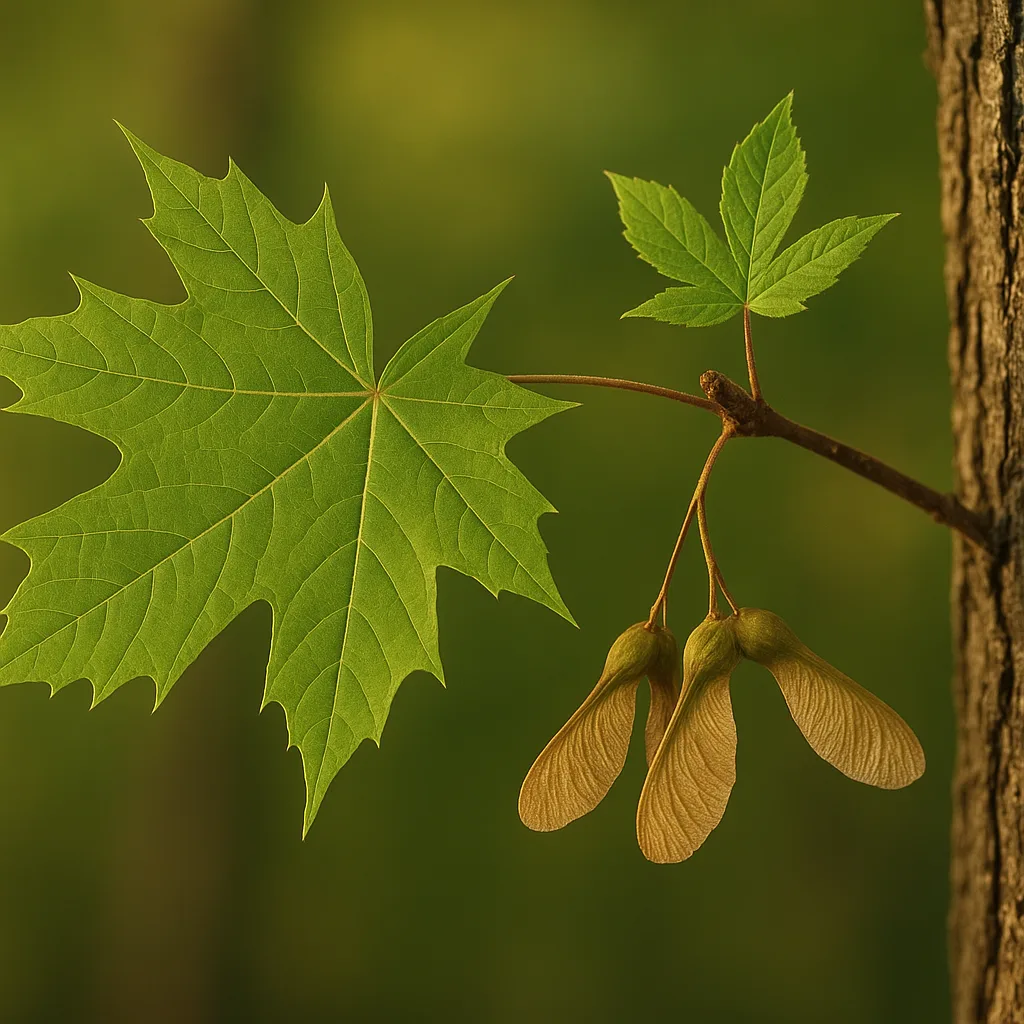
- Leaf shape: palmately lobed (maples) vs pinnate or simple toothed.
- Buds: opposite and often clustered at twig tips on maples.
- Bark texture: smooth, furrowed, or scaly — varies by species and age.
- Fruit type: paired winged samaras (the classic "helicopter" seeds).
- Habitat and range: where the tree grows narrows the likely species.
2. Leaves, buds and arrangement
Leaves and buds are the fastest, most reliable clues for maple tree identification.
Leaf arrangement and basic shapes
- Opposite leaves: Maples always have leaves (or leaflets) arranged opposite one another on the twig. This is a key trait — compare it to alternate arrangement in oaks, walnuts, and many other genera.
- Palmate lobing: Most maples have palmately lobed leaves (5–9 lobes typical). Leaf width ranges from about 5 cm in small ornamental species to 25 cm in large sugar maple leaves.
- Compound exceptions: Acer negundo (boxelder) has compound leaves (3–7 leaflets) but still opposite leaflet pairs on the rachis — a useful nuance.
Bud and petiole details
- Buds: Opposite buds sitting at the leaf scar tip; buds often have a pointed, conical shape. Bud color and size help: sugar maple buds are chestnut-brown and about 6–10 mm long; red maple buds are smaller and reddish.
- Petiole color/latex: Norway maple (Acer platanoides) oozes a milky sap if you snap the petiole — a diagnostic test often used in the field.
3. Bark and trunk: identify maple tree by bark
Many people search "maple tree identification bark" because mature bark patterns are visible year-round. Bark changes with age and species, so always note tree size and look at multiple sections.
For more on this topic, see our guide on Maple Leaf ID: Recognizing Acer Species in the Field.
- Sugar maple (Acer saccharum): older trees show tight, interlacing vertical ridges forming scaly plates; bark color gray to brown; furrows relatively shallow but complex.
- Red maple (Acer rubrum): smooth, light gray when young; becoming darker and scaly with small plated ridges as it ages.
- Silver maple (Acer saccharinum): often develops flaky, shaggy bark on older trunks; inner bark paler.
- Norway maple (Acer platanoides): dark gray furrows that become shallowly ridged, often with a corky texture on some branches.
Practical tips:
- Measure bark ridges and plate size: sugar maple ridges often 1–3 cm wide, forming a net-like pattern.
- Note the twig cross-section and lenticels: silver maple twigs show more prominent lenticels than sugar maple.
- Use bark plus buds: a trunk that looks maple-like but has alternate buds suggests a non-maple species.
4. Fruit, flowers and seasonal behavior
Samaras (paired winged seeds), spring flowers, and bud timing are among the most diagnostic seasonal features.
Samaras (the "helicopters")
- Form: Maples produce paired samaras (two-winged seeds joined at the base) in spring or early summer.
- Size: Samara wings range from 1.5 cm (small ornamental maples) up to 5 cm or more (silver maple). Typical sugar maple samaras are 2–3 cm long.
- Angle: The angle between paired samara wings is diagnostic: silver maple often shows nearly 180° spread; Norway maple usually 50–70°; sugar maple roughly 60–90°.
Flowers and phenology
- Spring bloom: Maples flower before or with leaf-out. Red maple blooms in early spring (March–May) with red flowers; silver and sugar maples have less conspicuous, yellow-green clusters.
- Leaf-out timing: Early leafing species like silver maple leaf out earlier in spring; sugar maple tends to leaf out later and turn color spectacularly in fall.
5. Common maple species: field notes and pictures in words
Below are concise, measurable field descriptions for the maples you are most likely to encounter in North America and Europe. Use these as mental "photo captions" when you compare to images in Orvik or a field guide.
You may also find our article on Mastering Oak Leaves: Identify Trees in the Field helpful.
Sugar maple (Acer saccharum)
- Height: 20–35 m tall; trunk DBH commonly 60–150 cm in mature trees.
- Leaves: 7–16 cm wide, 5 lobes with smooth sinuses; fall color brilliant orange-red to yellow.
- Bark: interlacing ridges, scaly plates on mature trees.
- Samaras: 2–3 cm, joined at ~60–90°.
- Range: Northeastern and Great Lakes regions; extends into the Appalachian Mountains.
Red maple (Acer rubrum)
- Height: 12–25 m; often multi-stemmed in wet sites.
- Leaves: 6–12 cm, 3–5 lobes with serrated margins; petioles often red.
- Bark: smooth when young, becoming shaggy or scaly with age.
- Samaras: smaller, often red-tinted; bloom and seed early in spring.
- Range: Widespread across eastern North America.
Silver maple (Acer saccharinum)
- Height: 15–30 m.
- Leaves: deeply cut lobes, 8–20 cm across, underside pale silver-white — the key visual cue.
- Bark: flaky or shaggy on mature trunks; twigs brittle.
- Samaras: long wings often 3–5 cm, spread wide.
- Habitat: floodplains, streambanks, wet soils.
Norway maple (Acer platanoides)
- Height: 12–25 m; often planted as a street tree and invasive in some regions.
- Leaves: 5–7 lobes, up to 20 cm across; milky sap in petiole when nicked.
- Bark: dark, furrowed with age; often coarse on old trees.
- Range: native to Europe; widely planted and naturalized in North America.
Boxelder (Acer negundo)
- Height: 6–20 m, often multi-stemmed.
- Leaves: pinnately compound, 3–7 leaflets; leaflets 3–10 cm long.
- Characteristic: tolerant of urban and disturbed sites.
6. Habitat, range and seasonal behavior
Where a tree grows and how it behaves through the seasons is as diagnostic as its morphology.
- Floodplain species: silver maple and boxelder tolerate saturated soils and frequent disturbance.
- Upland/nutrient-rich forests: sugar maple dominates mature, well-drained northern hardwood forests with rich soils.
- Urban settings: Norway maple, silver maple and various hybrids are common as planted street trees.
- Altitude and latitude: sugar maple favors cooler climates and higher elevations compared with red maple which tolerates a wider climatic range.
- Seasonal color: sugar maple shows intense fall colors (orange-red) while silver maple often fades earlier.
7. Compare & contrast: how to tell maples from lookalikes
Many searches that include "how to tell a maple tree" come from confusion with trees that have similar leaves or bark. Below are crisp comparisons.
You might also be interested in Identify Your Cat: A Field Guide.
Maple vs Black Walnut (Acer vs Juglans nigra)
- Leaf arrangement: Maples are opposite; black walnut has alternate, pinnately compound leaves (15–23 leaflets), 30–60 cm long.
- Fruit: Maples have paired samaras; black walnut produces a single round nut (3–5 cm) inside a green, fleshy husk.
- Bark: Black walnut bark is dark with deep furrows forming diamond-shaped ridges; maple bark is more variable but often with palmate leaf scars at twig nodes.
- Toxicity: Black walnut roots and husks produce juglone, which is allelopathic and can harm nearby sensitive plants (tomatoes, apples).
Maple vs Oak
- Leaf lobing: Oaks have lobed leaves but with alternate arrangement and often deeper sinuses or rounded tips; maples are opposite and usually palmate.
- Fruit: Oaks produce acorns; maples produce samaras.
Maple vs Ash
- Leaf arrangement: Ash (Fraxinus) leaves are opposite too, but they are pinnate (multiple leaflets) rather than palmately lobed.
- Bud and twig: Ash has a distinct stout terminal bud (if present) and smooth gray bark with diamond ridges on mature trees; maples have opposite simple leaves (except boxelder).
8. Tools, safety and best practices in field ID
Field identification blends observation with tools. Use a good hand lens, a tape measure, and a reliable identification app like Orvik to match your photos to reference images and species profiles. Orvik’s AI can help confirm features such as opposite leaves or samara shape when you upload close-up photos of leaves, bark, and fruit.
Related reading: How to Identify Maple Leaves in the Field.
- Photography tips: Photograph the whole tree, individual leaves (top and underside), buds, bark close-ups, and any fruit. Include a coin or ruler for scale when possible.
- Safety: Wear gloves when handling fresh black walnut husks—they stain and can be irritating. Be cautious under large old maples in storms; big limbs can fall. Some people have skin sensitivity to certain tree saps; avoid prolonged skin contact with broken bark or sap.
- Environmental caution: If you suspect juglone from black walnut is affecting garden plants, keep sensitive species at least 10–15 m away from the walnut dripline and avoid wood chip mulch made from black walnut.
- Ethics: Don’t remove nuts or seeds from private property without permission; leave wildlife food sources intact where possible.
Conclusion
Maple tree identification rests on a handful of reliable traits: opposite leaf arrangement, palmately lobed leaves (or compound in boxelder), paired samaras, and distinctive bark patterns that vary by species and age. Combine leaf and bud checks with samara and bark observations, note habitat and season, and use tools like Orvik to confirm when you have photos. With practice, you can go from question to confident identification in a single walk through the woods.
Tip: If you want targeted help, photograph (a) a close-up of the leaf upper and lower surfaces, (b) the twig showing opposite leaves and buds, and (c) the samara or fruit; upload these to Orvik and compare to the species matches.
Frequently Asked Questions
- How do you identify a maple tree by its bark?
- Look for bark that changes with age: sugar maple has interlacing ridges and scaly plates, red maple is smooth when young and becomes scaly, and silver maple often has flaky, shaggy bark. Combine bark clues with leaves and samaras for certainty.
- How can I tell a maple tree from a black walnut tree?
- Check leaf arrangement: maples have opposite leaves or leaflets; black walnut has alternate, pinnately compound leaves with 15–23 leaflets. Walnuts produce round nuts in green husks, while maples produce paired winged samaras.
- What do maple samaras look like and when do they appear?
- Maple samaras are paired winged seeds (often called helicopters). Size varies by species (1.5–5 cm). They typically develop in spring to early summer shortly after flowering and are visible through early summer.
- Can I use leaf shape alone to identify maples?
- Leaf shape is very helpful but not foolproof. Use leaf arrangement (opposite), bud position, samaras and bark together. Boxelder is a maple with compound leaves, which can confuse ID if you rely on simple leaf shape alone.
- Are any maples toxic to people or pets?
- Most maples are not toxic to humans; however, horses can be sensitive to wilted maple leaves (red maple toxicity). Black walnut wood and husks can be toxic to some plants due to juglone; handle walnut husks with gloves as they stain and may irritate skin.
- What’s the best way to identify a maple from a photo?
- Take multiple photos: whole tree, leaf top and underside, twig with buds, bark close-up, and samara or fruit. Upload these to an AI identification tool like Orvik for a rapid, evidence-based match.
- How do I identify a maple in winter when there are no leaves?
- In winter, use bud arrangement (opposite buds), bark texture, leftover samaras on branches, and branching pattern. Bud size and shape (e.g., sugar maple’s conical brown buds) help narrow species.