
Moringa is a small tree with outsized fame: a nutritious green known across continents by many names. If you searched "moringa common name" you probably want a clear answer — not just a list of labels, but the scientific identity, local names used in kitchens and markets, visual cues to confirm the plant in the field, and how it differs from look-alikes like malabar spinach. Below is an expert field guide to the common and botanical names of moringa, how to identify it, where it grows, and practical safety notes for foragers and growers. Orvik can help you confirm ID from photos in seconds, but this article gives the descriptive background you need to understand what you’re seeing.
1. The primary names: common, botanical and scientific
What people mean by "moringa"
The term "moringa" is used broadly but most often refers to the species Moringa oleifera Lam. It is the best-known member of the genus Moringa and is the species most widely cultivated for food and oil.
- Scientific / botanical name: Moringa oleifera Lam. (family Moringaceae).
- Common English names: moringa, drumstick tree, horseradish tree, ben oil tree.
- Popular local names: malunggay (Philippines), sajna or shigru (India), murungai (Tamil), munaga (Telugu), benzolive (some West African markets).
Why scientific names matter
When people ask "moringa common name," they often want to match an everyday label to a precise plant. Scientific names avoid confusion: Moringa oleifera uniquely identifies that species, whereas common names vary by language and region.
- Scientific name format: genus + specific epithet + authority (e.g., Moringa oleifera Lam.).
- Family: Moringaceae — placed in the order Brassicales, related to plants that produce mustard oils.
2. Other species and alternative botanical names
Species in the genus Moringa
Moringa is a small genus with about 13 accepted species worldwide. Moringa oleifera is dominant in cultivation, but others exist and may be seen in the wild or botanical collections.
- Moringa oleifera — the most common cultivated species (food, oil).
- Moringa stenopetala — native to Ethiopia and Kenya, larger leaflets and thicker pods; used similarly to M. oleifera.
- Moringa peregrina — found in the Arabian Peninsula and northeast Africa; seeds yield oil used traditionally.
- Other species: M. drouhardii, M. hildebrandtii, M. concanensis, etc. — more restricted ranges.
When a common name covers multiple species
"Drumstick tree" or "horseradish tree" may be applied to different Moringa species in local speech. Always cross-check with botanical characters (leaflet shape, pod length, flower and seed morphology) when precise identification matters for conservation, trade or medicinal use.
3. Visual identification: how to recognize Moringa oleifera
Key field characteristics
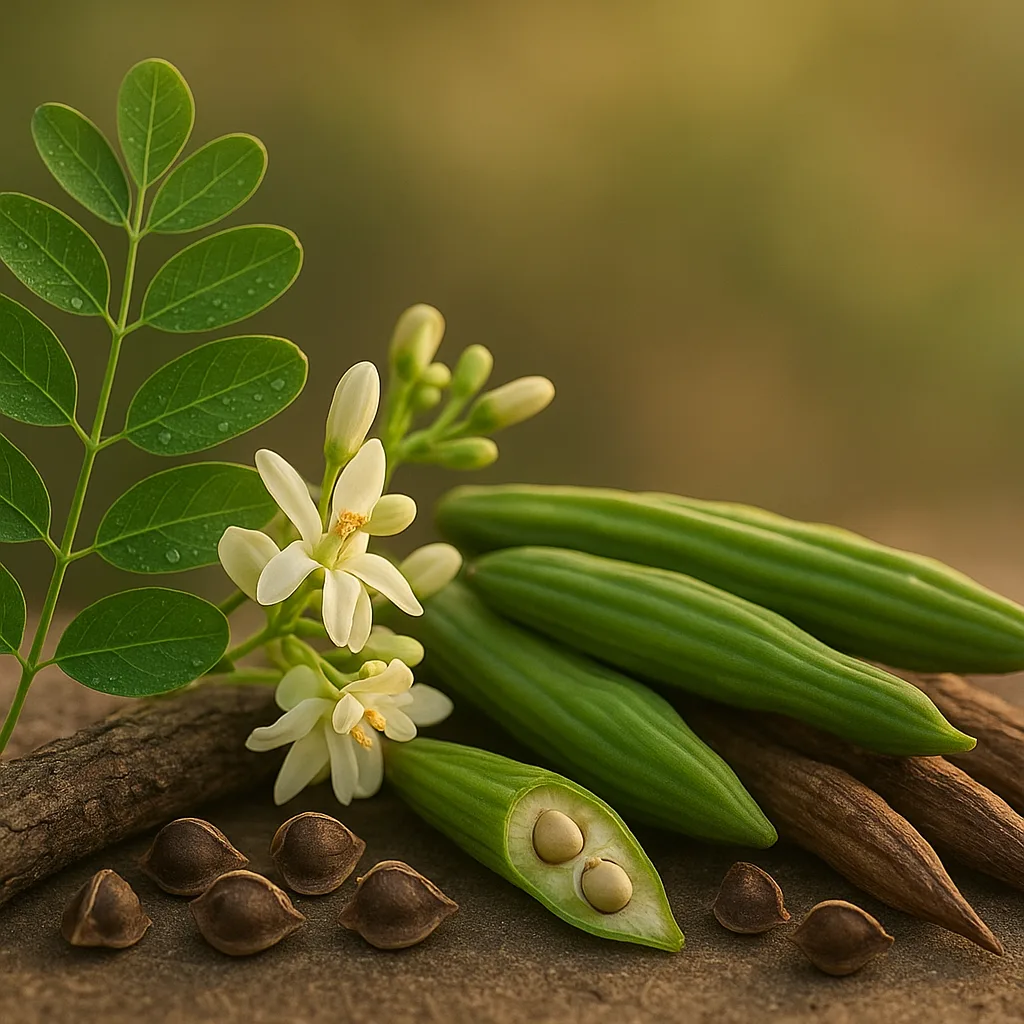
Below are practical, visual cues you can use to identify Moringa oleifera in the field. These features are measurable and repeatable.
For more on this topic, see our guide on Understanding Hydrangea Names — From Common to Scientific.
- Size and habit: Fast-growing, small to medium tree, typically 3–10 m tall; slender trunk with open, spreading crown.
- Leaves: Pinnate, 20–45 cm long, with 9–19 pairs of small, oval leaflets. Leaflets are typically 1–2.5 cm long, 0.5–1.2 cm wide, bright to dull green, smooth-margined.
- Flowers: Fragrant, bisexual, white to cream, about 1–1.5 cm across; arranged in loose, drooping panicles; bloom after rains in many regions.
- Pods ("drumsticks"): Long, slender, three-sided pods 20–45 cm long and 1–3 cm thick while green; turn brown and fibrous when mature.
- Seeds: Round to oblong, about 1–1.5 cm diameter, each surrounded by a papery three-winged hull; white to tan kernel.
- Bark and roots: Grey-brown bark; roots are often thick and tuberous with a pungent, horseradish-like taste if sliced (hence "horseradish tree").
Photographic cues for mobile ID apps
- Leaf close-ups showing pinnate arrangement and small oval leaflets.
- Pod images emphasizing length and three-sided cross-section.
- Flower cluster shots capturing white petals and yellowish stamens.
- Seed images where winged hulls are visible.
Using Orvik to upload these four image types increases the chance of a confident ID by the app, especially when images are taken in good light and from multiple angles.
4. Habitat, cultivation and geographic distribution
Native range and global spread
Moringa oleifera is native to the foothills of the Himalayas in northwestern India. From there it has spread by cultivation to most tropical and subtropical regions of the world.
- Native: Northwestern India (Punjab, Haryana, Rajasthan).
- Naturalized/Cultivated: Sub-Saharan Africa, Southeast Asia, the Philippines, the Caribbean, Central and South America, Australia.
- Altitude range: Sea level to ~1,000–1,200 m in many climates; can be found higher in frost-free locations.
Preferred growing conditions
Moringa is drought-tolerant and fast-growing under the right conditions. Practical cultivation notes:
You may also find our article on Identifying Dieffenbachia: Common Names & Tips helpful.
- Temperature: Thrives between 25–35 °C; sensitive to prolonged frost and freezing temperatures.
- Rainfall: Performs well with 250–1,500 mm annual rainfall; tolerates dry spells but requires water for optimal leaf and pod production.
- Soil: Prefers well-drained sandy or loamy soils with neutral to slightly acidic pH, but tolerates a broad range including rocky substrates.
- Sunlight: Full sun produces the best leaf and pod yields; tolerates partial shade.
5. Culinary, nutritional and traditional uses
What parts are used
Almost the entire tree is used in culinary or traditional medicine, especially in cultures where moringa is a long-standing part of the diet.
- Leaves: Eaten fresh as greens, cooked like spinach, or dried and powdered as a nutrient-dense supplement.
- Pods: Immature pods (drumsticks) are boiled in curries and soups; commonly eaten in South Asia.
- Seeds: Roasted for snacking, pressed for oil (ben oil), or used in water purification when crushed.
- Flowers: Edible; sometimes made into fritters or used in herbal teas.
Nutritional highlights
Moringa leaves are exceptionally nutrient-dense on a dry-matter basis: high in protein (often >20% dry weight), rich in vitamins A and C precursors, calcium and potassium compared to many leafy vegetables. Seeds contain 20–40% oil (ben oil), rich in oleic acid, and protein-rich press cake.
6. Safety, toxicity and cautions
Which parts to avoid or use cautiously
While many parts are edible, some moringa tissues contain biologically active compounds that require caution.
- Leaves and pods: Generally safe when cooked or eaten in standard culinary amounts; dried leaf powder is concentrated and should be dosed carefully.
- Seeds and seed cake: Used for oil and water treatment; some traditional preparations require processing to remove bitter or antinutritional components.
- Roots and bark: Contain alkaloids and potentially toxic compounds; roots have a pungent taste and traditional use is limited and not recommended without expert guidance.
- Pregnancy and medication interactions: Pregnant women should avoid certain concentrated extracts and high-dose supplements; moringa can interact with blood sugar and blood pressure medications.
Practical safety tips
- Start with small amounts when trying leaf powders or raw leaves for the first time.
- Avoid consuming raw root or bark preparations unless prepared by a trained practitioner.
- Consult a healthcare provider before taking concentrated moringa extracts if you are pregnant, nursing, or on medication.
7. Comparison: Moringa vs Malabar spinach and other look-alikes
How to tell moringa from malabar spinach (Basella alba / Basella rubra)
Malabar spinach (Basella spp.) is often grown as a leafy vegetable in tropical gardens and can be confused with moringa in leaf-filled dishes. They are botanically and morphologically different.
You might also be interested in Spotting Bed Bugs: A Clear Visual Guide.
- Scientific name of malabar spinach: Basella alba L. (sometimes cited as Basella rubra for the red-stem variety).
- Plant type: Malabar spinach is a succulent, climbing vine with large, fleshy heart-shaped leaves. Moringa is a woody, fast-growing tree with pinnate leaves composed of many small leaflets.
- Leaf appearance: Malabar spinach leaves are single, broad, 5–15 cm long, thick and glossy. Moringa leaflets are small (1–2.5 cm), thin and arranged along a rachis.
- Growth habit: Malabar spinach climbs or sprawls; moringa forms a single trunk with branches.
Moringa vs other local greens
In markets, dried moringa leaf powder might be compared with other green powders (spinach, fenugreek). The key is to check leaflet morphology, pod presence and tree habit. Use multiple characters rather than a single trait to confirm identity.
Related reading: Field Guide to Flower Names.
8. Using apps and field tools: How Orvik can help
Photographing for the best ID
Apps like Orvik make plant identification fast, but photo quality and variety matter. For moringa:
- Photograph the whole tree to capture habit and height (3–10 m in typical settings).
- Get close-ups of pinnate leaves and several leaflets (1–2.5 cm long).
- Photograph pods (drumsticks) if present — note length (20–45 cm) and three-sided form.
- Include a scale (ruler or coin) to help with size estimates.
Upload multiple images to Orvik: the app’s visual models perform better with a variety of views (leaf, flower, pod, bark). Orvik also returns likely species names and confidence scores and can link to local vernacular names, which helps answer the query "moringa common name" in a given region.
Field checks Orvik cannot replace
- Local human knowledge: market names and culinary context often clarify which "moringa" is meant in a recipe.
- Microscopic or chemical tests: for seed oil quality or toxic alkaloid presence, lab work is required.
Conclusion
When people search for "moringa common name" they typically want to know how the plant is referred to in everyday speech, and how that everyday label connects to a precise botanical identity. The short answer: the scientific (botanical) name is Moringa oleifera (family Moringaceae), while common names include moringa, drumstick tree, horseradish tree and malunggay (Philippines). For field confirmation, look for pinnate leaves with many small leaflets, fragrant white flowers, and long slender pods 20–45 cm in length. Use careful identification (multiple photos and habitat notes) and tools like Orvik to confirm uncertain finds. Remember safety: leaves and immature pods are widely edible, but roots and bark contain compounds best avoided without expert guidance.
Frequently Asked Questions
- What is the scientific name of moringa?
- The primary species is Moringa oleifera Lam.; the genus Moringa belongs to the family Moringaceae.
- What are common names for Moringa oleifera?
- Common names include moringa, drumstick tree, horseradish tree, ben oil tree, and regional names like malunggay (Philippines) and sajna (India).
- Is malunggay the same as moringa?
- Yes. Malunggay is a Filipino common name for Moringa oleifera.
- What is the scientific name for malabar spinach?
- Malabar spinach is Basella alba L. (and Basella rubra refers to a red-stem variety); it is not a moringa species.
- How can I visually identify moringa?
- Look for a small tree 3–10 m tall, pinnate leaves 20–45 cm long with many small oval leaflets (1–2.5 cm), white fragrant flowers, and long three-sided pods 20–45 cm.
- Are moringa leaves safe to eat?
- Yes, leaves and immature pods are commonly eaten and nutritious. Avoid consuming roots or bark without expert guidance, and consult a doctor before taking concentrated extracts if pregnant or medicated.
- How can Orvik help me identify moringa?
- Orvik's visual-ID tools match photos of leaves, flowers, pods and bark to species-level suggestions and regional common names—upload multiple clear images for the best results.