
Overview: What Is a Mulberry?
Mulberries are fast-growing deciduous trees in the genus Morus (family Moraceae). Common species people encounter are white mulberry (Morus alba), red mulberry (Morus rubra), and black mulberry (Morus nigra). Individual trees vary widely in shape, leaf form and fruit color, so identification depends on a combination of traits—leaves, bark, fruit, twigs and habitat.
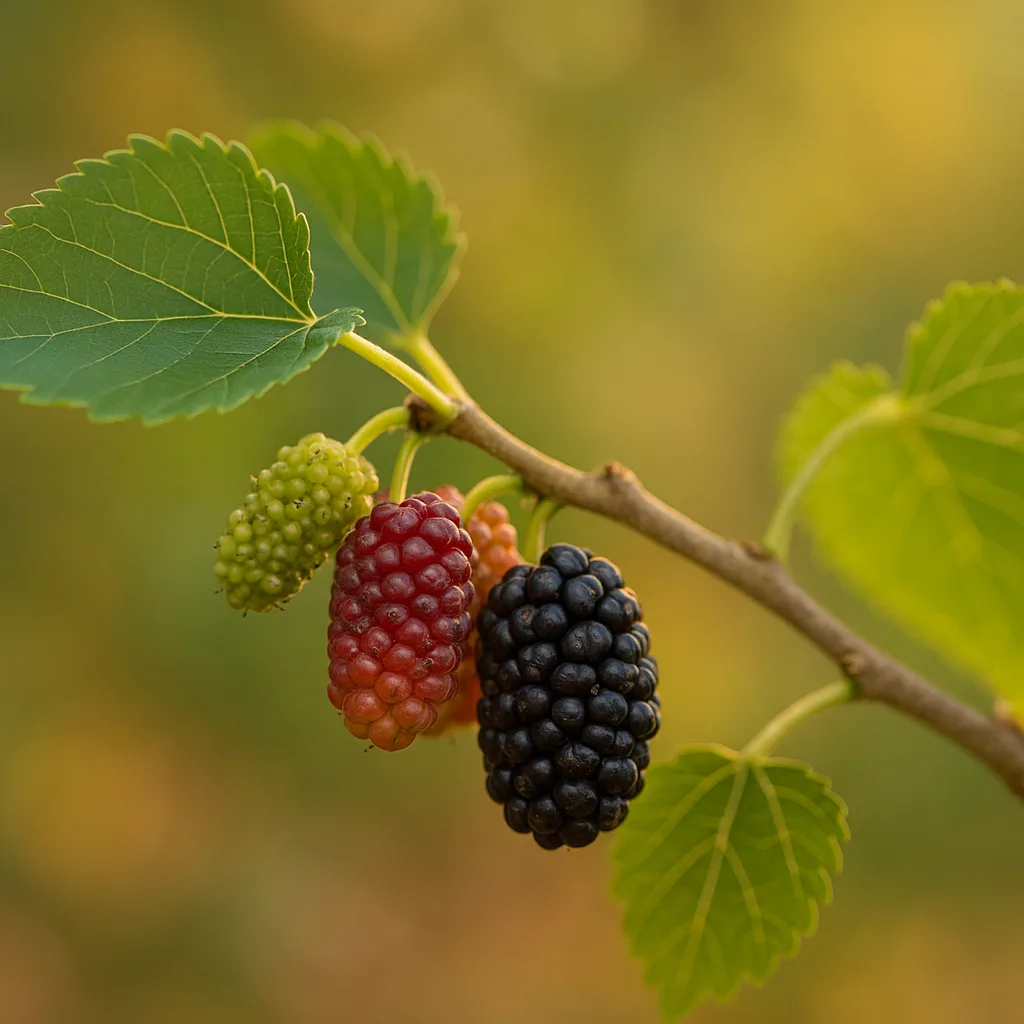
- Scientific names: Morus alba, M. rubra, M. nigra
- Typical height: 6–15 m (20–50 ft), though some cultivated trees reach 20 m
- Fruit: aggregate of drupelets, 1–3 cm long, colors from white/pale to red to deep purple-black
- Leaves: simple, alternate; often serrated margins and variable lobing
Key Identification Features
Use the following features together. No single trait is foolproof because mulberries hybridize and show regional variation.
Leaves: shape, size, texture
- Arrangement: alternate, simple (not compound)
- Size: typically 6–16 cm long, but can range smaller or larger depending on species and site
- Shapes: unlobed ovate to deeply lobed (especially on younger branches); margins usually serrated
- Texture: surfaces range from glossy and smooth to rough or fuzzy; underside often paler
- Petiole: usually 1–3 cm long
Bark, twigs and buds
- Bark: gray-brown, furrowed and scaly on older trees; younger branches smooth and light brown
- Twigs: stout, with leaf scars visible after leaves drop; buds are small and alternating
- Inner bark scent: some species have faintly sweet or non-descript scent when cut
Fruit and flowers
- Flowers: small catkin-like inflorescences in spring; many trees are dioecious (separate male and female) but monoecious trees occur
- Fruit: ripens late spring to mid-summer; an aggregate of small drupes 1–3 cm long; colors vary by species
- Fruit characteristics: soft, juicy, stain hands and clothes, seeds small and gritty
Mulberry Species: How to Tell the Major Ones Apart
Focus on the three species most commonly encountered in gardens, towns and natural areas.
White mulberry (Morus alba)
- Origin: native to China and central Asia; widely cultivated and naturalized worldwide
- Leaves: extremely variable—usually 6–12 cm, sometimes deeply lobed on younger growth; upper surface often shiny green, underside paler and sometimes slightly fuzzy
- Fruit: colors range from white/pale pink to dark purple, depending on cultivar; 1–3 cm long
- Notes: common in urban plantings; readily hybridizes with native species
Red mulberry (Morus rubra)
- Origin: native to eastern North America
- Leaves: typically larger and coarsely toothed, 8–16 cm; often heart-shaped or with shallow lobes; underside fuzzy and whitish
- Fruit: usually deep red to dark purple when ripe; 1–2.5 cm
- Notes: tends to occur in moist forests, streambanks and bottomlands
Black mulberry (Morus nigra)
- Origin: native to western Asia (Iran region) and cultivated in Europe
- Leaves: usually 8–15 cm, rough textured, often unlobed with coarse serrations
- Fruit: deep purple-black when ripe, intensely flavored, 1.5–3 cm long
- Notes: prized for flavorful fruit; less common in the wild than the other two species
Habitat, Range and Seasonal Behavior
Knowing where you found the tree and when you saw it helps narrow identification.
For more on this topic, see our guide on Spotting Hickory Trees in the Wild.
- White mulberry: planted and naturalized across North America, Europe, Asia and beyond; tolerates urban soils and drought
- Red mulberry: native to eastern and central North America; prefers rich, moist woods, stream valleys and fence rows
- Black mulberry: cultivated in temperate Europe and Asia; found in older orchards and gardens
Seasonal cues
- Spring: inconspicuous catkin flowers appear before or with leaves
- Late spring to mid-summer: fruit ripen—timing is species- and climate-dependent
- Fall: leaves turn and drop; bark and bud features become important for winter ID
Practical Field ID Tips and Visual Cues
Here are step-by-step, visual cues to use when you encounter a candidate mulberry tree.
- Leaf arrangement: confirm leaves are alternate and simple (not pinnate). If you see compound leaves, it's not a mulberry.
- Examine the leaf surface: note glossiness, roughness, hairs and underside color.
- Look for lobes: deeply lobed leaves on lower branches often indicate white mulberry or juvenile growth.
- Check fruit: color, size, and ripening time are diagnostic—white mulberry can have pale to dark fruit; red mulberry typically red to purple; black mulberry very dark.
- Note habitat: native red mulberry is more likely in intact eastern forests; white mulberry appears along roads and urban areas.
- Visual cue examples: a 1.5–2.5 cm, dark purple aggregate fruit + rough 10–15 cm leaf = likely black or red mulberry, depending on location.
- If leaves are pinnate (multiple leaflets), the tree may be elderberry or ash—see look-alikes below.
Look-alikes: How to Avoid Common Mistakes
People often confuse mulberries with other trees and shrubs. Compare key differences below.
You may also find our article on Spot and ID Berry-Bearing Trees in the Wild helpful.
Mulberry vs Elderberry (Sambucus)
- Leaves: Elderberry has pinnate leaves with 5–9 leaflets arranged oppositely; mulberry has single, alternate leaves
- Fruit: Elderberry fruits are tight clusters of small berries borne on flat-topped cymes; mulberry fruits are elongated clusters of druplets on a central axis
- Toxicity: raw elderberry fruit, leaves, stems and seeds contain cyanogenic glycosides and can be toxic if not cooked; mulberries are generally edible when ripe
Mulberry vs Fig (Ficus carica)
- Leaves: Fig leaves are large, deeply lobed but thick and soft; figs have a milky latex when cut; mulberry leaves thinner and not latex-producing
- Fruit: Figs are syconia (inverted flowers) with a different internal structure; mulberries are aggregates of druplets
Mulberry vs Elm (Ulmus) or Hackberry (Celtis)
- Leaf arrangement is alternate in elm and hackberry, like mulberry, but elm leaves are doubly serrate and asymmetric at the base; hackberry leaves have warty bark and different fruit (single small drupe)
- Bark: Hackberry has distinctive corky ridges; mulberry bark breaks into scaly, flaky plates
Uses, Cultivation and Ecological Notes
Mulberries have cultural, wildlife and agricultural value:
- Food: ripe mulberries are edible and used fresh, in jams and baked goods. Fruit size is generally 1–3 cm long.
- Silkworm food: white mulberry leaves are the primary diet for Bombyx mori (domesticated silkworm).
- Wildlife: birds and mammals feed on fruit and disperse seeds.
- Ornamental and shade: planted for quick canopy and fruit production, but can be messy (staining fruit drops).
Cultivation tips
- Soil: adaptable—prefers well-drained to moist soils
- Sun: full sun produces best fruit; tolerates partial shade
- Pruning: annual pruning shapes trees and reduces fruit drop in populated areas
Safety, Toxicity and Foraging Warnings
Mulberries are generally safe to eat when ripe, but exercise caution:
Looking beyond this category? Check out Spotting Bed Bugs: A Clear Visual Guide.
- Ripe fruit: edible and nutritious, but can cause staining and, in some individuals, mild gastrointestinal upset if consumed in large quantities.
- Unripe fruit: may be astringent and can cause stomach discomfort in sensitive people.
- Look-alike hazards: elderberry parts (raw) and some other berry-producing plants can be toxic—never eat berries unless you are sure of the ID.
- Pesticides and pollution: fruit collected near roads, orchards or sprayed trees may contain residues—wash thoroughly.
Using Technology: Photos, Keys and the Orvik App
If you want a second opinion in the field, modern tools speed ID and reduce mistakes. Orvik is an AI-powered visual identification app that can analyze leaf and fruit photos to suggest likely species and provide supporting traits. Use it as part of a workflow:
Related reading: Identify Trees from Photos: Expert Guide.
- Photograph multiple views: whole tree silhouette, close-up of leaf upper and lower surfaces, twig, bark and fruit cluster.
- Upload to Orvik for a machine-assisted ID and compare the app's suggestions with field characteristics.
- Confirm using a local flora or herbarium reference, particularly for protected native species like Morus rubra where hybridization with M. alba is common.
- Tip: include a ruler or coin in leaf photos for scale—Orvik and other tools rely on size context for accurate suggestions.
Comparison: White vs Red vs Black Mulberry — Quick Field Checklist
Use this checklist to make a rapid call in the field.
- Leaf variability high and lobed on younger shoots -> likely Morus alba
- Large, rough, often heart-shaped leaves, underside fuzzy; native range in eastern North America -> likely Morus rubra
- Very dark, large, intensely flavored fruit; cultivated/old orchard locations -> likely Morus nigra
- Found along roads/urban sites and variable fruit color -> suspect M. alba or hybrids
Conclusion
Mulberry tree identification is best accomplished by combining leaf traits, fruit color and form, bark and habitat. Because white mulberry hybridizes with native red mulberry, some trees are intermediates and require careful observation or genetic study for firm identification. For quick, reliable field help, photograph multiple features and consult resources: field guides, local flora and AI tools like Orvik. That combination of careful observation and modern tools will give you the most confident ID.
Work through it yourself
The keys below are free, need no account, and render every entry in the page source — so they work with scripting switched off, and the whole list is readable rather than hidden behind a filter.
- Identify a tree by its bark — Texture, colour and pattern — identify 34 trees with no leaves on them.
- Identify a tree by its leaf — Arrangement, compound or simple, margin and shape — 43 trees, four questions.
- Is this plant poisonous to dogs or cats? — Look up 73 plants and see what each one does to a dog, a cat or a horse.
- Seek or Google Lens: identification against visual search — prices and in-app purchase lists pulled from the App Store, not typed.
- PictureThis or PlantSnap: which plant subscription is worth it? — prices and in-app purchase lists pulled from the App Store, not typed.
Frequently Asked Questions
- How can I tell a mulberry leaf from an elderberry leaf?
- Mulberry leaves are simple and alternate (single leaf per node) with serrated or lobed margins. Elderberry leaves are pinnate, made of 5–9 separate leaflets arranged opposite each other. Also, elderberry fruit forms in flat clusters, while mulberry fruits form elongated aggregate clusters.
- What are the main visual differences between white, red and black mulberry?
- White mulberry (Morus alba) shows highly variable leaves often lobed on young shoots and can have pale to dark fruit; red mulberry (M. rubra) has larger, rough leaves with fuzzy undersides and red-to-dark fruit and is native to eastern North America; black mulberry (M. nigra) produces very dark, flavorful fruit and has rough, unlobed leaves, often in cultivated settings.
- Are mulberry fruits edible and safe to eat?
- Ripe mulberry fruits are edible and commonly eaten. They can stain hands and clothing and may cause mild stomach upset if overeaten. Avoid eating unripe mulberries and be cautious of fruit from trees near roads or treated with pesticides.
- Why is it sometimes hard to identify mulberry species?
- White mulberry readily hybridizes with red mulberry, producing intermediate forms. Leaf variability with age and environmental conditions also complicates ID. When in doubt, photograph multiple characteristics (leaf upper and lower surfaces, fruit, bark) and consult field guides or an app like Orvik.
- When is the best time to identify mulberries by fruit?
- Late spring through mid-summer is when mulberry fruits ripen, depending on climate. Fruit color and softness are diagnostic then—white/pale, red/purple or deep black—so visit during fruiting season for clearer identification.
- Can I use leaf hairs and texture to ID mulberries?
- Yes. Leaf texture and hairiness are useful: red mulberry leaves often have a fuzzy underside, white mulberry can have a paler or slightly fuzzy underside and black mulberry typically has rough, sandpapery leaves. Combine this with other traits for a reliable ID.
- How can Orvik help me identify a mulberry tree?
- Orvik accepts photos of leaves, fruit and bark and uses AI to suggest likely species and highlight distinguishing features. It’s a helpful second opinion, especially when you photograph multiple angles and include scale for size context.
- How can I identify a mulberry tree in winter when there are no leaves or fruits?
- In winter look at the bark, twigs and bud arrangement: mulberries develop rough, furrowed bark with age and young twigs are often slightly zigzag with alternate, pointed buds. Lenticels (small horizontal pores) and short spur-like fruiting shoots can persist, and comparing twig and bark photos to reference images (for example with Orvik’s photo-ID tool) helps confirm the ID when foliage is absent.
- How can I tell if a mulberry tree will produce fruit — how do I distinguish male and female mulberry trees?
- Many mulberry species are dioecious, so male trees produce only pollen-bearing, longer pendulous catkins while female trees (or pistillate parts) have shorter catkins that swell into the aggregate berries; monoecious trees or cultivars may have both. Check in spring for the type of catkins: persistent pollen catkins indicate a likely non-fruiting (male) tree, whereas catkins that thicken into small clustered drupes indicate a fruiting (female or bisexual) tree.