
Oak leaves are among the most familiar and yet most confusing leaves in temperate landscapes. With over 600 species worldwide in the genus Quercus, subtle differences in lobes, margins, hairs and acorns separate a white oak from a red oak or a live oak. This field guide approaches oak leaf identification like a naturalist: by describing precise measurements, visual cues, habitat patterns and seasonal behavior. Use Orvik in the field to compare photos and speed identification, and follow these practical tips to gain confidence on woodland trails and city streets.
Why identify oak leaves?
When people search oak leaf identification they usually want to know three things: which oak species is nearby, whether a tree is native or invasive, and whether any part of the tree poses a hazard or has ecological value. Accurate identification helps with conservation, wood use, tree care, foraging safety and wildlife habitat understanding.
- Ecological context: different oaks host different insect and bird communities.
- Practical use: wood qualities vary by species for furniture, firewood and tannins.
- Safety and management: some oaks drop heavy acorns, others tolerate urban stress better.
- Foraging caution: acorns are high in tannins and require leaching before consumption.
Oak leaf anatomy and key terms
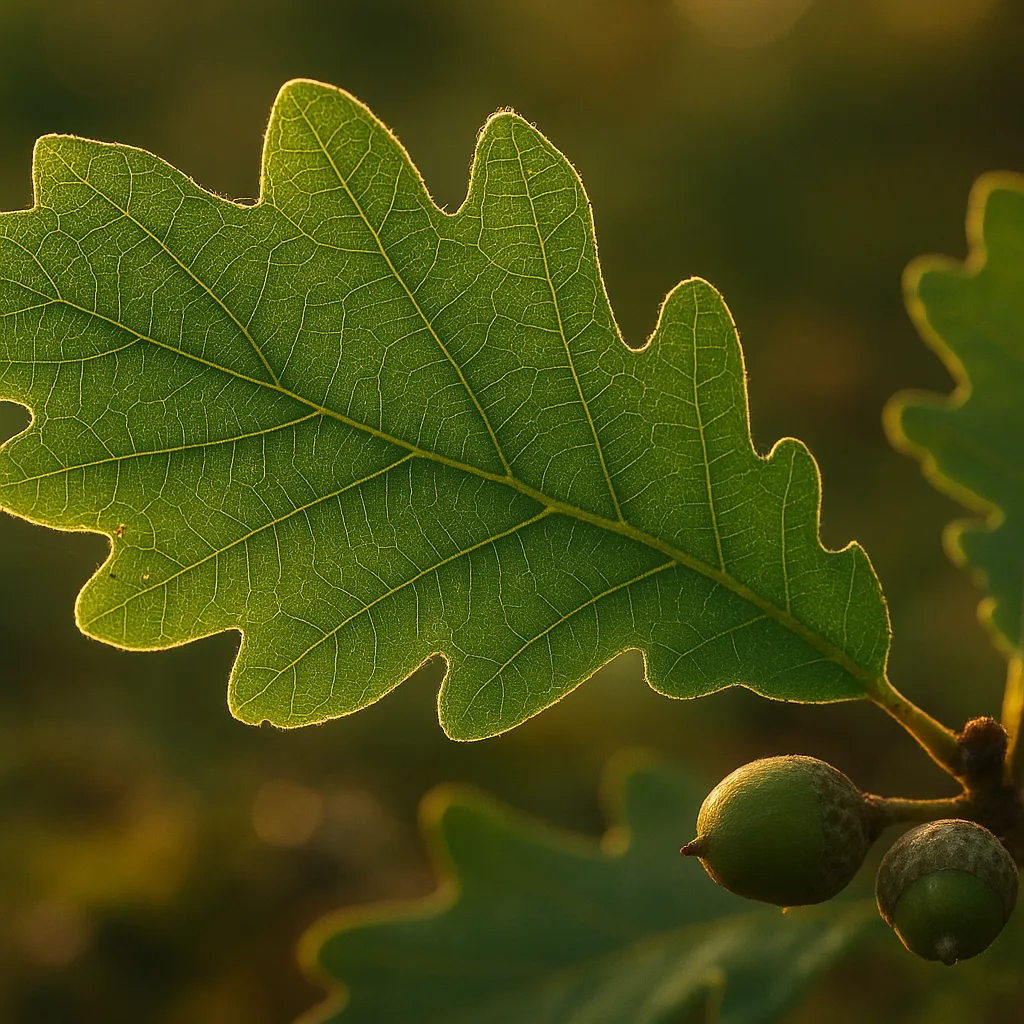
Before diagnosing species, know the leaf vocabulary. Most oak leaves are simple (one blade per petiole) and alternate on the stem. Key traits are very measurable and visible: leaf length and width, lobe count and shape, sinus depth (the indentations between lobes), margin type, surface hairs and the petiole.
- Blade: the flat part of the leaf. Typical oak blades range from 4 to 30 cm long (1.5 to 12 in).
- Lobes: projections along the margin. Count lobes to narrow species: 5 to 11 lobes are common in many temperate oaks.
- Sinuses: gaps between lobes, shallow in some species, deep to nearly to midrib in others.
- Margin: rounded or bristle-tipped (pointed) lobes. Rounded lobes indicate white oak group; bristle tips indicate red/black oak group.
- Petiole: stalk attaching the leaf to twig. Lengths vary 5–40 mm; long petioles often allow leaves to flutter.
- Venation: pinnate veins running from midrib into lobes; observe whether veins reach lobes directly or fork.
- Indumentum: hairs or scales on upper and lower surfaces; can be glabrous, pubescent, tomentose.
Major oak groups and representative species
Oaks are traditionally divided into several groups. In temperate regions the two most useful for leaf ID are the white oak group and the red/black oak group. There are also live oaks (evergreen), and many regional species that look similar.
White oak group (section Quercus)
Characteristics: rounded lobes, no bristle tips, usually paler underside, acorns mature in one season in some species.
For more on this topic, see our guide on Mastering Plant ID with AI: A Field Guide.
- Quercus alba (white oak): leaves 12–20 cm long with 7–9 rounded deep lobes; bark light ashy and scaly; native to eastern North America.
- Quercus robur (English oak): shorter leaves 7–14 cm with variable lobing and often a short stalk; common in Europe and introduced in North America.
- Quercus macrocarpa (bur oak): large leaves 12–30 cm with deep central sinuses and a distinctly large terminal lobe; common in midwestern savannas.
Red and black oak group (section Lobatae)
Characteristics: pointed lobes with bristle tips, typically darker upper surface, acorns often take two seasons to mature.
- Quercus rubra (northern red oak): leaves 14–24 cm with 7–11 pointed lobes; sinuses shallow to moderate; widespread across eastern North America.
- Quercus velutina (black oak): similar to red oak but with dark, blocky bark and sometimes more deeply cut lobes; undersides often hairy.
- Quercus coccinea (scarlet oak): deep sinuses and narrow rounded bases, famous for brilliant red fall color.
Live oaks and evergreen types
Characteristics: leaves often thick, leathery, sometimes unlobed or shallowly lobed, evergreen in mild climates.
- Quercus agrifolia (coast live oak): 3–7 cm long, spiny-margined or shallowly lobed, glossy dark green upper surface; native to California coast.
- Quercus ilex (holm oak): oval, leathery leaves with entire or shallowly toothed margins; Mediterranean native.
Practical identification tips and measurement guide
A field-ready ID should rely on a handful of consistent observations. Measure, photograph, and note the habitat. Below are prioritized cues to record, from quickest visual hints to definitive details.
You may also find our article on How to Identify Maple Leaves in the Field helpful.
- Count lobes and note whether lobes are rounded or bristle-tipped. Rounded = white oak group; bristle-tipped = red/black oak group.
- Measure leaf length and width in centimeters or inches. Many regional species have diagnostic size ranges.
- Examine the sinuses: deep sinuses often indicate bur oak, pin oak or scarlet oak; shallow sinuses can indicate white oak or chestnut oak.
- Check underside color and hairiness. A pale, fuzzy underside suggests Quercus alba or Q. macrocarpa; a glossier underside suggests Q. rubra.
- Look for reproductive features: acorn size, cup characteristics (scales, fringe), and time of year. Acorn cups with deep scales often belong to red oaks.
- Note habitat: wetlands, upland ridges, urban plantings and coastal scrub often host different oak assemblages.
- Useful measurement conversions: 1 inch = 2.54 cm. Many oak leaves fall into 4–30 cm (1.5–12 in) range.
- Petiole: short (under 1 cm) in some live oaks, longer (1–4 cm) in others—measure for species-level clues.
- Timing: leaves fully developed by late spring to early summer; fall color patterns useful in autumn ID.
Common lookalikes and how to tell them apart
Many tree species have lobed or toothed leaves that can be mistaken for oaks from a distance. The most frequent confusions in urban and riparian areas are poplars, basswoods (linden), and birches.
Oak vs Poplar (Populus species)
- Leaf shape: Poplar leaves (Populus tremuloides, Populus deltoides) are often triangular to deltoid or broadly ovate with a pointed tip, not deeply lobed like many oaks.
- Margin: Poplar margins are typically single-toothed or smooth; they do not have the rounded or bristle-tipped lobes of oaks.
- Petiole: Poplars have long, flattened petioles that make leaves tremble in the wind; oak petioles are round and less pendulous.
- Venation: Poplar veins fork near the base and have a more palmate pattern compared with oak pinnate venation.
Oak vs Basswood (Tilia americana, basswood)
- Leaf shape: Basswood leaves are heart-shaped (cordate) with an asymmetrical base and coarse serration; not lobed.
- Texture: Basswood leaves are thin, soft and often shiny above; oak leaves are firmer, can be leathery and sometimes hairy underneath.
- Flowers: Basswood has conspicuous pendulous clusters of fragrant yellowish flowers in summer; oaks have inconspicuous catkins.
Oak vs Birch (Betula species)
- Leaf shape: Birch leaves are ovate with doubly serrate margins and a pointed tip; sizes usually 3–8 cm, much smaller than many oaks.
- Bark: Birch bark is papery and often white, yellow or silver with lenticels; oak bark is thicker and fissured in mature trees.
- Habitat: Birches commonly colonize open, moist sites or early successional habitats; many oaks prefer drier ridges or mixed hardwood stands.
Remember: photographing the entire tree, bark and any fruiting structures helps avoid these confusions. Orvik can process multiple images and compare them to reference specimens to help rule out lookalikes quickly.
Looking beyond this category? Check out Mastering Coin Identification: A Field Guide.
Oak leaf identification chart and quick key
Below is a practical, condensed key to help identify the most commonly encountered oak leaf types in temperate North America and Europe. Use measurements and features in combination.
Related reading: How to Recognize Maple Trees in the Field.
- If leaf is unlobed or only shallowly lobed, look for evergreen/live oak or certain chestnuts. Check thickness and seasonality.
- If lobes are rounded and lack bristle tips, candidate species likely in white oak group. Check for 7–9 lobes and pale underside for Q. alba.
- If lobes are pointed with bristle tips, candidate species likely in red/black oak group. Note acorn maturation timing and cup structure.
- If central sinuses are exceptionally deep producing a fiddle-shaped leaf, consider Quercus macrocarpa (bur oak) or Quercus palustris (pin oak) for narrow central blade.
- Check acorn size: large acorns (2–5 cm) often indicate bur oak or some live oak species; small acorns (1–2 cm) commonly in red oaks.
- Examine bark and habit: smooth gray bark on young trees suggests Quercus robur; blocky dark bark indicates Quercus velutina.
- Quick species notes: Quercus alba leaves 12–20 cm, rounded lobes; Quercus rubra leaves 14–24 cm, 7–11 bristle-tipped lobes; Quercus agrifolia leaves 3–7 cm, evergreen and leathery.
- When in doubt, collect a photo of top and underside of a leaf, the twig with alternate leaves, the acorn and cup, and the bark. These five shots are usually enough for confident ID.
Safety, ecology and seasonal behavior
Understanding oak leaves means also understanding their role in ecosystems and potential risks.
- Wildlife value: Oaks support hundreds of insect species; their acorns feed birds, squirrels, deer and pigs. A single mature oak can produce thousands of acorns in a mast year.
- Seasonal behavior: Most temperate oaks are deciduous and drop leaves in autumn. Red oaks often produce red to russet fall colors; white oaks lean toward muted purples and browns. Live oaks retain leaves year-round.
- Toxicity and safety: Oak leaves and acorns contain tannins and other phenolics. In large amounts, especially wilted leaves or green acorns, they can cause tannic acid poisoning in livestock (horses, cattle, goats), leading to digestive upset and potential kidney damage. Do not feed acorns to livestock without expert guidance.
- Human caution: Acorns can be bitter due to tannins but are not acutely poisonous to people if properly leached. Avoid eating any wild nut or leaf without proper processing and identification.
- Allergies: Oak pollen is a common spring allergen. Handling leaves rarely causes allergic dermatitis, but insects or fungi on leaves may trigger reactions in sensitive people.
How to use Orvik and field methods for reliable ID
Modern tools accelerate identification. Orvik is an AI-powered visual identification app built to help naturalists, arborists and curious walkers match leaf photos to verified specimens. Use it as a second opinion after making your own observations.
- Take multiple photos: top of leaf, underside, petiole, acorn and entire tree from a distance. Include a scale like a coin or ruler when possible.
- Note habitat: soil moisture, elevation, neighboring species and whether the tree is solitary or in a stand.
- Record date and phenology: are leaves new, fully mature, or turning color? Are acorns present and what is their maturity?
- Upload images to Orvik and compare suggested matches. Review the app's reference images for bark, acorn cups and leaf underside details to confirm.
- Cross-check with a local flora or authoritative tree guide to confirm species that might be regionally similar.
- Field tip: avoid collecting leaves from protected trees without permission. Photographs are usually sufficient for identification.
- When documenting for records or research, include GPS coordinates and a brief habitat note: urban street tree, upland oak-hickory forest, riparian floodplain, coastal scrub, etc.
Conclusion
Oak leaf identification combines careful observation, measured details and an understanding of habitat and seasonal change. Distinguishing white oak from red oak is often a matter of lobe shape and bristle tips, while live oaks stand out by their leathery evergreen leaves. For practical, fast verification in the field, tools like Orvik are valuable—especially when you supply photos of both leaf surfaces, acorns and bark. With practice and the guidelines above, you will rapidly improve at recognizing the many faces of Quercus in your region.
Frequently Asked Questions
- How can I tell a white oak from a red oak by the leaf?
- White oaks have rounded lobes without bristle tips and often paler undersides; red/black oaks have pointed lobes with bristle tips and usually darker, glossier upper surfaces.
- What measurements are most useful for oak leaf ID?
- Measure leaf length and width (cm or inches), count lobes, note sinus depth, petiole length (mm), and observe underside hairiness and acorn size.
- Are oak leaves poisonous to people or pets?
- Oak leaves are not generally poisonous to people, but acorns and wilted leaves contain tannins that can be toxic to livestock and, in large amounts, can cause digestive problems in pets.
- How do I distinguish oak leaves from poplar, basswood or birch?
- Poplar leaves are typically triangular or ovate with flattened petioles; basswood leaves are heart-shaped and serrated; birch leaves are smaller, ovate and doubly serrate. Oaks are usually lobed or have distinct leathery texture.
- When is the best time to identify oaks?
- Late spring to early summer when leaves are fully developed is ideal; fall is useful for color cues; acorn presence in late summer through fall adds strong diagnostic information.
- Can I identify an oak from a single leaf photo?
- Often you can narrow to a group, but species-level ID is more reliable when you include the leaf underside, petiole, acorns and a photo of the bark or whole tree. Using Orvik with multiple images improves accuracy.
- What do deep sinuses in an oak leaf indicate?
- Deep sinuses create a fiddle-shaped or pinched central blade and often indicate species like bur oak or pin oak; examine lobe shape and acorn characteristics to narrow identification.