
Introduction: Why Bark Matters for Tree Identification
When leaves are absent or in winter, bark can be the most reliable field characteristic for identifying trees. Bark records a tree's age, growth habits and environmental stresses: smooth young bark, furrowed mature bark, flaky plates, peeling strips, lenticels, and corky ridges are all diagnostic features. This guide condenses decades of field observation and dendrology practice into a practical workflow for anyone trying to identify trees by their bark—whether you are a naturalist, land manager, or a gardener. Tools such as Orvik can speed the process by matching your photos to reference images, but understanding the visual cues will help you confirm identifications and make better photos for AI to analyze.
Bark Basics: Anatomy, Types, and What to Look For
Bark anatomy in plain terms
Bark consists of several layers: the outermost dead protective layer (rhytidome), the living inner bark (phloem), and underneath that the vascular cambium and xylem (wood). Visible features arise from how the rhytidome splits as the trunk expands.
- Outer bark texture: smooth, fissured, plated, scaly, peeling/exfoliating, or corky.
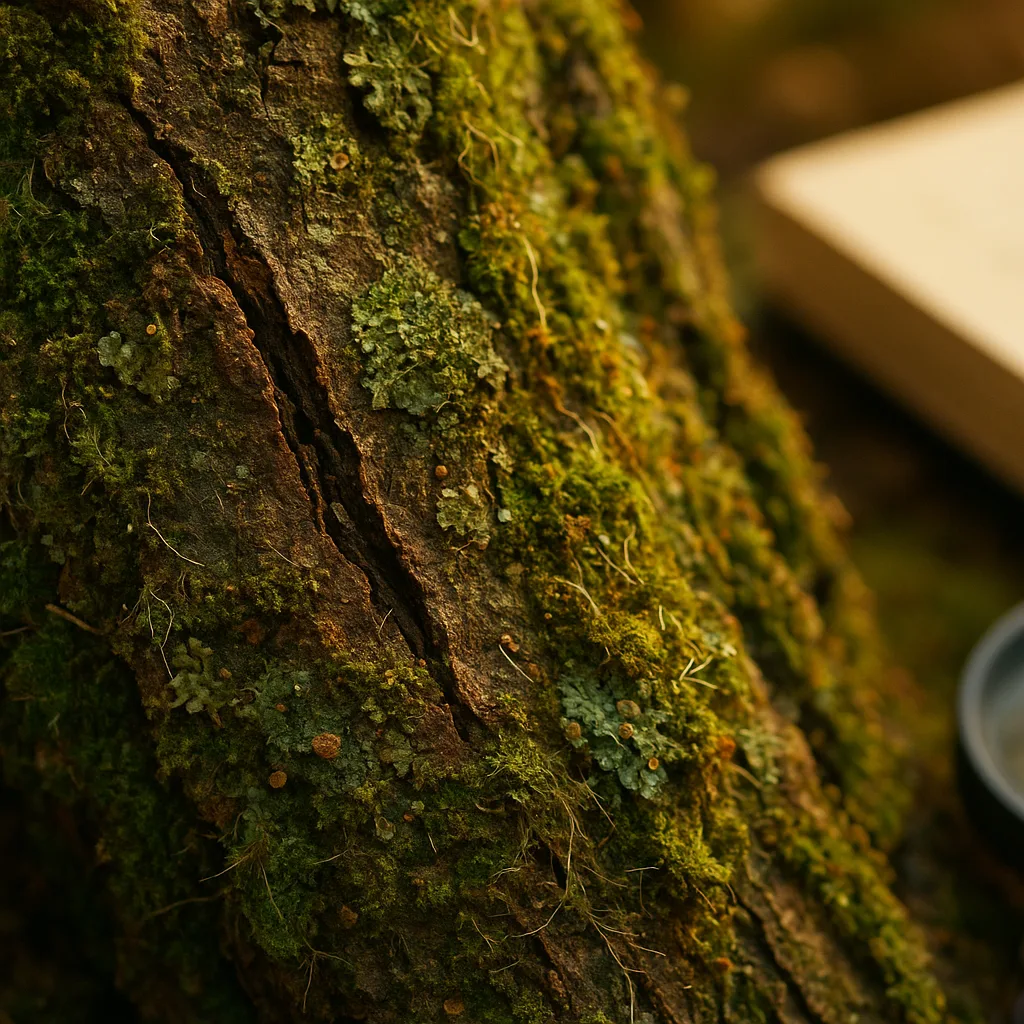
- Surface markers: lenticels (small raised pores), resin/ sap flow, moss and lichen coverage.
- Color and pattern: uniform gray, brown, white, black, mottled, or streaked.
Common bark types and quick ID clues
- Smooth: American beech (Fagus grandifolia) often has unbroken, light-gray bark even on mature trunks.
- Peeling/exfoliating: Paper birch (Betula papyrifera) and river birch (Betula nigra) peel in sheets; many Prunus (cherry) species peel in small flakes.
- Plated/furrowed: Oaks (Quercus spp.) and elms (Ulmus spp.) develop deep interlacing furrows with vertical ridges.
- Shaggy: Shagbark hickory (Carya ovata) has large, curling plates that peel away in long strips.
- Corky ridges: Some oaks and pears (Pyrus) have thick corky wings along branches.
How to Identify a Tree by Bark: A Step-by-Step Field Workflow
When you encounter an unknown trunk, follow a reproducible sequence to capture the features technicians and AI need to identify the tree correctly.
For more on this topic, see our guide on Master Tree ID: Leaves, Bark & Wood.
- Observe the scale: measure trunk diameter at breast height (DBH; 1.3 m / 4.5 ft above ground). Note if bark appearance changes from twig to trunk.
- Note color and major pattern: uniform, patchy, vertical furrows, horizontal lenticels, or peeling sheets.
- Describe texture: smooth, finely fissured (fissures < 2 mm), deeply furrowed (> 5 mm), flaky, or corky.
- Look for lenticels: small raised horizontal/vertical lines often 1–5 mm long on many young stems (e.g., cherry, birch).
- Check for distinctive features: narrow shaggy strips, diamond-shaped ridges (some ash), or blocky plates.
- Record habitat and location: is the tree in dry upland, floodplain, bog, urban street, or mixed hardwood forest? Geographic range narrows possibilities.
- Take photographs: vertical and close-up shots (see section on photos below).
Practical visual cues (with measurements)
- Fissure depth: shallow fissures are typically under 2–5 mm in young trees; mature oaks can develop fissures several centimeters deep.
- Plate width: plated bark often forms blocks 1–10 cm across; shagbark hickory plates can be 5–15 cm long.
- Lenticels size: 1–6 mm long and usually visible on young stems of Betula, Prunus, and some maples.
- Peeling sheets thickness: birch and eucalyptus peel in sheets 0.5–5 mm thick, revealing a contrasting underbark color.
Hardwood Bark Identification: Key Species and Their Signatures
This section focuses on commonly searched hardwoods people try to identify by bark: oak, maple, birch, beech, hickory, ash, cherry, elm and walnut. Each entry names the species (common and scientific), visible bark traits, typical habitat and geography, and seasonal behavior.
Oak (Quercus spp.)
- Species: White oak (Quercus alba), Northern red oak (Quercus rubra), English oak (Quercus robur).
- Bark: deep vertical furrows with interlacing ridges on mature trees; color ranges from light gray (Q. alba) to very dark brown/black fissured bark (Q. rubra).
- Measurements: furrow widths 0.5–3 cm; ridges can be several centimeters high on old trees.
- Habitat & range: temperate forests across eastern North America and Europe depending on species; tolerant of upland soils.
- Seasonal: bark becomes more cracked with age; acorn production peaks in mast years.
Maple (Acer spp.)
- Species: Sugar maple (Acer saccharum), Red maple (Acer rubrum), Silver maple (Acer saccharinum).
- Bark: young stems with smooth gray bark and vertical lenticels; mature sugar maple develops coarse, scaly plates; silver maple is more deeply furrowed and paler.
- Measurements: lenticels 1–3 mm; ridged plates 1–6 cm.
- Habitat: mixed hardwood forests, urban plantings; species-specific ranges across North America.
Birch (Betula spp.)
- Species: Paper birch (Betula papyrifera), Yellow birch (Betula alleghaniensis), River birch (Betula nigra).
- Bark: white to cream papery sheets (paper birch), golden peeling curls (yellow birch), flaky brown plates (river birch).
- Measurements: peeling sheets 1–10 cm wide; underlying bark often darker and smooth.
- Habitat: boreal and temperate moist soils; paper birch in northern latitudes, river birch along waterways in the eastern U.S.
Beech (Fagus grandifolia)
- Bark: smooth, thin, light gray—remarkably persistent even on large old trunks.
- Measurements: smooth surface with bark thickness usually under 1 cm; susceptible to sunscald and mechanical damage.
- Habitat: mesic eastern forests; often forms dense shade-tolerant stands.
Hickory (Carya spp.)
- Species: Shagbark hickory (Carya ovata), Pignut (Carya glabra).
- Bark: shagbark has long exfoliating strips 5–20 cm long; other hickories have tighter interlaced ridges.
- Habitat: well-drained upland soils across eastern North America.
Ash (Fraxinus spp.)
- Bark: ash shows diamond-shaped ridges on mature trunks; younger stems are smooth and gray with opposite branching pattern (helps identification).
- Notes: many ash species are currently threatened by emerald ash borer (Agrilus planipennis).
Cherry (Prunus spp.)
- Species: Black cherry (Prunus serotina).
- Bark: young twigs smooth with horizontal lenticels; mature bark shreds into small, irregular, flaky plates often described as "burnt potato chips" on older black cherry.
- Habitat: disturbed sites, upland forests across eastern North America.
Elm (Ulmus spp.)
- Bark: rough, deeply fissured with irregular interlacing ridges; often darker and corky on old trees.
- Habitat: riparian zones and urban plantings; many native elm populations reduced by Dutch elm disease.
Walnut (Juglans spp.)
- Bark: furrowed with diamond-shaped ridges; mature walnut has dark chocolate-brown furrows and plate-like ridges.
- Notes: walnut roots and leaves produce juglone, a compound toxic to some plants in proximity.
Comparison: How to Tell Similar Barks Apart
Many identification failures come from confusing species with superficially similar bark. Below are side-by-side comparisons with clear cues you can check in the field.
You may also find our article on Identify Plants Fast: Expert Guide to Free Apps helpful.
Oak vs. Maple
- Oak: vertical, deep furrows; ridges are coarse and blocky on mature bark. Oak bark often feels rough and hard when scratched.
- Maple: tends to have shallower, scaly plates; sugar maple plates flake rather than form deep furrows. Look at branch arrangement—maples have opposite branches while oaks do not.
Birch vs. Beech
- Birch: papery, peeling sheets; white or yellow bark, often with horizontal lenticels. Underbark contrasts in color.
- Beech: smooth and unbroken light-gray surface. Beeches rarely peel and feel almost like elephant skin in texture.
Ash vs. Hickory
- Ash: diamond-shaped ridges forming a relatively regular pattern; bark becomes coarse but retains pattern symmetry.
- Hickory: more irregular, often shaggy on Carya ovata, with long strips on mature shagbark hickory.
Cherry vs. Black Birch (Young Stems)
- Cherry: distinct horizontal lenticels on young stems; later develops scaly, flaking plates.
- Black birch: also has lenticels but the bark peels in thinner sheets; smell crushed twigs—black cherry has a bitter almond smell while birch smells wintergreen (methyl salicylate).
Using Tools and Apps: Making the Most of Orvik and Other Resources
Apps like Orvik accelerate identification by comparing photos to large reference libraries, but the app’s accuracy depends on the quality and angles of your images and the metadata you provide (location, season, DBH). Use the app as a second opinion rather than a sole authority.
- Take at least three images: a close-up of the bark (20–50 cm from the surface), a mid-distance photo showing branching or trunk form, and a full-context shot showing the tree’s setting and leaves (if present).
- Include scale: place a ruler, coin, or known object near the bark to show scale for plates and lenticels.
- Provide location and season: many apps use geographic filters—knowing latitude/region eliminates unlikely species.
- Verify Orvik results with field cues: use the app’s match plus your visual check (leaf arrangement, buds, overall habit).
Integrating field keys and local guides
- Use regional field guides and dichotomous keys to confirm species that are common in your area.
- Join local naturalist groups or iNaturalist communities to compare findings and learn regional variations.
Safety, Toxicity, and Conservation Considerations
Bark can be an indicator of tree health and of potential hazards. Be cautious: some trees are toxic, some are fragile, and others host dangerous pests or pathogens.
Looking beyond this category? Check out Mastering Visual ID: Your Photo Identifier Guide.
Related reading: Identify Plants Fast: Expert Guide to Flora Apps.
- Toxic species: Yew (Taxus spp.) contains taxine alkaloids—ingesting any part other than the red aril is potentially fatal to humans and animals.
- Allergic reactions: handling some bark, inner cambium or wood dust (e.g., black walnut) can trigger dermatitis or respiratory irritation in sensitive individuals.
- Structural hazards: loose bark, deep cavities, and fungal fruiting bodies (e.g., Ganoderma) indicate decay—avoid climbing or standing beneath large dead branches.
- Invasive pests: look for D-shaped exit holes on ash (emerald ash borer) or bark flakes and galleries indicating borers and beetles.
How to Take Bark Photos and Build a Bark Identification Chart
Good images are the backbone of both manual and AI-assisted identification. Here’s a simple protocol to create a reliable personal or regional bark identification chart.
- Photographing protocol:
- Close-up: fill the frame with bark, keep lens perpendicular to surface, include a scale (ruler or coin).
- Mid-shot: show a 1–2 m length of trunk to capture plate patterns or vertical fissures.
- Context shot: capture the entire trunk up to first major branching and the surrounding habitat.
- Lighting and season:
- Diffuse daylight is best—avoid harsh midday sun that flattens texture or creates glare on wet bark.
- Photograph in leaf-off seasons to see bark unobstructed; spring sap flows may reveal color contrasts.
- Creating a chart:
- Organize by bark type (smooth, peeling, plated) and then by region or size class (sapling vs mature).
- Include specimen data: DBH, GPS coordinates, habitat notes, season, and species (when confirmed).
- Use 3–4 diagnostic photos per species: detail, mid, and context images and one showing distinguishing features (e.g., lenticels).
Conclusion
Tree bark identification is an observational skill that improves with practice. By learning the vocabulary of bark—fissures, plates, lenticels, exfoliation—and by following a consistent field workflow (measure, photograph, note habitat), you’ll reduce guesswork and improve both manual ID and the usefulness of apps like Orvik. Start with common regional species and expand your chart over seasons. With attention to specific visual cues and some careful documentation, even winter walks can become a reliable way to map your local arboreal diversity.
Frequently Asked Questions
- Can you identify a tree from bark alone?
- Not always. Bark changes with age and environment, and some species look similar. Many mature hardwoods (oaks, birches, beech) have distinctive bark, but leaves, buds, or fruit improve certainty.
- What photos should I take for tree bark identification apps like Orvik?
- Take a close-up (20–50 cm from the surface), a mid-range shot showing 1–2 m of trunk, and a full-context image of the whole tree and habitat. Include a scale object and location metadata.
- When is the best season to identify trees by bark?
- Leaf-off seasons (late fall through early spring) are often best because the trunk is unobstructed. Spring sap flows may change color temporarily; summer moss or lichen can obscure details.
- Which barks are easiest for beginners to recognize?
- Paper birch (white peeling sheets), American beech (smooth light-gray), shagbark hickory (long peeling strips), and mature oaks (deep vertical furrows) are distinctive and good for learning.
- How can I tell oak from maple by the bark?
- Oaks develop deep vertical furrows and coarse ridges; maples tend to have shallower scaly plates. Checking branch arrangement helps: maples have opposite branching; oaks do not.
- Are any tree barks poisonous or dangerous to touch?
- Most barks are not acutely poisonous to touch, but some trees (e.g., yew) contain toxic compounds if ingested. Handling bark or wood dust from certain species (walnut, cedar) can cause dermatitis or respiratory reactions in sensitive people.
- Can bark indicate tree pests or disease?
- Yes—cracks, cankers, excessive sap flow, fungal conks, and unusual bark loss are common signs of disease or insect infestation. Noting these helps in early management or reporting invasive pests.