
When someone searches for "types of weeds with names" they want more than a list — they want to identify what’s growing in their lawn or garden, learn how to tell look‑alikes apart, and get practical management tips. This detailed field guide provides scientific names, visual cues (color, size, shape, texture), habitat and seasonal notes, and safety warnings so you can accurately identify and manage common weeds in turf, gardens, and yards. Use Orvik to snap a photo and cross‑check IDs in the field for faster, more confident identification.
1. How botanists classify common weeds
Weeds in lawns and yards fall into a few practical categories that determine how they grow and how to control them:
- Broadleaf weeds – dicot plants with wider leaves, typically distinct veins and sometimes showy flowers (e.g., dandelion).
- Grassy weeds – monocot grasses that resemble turfgrasses but differ in growth habit or life cycle (e.g., annual bluegrass).
- Sedges – grasslike plants in the Cyperaceae family with triangular stems (e.g., nutsedge).
- Vines and groundcovers – sprawling species that smother turf or garden plants (e.g., bindweed).
Identification starts with structure: leaf arrangement (alternate, opposite, basal rosette), stem cross‑section (round vs triangular), flower type (composite, spikelet, capsule), and growth season (annual, biennial, perennial).
2. Key lawn broadleaf weeds (names and ID)
Broadleaf weeds are the ones gardeners usually notice first because their leaves and flowers contrast with turf blades. Below are the most common and easily recognized species.
- Focus on: leaf shape, petiole length, presence of basal rosette, flower color and form.
- Measure: leaf length (cm or inches), flower diameter (mm), plant height (cm).
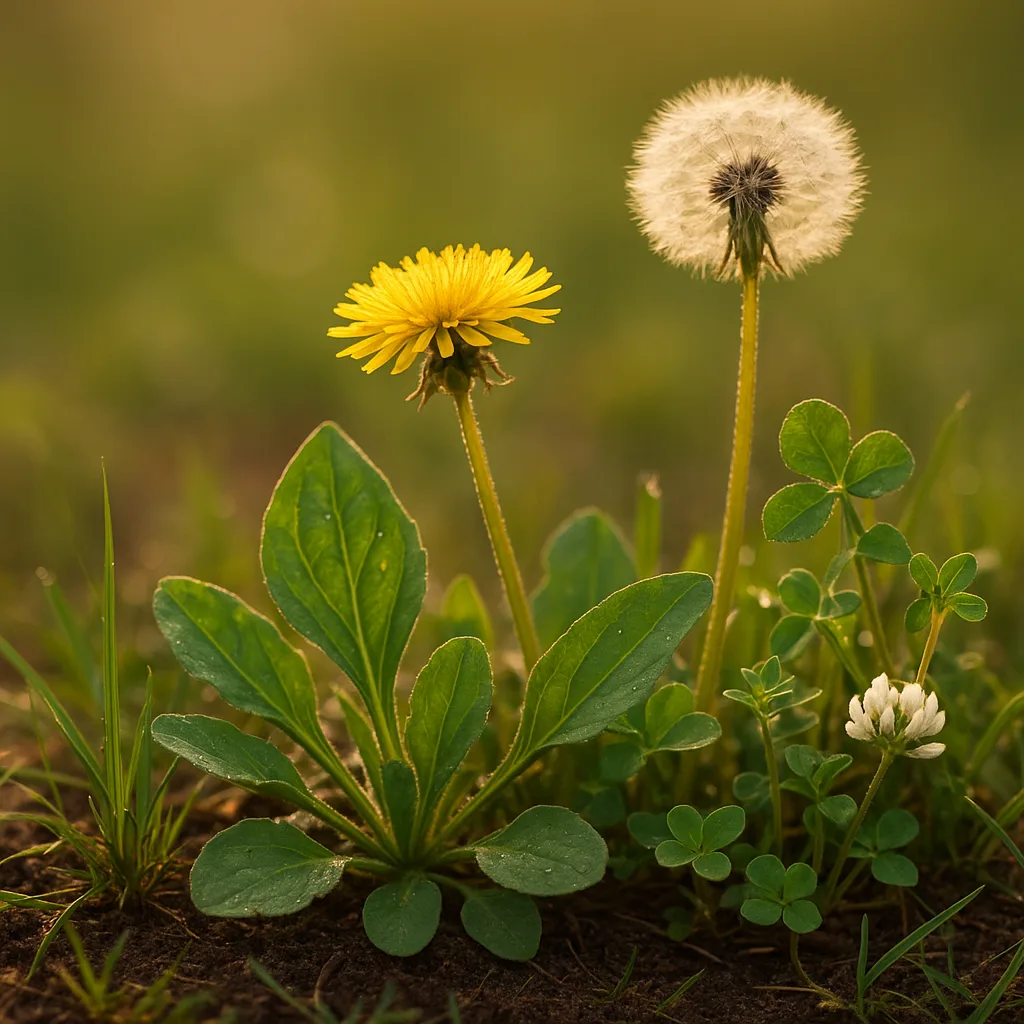
Dandelion (Taraxacum officinale)
- Identification: basal rosette of ±10–25 cm long toothed leaves; bright yellow composite flower 2–5 cm across; hollow, unbranched scape (flower stalk) that exudes milky latex when cut.
- Habitat & season: thrives in compacted soils and sunny lawns; flowers primarily spring and fall.
- Control note: deep taproot often >15 cm long — tug when moist or use targeted herbicide.
White Clover (Trifolium repens)
- Identification: trifoliate leaves (3 leaflets) often with a pale crescent; mats of prostrate stems; white to pink globular flower heads 1–2 cm wide.
- Habitat & season: prefers moist, low‑nitrogen soils; blooms late spring to early fall.
- Notes: fixes nitrogen; may be tolerated in low‑mow lawns or treated with spot control.
Plantains — Broadleaf plantain (Plantago major) & Ribwort (P. lanceolata)
- Identification: Plantago major has broad, rounded leaves 5–15 cm long in a basal rosette; P. lanceolata has narrow, lance‑shaped leaves. Both send up a flower spike (1–10 cm long) with inconspicuous tiny flowers.
- Habitat: compacted pathways and low‑mow turf; perennial.
Chickweed (Stellaria media)
- Identification: low, matting annual with opposite ovate leaves 1–3 cm long and tiny white star‑like flowers (petals deeply divided, appearing as 10).
- Season: cool‑season annual, common in spring and fall.
Spotted Spurge (Euphorbia maculata)
- Identification: prostrate summer annual; paired opposite leaves often with a reddish spot; stems exude milky sap. Leaves 1–3 cm long, plant mats tightly.
- Warning: milky sap can irritate skin or eyes — wear gloves when handling.
3. Common grassy weeds and turf invaders
Grassy weeds look like grass blades but differ in texture, color, or seedhead timing. They can come as annuals or perennials.
For more on this topic, see our guide on Identify Weeds Fast: Field Guide & App Tips.
- Key visual cues: ligule type (membranous or fringe of hairs), auricle presence, leaf blade width (mm), growth habit (clump vs spreading).
- Seasonal cue: warm‑season annuals produce in summer; cool‑season annuals in spring/fall.
Crabgrass (Digitaria sanguinalis and related species)
- Identification: sprawling, prostrate summer annual forming mats; stems up to 30–60 cm; seedheads with 3–8 finger‑like spikes (1–3 cm long).
- Habitat & timing: germinates from soil temps >15–18°C (60–65°F) in late spring; prolific seed producer.
Goosegrass (Eleusine indica)
- Identification: forms flat circular mats with hairless, grayish center; seedhead has 2–8 short spikes radiating from one point (look like a bird foot).
- Distinguish: often forms tighter, flatter mats than crabgrass and is more tolerant of compacted, high‑traffic areas.
Annual Bluegrass (Poa annua)
- Identification: bright green, fine‑textured, grows in patches; seedheads produced even in mowing height (tiny boat‑shaped spikelets), often visible in spring.
- Season: cool‑season annual but can survive mild winters as a short‑lived perennial.
Bermudagrass (Cynodon dactylon) in lawns
- Identification: creeping perennial grass with stolons and rhizomes; leaves 2–10 mm wide, rough to the touch; seedheads are short spikes in clusters.
- Issue: aggressive in warm climates and can invade cool‑season lawns.
4. Sedges and how to tell them apart
Sedges look like grasses but belong to the Cyperaceae family. Knowing the classic line "sedges have edges" helps: sedges have triangular stems that you can feel by rolling between fingers.
- Observe stem cross‑section: triangular = sedge; round hollow = grass.
- Look for shiny, V‑folded leaves and a distinctive three‑rank leaf arrangement.
Nutsedges — Yellow Nutsedge (Cyperus esculentus) & Purple Nutsedge (C. rotundus)
- Identification: triangular, solid stems; leaves 3‑6 mm wide with a glossy sheen; flowers form in clusters atop the stem (yellow or purplish). Produces underground tubers (nutlets) 2–6 mm enabling persistence.
- Habitat & season: loves wet or poorly drained soils and warm weather; thrives in summer.
- Control note: mechanical pulling often fails because tubers remain; persistent cultural or chemical control needed.
Nutsedge vs grass: How to tell them apart
- Stem feel: triangular in nutsedge (run your thumb and forefinger across the stem to feel the edges).
- Leaf arrangement: three vertical ranks in sedge vs two in most grasses.
- Growth habit: sedges produce a tufted, upright collar near center, not horizontal stolons like many grasses.
5. Vines and prostrate garden weeds
Many troublesome yard weeds are prostrate or vining and compete for space in garden beds and along fences.
- Common suspects: Bindweed, morning glory, purslane, creeping buttercup, ivy.
- Identification often relies on flower form, leaf shape and attachment, and presence of milky sap.
Field Bindweed (Convolvulus arvensis)
- Identification: twining perennial vine with arrowhead to triangular leaves 2–4 cm, funnel‑shaped white to pink flowers 2–4 cm wide; deep root system.
- Notes: spreads by long roots and can regrow from small fragments; persistent control is required.
Purslane (Portulaca oleracea)
- Identification: succulent, prostrate annual with smooth, fleshy leaves 1–3 cm long and yellow flowers 1 cm across. Stems are reddish and often form mats.
- Notes: edible in some cuisines but prolific; control by hand pulling when soil is damp.
Common Ivy (Hedera helix) and other aggressive groundcovers
- Identification: evergreen vine with lobed leaves; climbs by adventitious roots. Can smother shrubs and trees.
- Safety: remove slowly and carefully — old vines adhered to bark may harm trees if torn off abruptly.
6. Toxic and safety notes
Not all weeds are harmless. Some pose risks to children, pets, or livestock. Always exercise caution.
You may also find our article on Identify Garden Weeds Fast with Smart Photo ID helpful.
- Highly toxic species to know: Atropa belladonna (deadly nightshade) — potent alkaloids; Datura spp. (jimsonweed) — anticholinergic toxins; certain Solanum spp. (black nightshade) — variable toxicity. Avoid ingestion; keep pets and kids away.
- Contact irritants: Euphorbia spp. (spurges and some spurges like spotted spurge) have milky latex that can irritate skin and eyes.
- Allergic reactions: many pollen‑producing weeds (e.g., ragweed, Ambrosia artemisiifolia) produce pollen that triggers hay fever; ragweed is common in disturbed soil and roadsides.
When in doubt, use a trusted identification tool like Orvik to confirm species quickly, then consult local extension services for management and safety recommendations.
7. Practical field identification tips and tools
Good identification combines observation, measurement, and timing. Here are practical steps to follow in the field.
You might also be interested in Mastering Visual ID: Your Photo Identifier Guide.
- Start with form: is the plant grassy, broadleaf, sedge, or vine?
- Check leaves: arrangement (alternate/opposite/basal), margin (smooth/serrated), size (mm/cm), and texture (hairy/waxy).
- Examine stems: triangular vs circular, presence of hairs, hollow vs solid.
- Look at flowers/seedheads: composite (daisy‑like), spikelets (grasses), or tubular (vines).
- Note habitat and seasonality: wet areas, compacted paths, shady beds, or sunny turf each favor different weeds.
- Use these measurement cues: leaf width (mm), leaf length (cm), plant height (cm), flower diameter (mm).
- Document with photos: take close‑ups of leaves, a stem cross‑section, flower/seedhead, and whole plant silhouette. Orvik can analyze those images and suggest IDs with probability scores to help you narrow down possibilities.
For accurate ID, capture photos against a plain background with a ruler or coin for scale. Take pictures in good light (early morning or late afternoon reduces harsh shadows).
Related reading: Dracaena and Cats: What Owners Should Know.
8. X vs Y: Comparison cheat‑sheets
Compare look‑alikes side by side to avoid common misidentifications.
Crabgrass vs Goosegrass
- Crabgrass: hairy leaf sheath, seedheads with several finger‑like spikes, coarser texture, spreads more diffusely.
- Goosegrass: smoother, grayish center in mats, seedheads radiate from a single point, more tolerant of compaction.
Nutsedge vs Turfgrass
- Nutsedge: triangular stem, 3‑ranked leaves, glossy blades, produces tubers underground.
- Turfgrass: round/flat stems, 2‑rank leaf arrangement, generally softer/less glossy blades.
Dandelion vs Young Plantain
- Dandelion: deeply toothed leaves, hollow flower stalk with single yellow composite flower.
- Plantain: broad rounded leaves with parallel venation, no showy composite flower — small spikelets instead.
Conclusion
Knowing the common types of weeds with names, their visual signatures, habitat preferences, and seasonal behavior is the first step to effective control. Use measurement cues (leaf length/width, flower size), stem and leaf arrangement, and habitat context to narrow identification. For field confirmation, Orvik is a practical tool — snap multiple photos and compare results to avoid misidentifying look‑alikes. Pair accurate ID with appropriate cultural, mechanical, or chemical controls and consult local extension guidelines for region‑specific advice.
With these identification skills, you’ll be better equipped to manage your lawn and garden, reduce weed recurrence, and protect children, pets, and desirable plants from potentially toxic species.
Frequently Asked Questions
- What are the most common lawn weeds by name?
- Common lawn weeds include dandelion (Taraxacum officinale), white clover (Trifolium repens), crabgrass (Digitaria spp.), nutsedge (Cyperus spp.), annual bluegrass (Poa annua), plantain (Plantago spp.), and spotted spurge (Euphorbia maculata).
- How can I tell crabgrass from goosegrass?
- Crabgrass has coarser, often hairy sheaths and seedheads with several finger‑like spikes. Goosegrass forms flat mats with a grayish center and seedheads radiating from a single point; goosegrass tolerates compaction better.
- Is nutsedge a grass? How do I identify it?
- Nutsedge is a sedge, not a true grass. It has a triangular stem, glossy leaves in three vertical ranks, and produces underground tubers. Feeling the stem edges and checking leaf arrangement helps differentiate it from turfgrass.
- Which weeds are toxic to pets or children?
- Species to avoid include Atropa belladonna (deadly nightshade), Datura spp. (jimsonweed), and some Solanum species (e.g., black nightshade). Spurges (Euphorbia spp.) can irritate skin. Keep unknown plants away from kids and pets and verify species using a tool like Orvik if unsure.
- When is the best time to identify and control weeds in my lawn?
- Survey lawns in spring and early summer when many weeds are actively growing; identify cool‑season weeds in spring/fall and warm‑season weeds in late spring through summer. Control methods vary by species and season—target young plants when feasible.
- Can I use a smartphone app to identify weeds reliably?
- Yes. Apps like Orvik can quickly suggest identifications by analyzing multiple photos (leaf, stem, flower, whole plant) and increase confidence when used alongside field observations. Always cross‑check with local extension resources for management advice.
- How do I prevent weeds from returning after removal?
- Improve lawn health with proper mowing height, adequate fertilization and irrigation, aeration, and overseeding to increase turf density. For persistent weeds, use integrated approaches: repeat hand removal, targeted herbicides when appropriate, and address underlying soil issues like compaction or nutrient imbalance.