
1. Quick answer: chalk is made of what, in plain terms
Chalk is a soft, fine-grained, porous variety of limestone composed almost entirely of the mineral calcite (calcium carbonate, CaCO3). It forms from the microscopic shells (tests) of marine plankton—chiefly coccolithophores (single-celled algae) and foraminifera—accumulated and compacted on ancient sea floors. Typical chalk contains roughly 90–98% CaCO3, with minor amounts of clay, silt, iron oxides, and siliceous microfossils.
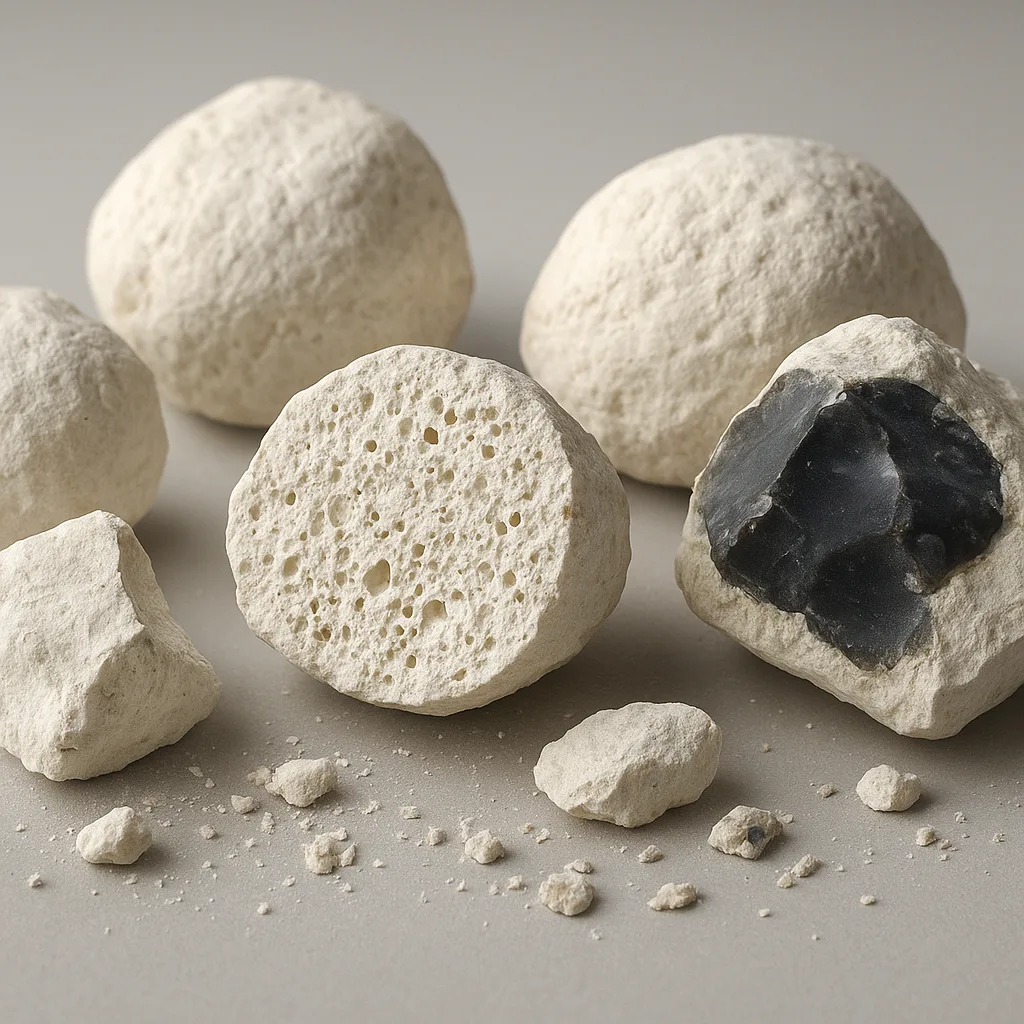
- Primary mineral: calcite (CaCO3), ~90–98% by weight
- Typical porosity: 30–40% in fresh sections; can be higher
- Typical grain size: microfossils and coccoliths 2–20 micrometers (µm)
2. How chalk forms: biology, chemistry and time
Chalk is a biogenic sedimentary rock produced in marine environments where microscopic plankton thrive. Over millions of years, the remains of these organisms rain down to the seafloor and are buried, compacted and lithified into chalk beds.
Key steps in chalk formation
- Production: Coccolithophores (order Isochrysidales) and foraminifera produce calcareous plates and tests.
- Deposition: Plates and tests settle through the water column as fine silt-sized particles.
- Burial and compaction: Overlying sediments compact the material; compaction reduces pore space but can leave chalk highly porous.
- Diagenesis: Chemical processes (recrystallization of calcite) solidify the sediment into rock.
In major chalk deposits like the White Cliffs of Dover or the Maastricht Chalk of the Netherlands, deposition occurred during the Late Cretaceous (about 100–66 million years ago) when large shallow seas covered parts of Europe. Chalk beds there can reach thicknesses of up to ~200 meters in places.
3. Microscopic composition and mineralogy
Chalk’s characteristic whiteness and softness reflect its microscopic makeup. Understanding the components helps explain its physical behavior, porosity, and how to identify it in the field.
Major components
- Coccoliths: Plate-like calcite crystals 2–20 µm in diameter formed by coccolithophores (phytoplankton). Their accumulated plates make the bulk of many chalks.
- Foraminiferal tests: Single- and multi-chambered shells (foraminifera) ranging from ~50 µm to several millimetres; often give chalk a fossiliferous texture.
- Micritic calcite: Very fine crystalline calcite (microcrystalline) that binds the particles.
- Clay and silt: Minor amounts (1–10%) of siliciclastic material; increases with distance from open oceanic settings.
Physical properties (typical values)
- Density (dry): 1.9–2.4 g/cm3
- Porosity: 20–50% (fresh chalk is often highly porous)
- Hardness (Mohs): ~1–3 (soft, can be scratched by a knife)
- Reaction with acid: vigorous effervescence with dilute hydrochloric acid (HCl) due to CaCO3
4. Field identification: visual cues and simple tests
When someone searches "chalk is made of what," they often want to identify chalk in the field or understand how it differs from rocks that look similar. Here are practical, science-based identification tips.
Visual and tactile cues
- Color: Usually pure white to off-white or light cream; iron staining may produce yellow, orange or brown patches.
- Texture: Fine-grained, powdery feel when scratched; may contain visible microfossils (tiny white disks or small shells).
- Fracture: Irregular, crumbly fractures; pieces may break into powdery fragments.
- Weight: Feels unusually light for a rock because of high porosity.
Simple field tests
- Acid test: Place one drop of dilute HCl (10%) on a fresh surface; chalk fizzes strongly due to CaCO3. If no reaction, suspect chert or shale.
- Hardness scratch: Chalk can be scratched with a fingernail or knife; chert cannot (chert is ~7 Mohs).
- Powder test: Rub on paper—chalk leaves a white streak; chert leaves little to no streak.
Use caution with acid and wear safety glasses. For quick identification from photos, apps like Orvik can assist by comparing image features and geolocation data to likely rock types.
For more on this topic, see our guide on How to Identify Any Rock in the Field.
5. Related rocks and how to tell them apart
This section answers the related queries: "what is a chert," "what is shale," "what is diatomite," and how each differs from chalk in form, composition and uses.
Chalk vs Chert: How to tell them apart
- Composition: Chalk = mostly CaCO3; Chert = microcrystalline silica (SiO2), often >95%.
- Hardness: Chalk soft (1–3 Mohs); chert very hard (7 Mohs), will cut glass.
- Appearance: Chalk is white/cream and powdery; chert is dense, may be gray, black, red or brown and exhibits conchoidal fracture with sharp edges.
- Field test: Chert does not effervesce with HCl; chalk does.
What is a chert and what is it used for?
Chert is a silica-rich, hard sedimentary rock formed by the diagenetic replacement of carbonate material by silica or by accumulation of siliceous microfossils (radiolaria, diatoms). Historically, chert was widely used to make tools and weapons (flint is a variety of chert). Modern uses include construction aggregate, road material, and sometimes decorative stone. Because of its hardness and fracture properties, chert is not useful as a source of lime like chalk.
Chalk vs Shale: How to tell them apart
- Composition: Shale = fine-grained siliciclastic sediment rich in clay minerals (illite, smectite) and often organic carbon; chalk = calcite-rich biogenic limestone.
- Structure: Shale is fissile—splits into thin layers; chalk breaks bread-like, not in sheets.
- Color: Shale ranges from gray to black to greenish; chalk is white to cream.
- Uses: Shale is used in brick, tile, and occasionally as source rock for hydrocarbons; chalk is used in agriculture (lime), industrial fillers, and historical use as pigment.
What is shale and what is oil shale used for?
Shale is a sedimentary rock composed mainly of clay-sized particles. "Oil shale" is a specific type of organic-rich shale containing significant kerogen—solid organic material that yields oil-like hydrocarbons when heated to ~300–500°C (pyrolysis). Oil shale is a potential unconventional energy source; it is mined and processed into shale oil via retorting, or it can be heated in situ. Drawbacks include high energy input, greenhouse gas emissions, water use, and potential for heavy metal and sulfur release.
- Kerogen content: commonly 10–40% in economic oil shales
- Processing temperatures: 300–500°C to convert kerogen to liquid hydrocarbons
- Environmental concerns: high CO2 emissions and water contamination risks
Diatomite vs Chalk
Diatomite (diatomaceous earth) is an accumulation of diatom frustules—silica-based cell walls of diatoms. It is soft, very porous (bulk porosity often >80%), and lightweight. Diatomite is white to off-white and feels chalky but is composed of amorphous silica (SiO2·nH2O), not calcite.
- Diatomite uses: filtration (brewing, water), abrasive cleaners, insecticide (dust), thermal insulation, and as lightweight aggregate.
- Key field test: Diatomite does not react with HCl and is extremely light and powdery; under a hand lens you can see rod- or disc-shaped frustules.
6. Uses of chalk and related materials
Chalk and similar deposits have a wide range of uses, from ancient tools to modern industry.
You may also find our article on Master Rock ID: Expert Guide to Stones helpful.
Common and industrial uses
- Agriculture: ground chalk (lime) is used to raise soil pH and supply calcium to plants (application rates vary: 0.5–4 tonnes/hectare depending on soil acidity).
- Construction: chalk can be a component in cement and lime production.
- Fillers and pigments: finely ground chalk acts as a white pigment and filler in paper, paints, plastics and rubber.
- Education and art: traditional blackboard chalk (largely compressed gypsum or synthetic in modern chalk); natural chalk historically used for drawing and marking.
Uses of related rocks
- Chert: tool-making (prehistoric), aggregate, decorative stone.
- Diatomite: filtration media, absorbents, mild abrasives, thermal insulation, and filler.
- Oil shale: potential source of unconventional liquid fuels, subject to environmental trade-offs.
7. Safety, toxicity and environmental notes
While chalk itself is relatively benign (calcium carbonate is common in soils and food supplements), other similar materials and processes have important safety considerations.
- Inhalation hazards: Fine dust from diatomite can contain crystalline silica if contaminated; chronic inhalation can cause silicosis. Even pure amorphous diatomite dust can be a respiratory irritant. Wear an N95/FFP2 respirator when handling fine powders.
- Chemical handling: Use gloves and goggles when performing acid tests with HCl. Dilute acid (10%) is sufficient for field effervescence tests.
- Cut hazards: Chert produces very sharp flakes—handle with gloves to avoid lacerations.
- Environmental impacts: Mining chalk and diatomite can disturb habitats; oil shale extraction releases greenhouse gases and may mobilize heavy metals and sulfides.
If you are identifying rock samples in the field, apps such as Orvik can reduce handling: take photos and let AI guide you to likely identifications and safety flags (e.g., whether dust control is needed).
8. Geographic distribution and notable deposits
Chalk is best known from Cretaceous marine deposits but similar calcitic sediments occur worldwide wherever plankton production was high and sediment conditions favored calcareous accumulation.
You might also be interested in Identify Any Insect from a Photo — Field-Proven Tips.
- Western Europe: iconic White Cliffs of Dover (England), Normandy coast (France), Maastrichtian chalk of the Netherlands — thicknesses up to ~200 m in some basins.
- North America: Pierre Shale Group interbedded with chalky limestones in the Western Interior Seaway of the Cretaceous; Florida and Caribbean contain Pleistocene to recent carbonate sediments with chalky layers.
- Other locations: chalk and chalk-like sediments are found in Japan, parts of Africa, and South America where Late Cretaceous seas existed.
Seasonal and ecological notes
Modern analogues to chalk formation are found in high-productivity marine settings (e.g., some continental shelves) where coccolithophores bloom seasonally. Seasonal blooms can create visible milky water known as "white tides" caused by high concentrations of coccolith plates. These blooms are most common in late spring to early autumn in temperate regions, depending on nutrient and light cycles.
Related reading: Field Guide to Rock Identification.
9. Practical tips for collectors, educators and farmers
Whether you’re a rock collector, teacher, or farmer wondering "chalk is made of what" for practical reasons, here are actionable tips.
- Collectors: Keep chalk samples dry and wrapped; label locality, bed, and orientation. Use a hand lens (10–40x) to spot coccoliths and foraminifera. Note reaction to dilute HCl.
- Educators: Demonstrate effervescence safely and compare with chert and shale samples to show differences in composition and hardness.
- Farmers: Soil testing before adding agricultural lime—match application rates to soil pH and target crops. Agricultural lab reports typically recommend lime tonnes/hectare based on buffer pH.
For quick on-the-go help, photograph uncertain samples and use Orvik to cross-reference images with geological databases and local distribution maps.
10. Chalk vs. Similar Materials: Quick comparison cheatsheet
- Chalk: white, soft, effervesces with HCl, porous, biogenic calcite.
- Chert: hard, conchoidal fracture, silica, no effervescence, sharp edges.
- Shale: layered/fissile, clay minerals, gray to black, may contain organic carbon.
- Diatomite: extremely porous and light, silica-based frustules, used as filter media.
- Oil shale: dark, organic-rich, contains kerogen; processed for liquid fuels.
Conclusion
When people ask "chalk is made of what," they’re usually seeking a simple, reliable answer: chalk is primarily microcrystalline calcite derived from the shells of marine microorganisms, compacted into a soft, white limestone. But the story extends beyond composition—chalk’s texture, porosity, formation environment, and uses tie into broader geological and ecological processes. Use visual cues (color, texture, porosity), simple field tests (HCl reaction, hardness), and modern tools like Orvik to confirm identifications. Be mindful of safety when handling powders or working with acids, and consider environmental consequences for large-scale extraction or processing of related materials like oil shale or diatomite.
If you want an accurate ID from a photo, try Orvik’s image-recognition features and local geology overlays—especially useful when a quick field decision is needed.
Frequently Asked Questions
- What exactly is chalk made of?
- Chalk is almost entirely microcrystalline calcite (CaCO3), formed from the remains of marine microorganisms such as coccolithophores and foraminifera; typical purity is 90–98% CaCO3.
- How can I tell chalk apart from chert or shale?
- Use simple tests: chalk is soft (scratchable with a knife), white and powdery, and fizzes vigorously with dilute HCl. Chert is hard (~7 Mohs), dense, shows conchoidal fracture and does not react with HCl. Shale splits into thin layers (fissile) and is clay-rich and darker in color.
- What is a chert and what is it used for?
- Chert is a hard, silica-rich rock (SiO2) often formed by replacement or accumulation of siliceous microfossils; uses include prehistoric toolmaking, aggregate, and sometimes decorative stone.
- What is diatomite and how does it differ from chalk?
- Diatomite (diatomaceous earth) is a silica-rich, extremely porous rock made of diatom frustules. It is lightweight and absorbent, used for filtration, abrasives, and insulation, whereas chalk is calcitic and used for lime, fillers, and agriculture.
- Is oil shale the same as shale and what is it used for?
- Oil shale is an organic-rich shale that contains kerogen; when heated (300–500°C) it yields liquid hydrocarbons. It is an unconventional fuel source but has environmental and energy-efficiency drawbacks.
- Are there health risks handling chalk or diatomite?
- Chalk (calcium carbonate) is generally low-risk, but fine dust can irritate eyes and lungs. Diatomite can contain crystalline silica contaminants and inhalation of dust may cause silicosis—use respirators and dust control. Always use gloves and eye protection when performing tests.
- Can I identify chalk from a photo?
- Often yes: look for white, soft, porous texture and fossil specks. For more confidence, use tools like Orvik which analyze images and compare to local geological data to suggest likely rock types.