
Introduction: What People Mean by "Crystal Identifier"
When someone searches for a "crystal identifier" they usually want a fast, reliable way to know what a specimen or mounted stone really is — whether it’s a piece of quartz, an amethyst point, a diamond in a ring, or a synthetic imitation. That intent spans collectors, jewelers, hobbyists, and buyers who need visual cues, simple field tests, and guidance on when to call in lab-grade tools. This guide brings field expertise, measurable properties, and practical photography and app-use tips (including how Orvik’s AI can help) so you can identify minerals, gems, and jewelry with confidence.
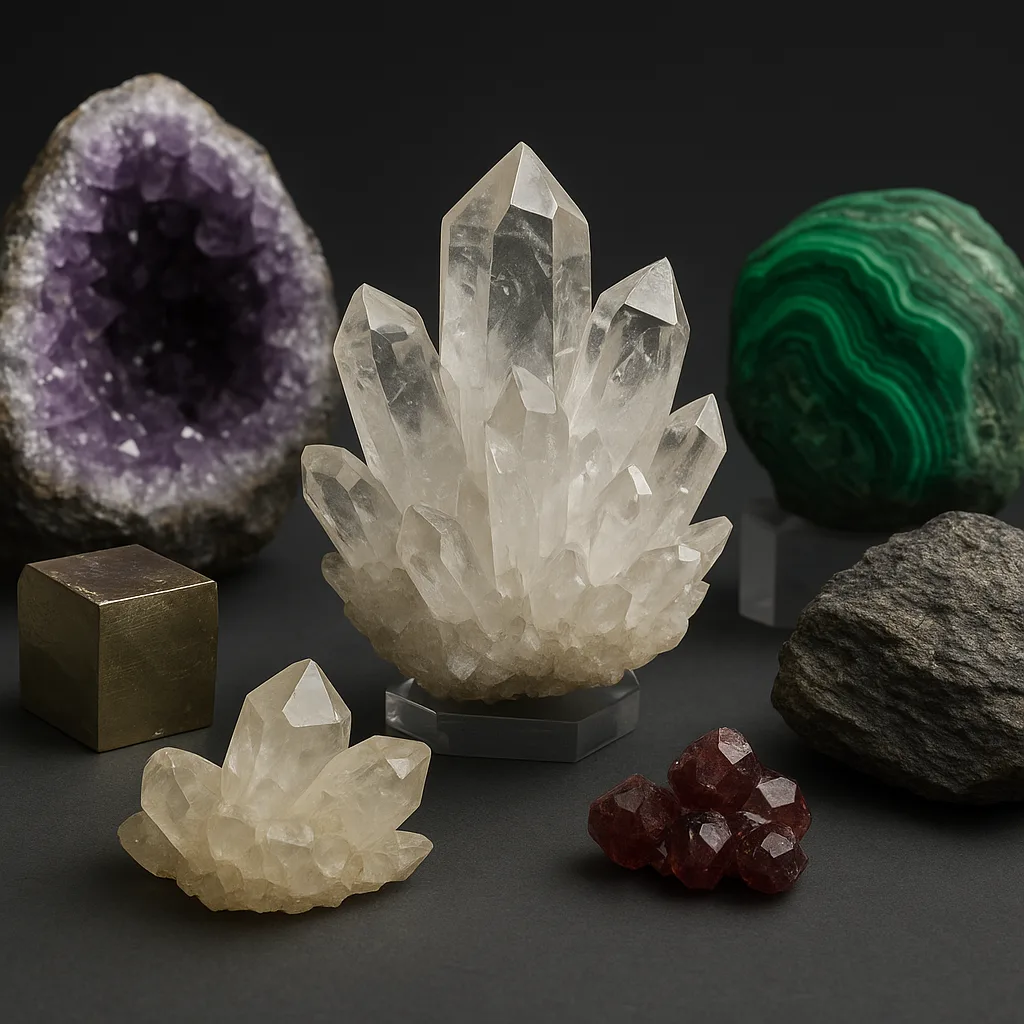
- Audience: collectors, jewelers, buyers, hobbyists.
- Scope: visual ID, simple field tests, jewelry-specific notes, habitat and distribution.
- Tools covered: hand lens (10x), streak plate, Mohs picks, refractometer, apps (Orvik).
How Crystals Differ from Gems, Minerals, and Glass
Precise language matters. In geology and gemology the terms have distinct meanings:
- Mineral: A naturally occurring inorganic solid with a defined chemical composition and crystal structure (e.g., quartz = SiO2).
- Crystal: A mineral with a visible external manifestation of its internal lattice (e.g., hexagonal quartz prism).
- Gem/Gemstone: A mineral (or organic material like amber) valued and often cut for use in jewelry (e.g., corundum as ruby/sapphire).
- Glass/Synthetic: Amorphous materials lacking a crystal lattice; may mimic gem appearance (e.g., soda-lime glass, cubic zirconia).
Crystal vs Glass
- Structure: Crystals show cleavage, crystal faces, or habitual forms; glass does not.
- Hardness: Glass ~5.5 on Mohs; many crystals (quartz 7, topaz 8) will scratch glass.
- Luster and inclusions: Natural crystals often show characteristic inclusions or growth zoning; glass bubbles are common but irregular.
Gemstone vs Raw Crystal
- Cut and polish change optical behavior: facets alter brilliance and dispersion.
- Settings in jewelry can hide diagnostic features; learn to examine under a loupe.
Practical Visual Identification Techniques
Field identification relies on replicable, measurable cues. Below are the primary visual and simple instrumental tests used by gemologists and mineralogists.
For more on this topic, see our guide on Inside the Geode: A Field Guide to Crystal Pockets.
Critical Visual Cues
- Color: Note hue, tone, and saturation. Amethyst is purple (often 120–180 nm Fe-related zoning); citrine is yellow to orange-brown.
- Crystal Habit & Shape: Quartz: six-sided prismatic crystals up to several meters in pegmatites; fluorite: cubic habit; pyrite: cubic crystals 1–20 mm common in veins.
- Luster: Adamantine (diamond), vitreous (quartz), resinous (amber), metallic (pyrite).
- Cleavage & Fracture: Calcite shows perfect rhombohedral cleavage (three directions); quartz has conchoidal fracture.
- Transparency: Transparent, translucent, or opaque; backlighting helps reveal banding or internal fractures.
Simple Field Tests
- Mohs Hardness: Fingernail ~2.5, copper coin ~3, steel file ~6.5, glass ~5.5. Quartz = 7, calcite = 3, fluorite = 4.
- Streak Test: Use unglazed porcelain: hematite leaves reddish-brown streak; pyrite leaves greenish-black or black streak.
- Specific Gravity (SG): Heft test or water displacement. Quartz ~2.65 g/cm3, galena ~7.4 g/cm3, pyrite ~4.9–5.2 g/cm3.
- Magnification: A 10x loupe easily shows growth zoning, inclusions, and facet wear in jewelry.
Optical and Instrumental Clues
- Refractive index (RI): quartz 1.544–1.553, diamond 2.417; use a refractometer for gems.
- Dichroscope: reveals pleochroism in tourmaline or tanzanite.
- UV lamp: some fluorites fluoresce blue, calcites may fluoresce red, diamonds can show blue fluorescence.
Jewelry and Mounted Stone Identification
Identifying a stone in a ring or pendant requires different tactics because settings can obscure features.
Diamond Ring Identifier: What to Look For
- Facet geometry: Round brilliant diamonds typically have 57–58 facets; look for crisp facet junctions and a high index of refraction (hard to see through simple observation, but sparkle pattern differs from CZ or moissanite).
- Fire vs Brilliance: Diamonds show high brilliance (white light return), moderate fire (spectral color). Moissanite often shows stronger rainbow fire under incandescent light.
- Inclusions: Carbon crystals, feathers, and pinpoints are common in natural diamonds and visible under 10x magnification.
- Hallmarks and Setting: Platinum settings and 4-prong solitaire settings are common for fine diamonds. Look for assay marks (e.g., Pt950, 18K) and maker's marks.
Jewelry Identifier Tips
- Photograph the stone with and without flash; flash exaggerates fire.
- Check the girdle for laser inscriptions (some certified diamonds have GIA numbers).
- Note weight and size: a 1.00 ct round diamond typically measures ~6.4–6.5 mm in diameter; a 0.50 ct ~5.0 mm.
- Use a jeweler’s loupe (10x) to see facet edges, chips, and inclusions.
Precious Stone Identifier—Mounted vs Loose
- Loose stones allow SG and RI tests; mounted stones limit tests to non-destructive techniques (loupe, microscope, UV, and observation).
- Ask for documentation: certificates from GIA, AGS, or other labs are definitive for diamonds and high-value gems.
Using Apps and AI: How Orvik Helps
AI-powered visual identification has advanced rapidly. Orvik is designed to analyze photos and suggest likely matches, combining image recognition with a database of minerals, gems, and jewelry. It can be especially helpful when you need a first-pass identification or when you’re unsure whether a stone is natural, synthetic, or an imitation.
You may also find our article on How to Identify Any Rock in the Field helpful.
How AI Identification Works
- Image analysis examines color distribution, crystal habit, facet geometry, and surface texture.
- Pattern matching compares input against thousands of labeled specimens and augments results with known localities and chemical/hardness data.
- Confidence scores guide whether a lab test is recommended.
Best Practices for Photographing Specimens for Orvik or Any App
- Use diffuse natural light (no harsh shadows). Morning/late afternoon light is often best.
- Provide scale: include a ruler or coin to show size (mm or cm).
- Capture multiple angles: top, side, prism faces, and underside for mounted stones.
- Include a close-up (10x crop or loupe photo) to reveal inclusions and surface texture.
- Note the setting: metal color and hallmarks help identify likely carat weight and quality of mounted gems.
Limitations and When to Seek a Lab
- AI cannot replace spectroscopy, X-ray diffraction, or professional grading for high-value items.
- Confusing cases: heat-treated stones, filled fractures, and diffusion-treated sapphires require gem lab analysis.
- Orvik and similar apps are excellent triage tools: they narrow possibilities and recommend next steps.
Common Crystals, Habitats, and Geographic Distribution
Understanding where a crystal typically forms helps narrow identification. Below are field‑tested notes for commonly encountered crystals and gems.
Quartz (SiO2)
- Habit: Hexagonal prismatic crystals with a six-sided termination; can be massive, drusy, or geode-lined.
- Hardness & Density: Mohs 7; SG ~2.65 g/cm3; RI 1.544–1.553.
- Distribution: Worldwide; major deposits: Brazil (Minas Gerais), Arkansas (Ouachita Mountains), Madagascar.
- Seasonality: Weathering exposes veins mainly in spring/fall in temperate climates.
Amethyst (purple quartz)
- Color zoning often seen: deep purple toward terminations, pale near base.
- Major sources: Uruguay (Artigas), Brazil (Rio Grande do Sul), Zambia.
Fluorite (CaF2)
- Habit: Isometric cubes or octahedra; bright fluorescence common.
- Hardness: Mohs 4; SG ~3.18 g/cm3.
- Major localities: Illinois (USA), Weardale (England), China (Hunan).
Emerald (variety of beryl, Be3Al2(Si6O18))
- Color: Chromic green caused by traces of Cr and/or V.
- Sources: Colombia (Muzo, Chivor), Zambia (Kagem), Brazil (Minas Gerais).
- Common size: Faceted emeralds range from 0.20 ct to >10 ct in museum pieces.
Diamond (C)
- Formation: High-pressure mantle origin; brought to surface via kimberlite or lamproite pipes.
- Localities: South Africa (Kimberley), Botswana, Russia (Yakutia), Canada (Ekati, Diavik).
- Typical lab tests: RI 2.417, SG ~3.51; electrical and thermal conductivity tests distinguish diamond from most imitations.
Comparison: How to Tell Common Look-Alikes Apart
Knowing typical confusions helps you choose the right test. Below are practical side-by-side checks with specific measurements.
You might also be interested in Goji Berries: A Field Guide to the Red Superfruit.
Related reading: Field Guide to Rock Identification.
Quartz vs Glass
- Hardness: Quartz (7) will scratch glass (~5.5); glass will not scratch quartz.
- Conchoidal fracture: Both can show it, but glass often shows swirl marks from manufacture; natural quartz shows growth zoning under magnification.
- Refractive index: Quartz RI ~1.55; glass varies but often ~1.50–1.52 (refractometer helps).
Diamond vs Moissanite vs Cubic Zirconia (CZ)
- Thermal conductivity: Diamond conducts heat vigorously; moissanite also high; CZ low. Thermal testers are fast but moissanite yields false diamond-positive results on some devices.
- Double refraction: Moissanite is doubly refractive and will show doubled facet junctions under 10x magnification; diamond and CZ are singly refractive.
- RI and SG: Diamond RI 2.417, SG ~3.51; CZ RI ~2.15–2.18, SG ~5.6–6.0 (heft test can help).
Amethyst vs Purple Fluorite
- Hardness: Amethyst (quartz) is 7; fluorite is 4 — a simple scratch on a glass plate or with a steel tool can distinguish.
- Cleavage: Fluorite has perfect octahedral cleavage; amethyst does not.
- Fluorescence: Fluorite often fluoresces under UV, while most amethyst does not.
Safety and Handling: Toxicity, Dust, and Cleaning
Some minerals are toxic or hazardous when handled improperly. Always treat unknown specimens with caution.
Toxic Minerals to Watch For
- Arsenic-bearing minerals: Arsenopyrite (FeAsS) can release arsenic dust when crushed — avoid inhaling and wear gloves.
- Mercury and Tin minerals: Cinnabar (HgS) is toxic; avoid grinding or heating.
- Asbestos group (serpentine family): Chrysotile fibers can be released when specimens are cut or abraded.
- Lead minerals: Galena (PbS) — wash hands after handling and avoid ingestion.
Safe Handling Practices
- Wear nitrile gloves when cutting or handling dusty specimens.
- Use a NIOSH-rated mask (e.g., N95) or respirator when sectioning or polishing minerals.
- Do not heat malachite or azurite — they can release toxic fumes.
- Store reactive minerals (pyrite) away from humid air to prevent oxidation.
Cleaning Jewelry and Specimens
- Soft brush, mild detergent, and warm water are safe for most stones except porous (opal, turquoise) or treatments (resin-filled emeralds).
- Ultrasonic cleaners: OK for rubies and sapphires, but dangerous for emeralds with oil or resin-filled fractures and many treated stones.
- Acid cleaners: Avoid unless you know the mineral — acids can dissolve calcite, aragonite, and many carbonates.
Conclusion
Identifying a crystal or gem combines careful observation, a few simple field tests, and sometimes instrumental analysis. For mounted stones such as a diamond ring, loupe inspection, hallmark reading, and knowledge of typical facet patterns are often sufficient for an informed judgment. AI tools like Orvik add speed and a second opinion: submit clear photos and follow recommended tests to narrow possibilities before committing to a lab report. Above all, handle specimens safely — avoid inhaling dust or heating unknown materials — and when in doubt, seek a certified gem lab for conclusive identification.
Frequently Asked Questions
- How can I identify a crystal at home?
- Start with visual cues (color, crystal habit, luster), perform simple tests (Mohs scratch, streak on porcelain), and use a 10x loupe. For mounted stones, photograph multiple angles and consult an app like Orvik to narrow possibilities.
- Is there an app that can identify gemstones from photos?
- Yes. AI apps such as Orvik analyze photos and suggest likely matches using image recognition and databases. They are useful for first-pass identification but not a replacement for lab analysis.
- How do I tell real diamond from imitation?
- Use a combination of tests: thermal conductivity (diamond testers), examine for doubled facet junctions (moissanite), check RI and specific gravity in the lab. Under 10x magnification, natural diamonds show characteristic inclusions.
- Are quartz and glass easy to confuse?
- They can look similar. Distinguish them by hardness (quartz = Mohs 7 scratches glass), growth zoning under magnification, and by measuring refractive index if possible.
- What minerals are dangerous to handle?
- Arsenic-bearing minerals (arsenopyrite), cinnabar (mercury), and asbestos-bearing serpentine can be hazardous. Avoid inhaling dust, wear gloves, and don’t heat unknown specimens.
- When should I get a professional gem lab report?
- For high-value purchases, insurance, sale, or legal disputes. If AI or field tests are inconclusive, a certified lab (GIA, AGS) provides definitive identification and grading.
- Can Orvik identify jewelry pieces like a jewel or precious stone identifier?
- Orvik can suggest identifications for mounted stones and provide possible gem types and treatments from photos, serving as a convenient jewel and precious stone identifier before professional confirmation.