
When someone types "granite is what type of rock" into a search box, they usually want a clear, usable answer: what granite is made of, how it formed, how to tell it from similar rocks like gneiss, and whether that speckled slab on the countertop is really the same stuff as the outcrop on the trail. This article answers those questions with field-tested identification tips, mineral chemistry, geographic notes, safety guidance, and practical comparisons. Use these cues in the field or upload photos to Orvik for quick visual identification.
What is granite?
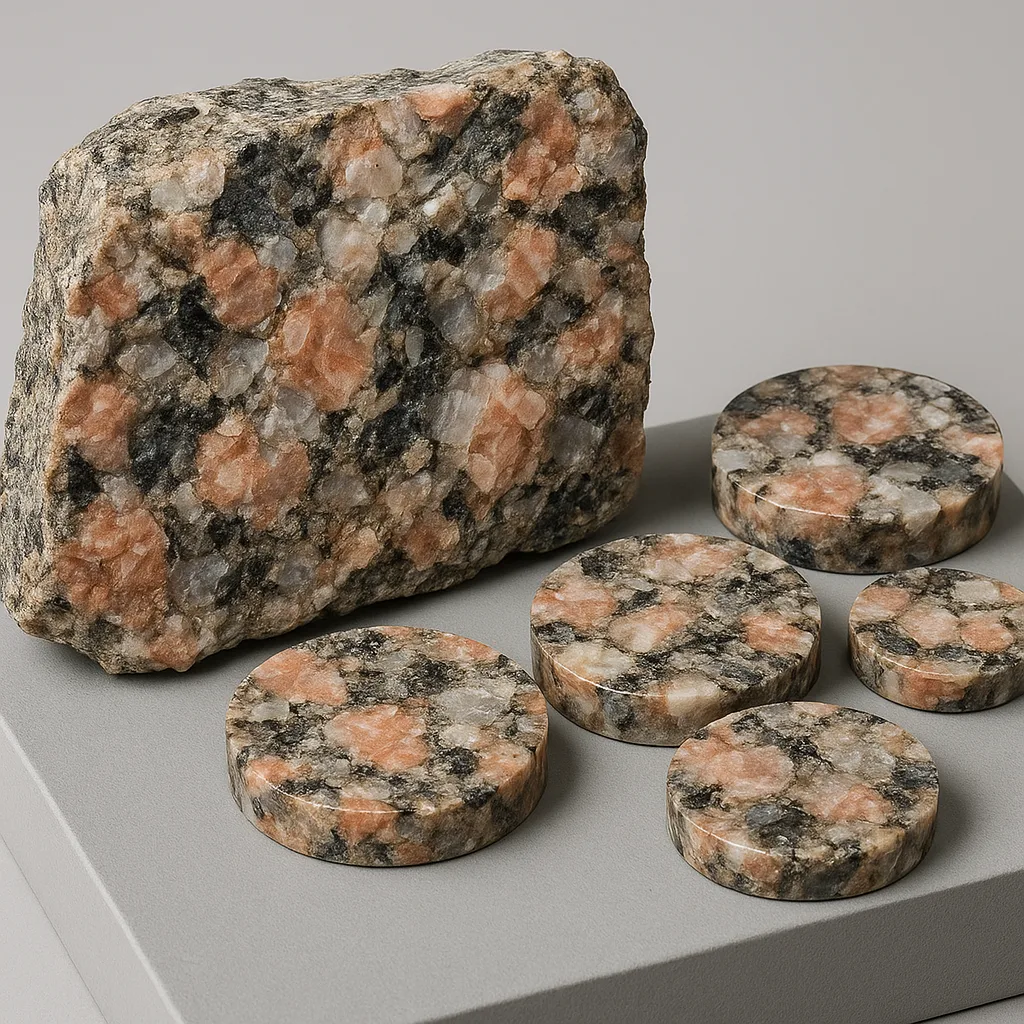
Granite is a coarse-grained, silica-rich igneous rock that crystallized from molten magma deep within Earth’s crust. It is one of the most abundant continental rocks and forms the skeletal framework of many mountain ranges and continental interiors. In technical terms, granite is an intrusive (plutonic) felsic igneous rock with a phaneritic texture—meaning its mineral grains are large enough to see with the naked eye.
What is granite made of?
Granite is a mineral assemblage, not a single mineral. Typical mineral proportions vary, but a typical granite contains:
- Quartz (SiO2): commonly 20–40% by volume; glassy, gray to clear crystals
- Feldspars (K-feldspar and plagioclase): often 35–65%; pink, white, or cream-colored grains
- Micas (biotite, muscovite): 0–15%; flaky, dark (biotite) or silvery (muscovite)
- Accessory minerals: hornblende, zircon, apatite, magnetite, titanite in trace amounts
Typical chemical signature: high silica (SiO2 commonly 65–77 wt%), moderate alkalis (Na2O + K2O), and relatively low iron and magnesium compared with mafic rocks.
Texture and grain size
- Phaneritic texture: individual crystals visible without magnification, typically 1–5 mm across.
- Pegmatitic varieties: some granites contain exceptionally large crystals (>1 cm, sometimes >10 cm) called pegmatites.
- Interlocking grains: crystals are tightly intergrown, giving granite its strength and durability.
Granite is what type of rock? (Classification)
Short answer: granite is an igneous rock—specifically an intrusive (plutonic) felsic igneous rock. That classification explains both its origin and its typical appearance.
For more on this topic, see our guide on How to Identify Any Rock in the Field.
How granite forms
- Intrusive origin: granitic magma cools slowly miles beneath the surface, allowing large crystals to grow.
- Plutons and batholiths: large bodies of granite form as plutons; several coalescing plutons create batholiths tens to hundreds of kilometers across.
- Depth and cooling: slow cooling at depths of several kilometers yields the coarse phaneritic texture.
Relationship to other rock types
Understanding granite's place in rock classification helps answer related search queries such as "what type of rock is gneiss". Gneiss is metamorphic—not igneous. In many places, pre-existing granite has been metamorphosed into gneiss under high temperature and pressure, producing banded textures and mineral segregation.
- Granite: igneous, coarse-grained, unfoliated.
- Gneiss: metamorphic, banded/foliated; may have originated from granite or sedimentary rocks.
- Other igneous types: diorite (intermediate), gabbro (mafic) differ in mineralogy and color.
How to identify granite in the field: practical tips
If you want to know "what does a granite rock look like" or "what do metamorphic rocks look like", focus on these hands-on cues. These are the same cues used by geologists on mapping trips and by identification apps like Orvik.
Visual cues: color, pattern, and grain
- Color: commonly light—white, gray, pink, or cream—depending on feldspar type. Dark specks are typically biotite or hornblende.
- Pattern: an even, speckled "salt-and-pepper" or mottled look from interlocking crystals.
- Grain size: crystals usually 1–5 mm; if you can clearly see individual quartz and feldspar crystals without magnification, it's likely plutonic.
Physical tests and measurements
- Hardness: quartz in granite is Mohs 7; feldspar ~6 — scratch tests against steel or a pocketknife can help (granite resists scratching by a knife).
- Density: bulk density around 2.6–2.7 g/cm3; heft the rock to compare to sedimentary rocks (granite feels heavier than limestone clasts of similar size).
- Luster and fracture: quartz shows vitreous luster; grains fracture conchoidally but the rock breaks in blocky, irregular fragments.
- Streak: streak is usually colorless or light gray—streak tests are less diagnostic for granites.
Tools and techniques
- 10x hand lens or loupe to inspect grain boundaries and mineral shapes.
- Field notebook and a small ruler or coin for scale in photos uploaded to Orvik.
- Hammer only where permitted—observe solitude and safety rules if sampling.
Tip: when photographing for Orvik or any ID tool, include a coin or ruler for scale, take close-ups of the grain texture and a wider shot of the outcrop, and photograph under diffuse light to reduce glare on polished surfaces.
You may also find our article on Field Guide to Rock Identification helpful.
Granite vs similar rocks: How to tell them apart
People commonly confuse granite with gneiss, diorite, and even some sedimentary rocks. Below are targeted comparisons to answer search queries like "what type rock is granite" or "what type of rock is gneiss" and to help you separate look-alikes in the field.
Granite vs Gneiss
- Texture: granite is unfoliated with randomly oriented crystals; gneiss is foliated with alternating light/dark bands.
- Origin: granite is igneous; gneiss is metamorphic (may derive from granite, shale, or other rocks).
- Visual cue: look for linear banding or alignment of mica—if present, you're likely looking at gneiss.
Granite vs Diorite
- Color: diorite is darker (salt-and-pepper look but with more black amphibole/biotite); granite tends to be lighter due to abundant light-colored feldspar and quartz.
- Mineralogy: diorite has little to no quartz compared with granite.
Granite vs Rhyolite and Basalt
- Grain size: rhyolite is the fine-grained (extrusive) equivalent of granite—too fine to see crystals without magnification; basalt is mafic and dark.
- Environment clue: if you see vesicles or glassy texture, it's volcanic (rhyolite/basalt), not granite.
Geographic distribution and habitats of granite
Granite builds continents. It occurs extensively in the cores of mountain belts and in large batholiths. You’ll find classic granite exposures and landscapes in many regions at specific scales and ages.
- Major examples: Sierra Nevada batholith (California, USA), Coast Plutonic Complex (British Columbia, Canada), Scottish Highlands and Cairngorms, the White Mountains and Adirondacks (NE USA), and many Precambrian shields worldwide.
- Typical settings: continental crust—batholiths, plutons, stocks, and dome-like intrusions. Granite rarely forms in oceanic crust settings.
- Age range: granites span ages from >3 billion years (Archean) to tens of millions of years (e.g., Cretaceous granites ~100 Ma). Many are Precambrian (>540 Ma).
Surface expression and habitat
- Outcrops: large, rounded tors and cliffs where erosion has removed overlying rock.
- Soils: weathered granite produces sandy, acidic soils called grus—often supporting heathland or coniferous forest.
- Ecological notes: granite landscapes often host specialized lichen communities and shallow-soil flora; water drains quickly through fractured granite.
Seasonal behavior: granite itself is geologically stable, but weathering rates change seasonally—freeze-thaw cycles in cold climates accelerate block detachment and create talus slopes; lichen growth and biological weathering are more active in wetter seasons.
You might also be interested in Ladybug Diets: A Field Guide to What They Eat.
Uses, hazards, and conservation
Granite is prized for its strength, durability, and aesthetics—leading to widespread quarrying and many modern applications. But it also has health and environmental risks.
Related reading: Inside Igneous Rock: Formation, Types & Field ID.
- Common uses: monuments, building stones, countertops, paving, crushed aggregate for roadbeds.
- Commercial forms: polished slabs, honed surfaces, crushed gravel and aggregate.
- Economic value: high-grade dimension stone fetches premium prices in construction and decorative markets.
Safety and toxicity
- Silica dust: cutting, grinding, or polishing granite releases respirable crystalline silica (quartz). Prolonged exposure can cause silicosis and increase lung cancer risk. Controls: wet cutting, local exhaust ventilation, and respirators (NIOSH-approved N95 or P100 as appropriate).
- Radon and radioactivity: some granites contain trace uranium and thorium producing low-level radon. Most granites are safe, but indoor radon testing is the reliable way to assess risk in enclosed spaces.
- Mechanical hazards: slabs and boulders are heavy—use mechanical lifting and proper personal protective equipment (PPE) when handling.
Conservation and quarrying impacts
- Quarrying can scar landscapes, disrupt drainage, and destroy habitats; reclamation and careful planning reduce impacts.
- Many natural granite landscapes are protected in parks and reserves; responsible sampling and photo documentation are encouraged.
Using Orvik and other tools to confirm granite
Visual ID is powerful, but modern tools speed confirmation. Orvik, an AI-powered visual identification app, can help by comparing your photos to a curated database and suggesting likely rock types. Combine app suggestions with field tests and simple measurements for robust ID.
- Photo tips for Orvik and other apps: take a close-up of the texture, a wider shot of the outcrop, and include a scale (coin or ruler). Capture photos in diffuse light to avoid reflections from polished grains.
- Metadata: include location (GPS), elevation, and notes on the environment—this contextual data improves algorithmic matches.
- Follow-up: use Orvik's suggestions as a starting point—verify with a hand lens, hardness checks, and, if possible, thin-section microscopy or XRF analysis for precise composition.
Orvik is particularly good at distinguishing granitic textures from gneissic banding and volcanic equivalents like rhyolite. Remember: an app increases confidence but doesn’t replace basic field skills.
Conclusion: What to remember
Granite is an intrusive, felsic igneous rock with coarse, interlocking crystals of quartz and feldspar. If you can see visible grains, note a speckled light color with dark flecks, and feel a dense, hard rock, you’re likely looking at granite. Gneiss, in contrast, is metamorphic and shows foliation. Use simple field tests (hand lens, hardness) and modern tools like Orvik to confirm identifications. Always follow safety precautions when sampling or working with granite—especially to control silica dust.
Frequently Asked Questions
- What is granite made of?
- Granite is primarily quartz (20–40%), potassium and sodium feldspars (35–65% total), plus minor biotite or muscovite and accessory minerals.
- granite is what type of rock?
- Granite is an igneous rock—specifically an intrusive (plutonic) felsic rock with a coarse-grained, phaneritic texture.
- What type of rock is gneiss?
- Gneiss is a metamorphic rock characterized by banding and mineral segregation, often formed from granite or sedimentary rocks under high temperature and pressure.
- What does a granite rock look like?
- Granite appears as a light-colored, speckled rock with visible interlocking crystals of quartz and feldspar and dark flecks of mica.
- How do I tell granite from similar rocks?
- Check for visible quartz and feldspar grains, lack of banding (which indicates metamorphism), hardness (resists knife scratching), and use a hand lens and photo-based ID tools like Orvik for confirmation.
- Is granite dangerous or toxic?
- Granite itself is not toxic, but cutting or grinding it produces respirable crystalline silica that can cause silicosis; use wet cutting, ventilation, and appropriate respirators.
- Where is granite commonly found geographically?
- Granite forms large batholiths and plutons in continental crust—famous examples include the Sierra Nevada (USA), Coast Plutonic Complex (Canada), and many Precambrian shields worldwide.