
What is limestone?
Limestone is a sedimentary rock composed primarily of calcium carbonate (CaCO3). By definition in sedimentary petrology, a rock with more than about 50% calcium carbonate is classed as limestone. It forms in a variety of settings, most commonly in shallow, warm marine environments where organisms with carbonate shells and skeletons live and die. Over geological time those biogenic fragments, plus chemically precipitated calcite or aragonite, lithify into limestone.
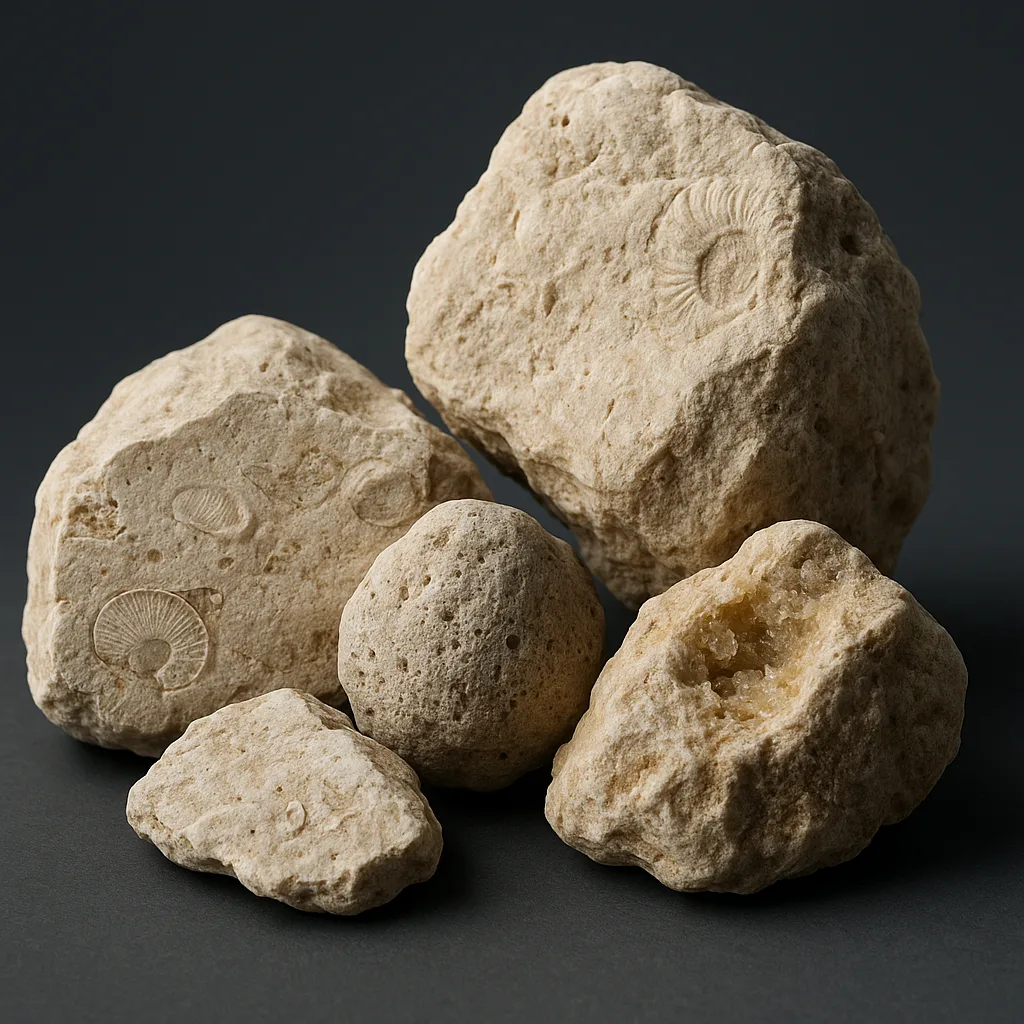
- Primary mineral: calcite (CaCO3); aragonite commonly present but unstable over geologic time.
- Secondary minerals: minor dolomite (CaMg(CO3)2), clays, silt, silica, iron oxides.
- Typical rock density: 2.3–2.7 g/cm3 (varies with porosity).
- Mohs hardness: roughly 3 (scratches easily with a knife).
Composition and formation
Limestone forms by three primary processes: accumulation of biogenic carbonate (shells, corals, foraminifera), chemical precipitation of carbonate from water (e.g., travertine), and diagenetic alteration such as dolomitization. Details of formation determine texture, porosity, and the rock's appearance.
Key compositional facts
- Calcite content: most limestones contain >50% CaCO3; many marine limestones exceed 90% calcite.
- Aragonite vs calcite: aragonite is a metastable polymorph of CaCO3 found in many shells; it commonly alters to calcite during burial diagenesis.
- Dolomitization: replacement of Ca2+ by Mg2+ can convert limestone to dolostone (often called dolomite rock).
How limestones form (basic processes)
- Biogenic accumulation: shells and skeletal fragments accumulate on seafloors and are compacted.
- Chemical precipitation: warm waters precipitate calcite; examples include hot-spring travertines or marine cements.
- Recrystallization and cementation during burial turn loose carbonate sediment into solid rock.
Visual ID: field characteristics and practical tips
When someone searches "limestone what type of rock" they usually want quick, usable cues to identify rock samples in the field. Below are practical visual and tactile signs with quantitative cues where useful.
- Color: most commonly white, light-gray, buff, tan, or pale brown. Heavy iron staining can make limestone yellow, orange or red. Chalk (a form of limestone) is bright white.
- Texture/grain size: ranges from micritic (microcrystalline carbonate mud) to fossil-bearing coarse grain. Ooids (spherical grains) are typically 0.2–2.0 mm in diameter; fossil fragments range from microscopic foraminifera (<1 mm) to large bivalve shells 10–100+ mm.
- Fossils: presence of identifiable shell fragments, corals, brachiopods, foraminifera, and crinoid stems is common in many limestones.
- Reaction to acid: a drop of dilute hydrochloric acid (10% HCl) produces immediate, vigorous effervescence (CO2 bubbles) on most limestones that contain calcite. This remains the single most reliable field test.
- Hardness and scratch test: Mohs ~3 — a steel knife (hardness ~5–6) will scratch limestone; glass (hardness ~5.5) will not scratch it easily.
- Bedding and layering: limestones typically form beds from centimeters to many meters thick with planar or wavy bedding, sometimes with cross-beds in oolitic sands.
Field identification checklist:
- Color check: light shades typical.
- Acid test: vigorous fizz with 10% HCl = calcite-rich limestone.
- Look for fossils or ooids under hand lens (10x–20x).
- Check hardness: soft vs hard relative to knife.
- Observe bedding thickness and cliff behavior (limestone often forms vertical cliffs and karst).
Safety note: when performing an acid test, wear eye protection and gloves; use a small drop of diluted acid and neutralize spills promptly.
Common types and related rocks
Limestone is not a single uniform rock but a family with textures and genesis that yield different names. Here are the common subtypes and related materials.
- Chalk: very fine-grained, white, composed largely of coccolithophores (microscopic plankton). Example: White Cliffs of Dover.
- Fossiliferous limestone: clearly visible shell fragments and skeletal remains.
- Oolitic limestone: composed of ooids — concentric spherical grains typically 0.2–2 mm across.
- Micritic limestone: very fine carbonate mud matrix, often appears smooth or dense.
- Travertine and tufa: terrestrial carbonates precipitated from freshwater springs; travertine is dense and banded, tufa is more porous.
- Dolostone (dolomite rock): formed by partial or complete replacement of calcite by dolomite mineral; often called "dolomite" in rock names.
What is a dolomite?
Dolomite can refer to the mineral dolomite (CaMg(CO3)2) or to dolostone, the rock dominated by that mineral. Dolostone forms when magnesium-rich fluids alter limestone (a process called dolomitization). Key field differences:
- Dolostone often reacts weakly or not at all with cold dilute HCl unless powdered; powdered dolomite will fizz slowly.
- Dolostone tends to be slightly harder and slightly more resistant to weathering than pure calcite limestone.
- Color and texture can be similar to limestone — use acid test and thin section/mineral analysis for confirmation.
What is a lava?
Lava is molten rock that reaches Earth’s surface during volcanic eruptions; when it cools and solidifies it forms extrusive igneous rocks such as basalt, andesite, or rhyolite. Lava is chemically and texturally different from limestone:
For more on this topic, see our guide on Field Guide to Identifying Fossils.
- Composition: predominantly silicate minerals (olivine, pyroxene, plagioclase, quartz in felsic lavas), not calcium carbonate.
- Texture: glassy, fine-grained, or vesicular; common features include flow bands and vesicles (gas bubbles).
- Reaction with acid: lava does not fizz with dilute HCl unless it contains carbonate contamination.
We include lava here because many people confuse dense, pale lavas or altered volcanic tuffs with carbonate rocks in the field; the acid test and texture differences clear that up quickly.
Limestone vs other rocks: key comparisons
People searching "limestone what type of rock" are often trying to distinguish limestone from visually similar rocks. Below are concise comparisons with practical tests.
Limestone vs dolostone
- Acid test: limestone (calcite) reacts vigorously with cold 10% HCl; dolostone reacts weakly until powdered.
- Feel and hardness: dolostone may feel slightly harder; both can look similar in hand sample.
- Best method: powdered sample or thin section under microscope to confirm dolomite mineral.
Limestone vs marble
- Marble is metamorphosed limestone — crystalline and interlocking calcite crystals; lacks original fossils and bedding.
- Marble often takes a polish and exhibits a sugary texture; limestone typically retains fossils and bedding.
- Both react with HCl because both are calcite-rich.
Limestone vs sandstone
- Sandstone is dominated by silicate grains (quartz) and will not effervesce with dilute HCl.
- Sandstone often feels gritty; limestone feels smoother and may be chalky or crystalline.
Limestone vs basalt/lava
- Basalt is dark, fine-grained, mafic igneous rock; limestone is lighter colored and carbonate-rich.
- Basalt has mineral phenocrysts or vesicles and does not fizz with acid.
Quick field tests list:
- Observe color and texture (fossils, ooids, grains).
- Perform acid test with 10% HCl.
- Check hardness with a knife.
- Look for bedding and karst features (sinkholes, caves).
Distribution, habitats, and seasonal behavior
Limestone is widespread worldwide because carbonate-producing environments have existed throughout most of Earth’s history. Today, carbonate platforms and reefs are concentrated in tropical to subtropical shallow seas, but ancient limestones crop out on every continent.
- Modern settings: shallow continental shelves, coral reef systems (e.g., the Great Barrier Reef region), carbonate ramps, and carbonate tidal flats.
- Notable outcrops: Yucatán Platform and cenote fields (Mexico), the Carboniferous limestones of the UK, the limestones of the Appalachian Valley and Ridge, Florida and Bahamas limestones, and the karst of the Dinaric Alps and Guilin, China.
- Karst landscapes: limestone dissolution creates caves, sinkholes, springs, and disappearing streams. Karst occurs in regions with abundant limestone bedrock and sufficient rainfall.
Seasonal and active processes:
- Speleothem growth in caves (stalactites and stalagmites) is tied to water chemistry and drip rate; typical calcite deposition rates range from fractions of a millimeter to several millimeters per year depending on climate and drip chemistry.
- Surface karst evolution accelerates in wet seasons with higher CO2-rich soil waters; droughts slow dissolution temporarily.
- Marine carbonate production often peaks in warm seasons where biological productivity increases, influencing reef and shelf carbonate accumulation rates.
Uses, hazards, and safety
Limestone is one of the world's most important industrial minerals and building materials, but it carries specific hazards for users and those working with it.
You may also find our article on How to Identify Any Rock in the Field helpful.
- Major uses: crushed stone for construction, cement and lime production, soil pH amendment (agriculture), aggregate, dimension stone for building and sculpture, and as a raw material in glass and steelmaking.
- Environmental role: limestone aquifers are major groundwater reservoirs; karst regions host productive springs but are vulnerable to contamination.
Hazards and safety precautions
- Dust: cutting, sawing, or crushing limestone generates dust (calcite particles). Protect with appropriate respirators (N95 or better) and eye protection. Long-term inhalation of silica-rich impurities can cause lung disease.
- Chemical handling: use care when applying acid in the field for identification — dilute acids, eye protection, and gloves are essential.
- Karst danger: caves and sinkholes are hazardous environments — risk of collapse, falling, and confined-space issues; do not enter caves without training and safety equipment.
- Water quality: karst aquifers are susceptible to rapid contamination due to direct conduits; treat drinking water appropriately.
How Orvik can help
Orvik, an AI-powered visual identification app, can be a practical tool when you’re uncertain whether a sample is limestone. By analyzing color, texture, visible fossils, and macro-features from photos, Orvik helps narrow possibilities and suggests tests to confirm (for example, recommending an HCl test if calcite-rich limestone is suspected).
- Use Orvik to compare your sample photograph against a large visual database of carbonate rocks and fossils.
- Orvik can flag features like ooids, crinoid stems, bryozoan colonies, or cross-bedding that point to specific limestone types.
- Combine Orvik’s visual ID with field tests (acid reaction, hardness, bedding observation) for reliable identification.
Tip: take close-up photos (with a scale like a coin or ruler) and broader context shots (outcrop and surrounding terrain). That context improves Orvik’s suggestions and speeds identification in the field.
Conclusion and FAQ
In short: if you’ve typed "limestone is what type of rock" into a search bar, the answer is clear — limestone is a sedimentary carbonate rock composed primarily of calcite (CaCO3), often formed from shells and chemical precipitation in marine and freshwater environments. Practical field identification relies on visual cues (color, fossils, ooids), texture, the acid test, and contextual evidence like karst features. Tools like Orvik help confirm visual traits, but simple field tests remain decisive.
Frequently Asked Questions
- Q: How can I tell limestone from dolomite in the field?
A: Use dilute (10%) HCl: limestone effervesces vigorously, dolostone reacts weakly unless powdered. Look for subtle differences in hardness and seek microscopic or geochemical analysis for confirmation.
You might also be interested in Dolphin Diets: What They Eat and Why.
- Q: What does limestone look like up close?
A: It often appears light-colored (white to tan), can be fine-grained or coarse with visible fossils, ooids (0.2–2 mm), or a microcrystalline texture. Under a hand lens you may see shell fragments or micrite.
- Q: Is limestone dangerous or toxic?
A: Limestone itself is not toxic, but dust from cutting or crushing can irritate lungs and eyes. Wear respiratory protection and goggles when working with it. Avoid entering unmanaged caves or unstable karst terrain.
Related reading: Master Rock ID: Expert Guide to Stones.
- Q: Can lava turn into limestone?
A: No. Lava is molten silicate rock that solidifies into igneous rocks (basalt, andesite, rhyolite). Limestone is a carbonate sedimentary rock formed from biological and chemical processes, not from cooling magma.
- Q: What is a good field test for limestone?
A: A small drop of 10% HCl on a fresh surface—if it fizzes vigorously, you almost certainly have calcite-rich limestone. Use eye protection and gloves.
- Q: How fast do limestone caves grow speleothems?
A: Growth rates vary widely, from fractions of a millimeter to a few millimeters per year, depending on drip rate, CO2 concentration, and carbonate saturation of the water.
- Q: Where are limestones commonly found?
A: Worldwide. Common modern settings include shallow tropical shelves, reef environments, and carbonate tidal flats. Prominent outcrops are found in Mexico (Yucatán), the UK, U.S. Appalachians and Florida, the Caribbean, and many parts of Europe and Asia.
If you want to identify a sample, try photographing it with a scale, run a tentative HCl test safely, and use Orvik to compare visuals. Combining those observations gives a robust identification pathway in the field.
Frequently Asked Questions
- What type of rock is limestone?
- Limestone is a sedimentary carbonate rock composed primarily of calcium carbonate (CaCO3), typically formed from accumulated shells, skeletons, and chemical precipitation.
- How can you tell limestone from dolomite?
- Use dilute HCl: limestone (calcite) effervesces vigorously with cold 10% HCl; dolostone reacts weakly unless powdered. Microscopic or chemical tests confirm dolomite.
- What does limestone look like?
- Limestone is usually light-colored (white, gray, tan), may contain visible fossils, ooids (0.2–2 mm), or be microcrystalline. It often shows bedding and can form cliffs and karst.
- What is a dolomite?
- Dolomite refers to the mineral CaMg(CO3)2 or to dolostone, the rock made largely of that mineral, typically formed by magnesium-rich fluids altering limestone.
- What is lava and what is it made of?
- Lava is molten rock erupted at Earth's surface; it solidifies into igneous rocks (basalt, andesite, rhyolite) composed mainly of silicate minerals such as olivine, pyroxene, and feldspar.
- Is limestone dangerous?
- Limestone is not toxic, but dust from cutting or crushing can irritate lungs and eyes. Use respiratory and eye protection. Caves and sinkholes present physical hazards.
- How do I test limestone in the field?
- Perform a small dilute HCl drop test (10%): vigorous fizz indicates calcite-rich limestone. Also check for fossils, hardness (~Mohs 3), and bedding.