
What is obsidian? — Defining the rock
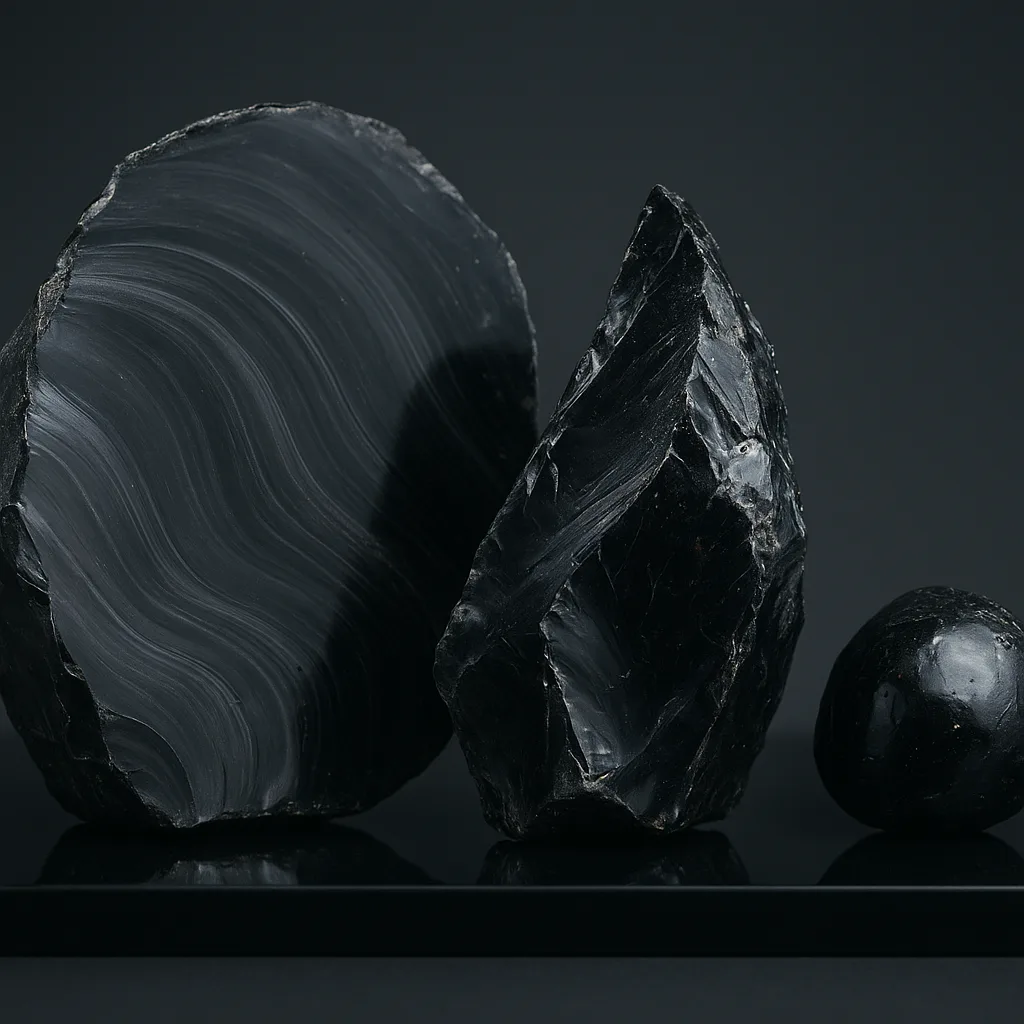
Obsidian is a natural volcanic glass: an amorphous, non-crystalline igneous material that forms when felsic lava cools so rapidly that mineral crystals do not have time to grow. Though commonly called a rock, in strict petrological terms obsidian is a mineraloid because it lacks an ordered atomic structure like true minerals such as quartz or feldspar.
Key scientific facts
- Type: volcanic glass (an igneous mineraloid)
- Typical silica (SiO2) content: ~70–77% by weight (rhyolitic composition)
- Density: about 2.3–2.6 g/cm3
- Mohs hardness: roughly 5–6
- Formation environment: high-viscosity, high-silica lava that cools very rapidly
When someone searches “obsidian what type of rock,” they want a clear, practical answer: obsidian is a volcanic glass—an extrusive igneous material formed from rapidly chilled silica-rich lava.
How obsidian forms: the geology and chemistry
Obsidian forms at the interface of volcanic processes and rapid cooling. The chemistry and cooling history determine whether erupted melt becomes crystalline volcanic rock (like rhyolite) or glassy obsidian.
Formation process
- Magma with high silica (>70% SiO2) erupts or extrudes as viscous lava.
- Rapid quenching follows—either by contact with air, water, or quick loss of heat in a small flow or dome—preventing crystals (phenocrysts) from forming.
- The result is an amorphous network of silicon and oxygen—volcanic glass with conchoidal fracture.
Temperature and physical conditions
- Rhyolitic magmas that produce obsidian generally erupt at ~700–850 °C (1,292–1,562 °F).
- Lower water content and very high viscosity favor glass formation; dissolved volatiles (H2O, CO2) influence vesiculation and texture.
- Cooling rates must be fast enough to outpace crystal nucleation—often seconds to hours at the flow surface.
Because obsidian is glass, it can slowly hydrate over geologic time to form perlite or even fine-grained devitrified textures containing cristobalite or tridymite.
Visual identification and field tips
Identifying obsidian in the field is straightforward if you know the key visual and tactile cues. Below are specific features to check, with measurements and practical tests you can do without laboratory equipment.
For more on this topic, see our guide on Understanding Pumice: The Frothy Volcanic Rock.
Primary visual cues
- Glassy luster: bright, vitreous reflection on broken surfaces.
- Conchoidal fracture: curved, shell-like breakage surfaces with smooth ripples.
- Color: commonly deep black or dark brown; can be green, mahogany (brown-black), red, or clear; thin edges often translucent (amber or green tint).
- No visible crystals: under a 10× hand lens, you should not see interlocking mineral crystals—appearance is homogenous.
Touch, sound, and simple tests
- Edge sharpness: freshly broken obsidian forms extremely sharp edges—able to cut skin or slice paper.
- Density feel: at ~2.4–2.6 g/cm3 it feels lighter than most mafic volcanic rocks (e.g., basalt) but heavier than pumice.
- Streak test: obsidian generally produces a white or colorless streak only when powdered; intact glass will not leave a streak on unglazed porcelain.
Practical photographic tips for use with Orvik
- Photograph a fresh fracture surface in bright, diffuse daylight to capture luster and conchoidal ripples.
- Include a thin edge against light to show translucency or coloring.
- Use Orvik to compare your image with reference samples and get suggested IDs and local occurrence data.
Varieties and appearance: what does obsidian look like?
Although many people picture obsidian as simply shiny black glass, it has a surprising variety of appearances caused by trace elements, inclusions, and devitrification.
Common named types
- Black obsidian: the most familiar form; uniform dark color caused by tiny magnetite or graphite inclusions.
- Mahogany obsidian: brown-black banding or streaks from iron-rich inclusions.
- Snowflake obsidian: black glass with white spherulitic cristobalite inclusions that form rounded "snowflake" patterns.
- Rainbow/fire obsidian: iridescent sheen from microscopic gas-bubble alignments or nanolayers producing play-of-color.
- Perlite: hydrated, concentric fracture texture from weathered obsidian—appears pearly and may flake.
Microscopic and chemical differences
Under a microscope, obsidian may show spherulites (radial crystal aggregates) or microlites if partial devitrification occurred. Trace iron and magnesium shift color, while inclusions of magnetite or organic carbon darken it further.
Where to find obsidian: habitat and geographic distribution
Obsidian forms in specific volcanic settings—most commonly in continental arc or hotspot rhyolitic eruptions. Knowing the geological habitat helps you target likely localities.
You may also find our article on How to Identify Any Rock in the Field helpful.
Typical geological settings
- Rhyolitic lava domes and short, viscous flows
- Dikes and sills where small amounts of high-silica melt are extruded and rapidly quenched
- Contact with water—rapid quenching at flow margins or where lava meets lake water
Where obsidian is commonly found
- United States: Glass Mountain (CA), Obsidian Butte and Glass Buttes (OR), Obsidian Cliff (Yellowstone NP, WY), Mono Lake and Glass Mountain (CA).
- Mexico: Sierra de las Navajas and the Michoacán highlands, historically important for tool-making.
- Europe: Lipari and Pantelleria (Italy), glassy flows in Cappadocia (Turkey).
- Other regions: New Zealand (Taupo Volcanic Zone), Iceland (rare, but present in silicic pockets), Armenia and the Caucasus.
Obsidian occurrences are often mapped at the scale of volcanic fields. Orvik can help you locate nearby recorded obsidian sites by matching photos and GPS.
Uses: ancient tools to modern blades — what can obsidian be used for?
Obsidian has an unusually sharp fracture property that made it invaluable to prehistoric peoples and still gives it niche uses today.
Historical and archaeological uses
- Projectile points and blades: Native American cultures crafted arrowheads and knives from obsidian because conchoidal fracture produces razor-sharp edges.
- Trade and economy: obsidian sources were traded widely; sourcing studies use geochemistry to trace artifacts to volcanoes.
- Ritual objects: polished mirrors and ceremonial blades in Mesoamerican cultures.
Modern uses
- Decorative and jewelry: cabochons, beads, and carved figurines.
- Scientific and surgical blades: finely polished obsidian can produce a cutting edge measured in nanometers; specialized surgeons have used obsidian scalpels in microsurgery for extremely fine incisions.
- Lapidary and collectors: specimens prized for unique patterns like snowflake or rainbow sheen.
While obsidian can be used to make very sharp edges, it is brittle—unlike steel it chips rather than bends. This limits its practical applications for general-purpose heavy-duty cutting tools.
Looking beyond this category? Check out Insects Explained: Nature’s Smallest Giants.
Safety, toxicity, and handling
Obsidian is not chemically toxic in its solid form, but it presents mechanical and respiratory hazards if improperly handled.
Related reading: Master Rock ID: Expert Guide to Stones.
Safety warnings and best practices
- Sharp edges: freshly fractured obsidian can be as sharp as surgical scalpels—handle with thick gloves and protective sleeves to avoid cuts.
- Dust hazards: cutting, grinding, or polishing obsidian generates fine silica-rich dust. Although obsidian is amorphous silica, respirable dust exposure can still irritate lungs. Use N95/FFP2 or higher respirators, local exhaust ventilation, and wet methods to suppress dust.
- Eye protection: fragments and splinters can cause serious eye injury; wear safety goggles during any mechanical work.
- Storage: store specimens away from children and pets; label sharp pieces and keep in padded containers.
For identification or casual collecting, use Orvik to document finds rather than breaking pieces off out of curiosity—preserving geological and archaeological context is important.
Comparison: Obsidian vs similar materials — how to tell them apart
People often confuse obsidian with other dark volcanic rocks, chert, or even man-made glass. The following comparisons focus on field-diagnostic differences.
Obsidian vs basalt
- Texture: obsidian is glassy and homogenous; basalt is fine-grained crystalline with tiny visible minerals (pyroxene, plagioclase).
- Fracture: obsidian shows conchoidal fracture; basalt fractures irregularly and may show columnar jointing in flows.
- Vesicles: basalt commonly has vesicles and may be dense; obsidian is typically non-vesicular (glassier) though rare bubbles occur.
Obsidian vs flint/chert
- Composition: flint/chert is microcrystalline quartz (SiO2) with a cryptocrystalline structure; obsidian is amorphous glass.
- Appearance: chert can be waxy and duller; obsidian is glassy and usually more translucent at edges.
- Hardness: chert is harder (Mohs ~7) and will scratch steel/knife more readily than obsidian (~5–6).
Obsidian vs man-made glass
- Context: man-made glass is often found near human sites and has uniform thickness, bubbles aligned in a direction, or smooth manufactured surfaces.
- Inclusions and weathering: natural obsidian frequently shows flow banding, spherulites, or devitrification halos that are less common in modern glass.
- Provenance tools: Orvik can help by comparing your photo to reference databases to differentiate natural obsidian from anthropogenic glass.
Conclusion
When someone types “obsidian what type of rock,” they need a clear, practical answer: obsidian is a volcanic glass—a high-silica igneous mineraloid formed by very rapid cooling of viscous lava. Its glassy luster, conchoidal fracture, and sharp edges make it easy to identify in the field, and its unique properties explain both its historical importance for tool-making and its modern niche uses in jewelry and microsurgery. For reliable identification, document fresh fracture surfaces and thin edges in good light and consider using Orvik to compare images to verified reference material and local occurrence data.
Frequently Asked Questions
- What is obsidian made of?
- Obsidian is primarily silica (SiO2), typically about 70–77% by weight, with trace iron, magnesium and other elements that affect its color.
- Is obsidian a rock or glass?
- Obsidian is a volcanic glass—technically a mineraloid—because it lacks a crystalline atomic structure like true minerals and cooled too rapidly to form crystals.
- How can I tell obsidian from flint or chert?
- Obsidian is glassy with conchoidal fracture and often translucent at thin edges; flint/chert is microcrystalline quartz (harder, Mohs ~7) and usually looks waxy rather than vitreous.
- Can obsidian cut you?
- Yes. Freshly fractured obsidian forms razor-sharp edges capable of deep cuts; handle with gloves and store sharp specimens safely.
- Where is obsidian commonly found?
- Obsidian forms at rhyolitic lava domes and short flows. Notable localities include Yellowstone (Obsidian Cliff), Glass Buttes (Oregon), Mono Lake and Glass Mountain (California), Lipari (Italy), Mexico, and New Zealand.
- Is obsidian dangerous to grind or polish?
- Grinding produces fine silica-rich dust; while obsidian is amorphous, respirable dust can still harm lungs. Use wet cutting, local exhaust ventilation and proper respirators (N95/FFP2 or better).
- What can obsidian be used for?
- Historically used for projectile points and cutting tools; today for decorative stone, jewelry and occasionally extremely fine surgical blades. Its brittleness limits heavy-duty applications.
- How can Orvik help with obsidian identification?
- Orvik uses image recognition and reference databases to compare your photos with verified samples and local occurrence records, helping confirm whether a specimen is obsidian and suggesting its likely variety.