
Sandstone is one of the most familiar sedimentary rocks on Earth: durable enough for buildings and monuments, yet porous enough to host aquifers and oil reservoirs. If you’ve asked "what are sandstone" while hiking, restoring an old wall, or using a field app like Orvik, this guide explains their composition, appearance, formation, and how to tell them apart from quartzite and shale with practical, measurable clues.
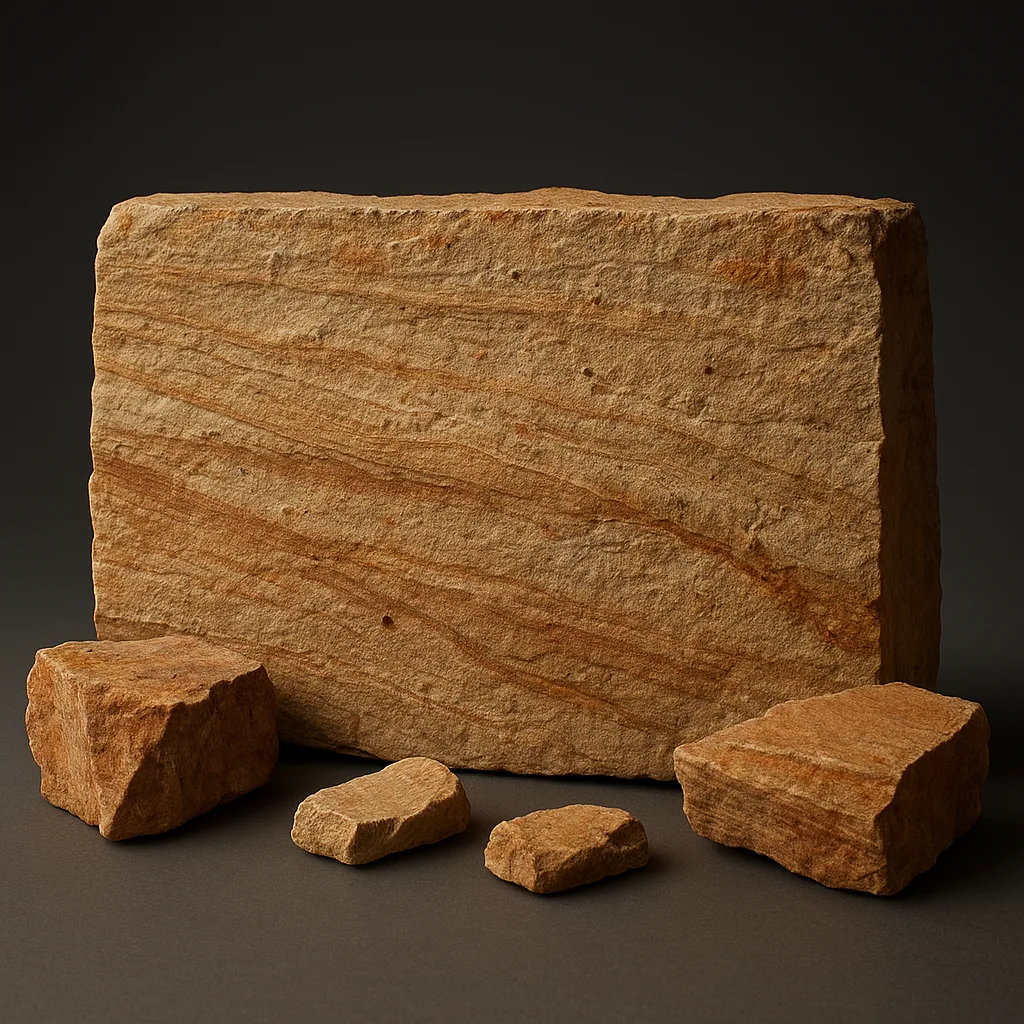
What Is Sandstone? Basic Definition and Formation
Definition
Sandstone is a clastic sedimentary rock composed predominantly of sand-sized particles— grains between 0.0625 mm and 2.0 mm in diameter—cemented together by mineral cements.
How sand becomes sandstone
- Transport: sand grains are transported by rivers, wind, or waves.
- Deposition: grains settle in environments like beaches, river channels, dunes, or shallow marine shelves.
- Burial and compaction: overburden pressure reduces pore space as sediments accumulate.
- Cementation (diagenesis): minerals precipitate from groundwater to bind grains—common cements are silica (SiO2), calcite (CaCO3), and iron oxides (Fe2O3).
Typical burial depths for sandstone lithification range from a few meters to several kilometers; diagenetic temperatures are commonly 20–200 °C depending on depth and geothermal gradient.
For more on this topic, see our guide on How to Identify Any Rock in the Field.
Composition and Mineralogy
Main constituents
- Quartz (SiO2) — the dominant mineral in many sandstones because of its hardness and chemical resistance.
- Feldspar — common in arkosic sandstones; weathering delivers potassium and plagioclase feldspars.
- Rock fragments — lithic fragments from pre-existing rocks in lithic sandstones.
- Clay minerals — illite, kaolinite, chlorite commonly fill pores and matrix.
- Cement minerals — silica, calcite, iron oxides control strength and color.
Quantitative measures
- Grain size: 0.0625–2.0 mm (sand fraction).
- Porosity: typically 5–30% in consolidated sandstones; can exceed 30% in very well-sorted examples.
- Permeability: ranges from <1 millidarcy (mD) in tight sandstones to thousands of mD in very porous types (important for aquifers and reservoirs).
- Compressive strength: commonly ~20–200 MPa depending on cement and porosity.
What Sandstone Looks Like: Visual and Tactile ID
Color, texture and grain patterns
Sandstone exhibits a wide palette of colors—white, tan, brown, red, pink, yellow, gray, and green—depending largely on cement and trace minerals. Iron oxide (hematite) produces reds and browns; calcite cement tends to make a lighter cream color; glauconite or chlorite may impart greenish tones.
You may also find our article on Master Rock ID: Expert Guide to Stones helpful.
Practical identification tips
- Grain visibility: Under good light, you can often see or feel individual sand grains. Use a hand lens (10x) to confirm grain size and roundness.
- Touch: sandstones feel gritty; matrix-rich varieties may feel smoother.
- Bedding: look for planar or cross-bedding, ripple marks, and graded beds—features that indicate depositional setting.
- Fossils: low-energy marine and deltaic sandstones can contain shells or trace fossils; look for fragments, burrows, or imprints.
- Density test: sandstones are less dense than many igneous rocks but denser than shale—typical density 2.2–2.7 g/cm3.
Field measurements and tools
- Hand lens (10x–20x) to examine grain boundaries and cement.
- Steel nail or glass plate for hardness scratch test (quartz grains resist steel).
- Acid (10% HCl) to test for calcite cement (fizzes on contact).
- Orvik app or similar visual ID tools to compare photos and geologic characteristics in situ.
Environments and Geographic Distribution
Common depositional environments
- Fluvial (river channels and floodplains) — often well-sorted, cross-bedded sandstones.
- Aeolian (sand dunes) — very well-sorted, frosted grains, large cross-beds (e.g., Navajo Sandstone).
- Shoreline and coastal (beach, barrier islands) — well-rounded grains with parallel bedding.
- Shallow marine and deltaic — variable sorting, may contain marine fossils.
Where to see famous sandstones
- United States: Navajo Sandstone (Utah/Arizona), Entrada Sandstone (Utah), the Dakota Formation in the Great Plains.
- United Kingdom: Old Red Sandstone (Devonian-aged sequences in Scotland and Wales).
- India: extensive Gondwana and marine sandstones across peninsular regions.
- Global: continental shields and sedimentary basins worldwide host sandstone formations spanning from Precambrian to modern Holocene deposits.
Seasonal behavior: sandstone surfaces can weather more rapidly in climates with freeze-thaw cycles—water in pores expands on freezing and accelerates spalling. In arid climates, wind abrasion polishes exposed surfaces over millennia.
Sandstone vs Quartzite vs Shale: How to Tell Them Apart
Definitions at a glance
- Sandstone — clastic sedimentary rock made of sand-sized grains cemented together.
- Quartzite — a metamorphic rock formed when quartz-rich sandstone is subjected to heat and pressure, recrystallizing the quartz grains into an interlocking mosaic.
- Shale — fine-grained clastic sedimentary rock composed of silt and clay; fissile (splits into thin layers).
Field tests and visual cues
- Grain visibility: you can usually see or feel sand grains in sandstone; quartzite often looks more glassy and may not show discrete grains because grains recrystallize and interlock; shale feels smooth and earthy with no visible sand grains.
- Hardness: quartzite is very hard (Mohs ~7) and will scratch glass easily; sandstone hardness varies (Mohs ~6–7 depending on cement); shale is softer (Mohs ~3–4) and can be scratched more easily.
- Reaction to acid: sandstone with calcite cement will fizz with dilute HCl; quartzite (pure quartz) will not react; shale may react weakly if calcareous.
- Cleavage and layering: shale exhibits excellent fissility—splits into thin sheets; sandstone breaks through grains; quartzite fractures irregularly and may have a conchoidal fracture.
Quick comparison table (descriptive)
- Texture: Sandstone—gritty; Quartzite—glassy, granular mosaic; Shale—smooth, laminated.
- Formation: Sandstone—deposition; Quartzite—metamorphism of sandstone; Shale—compaction of clay/silt.
- Uses: Sandstone—building, aquifers; Quartzite—decorative stone, aggregate; Shale—source rock for hydrocarbons, bricks.
If you're in doubt while in the field, photograph the rock and use Orvik to compare images and geologic descriptors—the app is particularly useful for non-specialists who want rapid visual ID combined with reference data.
You might also be interested in Dolphin Diets: What They Eat and Why.
Practical Uses, Durability and Hazards
Common uses
- Construction stone and dimension stone for buildings and paving (e.g., sandstone blocks and flagstone).
- Reservoir rock for groundwater and hydrocarbons due to porosity and permeability.
- Decorative stone and monuments—patina and color variations are prized in architecture.
Durability factors
- Cement type: silica-cemented sandstones are typically stronger and more resistant to chemical weathering than calcite-cemented varieties.
- Porosity and permeability: high porosity can reduce compressive strength and increase susceptibility to freeze-thaw damage.
- Mineral composition: feldspar-rich (arkosic) sandstones can decompose chemically faster than quartz-rich sandstones.
Health and safety warnings
- Crystalline silica: cutting, grinding, or drilling sandstone releases respirable silica dust (quartz) that can cause silicosis and lung cancer. Use wet cutting, local exhaust ventilation, and N95/FFP2+ respirators.
- Acid tests: dilute hydrochloric acid (10% HCl) is corrosive—use gloves and eye protection and neutralize after testing.
- Falling hazards: sandstone cliffs and ledges can be unstable; avoid standing beneath overhangs and wear helmets in rockfall-prone areas.
Tools, Techniques and the Role of Apps like Orvik
Field kit essentials
- Hand lens (10x–20x) to examine grain shape and size.
- Geologist's hammer for fresh surfaces (use safely and with permit where required).
- Portable acid bottle (10% HCl) for cement tests—use sparingly and safely.
- Compass-clinometer and tape measure for measuring bedding orientation and thickness.
- PPE: respirator, gloves, eye protection for mechanical tests.
How Orvik helps
- Image recognition: Orvik can compare your photos against a database of rock types and geological attributes to suggest likely IDs.
- Contextual data: when paired with GPS, Orvik provides formation names and regional geology to narrow interpretations.
- Learning aid: Orvik's suggested diagnostic tests and checklists help beginners perform the right field checks.
Combining classic field techniques with an app like Orvik speeds up identification and gives you a checklist to confirm a sandstone diagnosis before collecting samples or making engineering decisions.
Related reading: Field Guide to Rock Identification.
Conclusion
When someone types "what are sandstone" into a search box they usually want to know how to recognize the rock, how it forms, and how it differs from look-alikes like quartzite and shale. Sandstone is a sand-grained sedimentary rock bound by mineral cements; its appearance ranges widely with cement and mineralogy, and its depositional environments tell a story of ancient rivers, dunes, and shores. Use a hand lens, hardness and acid tests, and apps like Orvik to confirm field IDs. Take standard safety precautions when sampling—crystalline silica is hazardous and requires proper PPE. With the visual cues and tests outlined here you’ll be able to identify and understand sandstone confidently in the field.
Frequently Asked Questions
- What is a quartzite?
- Quartzite is a metamorphic rock formed when quartz-rich sandstone is subjected to heat and pressure, causing recrystallization of quartz into an interlocking, very hard rock.
- What type of rock is quartzite?
- Quartzite is a metamorphic rock—not sedimentary. It originates from sandstone that has been metamorphosed by burial or tectonic forces.
- What type of stone is sandstone?
- Sandstone is a clastic sedimentary rock made primarily of sand-sized mineral grains (0.0625–2 mm), most commonly quartz, bonded by mineral cements like silica, calcite, or iron oxides.
- What is quartzite made of?
- Quartzite is composed almost entirely of recrystallized quartz (SiO2). Trace amounts of other minerals can be present but quartz dominates the fabric.
- What does sandstone look like?
- Sandstone typically looks gritty and granular with visible sand-sized grains; it comes in colors from white and tan to red and green depending on cement and impurities and often shows bedding, cross-beds, or ripple marks.
- What does shale look like?
- Shale is fine-grained, smooth, and fissile—meaning it splits into thin layers. It often appears gray, black, green, or red and lacks visible sand grains.
- How can I tell sandstone from quartzite in the field?
- Key tests: hardness (quartzite is harder and scratches glass), grain visibility (sandstone shows distinct grains; quartzite often looks interlocking), and acid test (sandstone with calcite cement may fizz with dilute HCl; quartzite will not). A hand lens and a steel/glass scratch test help confirm the ID.
- Is sandstone safe to cut or work with?
- Cutting or grinding sandstone releases respirable crystalline silica dust, which is hazardous. Use wet-cutting, local exhaust ventilation, and appropriate respirators (N95/FFP2 or better) and follow workplace safety guidelines.