
What is a geode?
A geode is a rounded rock that contains an internal cavity lined with mineral crystals. Unlike ordinary solid stones, geodes have a hollow or partially hollow center (a vug) that has allowed crystals to grow inward from the walls. Geodes range in size from pea-sized spheres under 1 cm in diameter to huge specimens exceeding 1 m across; common collectible geodes are often 3–15 cm (1–6 in) in diameter.
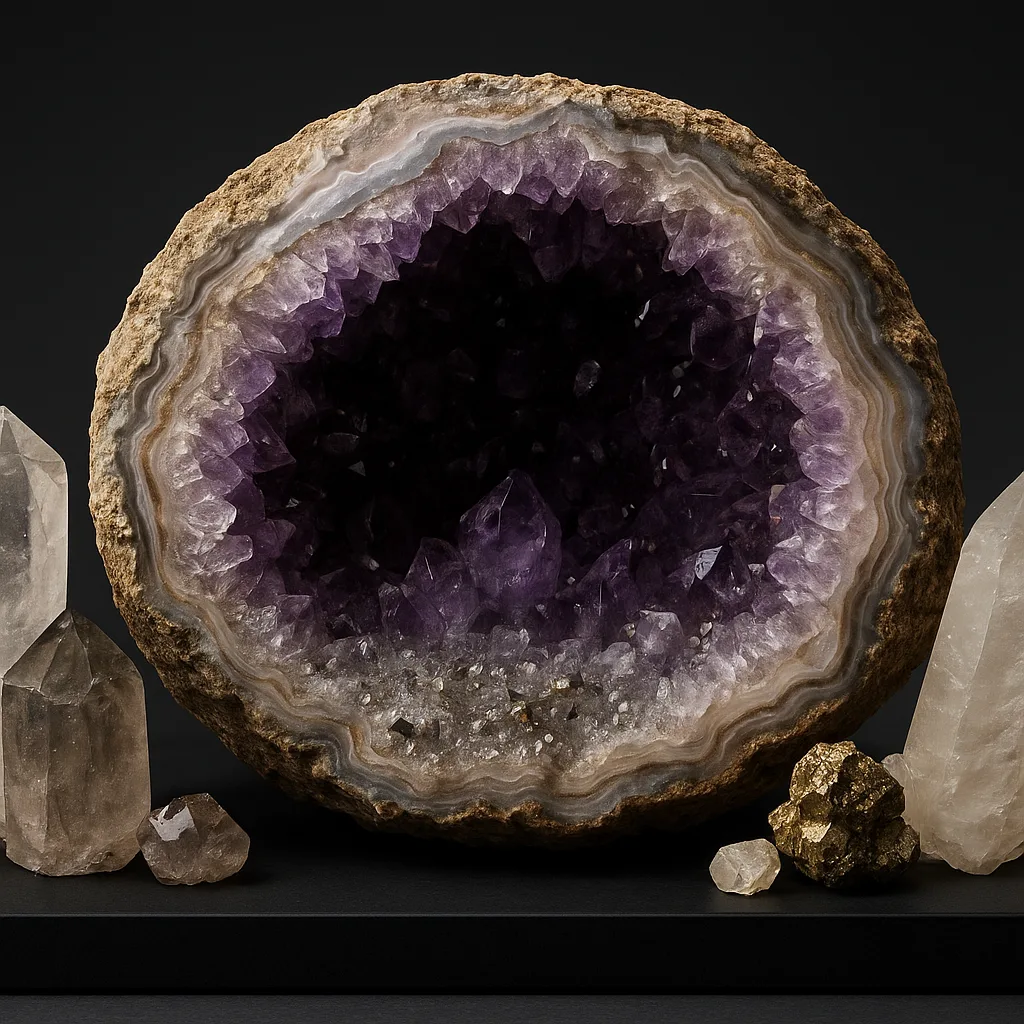
- Definition: Rock with an internal cavity lined with crystals or mineral deposits.
- Typical size: 1 cm to >1 m; most hobbyist specimens 3–15 cm.
- Common exterior: rough, bumpy, usually dull and nondescript.
How geodes form
Geodes form by two main geological pathways: volcanic (igneous) processes and sedimentary concretion processes. Both create a space in the host rock where minerals can precipitate from fluids and crystallize on the cavity walls.
Volcanic (igneous) geode formation
In volcanic settings, gas bubbles trapped in cooling lava or in vesicular basalt create cavities. Hydrothermal fluids or silica-rich groundwater later percolate into those cavities and deposit layers of chalcedony and quartz, sometimes over thousands to millions of years.
- Host rock examples: basalt, rhyolite, pumice.
- Process timeline: typically thousands to millions of years for large crystals to form.
- Common minerals: chalcedony first, then quartz varieties (including amethyst).
Sedimentary geode (concretion) formation
In sedimentary environments, geodes often form as concretions around organic material, fossils, or cavities in limestone and shale. Mineral-rich groundwater precipitates silica, calcite, or other minerals inward from the outer shell, leaving a cavity that later becomes lined with crystals.
- Host rock examples: limestone, nodular shale, calcareous deposits.
- Indicators: layered host rock, nodular outward shape, often heavier due to calcite content.
- Mineral timeline: similar long-term precipitation, with calcite sometimes forming first.
What are geodes made of?
The composition of geodes varies with the chemistry of the fluids that filled the cavity. The most common materials are forms of silica (SiO2), but a wide range of minerals can occur.
For more on this topic, see our guide on Inside Igneous Rock: Formation, Types & Field ID.
- Chalcedony (microcrystalline quartz): commonly forms an inner lining or botryoidal layer; often bluish-gray to white.
- Quartz (macrocrystalline SiO2): clear, smoky, or amethyst (purple) varieties often dominate the interior crystals.
- Amethyst (purple quartz): Fe3+ impurities and irradiation give the purple color; common in Brazilian and Uruguayan geodes.
- Calcite (CaCO3): forms rhombohedral crystals; reacts with dilute hydrochloric acid (fizzes).
- Celestine (SrSO4): pale blue crystals, known from Madagascar and Ohio.
- Fluorite (CaF2): can impart purple, green or yellow cubic crystals inside some geodes.
By abundance, silica minerals (chalcedony + quartz) dominate most geode interiors—likely >80% of typical occurrence—while carbonates and sulfate minerals are less common but visually distinctive when present.
How to identify geodes in the field
Many people searching “what is a geode” really want to know how to spot one in the field and avoid cracking an ordinary rock. Here are practical, visual, and physical tips you can use on hikes or digs.
- Exterior shape: rounded, bulbous, or slightly pear-shaped; often nodular rather than angular.
- Surface texture: rough, weathered, and bumpy; may show a thin crust of chalcedony or iron staining.
- Weight and density: many geodes are lighter than solid rocks of the same size due to the cavity; they may feel deceptively light.
- Sound test: when lightly shaken, small loose-crystal geodes may rattle; do not aggressively shake delicate specimens.
- Color cues: exteriors are usually gray, brown, or tan; bright exterior colors often signal mineral staining rather than crystal interiors.
- Fracture hints: hairline cracks revealing a glassy sheen, botryoidal texture, or banded chalcedony can indicate an interior cavity.
Practical fieldtools and techniques
- Use a geologist's hammer or rock pick and wear safety glasses when testing possible geodes.
- Tap gently with the hammer to hear if the rock sounds hollow—avoid heavy blows that can shatter crystals.
- Photograph suspicious rocks and use an app like Orvik to compare images to known geode examples before opening.
What do geodes look like on the outside?
Outside, geodes rarely reveal their inner beauty. The exterior is a disguise that helps them blend with surrounding rocks.
You may also find our article on Visual Crystal ID: A Specialist’s Field Guide helpful.
- Common exterior colors: dull gray, brown, beige, or rusty orange from iron oxides.
- Surface forms: knobby or lumpy; sometimes smooth and spherical if the outer layer was chalcedony.
- Size variation: small pea-sized nodules up to soccer-ball-sized or larger boulders.
Because the exterior can look like ordinary limestone, basalt, or gravel, collectors often rely on context—local geology, nearby known geode beds, and regional guides—to narrow possibilities. Orvik can help by providing quick visual comparisons against a large image library and identifying features like botryoidal chalcedony or vesicle textures.
X vs Y: How to tell geodes apart from similar rocks
Some rocks and mineral occurrences look like geodes at first glance. Here are clear comparisons to help you distinguish them.
Geode vs Nodule
- Geode: hollow or partially hollow interior with visible crystals.
- Nodule: typically solid through the center (e.g., flint nodules in chalk); may show concentric structure but no large cavity.
Geode vs Agate
- Agate: a form of banded chalcedony. Some agates are solid banded stones; others occur as geode linings. Agates often show concentric banding visible on cut surfaces.
- Geode: may contain agate bands as an inner layer, but the key is a central void with crystal druse.
Geode vs Thunder Egg
- Thunder egg: a type of nodule formed in volcanic ash or rhyolite, often filled with chalcedony or agate; usually solid (no hollow cavity) but can have small vugs.
- Geode: more frequently hollow and lined with larger crystals.
Geode vs Vug
- Vug: any cavity in rock, often larger and irregular. Geodes are a subset of vugs that are rounded, nodule-like, and commonly filled with crystalline linings.
Where to find geodes: habitat, distribution, and seasons
Geodes occur worldwide where suitable host rocks and mineral-rich fluids have existed. Knowing local geology and seasons for field access improves your chances of finding them.
You might also be interested in Field Guide to Flower Names.
- United States hotspots: Keokuk, Iowa (classic Keokuk geodes); Indiana and Kentucky (limestone geodes); southern Illinois; Chihuahua, Mexico (border region); California (Pinto Basin); Utah and Western U.S. deserts.
- International sources: Brazil and Uruguay (large amethyst-lined geodes); Madagascar (celestine and agate); Morocco (halite/gypsum geodes in some basins); Namibia (fluorite-lined specimens).
- Habitats: dry streambeds, limestone outcrops, basalt flows, old quarries, road cuts and glacial deposits where erosion has liberated geodes from host rock.
Seasonal and access considerations
- Dry seasons and low water levels expose more rock and make collecting easier in streambeds and quarries.
- Avoid wet seasons when loose talus is unstable and flash flooding risk increases in washes and arroyos.
- Always check land ownership—collecting on public lands is regulated and private land requires permission.
Using Orvik to photograph geological outcrops can help match local patterns to known geode localities quickly, improving field ID and trip planning.
Related reading: How to Identify Any Rock in the Field.
What are geodes used for? Care, cutting, and safety
Geodes have a range of uses from scientific to decorative. How you open and care for a geode depends on your intended use and safety precautions.
- Decorative: display pieces, bookends, lamps, and home accents.
- Jewelry: thin cross-sections and small crystals are cut and set in pendants, rings and earrings.
- Educational and scientific: teaching mineralogy, studying growth patterns, and isotope dating of formation fluids.
- Metaphysical: used in crystal healing and energy work by some groups (no scientific basis for health claims).
Opening and cutting geodes: methods and safety
- Center-cut saws: diamond-bladed trim saws or tile saws give the neatest results and preserve crystallography; always use water cooling to suppress dust.
- Geode cracker: mechanical splitters apply uniform pressure and can split geodes cleanly along natural seams.
- Hammer and chisel: riskier and likely to damage crystals; use protective goggles and split with controlled taps.
- Safety considerations: silica dust from cutting quartz is a respirable carcinogen (respirable crystalline silica). Use wet cutting, local exhaust, and N95/respirator rated masks. Wear eye protection and gloves to prevent cuts from sharp crystals.
Cleaning and preservation
- Rinse loose dirt with water and a soft brush. For stubborn iron stains, dilute oxalic acid can lighten color—use gloves and follow safety instructions.
- Do not use harsh acids on calcite-lined geodes—acid will dissolve calcite.
- To enhance appearance, a thin coat of mineral oil or museum-grade clear coat can bring out color, but avoid permanent alteration if specimen is scientific.
Safety, legal, and ethical considerations
Collecting geodes is rewarding, but responsible collecting prevents injury and preserves local geology.
- Personal safety: watch for falling rock, unstable slopes, and snakes or insects in arid regions. Use steel-toed boots and gloves.
- Cutting hazards: silica dust control is essential. Use wet cutting and a respirator when dry cutting is unavoidable.
- Legal/ethical: many quarries and conservation lands prohibit collecting. Obtain permits or landowner permission. Leave large scientific specimens for research unless you have authorization.
Conclusion
When people ask “what is a geode,” they are often seeking more than a definition—they want to recognize, find, open, and care for these hidden crystal pockets. Geodes are geological time capsules: rounded rocks formed in volcanic or sedimentary settings whose interiors record mineral-rich fluids and slow crystal growth. With visual cues (rounded exterior, lighter weight, banded chalcedony on breaks), proper tools and safety, and help from field tools like Orvik for image-based ID, both beginners and experienced collectors can enjoy discovering geodes responsibly.
Frequently Asked Questions
- What is a geode?
- A geode is a rounded rock containing an internal cavity lined with mineral crystals, often formed in volcanic vesicles or sedimentary concretions.
- What are geodes made of?
- Most geodes are primarily silica-based: chalcedony and quartz (including amethyst). Other minerals like calcite, celestine, and fluorite can also occur.
- How can I tell if a rock is a geode?
- Look for a rounded, nodular exterior, lighter weight for size, hairline cracks showing a glassy sheen or bands, and sometimes a faint rattle if crystals are loose.
- Where are geodes commonly found?
- Common localities include Keokuk, Iowa; southern Illinois; Indiana; Chihuahua, Mexico; Brazil and Uruguay for amethyst geodes; and Madagascar for celestine.
- Are geodes dangerous or toxic?
- The minerals are not inherently toxic, but cutting or grinding geodes releases respirable silica dust, which is hazardous—use wet cutting and appropriate respirators.
- How should I open a geode?
- Best methods are diamond-blade saw cutting (wet saw) or a mechanical geode cracker. Avoid uncontrolled hammering; always use eye protection.
- What does an agate look like compared to a geode?
- Agate is banded chalcedony and can be a solid or the lining inside a geode. Agates show concentric banding when cut, while geodes emphasize a hollow cavity lined with crystals.
- Can Orvik help identify geodes in the field?
- Yes. Orvik's image-based identification tools and database can help compare your photos to known geode types and suggest likely matches and localities.