
Introduction — Quick answer: what is a pumice?
Pumice is a highly vesicular, glassy volcanic rock formed when gas-rich, high-silica magma cools and depressurizes explosively. It is essentially volcanic glass full of bubbles (vesicles), light enough that many pumice pieces float on water. People asking "what is a pumice" are usually trying to identify a lightweight, frothy stone, to learn how it forms, and to know how it differs from other rocks. This guide gives practical field-identification tips, measurements, comparison charts, safety notes, and context for collectors and curious naturalists.
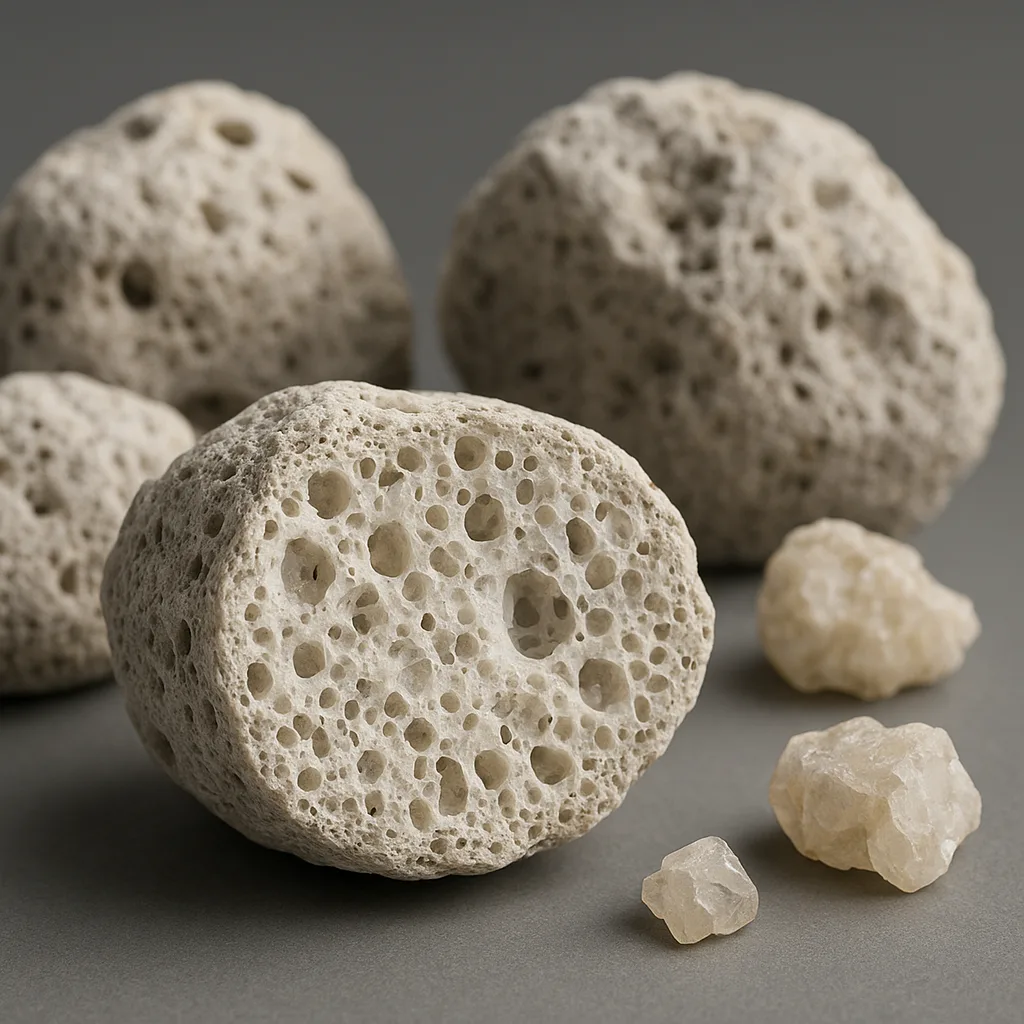
- Key traits: glassy, vesicular, low density (often floats), pale colors.
- Typical composition: rhyolitic to dacitic volcanic glass with minor crystals (quartz, feldspar).
- Common uses: abrasives, horticulture, lightweight concrete aggregate.
How pumice forms
Explosive eruptions and vesiculation
Pumice forms during explosive, gas-rich volcanic eruptions. As viscous, silica-rich magma rises, pressure drops and dissolved volatiles (mainly H2O and CO2) exsolve as gas bubbles. Rapid decompression and cooling cause the melt to quench into a glass while the gas bubbles are trapped, producing a frothy, highly porous solid.
- Vesicle sizes: from <0.1 mm to several centimeters in diameter.
- Porosity: typically 60%–90% by volume.
- Bulk density: commonly 0.25–0.90 g/cm3 (many pieces float because density <1.0 g/cm3).
Composition and chemistry
Most pumice is felsic — rhyolitic or dacitic — meaning it is high in silica (SiO2 > 63%). Mineral content can include:
- Glassy matrix (dominant) — quenched volcanic glass such as perlite or tachylyte in rarer types.
- Phenocrysts: quartz, alkali feldspar (orthoclase, sanidine), plagioclase, biotite.
- Accessory minerals: magnetite, zircon, apatite in trace amounts.
There are also less common mafic pumices (andesitic) but these are darker and denser and more typically called scoria when mafic.
Identification: Visual and physical cues
Color, size, and shape
Visual cues are often the quickest way to flag a specimen as pumice:
- Color: usually white, cream, light gray, pale yellow or tan. Rarely pinkish or buff depending on oxidation and mineral content.
- Size: individual clasts range from pea-sized (several mm) to fist-sized or larger (several cm to 10s of cm). Pumice fragments in pumice rafts can be cobble-size.
- Shape: often irregular and angular if from pyroclastic fall; can be rounded if tumbled in water.
Texture and simple field tests
Use these physical tests when you find a suspicious rock:
- Float test: most pumice with bulk density <1 g/cm3 floats. Place in water — persistent floatation strongly indicates pumice, though very weathered or waterlogged pieces may eventually sink.
- Vesicular texture: look for abundant interconnected bubbles; cross-sections often show a frothy pumice fabric.
- Hardness and brittleness: the glass itself has Mohs hardness ~5–6, but pumice is brittle and crumbles under pressure.
- Scratch test: a steel knife will not easily scratch volcanic glass, but small fragments flake off due to porosity.
Practical field-ID tips
When using apps like Orvik or standard field guides, take these steps for reliable ID:
- Photograph both external surfaces and a fresh broken face to reveal vesicles and glassy texture.
- Note context: is it near volcanic deposits, beaches adjacent to volcanic islands, or in alluvial/costal float zones?
- Try the float test (do it where permitted) and note whether the specimen retains bubbles after immersion.
- Record weight and approximate density by hefting — pumice feels much lighter than it looks.
- Upload images and location to Orvik to get an AI-assisted identification and comparable examples.
Where pumice is found: habitat, distribution, and behavior
Geographic hotspots
Pumice occurs wherever explosive, silica-rich volcanism happens. Notable regions include:
For more on this topic, see our guide on Obsidian: The Volcanic Glass Explained.
- Pacific Ring of Fire: Japan, Indonesia (e.g., Krakatoa-area deposits), and the Philippines.
- New Zealand: Taupo and Taupo Volcanic Zone — large rhyolitic eruptions produce pumice sheets.
- Iceland: silicic eruptions produce light-colored pumice; basaltic areas tend to produce scoria instead.
- Western North America: Cascade Range (Mount St. Helens, Mount Mazama/Crater Lake) and other rhyolitic centers.
- Submarine volcanoes: pumice rafts have been tracked across oceans after submarine or shallow eruptions (e.g., Havre Seamount events).
Pumice rafts and seasonal behavior
Pumice can form floating rafts that travel for months to years on ocean currents. These rafts behave seasonally only in that their shoreline arrival depends on eruption timing and oceanic circulation rather than an intrinsic seasonality.
- Pumice rafts can blanket beaches thousands of kilometers from the eruption source.
- Pieces may become rounded and waterlogged over time and then sink.
- Shoreline finds typically spike after recorded eruptions or storm-driven strandings.
Uses of pumice and safety considerations
Common practical uses
Pumice has numerous real-world applications because of its light weight, porosity, and abrasive qualities:
- Cosmetics and personal care: pumice powders and stones for exfoliation.
- Horticulture: pumice as a soil amendment improves drainage and aeration; particle sizes used range from 1–10 mm.
- Construction: lightweight aggregate in concrete and insulating blocks; reduces weight while retaining strength.
- Abrasives: polishing compounds, pumice stones for tough stains and shoe cleaning.
- Filtration: high-surface-area aggregates for wastewater treatment and filtration media.
Safety and toxicity warnings
Pumice is not highly toxic, but take precautions when cutting, grinding, or inhaling dust:
- Silica content: pumice glass contains amorphous silica; abrasive dust may include respirable crystalline silica. Use a respirator (N95 or better) when cutting or grinding.
- Abrasive risk: pumice stones abrade skin and surfaces — use gently on skin and avoid eye contact with particles.
- Environmental caution: collecting large volumes from beaches or volcanic deposits may be regulated. Check local rules and avoid removing habitat-forming pumice rafts that provide shelter for marine life.
Comparisons — How to tell pumice apart from other rocks
Pumice vs scoria
Scoria and pumice are both vesicular volcanic rocks, but key differences help you tell them apart:
- Composition: pumice is usually felsic (rhyolitic/dacitic), scoria is mafic (basaltic/andesitic).
- Color: pumice is light-colored (white–cream–light gray); scoria is dark (black–red–brown).
- Density: pumice commonly floats (density <1.0 g/cm3); scoria usually sinks (density >1.0 g/cm3).
- Vesicles: scoria vesicles are often larger and more isolated; pumice has a finer, more interconnected froth.
Pumice vs obsidian
Obsidian is volcanic glass but dense and non-vesicular:
- Obsidian: glassy, conchoidal fracture, usually dark, dense (sinks), smooth surfaces.
- Pumice: frothy, porous, usually pale, lightweight or buoyant.
Pumice vs pudding stone (conglomerate)
Pudding stones are sedimentary conglomerates, not volcanic glass. How to distinguish:
You may also find our article on How to Identify Any Rock in the Field helpful.
- Pudding stone: composed of rounded pebbles or clasts cemented in a matrix. Pebbles are typically well-rounded and varied in composition.
- Pumice: foam-like texture with void spaces rather than embedded pebbles.
- Test: break a piece — pudding stone shows distinct clast boundaries; pumice breaks through vesicles and glassy walls.
Pumice vs pegmatite
Pegmatites are coarse-grained intrusive igneous rocks (granites with very large crystals) and are fundamentally different:
- Pegmatite: crystals commonly >2.5 cm (1 in), often quartz, feldspar, mica; dense, crystalline texture.
- Pumice: glassy, vesicular, no large interlocking crystals, low bulk density.
- Habitat: pegmatite occurs in intrusive bodies within continental crust; pumice occurs in volcanic ejecta and pyroclastic deposits.
Pumice vs yooperlite
Yooperlite is a trade name for a sodalite-bearing syenite that fluoresces orange under UV light and is not vesicular. Key contrasts:
- Yooperlite: igneous plutonic rock (sodalite-rich syenite) that glows bright orange under longwave UV light due to fluorescent sodalite; dense and non-porous.
- Pumice: lightweight, porous, does not fluoresce orange under UV in normal cases.
- Identification tip: carry a small UV flashlight or use Orvik to check fluorescence and texture — yooperlite immediately stands out under UV.
Collector's notes: practical tips, ethics, and care
Collecting and curating specimens
If you collect pumice, do so responsibly and provide good documentation:
- Record GPS coordinates, date, and local context (beach strandline, pumice field, cliff deposit).
- Small samples are fine for personal study; avoid stripping large areas of natural material.
- Label specimens with locality and notes — essential for scientific or hobby collections.
Caring for pumice specimens
Pumice is durable but porous and can absorb salts and organic matter:
- Rinse gently with fresh water to remove salts if collected from the sea; allow to dry thoroughly to avoid salt crystallization that can break surfaces.
- Store in a dry, cool place. For display, support irregular pieces to prevent stress on thin walls between vesicles.
- When cutting or polishing, use water-cooled diamond tools and respirators to limit dust.
FAQ — common questions about pumice
- Q: Can pumice really float?
A: Yes. Many pumice clasts have bulk densities <1 g/cm3 because of their high porosity (60%–90%). Fresh pumice commonly floats, though prolonged seawater saturation or heavy encrustation can make pieces sink.
Looking beyond this category? Check out How to ID a Bird from a Photo.
- Q: Is pumice the same as scoria?
A: No. Both are vesicular volcanic rocks, but pumice is typically felsic, light-colored, and buoyant. Scoria is mafic, darker, denser, and usually sinks.
- Q: How do I tell pumice from a pudding stone?
A: Pudding stones are conglomerates made of rounded pebbles cemented together. Pumice is frothy and glassy with interconnecting vesicles, not pebbles.
Related reading: Master Rock ID: Expert Guide to Stones.
- Q: Is pumice dangerous?
A: Pumice is not highly toxic, but its dust can be hazardous if inhaled (silica exposure). Use respiratory protection and eye protection when cutting or grinding.
- Q: What is yooperlite and how does it differ?
A: Yooperlite is a sodalite-bearing syenite that fluoresces orange under longwave UV light. It is dense and non-vesicular, unlike pumice.
- Q: Can I use pumice in my garden?
A: Yes. Pumice is widely used as a soil amendment to improve drainage and aeration. Typical horticultural grades are 1–10 mm in size.
- Q: Where is the best place to find pumice?
A: Coastal beaches near volcanic islands, pumice deposits around rhyolitic volcanic centers, and areas downwind or downstream from explosive eruptions are good places. Use Orvik to confirm field finds with photos and locality data.
Conclusion
Pumice is a distinctive volcanic glass — foamy, light, and often buoyant — produced by explosive, gas-rich eruptions of silica-rich magma. Identification relies on recognizing its vesicular texture, pale colors, low bulk density, and glassy walls. Differentiate pumice from scoria (darker and denser), obsidian (dense glass), pudding stones (sedimentary conglomerates), pegmatites (coarse crystals), and yooperlite (fluorescent syenite) by using the visual, tactile, and simple tests described above. For field confirmation, photograph your specimen (fresh broken face and context), record coordinates, and try tools like Orvik to compare your observations with curated image libraries and AI-assisted IDs. With care and proper safety measures, pumice is an accessible and fascinating specimen for collectors, gardeners, and anyone intrigued by the raw power of volcanic processes.
Frequently Asked Questions
- Can pumice float on water?
- Yes. Many pumice pieces have bulk densities under 1.0 g/cm³ because of very high porosity (60%–90%), so they can float until waterlogged or degraded.
- What type of rock is pumice?
- Pumice is a volcanic (extrusive) rock — a highly vesicular volcanic glass typically of felsic composition (rhyolitic to dacitic).
- How is pumice different from scoria?
- Pumice is generally light-colored, high-silica, and buoyant. Scoria is darker, mafic, denser, and usually sinks; scoria vesicles tend to be larger and less interconnected.
- What are pegmatites and how do they differ from pumice?
- Pegmatites are coarse-grained intrusive igneous rocks with very large crystals (often >2.5 cm). They are dense and crystalline, unlike the glassy, porous pumice.
- What are pudding stones?
- Pudding stones are sedimentary conglomerates made of rounded pebbles cemented in a matrix. They look like pebbly 'puddings' and are not vesicular, so they differ clearly from pumice.
- What is a yooperlite rock?
- Yooperlite is a sodalite-rich syenite found in Michigan's Upper Peninsula that fluoresces bright orange under longwave UV light; it is dense and non-vesicular, unlike pumice.