
What is basalt? A precise definition
Basalt is a fine-grained, mafic igneous rock that forms from the rapid cooling of low-viscosity lava at or very near Earth’s surface. It is the most common volcanic rock on Earth and makes up much of the oceanic crust. Chemically, basalt is low in silica (typically 45–53 wt% SiO2) and relatively rich in iron (Fe), magnesium (Mg), and calcium (Ca). Its primary mineral constituents are plagioclase feldspar (labradorite to andesine), clinopyroxene (augite), and, in more Mg-rich varieties, olivine.
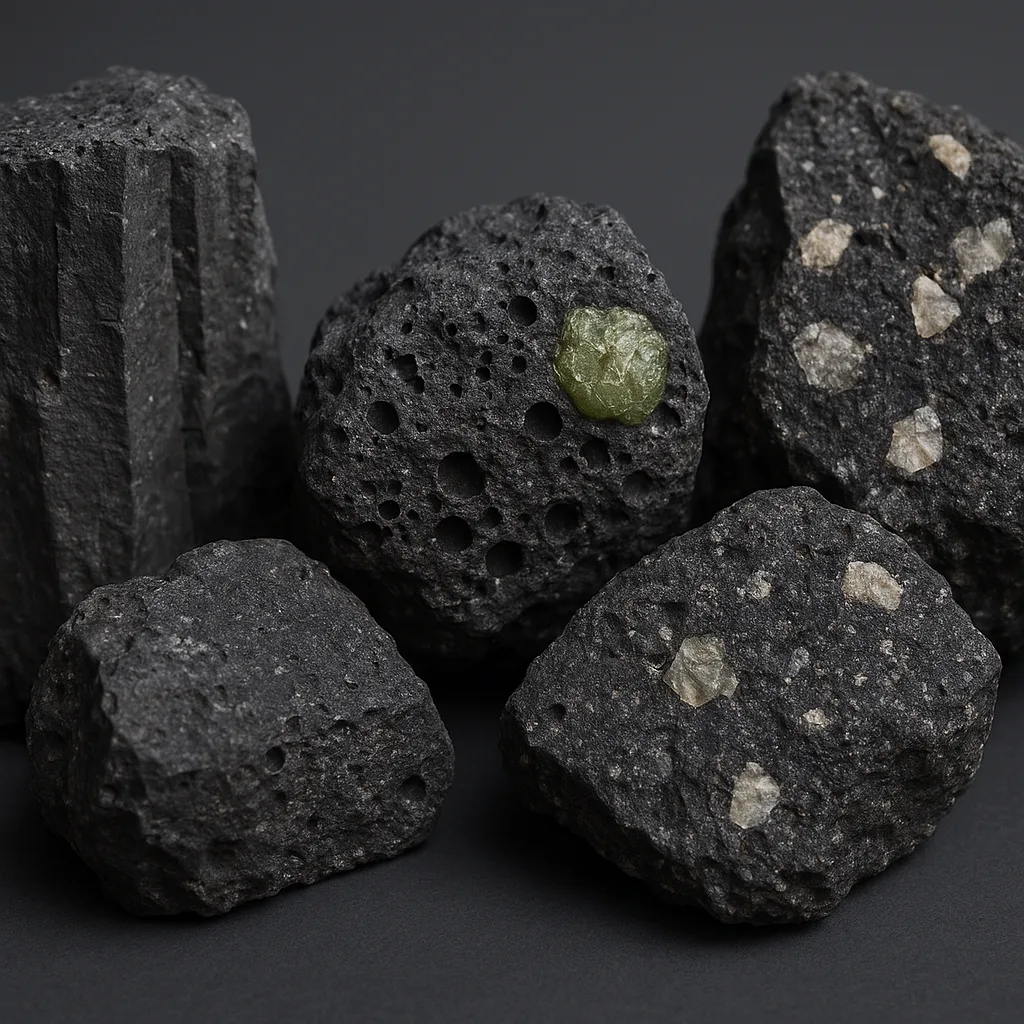
Key facts at a glance
- Rock type: Extrusive igneous (volcanic), mafic.
- Silica content: ~45–53% SiO2.
- Typical density: 2.8–3.0 g/cm3.
- Lava temperature: commonly 1,100–1,250 °C at eruption.
- Texture: Aphanitic (fine-grained) to porphyritic; frequently vesicular.
How basalt forms: geologic environments
Basalt forms wherever mantle-derived magma reaches the surface and cools quickly. The most important geologic settings for basalt production are mid-ocean ridges, oceanic hotspots, continental rift zones, and large igneous provinces (flood basalts).
Common basalt-forming settings
- Mid-ocean ridges: Spreading centers produce continuous basaltic oceanic crust. This is typically tholeiitic basalt.
- Hotspots and shield volcanoes: Hawaii and Iceland produce abundant alkali or transitional basalts, often with pahoehoe and aa lava textures.
- Continental flood basalts (large igneous provinces): Vast eruptions like the Deccan Traps (India, ~66 Ma) and the Columbia River Basalt Group (Washington/Oregon, 17–6 Ma) covered thousands of square kilometers in layered basalt flows.
- Pillow basalts: Form where basaltic lava extrudes under water, producing rounded “pillows.â€
Physical characteristics and field identification tips
People asking "what does basalt look like" usually want practical visual cues. Basalt is relatively straightforward to identify if you know what to look for.
Visual and tactile cues
- Color: Typically dark gray to black; fresh surfaces often appear bluish-gray. Weathered basalt can have brownish or rusty iron-oxide staining.
- Grain size: Fine-grained (aphanitic). Individual minerals are usually too small to see without a hand lens, although some basalts are porphyritic with conspicuous phenocrysts (olivine or plagioclase) up to several millimeters or centimeters across.
- Texture: May be dense and massive, vesicular (containing small rounded gas bubbles), or show columnar jointing (hexagonal columns from cooling contraction).
- Vesicles: When present, they are usually small (millimeters to centimeters) and may be filled with secondary minerals like calcite, zeolites, or chalcedony.
- Hardness and density: Dense basalts feel heavy for their size (2.8–3.0 g/cm3) and generally scratch glass due to hard mineral content.
Practical identification checklist
- Examine color and fresh fracture surface (not just weathered skin).
- Look for vesicles or phenocrysts under a hand lens (10x–20x).
- Check for columnar jointing or flow structures (e.g., layering with ropey pahoehoe surface).
- If possible, measure specific gravity or heft; basalt is heavier than many sedimentary rocks.
- Use Orvik or a field guide app to compare photos and confirm mineral clues in situ.
Types of basalt and notable examples
Basalt is not a single monolithic rock type; geologists subdivide it by chemistry, texture, and environment of formation. Each variety has distinctive field and laboratory signatures.
For more on this topic, see our guide on How to Identify Any Rock in the Field.
Major basalt varieties
- Tholeiitic basalt: Common at mid-ocean ridges and many flood basalts; low in alkalis and typically iron-rich.
- Alkali basalt: Higher in sodium and potassium; common in continental rift and hotspot settings (e.g., some Hawaiian flows).
- Pillow basalt: Rounded, lobate structures formed underwater; typical on ocean floors and submarine volcanoes.
- Porphyritic basalt: Contains larger crystals (phenocrysts) of olivine or plagioclase surrounded by fine-grained groundmass.
- Vesicular basalt/scoria: Highly vesicular; scoria tends to be red or brown from oxidized iron and is more frothy.
Famous basalt localities
- Giant's Causeway, Northern Ireland: well-known hexagonal columnar jointing.
- Deccan Traps, India: one of the largest continental flood basalts, ~66 million years old.
- Columbia River Basalt Group, USA: layered flood basalts covering >163,000 km2 originally.
- Hawaii and Iceland: classic modern basaltic shield volcanism with flowing lava sheets.
- Lunar mare basalt: the dark plains on the Moon formed by basaltic lava flows.
Basalt chemistry, minerals and microscopic features
Understanding what basalt is made of helps explain its behavior and appearance. Basalts are the surface expression of mantle melts modified by fractional crystallization, assimilation, or mixing.
Mineralogy and chemistry
- Main minerals: Plagioclase (Ca-rich labradorite/andesine), clinopyroxene (augite), olivine (forsterite-rich in Mg-rich basalt), and accessory magnetite, ilmenite, and apatite.
- Silica: ~45–53 wt% SiO2, placing basalt in the mafic field.
- Other elements: Elevated Fe, Mg, Ca; variable Na and K depending on alkali content.
- Textures under microscope: intersertal and intergranular groundmass, chill margins with glass, and microlites (tiny, needle-like crystals).
Laboratory tests that confirm basalt
- Thin-section petrography to see mineral assemblage and texture.
- X-ray fluorescence (XRF) or ICP-MS for major and trace element chemistry.
- Density and magnetic susceptibility measurements; many basalts contain titanomagnetite affecting magnetism.
Basalt vs. other rocks: how to tell them apart
People searching "basalt is what type of rock" are usually distinguishing it from other dark rocks. These comparisons focus on field-observable differences.
You may also find our article on Field Guide to Rock Identification helpful.
Basalt vs gabbro
- Both are mafic and similar in composition, but basalt is extrusive (fine-grained) while gabbro is its intrusive equivalent (coarse-grained crystals, visible to the eye).
- Gabbro typically forms below the surface and cools slowly; basalt cools quickly at the surface.
Basalt vs andesite vs rhyolite
- These are volcanic (extrusive) rocks that differ in silica content: basalt (low, mafic), andesite (intermediate, ~57–63% SiO2), rhyolite (high, felsic, >69% SiO2).
- Color and density help: basalt dark and dense; andesite often gray to greenish; rhyolite lighter colored and less dense.
Basalt vs scoria vs pumice
- Scoria is a highly vesicular mafic rock similar in composition to basalt but typically more frothy and red-brown due to oxidized iron.
- Pumice is highly vesicular and light enough to float, but is typically felsic (rhyolitic) and pale in color, not basaltic.
Basalt vs metamorphic dark rocks (amphibolite, schist)
- Metamorphic rocks often show foliation or alignment of minerals; basalt is massive or shows flow structures and vesicles. Use a hand lens to look for mineral crystals versus microcrystalline groundmass.
- Scratch or break a fresh surface: metamorphic minerals may show larger, platy or prismatic crystals visible to the eye.
Where to find basalt: geographic distribution and habitats
Basalt forms on the ocean floor and continents. If you want to find basalt in the field, these are the most productive places to look.
Where to look
- Coastal cliffs and sea stacks on volcanic islands and continental margins often expose basalt flows and pillow basalts.
- Large plateau regions and escarpments in areas with flood basalts (Deccan, Columbia River) show stacked basalt layers.
- Volcanic fields, recent lava flows, and lava tubes on shield volcanoes (Hawaii, Iceland).
- Oceanic crust: basalt is the dominant rock of the ocean floor, so mid-ocean ridge basalts are sampled via dredging and submersible studies.
Habitat and seasonal notes
- Basalt outcrops often host lichen, moss, and hardy plant communities; vegetation cover can be seasonal and denser in wet seasons.
- Freeze-thaw in temperate climates can create blocky talus from columnar basalt; look for freshly cleaved faces after winter thawing.
- Weathered basalt can form fertile, clay-rich soils high in iron and magnesium that support lush vegetation in tropical climates (e.g., Hawaiian soils).
When exploring, photograph fresh surfaces and use apps like Orvik to cross-check visual features against reference images and distribution data.
Looking beyond this category? Check out Identify Birds by Sound: A Practical Field Guide.
Uses, safety, and environmental considerations
Basalt is valuable in construction, manufacturing, and environmental applications, but there are safety considerations when working with it.
Related reading: Granite: Field Guide to a Classic Rock.
Common uses
- Aggregate for road base, railroad ballast, and concrete.
- Dimension stone and decorative facing tiles (polished basalt offers a dense, dark finish).
- Basalt fiber: spun from melted basalt for use in composites and rebar alternatives.
- Rock wool and insulation produced from basaltic material.
Safety and toxicity
- Basalt itself is not poisonous, but cutting, sawing, or drilling produces respirable dust that may contain crystalline silica; prolonged inhalation can cause silicosis. Use respiratory protection and dust controls.
- Basalt dust can be abrasive; wear eye protection and gloves when working with it.
- Some basalt contains magnetic minerals (titanomagnetite) and trace elements; handle with normal industrial hygiene practices.
Practical field workflow: identifying basalt with confidence
If you’re asking "what is basalt rock made of" in the field, follow a simple workflow to confirm your ID and document your find.
Step-by-step field checklist
- Observe fresh surfaces; avoid relying solely on weathered outer crusts.
- Note color, vesicles, and presence of phenocrysts with a hand lens (10x–20x).
- Look for flow structures, columnar jointing, or pillow shapes if underwater extrusion is possible.
- Estimate heft to judge density; basalt usually feels heavier than sandstone or limestone of similar size.
- Photograph multiple scales: a close-up of the texture, a medium shot for context, and a wide shot showing the outcrop or landscape. Orvik can help match your photos to reference specimens and suggest likely rock types.
- If needed, collect a small sample (follow land access rules), label it, and send to a lab for thin section or XRF analysis.
Conclusion
Basalt is a dark, fine-grained mafic igneous rock that tells the story of mantle melting, fast cooling, and volcanism. From the ocean floor to iconic columnar cliffs and vast flood basalt plateaus, basalt shapes landscapes and supplies critical raw materials. In the field, focus on color, texture, vesicles, and flow structures to identify basalt; use tools like a hand lens, GPS-tagged photos, and apps such as Orvik to confirm your observations. Always practice safe handling to avoid dust inhalation when working with or sampling basalt.
Frequently Asked Questions
- What is basalt rock type?
- Basalt is an extrusive igneous rock of mafic composition that forms from rapid cooling of basaltic lava at or near Earth's surface.
- What are basalt rocks made of?
- Basalt is mainly composed of plagioclase feldspar, clinopyroxene (augite), and often olivine, with accessory magnetite, ilmenite, and sometimes glass.
- What does basalt look like in the field?
- Basalt is dark gray to black, fine-grained, commonly vesicular or porphyritic, may show columnar jointing or pillow shapes, and feels dense and heavy.
- How do I tell basalt apart from gabbro or andesite?
- Basalt is fine-grained and extrusive; gabbro is coarse-grained intrusive with visible crystals. Andesite is intermediate in silica and typically lighter in color and density than basalt.
- Is basalt toxic or hazardous to handle?
- Basalt itself is not poisonous, but cutting or grinding produces dust that may contain crystalline silica. Use appropriate respiratory protection and dust controls.
- Where is basalt found?
- Basalt forms much of the oceanic crust and is common at mid-ocean ridges, hotspots (Hawaii, Iceland), continental rift zones, and in large flood basalt provinces like the Deccan Traps.
- Can I use an app to identify basalt in the field?
- Yes. Field ID apps like Orvik can help match your photos to reference images and provide quick, evidence-based suggestions for rock identification.