
Quick answer: What is the hardest rock?
Short, precise response
The title many people want when asking "what is the hardest rock" is actually a question about minerals: the hardest natural material known is diamond — pure carbon arranged in a cubic crystal lattice — which rates a 10 on the Mohs hardness scale. In strict geological language, diamond is a mineral. If by "rock" you mean consolidated mixtures of minerals, no common rock as a whole matches diamond’s hardness; instead, very hard rocks are those dominated by durable minerals such as quartz, garnet, and olivine (e.g., quartzite, garnet-bearing schists, and peridotite).
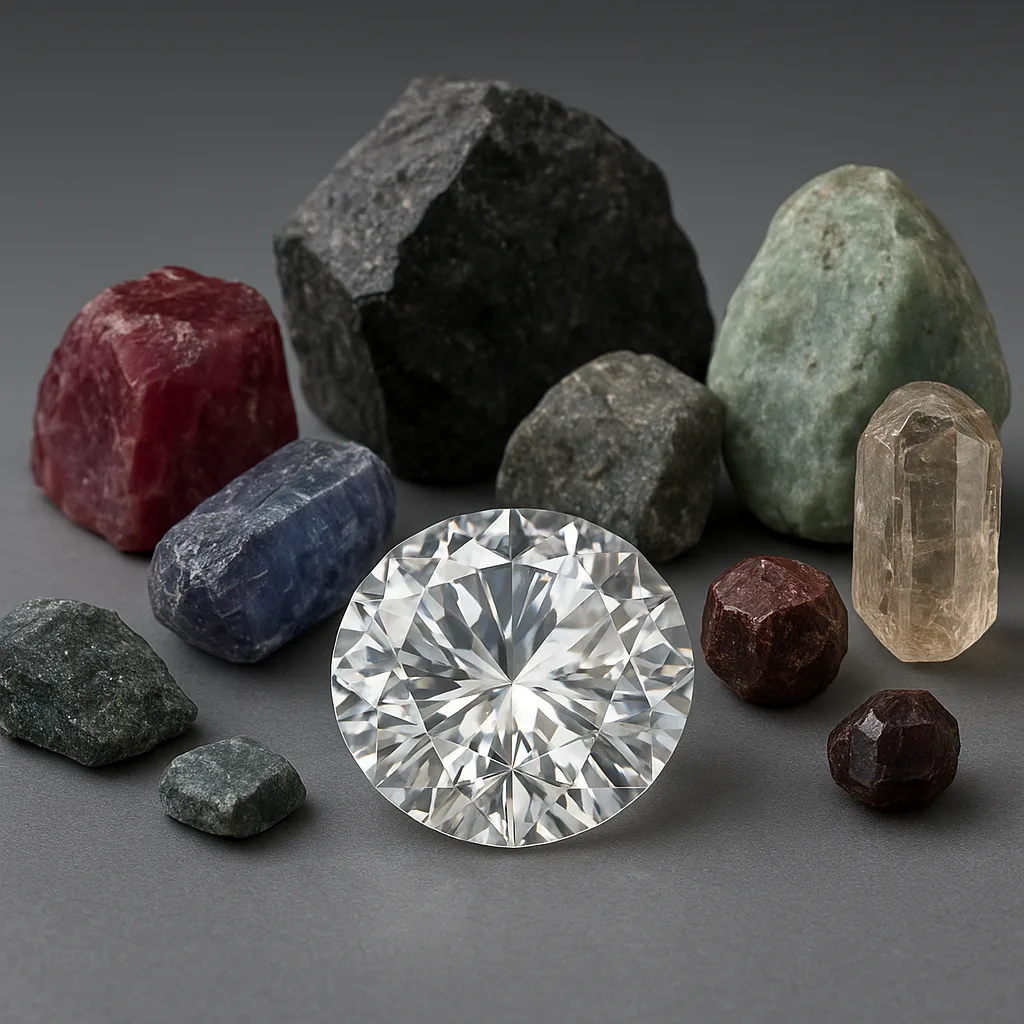
- Hardest mineral: Diamond (Mohs 10)
- Hardest common rocks: Quartzite, some basalts, metamorphic rocks like gneiss
- If you’re asking to identify a hard specimen in the field, use visual cues and simple scratch tests, or take a photo to Orvik for fast identification.
Hardness versus strength: how geologists measure it
Mohs, Vickers, and mechanical strength
People conflate hardness, toughness, and strength. These are different mechanical properties:
- Hardness (Mohs scale): resistance to scratching. Diamond = 10, corundum (sapphire/ruby) = 9, quartz = 7.
- Microhardness (Vickers or Knoop): measures indentation resistance in MPa or GPa — useful for precise lab work.
- Toughness: resistance to breaking or fracturing (diamond is hard but brittle).
- Compressive strength: how much load a rock can bear (often reported in MPa). Granite ~130–250 MPa, basalt ~150–300 MPa, quartzite ~150–400 MPa depending on porosity.
Practical notes
Hardness helps you identify minerals with simple tests (a steel knife ~5.5 Mohs, a glass plate ~5.5–6). Strength matters for engineering: basalt is often stronger under compression than many sedimentary rocks, so it’s used as crushed aggregate. When someone searches "what is the hardest rock," they're usually looking for either the ultimate answer (diamond) or the most scratch-resistant rocks they might find on a hike or use in construction.
Diamonds: formation, where they are found, and how to identify them
How diamonds form
Diamonds form deep in the Earth’s mantle at depths of about 140–200+ kilometers in high-pressure, high-temperature conditions. They are brought to the surface by fast, explosive volcanic eruptions along narrow conduits called kimberlite and lamproite pipes during events often associated with ancient tectonic cratons.
For more on this topic, see our guide on How to Identify Any Rock in the Field.
- Mineral: diamond (elemental carbon, crystal system: cubic)
- Typical formation depth: 140–200+ km in mantle keel beneath cratons
- Transport: kimberlite and lamproite volcanic pipes
- Key global producers: Russia (Yakutia), Botswana, South Africa, Canada (NWT, Nunavut), Australia (historically, Argyle mine)
What rock are diamonds found in?
Diamonds are most commonly found in two primary host rocks:
- Kimberlite — ultramafic, volatile-rich igneous rock that forms carrot-shaped pipes. Fresh kimberlite can be dark, coarse, and contain olivine macrocrysts and a fine ash matrix. Weathered kimberlite often weathers to a reddish-brown clay called "yellowground" or a blue-gray clay called "blueground".
- Lamproite — another ultrapotassic volcanic rock that hosts diamonds in some localities (e.g., Argyle in Australia produced pink diamonds from lamproite).
Field identification cues for diamond-bearing rocks
- Appearance: fresh kimberlite can look dark, glassy to vesicular, with green olivine phenocrysts; weathered exposures may be clay-rich and brick-colored.
- Texture: kimberlite often has a mix of fine ash-like matrix plus larger xenocrysts (olivine, garnet, ilmenite), and fragments of mantle rock.
- Associated minerals: garnet (pyrope), chromian diopside, ilmenite, spinel — these indicator minerals help prospectors target kimberlite.
Practical tip: if you find garnet crystals with high chromium content (deep red pyrope) or green diopside with chromium, that could indicate proximity to diamondiferous kimberlite. Use Orvik to analyze photos and compare specimen features to known indicator minerals and host rocks.
Hardest rocks you'll encounter: a ranked list and field properties
Common hard rocks and why they are tough
When you consider whole rocks (aggregates of minerals), these are often cited as among the hardest or most durable:
You may also find our article on Field Guide to Rock Identification helpful.
- Quartzite — metamorphosed quartz sandstone; quartz grains recrystallize and interlock. Mohs ~7 (because quartz dominates); compressive strength commonly 150–400 MPa.
- Basalt — fine-grained volcanic rock rich in plagioclase and pyroxene; very dense and strong under compression (150–300 MPa).
- Granite — coarse-grained igneous rock of quartz, feldspar, and mica; durable in many settings; compressive strength ~130–250 MPa.
- Gneiss — high-grade metamorphic rock with banded texture and strong mineral alignment; often as strong as granite or stronger due to interlocking minerals.
- Peridotite (including dunite) — ultramafic mantle rock dominated by olivine; very dense and hard in intact blocks, though weathering can alter it to softer serpentine.
Identification tips for these rocks
- Quartzite: glassy to sugary appearance, conchoidal fracture in quartz grains, often resists weathering and forms ridges.
- Basalt: dark gray to black, fine-grained, sometimes columnar jointing; heavy for its size.
- Granite: visible interlocking crystals of quartz (glassy gray), K-feldspar (pink/white), and mica (flakes of biotite or muscovite).
- Gneiss: alternating light and dark bands; foliated texture with visible layering.
- Peridotite/dunite: greenish from olivine; heavy and coarse grains; may have a rough sugary texture when fresh.
Rarest and most expensive rocks and minerals
Clarifying rock versus mineral
Searchers ask both "what is the most rare rock" and "what is the rarest rock in the world" — often meaning minerals. Rocks are mixtures of minerals. Some of the truly rare specimens are specific minerals (painite, red beryl), rare rock types (lunar or martian meteorites), or unique gem-quality specimens (fancy colored diamonds, jadeite of Imperial quality).
- Rarest minerals: painite (CaZrBAl9O18), once known from only a handful of crystals; musgravite and red beryl (bixbite) are also extremely rare.
- Rarest rocks: lunar rocks and some martian meteorites are effectively the rarest natural rocks on Earth in terms of availability to collectors.
- Most expensive specimens: large, flawless colored diamonds (pink, blue, red), Imperial jadeite, and historically important specimens fetch tens of millions of dollars at auction.
Notable examples
- Pink Star Diamond — sold for over $71 million (2017 auction) — exceptional colored diamond specimens command the highest per-carat prices.
- Imperial Jade (Burmese jadeite) — prized in East Asia; specific pieces have sold for millions depending on translucency and color.
- Lunar samples — Moon rocks returned by Apollo missions have extraordinary scientific value and are legally controlled, making them functionally priceless.
- Pallasite meteorites — nickel-iron and olivine mixtures, admired by collectors; high-quality specimens command high sums per kilogram.
Practical field identification: tips, tests, and using Orvik
Visual cues and quick field checks
If you want to know whether a specimen is extremely hard or might be diamond-bearing, follow these field checkpoints (remember: never damage protected features, and avoid destructive tests on museum or historical pieces):
Looking beyond this category? Check out Goji Berries: A Field Guide to the Red Superfruit.
- Color: diamond crystals are often colorless, pale yellow, or brown; fancy colors (pink, blue, green) are rare. Host rocks like kimberlite are typically dark, greenish, or clay-rich when weathered.
- Crystal shape: diamond commonly forms octahedra, cubes, or dodecahedra; look for sharp, faceted crystal faces in small crystals.
- Luster and transparency: diamond has an adamantine (brilliant) luster and high refractive index — it sparkles intensely compared with other minerals.
- Associated grains: find indicator minerals (pyrope garnet, chromium diopside, olivine) to suspect diamondiferous ground.
- Hardness test: a steel file (approx Mohs 6.5) will not scratch a diamond; glass (Mohs ~5.5) will be scratched by a diamond. Do not try this on museum samples.
How Orvik can help
- Take a clear photo of the specimen’s faces, texture, and any visible crystals and upload it to Orvik for AI-assisted identification and comparison against known indicator minerals and rock types.
- Orvik can flag likely host rocks (kimberlite/lamproite) and suggest probable minerals to sample for lab testing (e.g., garnet types, ilmenite).
- Use Orvik in tandem with field tests — photos plus notes on hardness, weight, and locality make identifications far more reliable.
Comparisons and safety: X vs Y and health/legal notes
Diamond vs. corundum vs. moissanite
- Diamond: Mohs 10, extremely high refractive index, perfect octahedral cleavage, brittle fracture; natural product of mantle processes.
- Corundum (ruby/sapphire): Mohs 9, aluminum oxide (Al2O3), hexagonal crystals, very hard but not as hard as diamond; used as a diamond substitute historically.
- Moissanite (SiC): lab-grown or natural; Mohs ~9.5, often confused with diamond by novices because of brilliance; distinguished by double refraction and slightly different sparkle.
Kimberlite vs. lamproite: how to tell them apart
- Kimberlite: often contains olivine macrocrysts, phlogopite, and a matrix with carbonate; weathers to clay; typically associated with ancient cratons.
- Lamproite: richer in potassium and volatile elements; mineralogy includes leucite, phlogopite, and sometimes diamonds of different morphology; Argyle (Australia) is a famous lamproite occurrence.
Safety and legal/ethical rules
When collecting or even handling rocks, be mindful of hazards and laws:
Related reading: Granite: Field Guide to a Classic Rock.
- Do not collect in protected areas (national parks, many historical sites). Removing samples can be illegal.
- Avoid inhaling dust: crushing or sawing rocks can produce respirable silica or asbestos fibers (e.g., chrysotile in serpentine). Use a mask and proper ventilation.
- Some minerals and ores are toxic: arsenopyrite, realgar (arsenic sulfides), and some uranium-bearing minerals (autunite, torbernite) are radioactive or chemically hazardous. Use gloves and avoid ingestion.
- Be cautious around abandoned mines — shafts, toxic runoff, and unstable rock are hazards.
If uncertain about a specimen’s safety, photograph and submit it to Orvik or a local university geology department rather than handling it extensively.
Conclusion
So, what is the hardest rock? The shortest, most accurate answer is that the hardest natural material is the mineral diamond (Mohs 10), and diamonds are most commonly found in kimberlite and lamproite volcanic rocks. When you broaden the term to whole rocks, quartzite, basalt, and some gneisses and peridotites are among the hardest common rocks encountered in the field. If you want to take identification beyond guesswork, use good visual checks and tools like Orvik to compare photos to documented specimens; for scientific certainty, lab tests (e.g., X-ray diffraction, Raman spectroscopy) are required. Always prioritize safety and legal collecting practices when examining rare or potentially hazardous specimens.
Frequently Asked Questions
- Is diamond the hardest rock in the world?
- Diamond is the hardest natural mineral (Mohs 10). Because 'rock' is an aggregate of minerals, no common rock as a whole equals diamond's hardness; diamonds occur as individual mineral crystals within rocks such as kimberlite and lamproite.
- What rock are diamonds found in?
- Diamonds are most commonly found in kimberlite and lamproite volcanic pipes. Prospectors also find diamonds in alluvial deposits where erosion has concentrated gem-bearing gravels.
- What is the strongest rock for building and engineering?
- Strength depends on property: basalt and quartzite have high compressive strength (often 150–400 MPa), and many granites are also strong. Engineers choose rock type based on compressive strength, fracture pattern, and durability.
- What are the rarest minerals or rocks?
- Rarest minerals include painite, musgravite, and red beryl. Rarest rocks include lunar and some martian meteorites; availability and legal status make them effectively unique.
- How can I tell a diamond from moissanite or glass in the field?
- Look for adamantine luster and octahedral crystal shape; diamond scratches glass and will not be scratched by steel. Moissanite shows double refraction and slightly different fire. For definitive ID, use lab methods or an app like Orvik to cross-check photos.
- Are there safety concerns when handling rocks?
- Yes. Some rocks contain asbestos (serpentine), heavy metals, or radioactive minerals. Avoid crushing or inhaling dust, wear gloves, and follow legal rules about collecting. If unsure, photograph and consult experts or Orvik.
- Why does hardness differ from toughness?
- Hardness measures resistance to scratching; toughness measures resistance to fracture. Diamond is extremely hard but relatively brittle (low toughness) compared with some tougher but softer materials.