
Hickories (genus Carya, family Juglandaceae) are unmistakable once you know the key traits: pinnate leaves, heavy dense wood, distinctive nuts, and—on some species—shaggy bark. This field guide gives measured, practical cues to identify hickory trees and their wood in the forest and around your home. If you prefer image-based ID, apps like Orvik can confirm a photo and point to species-level features.
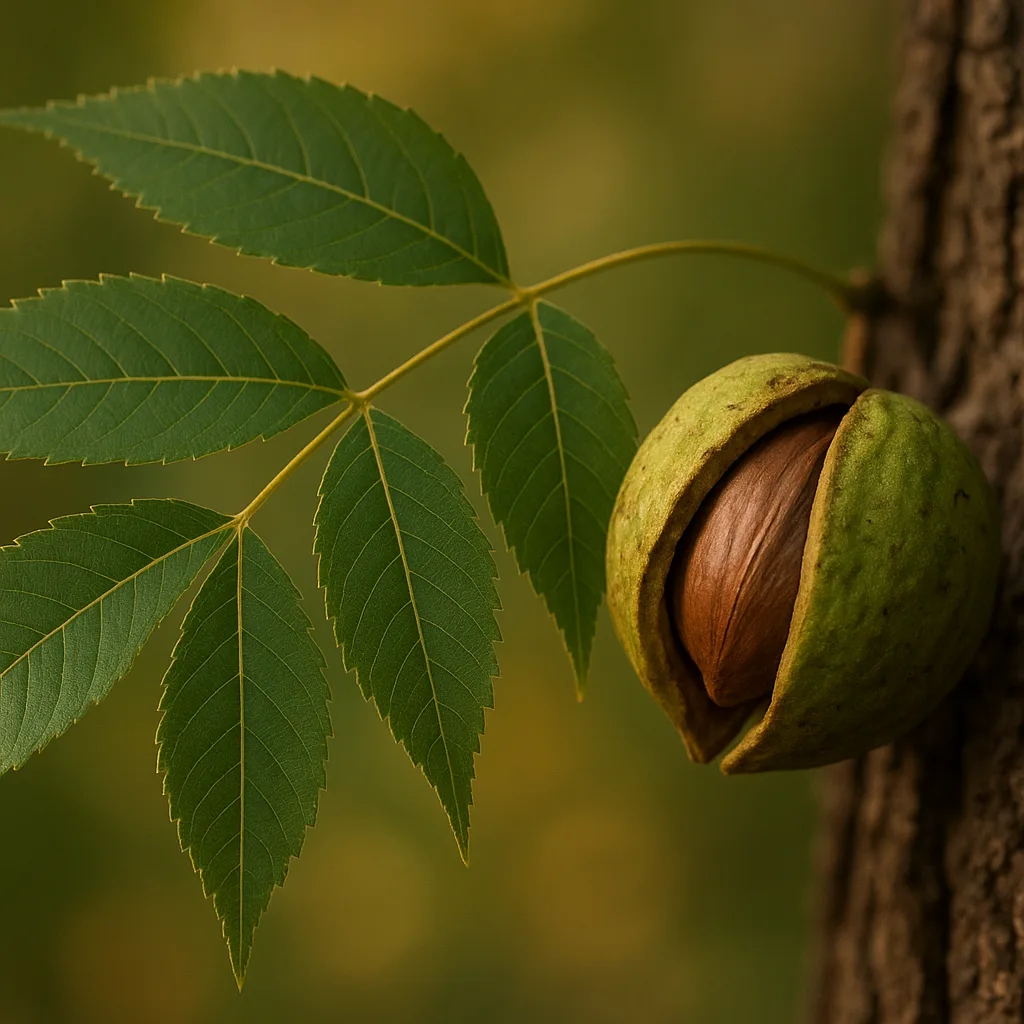
Quick ID snapshot
Before we dig into details, here are the fastest signs to check when you want to identify a hickory tree in under a minute.
- Leaves: compound (pinnate) with usually 5–9 leaflets; leaflets 6–18 cm long.
- Bark: can be smooth, blocky, or shaggy—shagbark hickory has long peeling strips.
- Nuts: hard, round to oblong nuts in a 3–4-part husk that splits at maturity in autumn.
- Wood: very dense, pale sapwood and reddish-brown heartwood; heavy to lift.
- Size & habitat: deciduous tree 15–30 m (50–100 ft) tall, common in eastern and central North America.
Leaves, buds & twigs
Leaf structure is one of the most reliable field indicators for hickory. Measure and examine leaves, buds, and twig traits to narrow species.
Leaf structure and measurements
- Pinnate leaves: a single compound leaf with a central rachis and 3–17 leaflets depending on species; most common eastern species have 5–9 leaflets.
- Leaflet size: typically about 6–18 cm (2.5–7 in) long and 2–5 cm (0.8–2 in) wide.
- Arrangement: alternate compound leaves—look for alternate placement along stems rather than opposite.
- Leaf margin: serrated (finely toothed) margins on most species.
Buds, twigs and seasonal cues
- Buds: terminal buds often large and pointed; shagbark and mockernut have stout terminal buds about 8–15 mm or larger.
- Twigs: stout and smooth when young; some species have hairy (tomentose) twigs—e.g., Carya tomentosa (mockernut).
- Leaf fall: deciduous—leaves turn yellow to brown in autumn and fall, exposing the bark and nuts.
Tip: if you find a single compound leaf on the ground, measure the number of leaflets and leaflet length; that alone tells you whether you are looking at a hickory rather than a walnut or ash.
Bark & trunk
Bark on hickories varies notably by species. Bark texture and pattern are excellent for in-season and winter ID.
For more on this topic, see our guide on Spotting Osage Orange Trees in the Field.
Common bark types and what they mean
- Shagbark hickory (Carya ovata): long, peeling vertical strips that curl away from the trunk—strips often 10–30 cm long and very visible from a distance.
- Pignut & bitternut hickory (C. glabra, C. cordiformis): smoother, tightly furrowed bark with small scaly plates rather than large strips.
- Mockernut (C. tomentosa): blocky, furrowed bark with thick ridges.
Trunk measurements & form
- Height: most mature hickories 15–30 m (50–100 ft).
- Diameter: mature trunks range widely; a healthy mature shagbark might be 60–120 cm (2–4 ft) dbh (diameter at breast height).
- Form: usually a single dominant trunk with branching crown; older trees show deeply furrowed bark.
Practical tip: look at bark up close and at a distance. Shagbark is most obvious at a distance; species with blocky bark require touching and close inspection.
Nuts, fruit & seasonal cues
Hickory nuts and their husks are defining characteristics. Nuts ripen in late summer to autumn and are often the clearest sign of a hickory in the landscape.
Nuts and husks
- Husk structure: 3–4-valved green husk that splits open when mature to reveal the nut.
- Nut size: varies by species—about 1–4 cm (0.4–1.6 in) diameter. Shagbark nuts commonly 2.5–3.8 cm (1–1.5 in).
- Nut shape: round to slightly oblong; shells are thick and hard to crack.
- Edibility: many hickory nuts (e.g., shagbark, pecan) are edible and prized; do not eat unknown nuts without positive ID.
Seasonal behavior
- Flowering: small catkin-like flowers in spring (wind-pollinated).
- Fruit drop: husks split and nuts fall in late summer to autumn—look under the tree for fallen nuts and husks.
- Leaf change: leaves yellow-brown in autumn, but timing varies by latitude—northern populations drop earlier.
Safety note: some hickory nuts can be bitter or poorly flavored depending on species and year; also be aware of wildlife foraging beneath trees—raccoons, squirrels, and deer commonly harvest hickory nuts.
You may also find our article on How to Identify Mulberry Trees in the Wild helpful.
Wood, firewood & how to identify beech wood
Identifying hickory wood by appearance, weight, and burning properties helps when you encounter logs, split firewood, or finished lumber.
Appearance and physical properties
- Color: sapwood pale creamy to almost white; heartwood ranges from light to medium reddish-brown.
- Grain & texture: generally straight-grained but can be interlocked; coarse texture with visible growth rings.
- Density and hardness: hickory is among the heaviest and hardest North American hardwoods—approximate Janka hardness range 1,800–2,700 lbf depending on species (very hard to split when green).
- Weight: feels heavy for its size compared with oak or maple; dry hickory firewood is dense and sinks more readily than softer hardwoods.
How to identify hickory firewood
- Look at the split face: hickory shows bright sapwood and darker heartwood bands; the pattern is coarse and often has small ray flecks when quarter-sawn.
- Test the weight: a similarly sized split piece will be heavier than ash or birch.
- Burning behavior: hickory burns hot and long, producing long-lasting coals and a sweet, smoky aroma—excellent for cooking and heating.
- Smell and smoke: when burning, hickory produces a pleasant, robust smoke favored for smoking meats; the smell is stronger than oak.
How to identify beech wood (comparison)
- Color: American beech (Fagus grandifolia) is very pale, nearly uniform beige to light brown, with little heartwood contrast; hickory shows more contrast between sapwood and heartwood.
- Grain: beech has a fine, straight grain and smooth texture; hickory is coarser and heavier with stronger rays.
- Weight & hardness: beech is hard and heavy but generally lighter and slightly less dense than hickory; Janka for beech ~1,300–1,350 lbf (so hickory is significantly harder).
- Uses: beech is commonly used for furniture and tool handles; hickory is prized for tool handles, flooring, and smoking wood due to its extreme toughness and high energy content.
Tip: if you have a sample of wood and a photo, Orvik can analyze grain patterns and color to help you distinguish hickory from beech and other hardwoods.
Habitat, range & seasonal behavior
Knowing where hickories grow and how they behave through the seasons helps narrow species and avoid confusion with non-native trees.
You might also be interested in Spotting Bed Bugs: A Clear Visual Guide.
- Geographic range: hickories (Carya spp.) are native to eastern and central North America—most species range from southeastern Canada through the eastern United States and into parts of the Midwest and south.
- Preferred soils: many hickories prefer rich, well-drained soils; some (like shagbark) tolerate rocky ridges and limestone soils.
- Associated habitats: mixed hardwood forests, river bottoms, upland slopes, and open woods—often present with oaks, maples, and beeches.
- Seasonal cues: flowers in spring, nuts ripen in late summer to autumn, leaves drop in fall—look for nut-fall to confirm identification in autumn.
Practical distribution note: if you are west of the Rocky Mountains you are unlikely to encounter native hickory species; in those regions look for horticultural plantings or imported wood.
Related reading: Spot and ID Berry-Bearing Trees in the Wild.
Hickory vs look-alikes (how to tell them apart)
When someone searches "how do I identify a hickory tree" they often actually mean "how do I tell it apart from similar trees?" Below are side-by-side comparisons with common confusers: hemlock, beech, and walnut.
Hickory vs hemlock
- Hickory (Carya): deciduous, compound leaves with multiple leaflets; produces nuts; bark variable including shaggy types.
- Hemlock (Tsuga): evergreen conifer with short, single needles arranged on twig; small conelets in late summer; bark furrowed but not shaggy.
- Important distinction: "hemlock" also names the poisonous herb Conium maculatum. Don’t confuse the conifer hemlock with poison hemlock. If you’re looking at a tree with needles, it’s a hemlock (tree); if it’s a terrestrial herbaceous plant with hollow spotted stems, it may be poison hemlock (not a tree).
Hickory vs beech
- Leaves: beech has simple leaves with serrated edges; hickory has compound leaves made of multiple leaflets.
- Bark: beech bark is smooth, silvery-gray and not peeling; shagbark hickory peels dramatically.
- Wood: beech wood is paler, finer-grained, and less dense than hickory.
Hickory vs walnut
- Leaves: walnut (Juglans) also has pinnate leaves, but walnut leaflets are often more numerous and the terminal leaflet arrangement differs; walnut buds tend to be larger and more aromatic when crushed.
- Nuts: walnut fruit has a fleshy green husk that surrounds a single nut, while many hickories have a 3–4-valved husk with distinctly shaped nuts.
- Bark: walnut bark forms diamond-shaped ridges; hickory varies but shagbark is distinctive.
Practical tip: if you have a compound leaf, examine the nut and bark—those two features together will usually separate hickory from walnut, ash, or other look-alikes.
FAQ
- Q: How do I identify a hickory tree from its leaves?
A: Look for pinnate leaves with 5–9 serrated leaflets each 6–18 cm long; alternate arrangement on the twig helps confirm. - Q: How can I tell hickory firewood from other hardwoods?
A: Hickory firewood is very dense and heavy, has clear sapwood/heartwood contrast, burns hot and long, and gives a strong sweet smoke. It’s harder to split green than oak or maple. - Q: Is hickory wood the same as beech or oak?
A: No. Hickory is typically denser and harder than beech and often shows a stronger contrast between sapwood and heartwood than oak. Grain and ray patterns differ—beech is finer-grained and paler. - Q: How do I identify hemlock versus hickory?
A: Hemlock trees are evergreen conifers with needles, while hickories are deciduous with compound leaves and nuts. If it has needles, it’s not a hickory. - Q: Can I eat hickory nuts?
A: Many species produce edible nuts (shagbark, pecan). However, always confirm species before eating; some hickory nuts can be bitter, and individual allergies are possible. - Q: Will hickory wood cause allergic reactions?
A: Wood dust from hickory can cause respiratory irritation or dermatitis in sensitive people—use dust protection and gloves when cutting or sanding. - Q: What tool handles are made from hickory?
A: Hickory’s toughness makes it a classic choice for tool handles (hammers, axes) and ladder rungs—its shock resistance is excellent.
Conclusion
To identify hickory trees reliably, combine several field cues: compound leaves (5–9 leaflets), distinctive bark (shaggy on some species), hard nuts in a splitting husk, and very dense wood. Season and location narrow the possibilities—nuts in autumn, flowering in spring, and a range across eastern and central North America. For quick photo-based confirmation, Orvik is a helpful tool that can analyze leaf, bark, or wood photos and point you toward the most likely species. Practice by measuring leaflets, checking the bark texture, and collecting a fallen nut to compare with this guide. With these measured observations you’ll be able to answer “how do you identify a hickory tree?” with confidence in the field.
Frequently Asked Questions
- How do I identify a hickory tree by its leaves?
- Hickory leaves are compound (pinnate) with usually 5–9 serrated leaflets, each about 6–18 cm long, arranged alternately on the stem.
- What does hickory bark look like?
- Bark varies by species: shagbark hickory has long peeling strips, while pignut and bitternut have tighter, furrowed or blocky bark. Examine both up close and from a distance.
- How can I tell hickory firewood apart from other woods?
- Hickory firewood is very dense and heavy, shows sharp sapwood-to-heartwood contrast, burns hot with long coals, and gives a strong, pleasant smoke favored in cooking.
- Is hemlock the same as hickory?
- No. Hemlock (Tsuga) is an evergreen conifer with needles and cones. Hickory is a deciduous tree with compound leaves and nuts. Don’t confuse the tree hemlock with the poisonous herb 'poison hemlock.'
- How do I identify beech wood versus hickory wood?
- Beech wood is paler, fine-grained, and more uniform in color, with a smoother texture. Hickory is denser, often darker heartwood, coarser grain, and significantly harder (higher Janka rating).
- Are hickory nuts edible?
- Many hickory nuts (e.g., shagbark, pecan) are edible and tasty. Always verify species before eating and be mindful of possible allergies or bitter crops.